Think about the last time you dialed a number and the call did not go through. Maybe the signal was weak, or the line was busy. You waited a moment and tried again. For most calls, that minor delay is forgettable. But if the call you are trying to place is to 911, a campus control room, or an on-site emergency line, those same few seconds can change what happens next — for the person in trouble, for the people trying to help, and for everyone who depends on a fast, coordinated response.
Emergency communication exists for one reason above all others: to connect someone in danger with the assistance they need, as quickly and clearly as possible. When that connection is blocked, delayed, misdirected, or deliberately broken, the consequences ripple outward. A medical call may go unanswered for another minute. A fire alarm may never reach the dispatch console. A security team may coordinate in the dark because the radio channel has gone quiet. The original problem does not go away — it gets worse while help is held back.
In practical terms, interfering with emergency communication means preventing or hindering a person, a device, or a communication path from delivering an urgent request for help. The legal definitions vary from one jurisdiction to another, and this article does not offer legal advice. But the operational reality is consistent everywhere: a distress message is supposed to travel fast and arrive intact. Anything that stops that from happening increases risk for everyone on the line.
Why a Blocked Emergency Call Is Not Just an Inconvenience
There is a fundamental difference between a dropped business call and a blocked emergency call. In an office, a disconnected line usually means redialing in a minute or two. In an emergency, the same interruption can mean slower medical attention, delayed evacuation guidance, missed security coordination, or confusion across teams that are all trying to respond to the same incident at the same time.
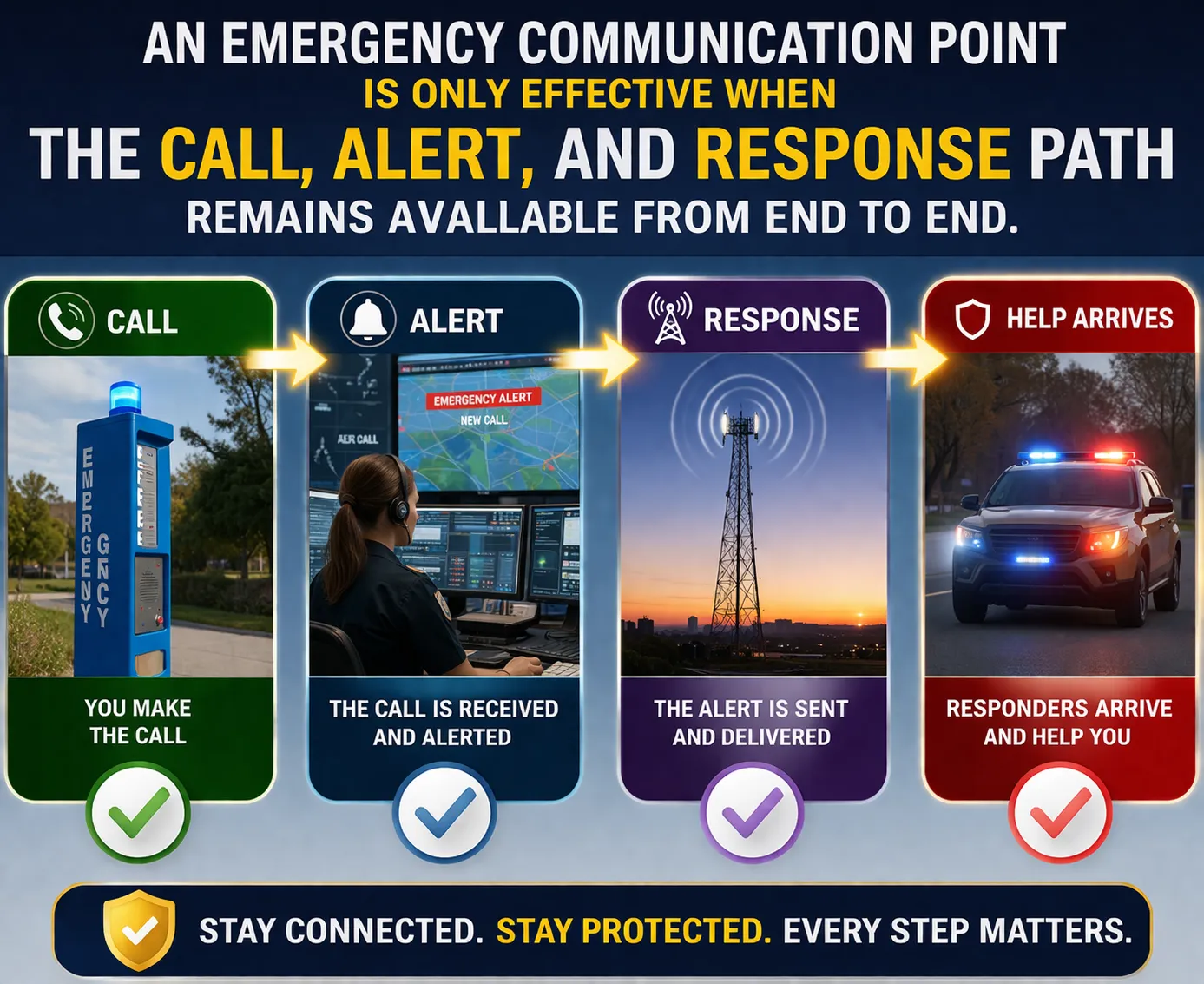
What makes this especially serious is that emergency communication is not a single action — it is a sequence. Someone reports the incident. An operator receives and triages it. Dispatchers send the right resources. Field teams acknowledge and coordinate. Each step depends on the one before it. When interference breaks the first link, the failure tends to cascade through every step that follows. A report that never arrives cannot be triaged. A dispatch that never goes out cannot be acknowledged. The whole chain slows down or stops.
This is why interference is treated differently from ordinary network downtime. It is not just about a device being offline or a service being temporarily unavailable. It is about a deliberate or preventable break in a path that people rely on when they have no other option. Understanding that distinction is the starting point for designing systems that hold up under real pressure.
What Interference Looks Like in Practice
Interference does not always look the same. Sometimes it is obvious — someone physically grabs a phone out of another person's hand during a crisis. Other times it is nearly invisible — a cable quietly disconnected, a setting changed, a signal jammed in a way that no one notices until the system is needed. Recognizing the different forms is the first step toward defending against them.
Physically preventing someone from calling for help
The clearest form is stopping a person from making an emergency call or sending a distress signal. That can mean taking a handset, seizing a mobile phone, disconnecting a cable, removing access to a help point, or physically blocking someone from reaching a communication terminal. In legal and public safety terms, this is often the most straightforward category because the intent and the action are both visible. The common thread is always the same: another person is prevented from asking for urgent assistance at the moment they need it most.
Damaging or disabling the equipment itself
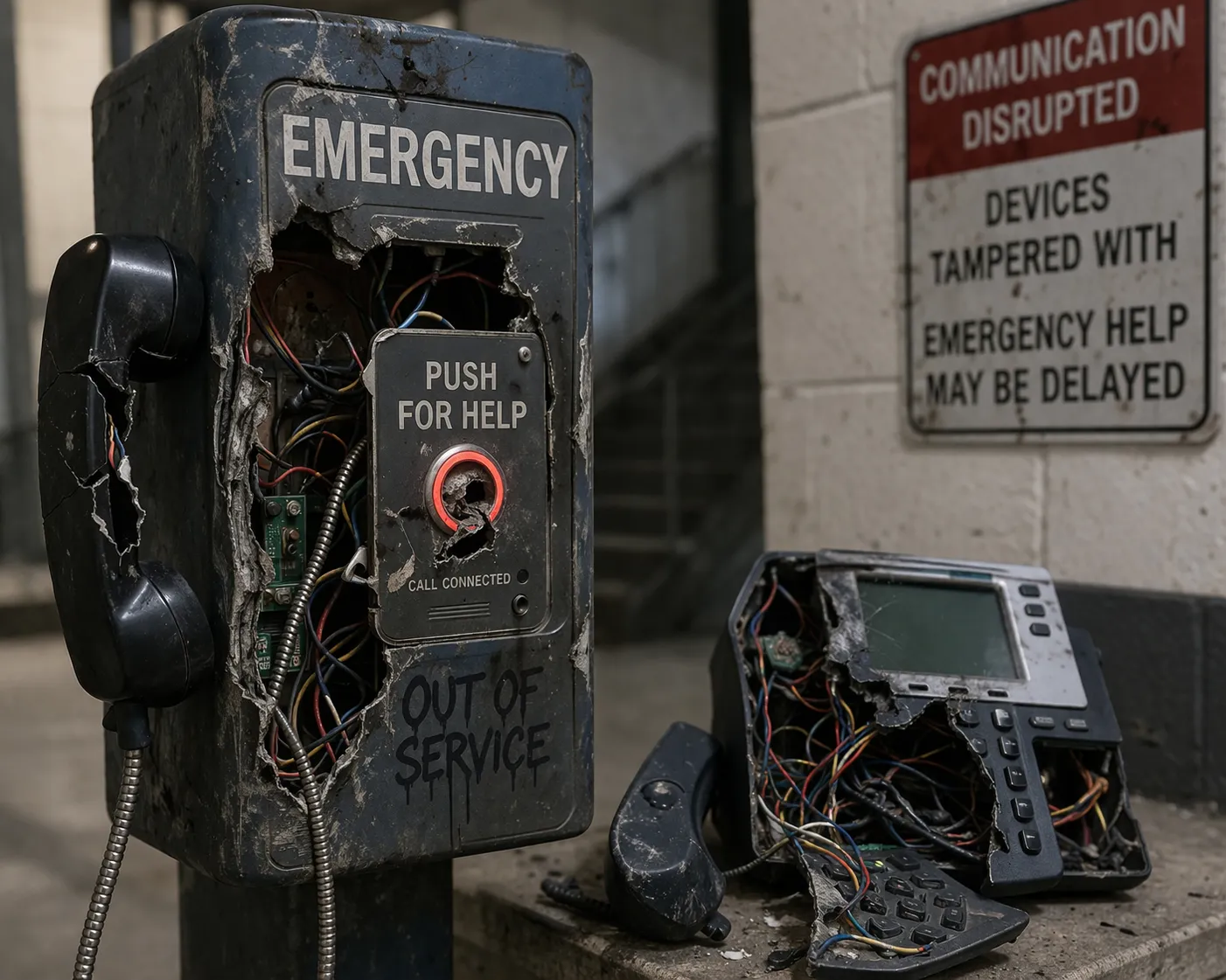
Interference can also target the endpoint. Breaking a phone, cutting power to an intercom, tampering with a panic button, disabling a loudspeaker path, or taking a gateway or switch offline without authorization — all of these can interrupt communication even if no one is physically prevented from dialing. In modern systems, the chain extends well beyond a single handset. Controllers, gateways, switches, radios, speakers, alarm interfaces, cabling, network links, and backup power all form part of the path. Disabling any one of them can break the wider chain, sometimes in ways that are not obvious until an actual emergency occurs.
Jamming and other radio disruption
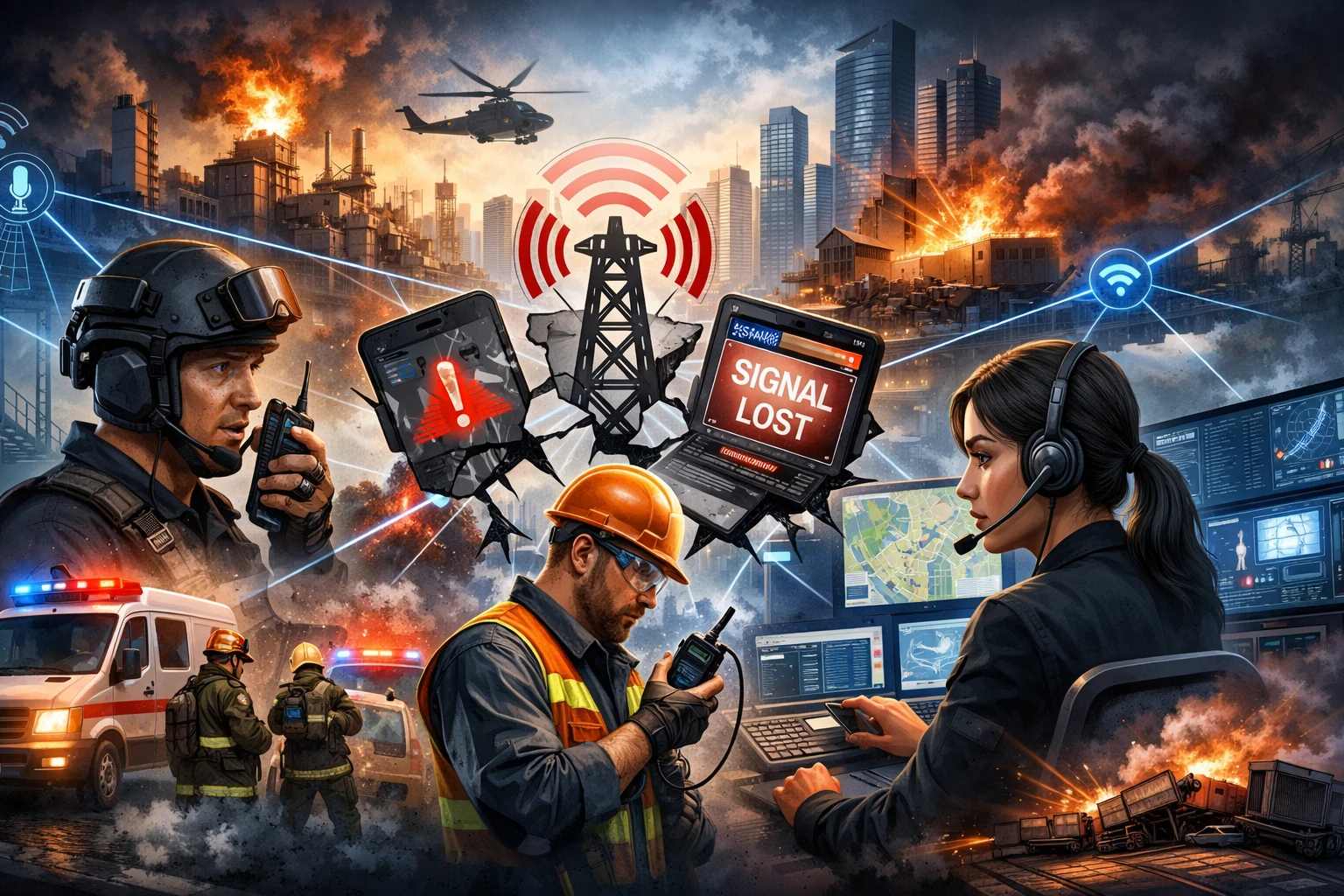
Wireless emergency communication is vulnerable when radio signals are intentionally blocked or degraded. Jamming devices and similar methods can prevent calls, messages, alarms, and wireless coordination traffic from getting through. What makes this especially dangerous is that it does not target a single person — it blankets an area. Mobile calling, public safety radio, GPS, and on-site coordination can all be affected simultaneously. In a warehouse, a transport corridor, a campus, an industrial site, a healthcare facility, or a public venue, that kind of blanket disruption can paralyze multiple response channels at once.
False or misleading information
Not all interference is physical or electronic. False information can be just as disruptive. Someone may knowingly claim that help is no longer needed, send inaccurate location details, or trigger confusion that causes responders to move in the wrong direction. In emergency operations, speed and clarity are everything. A false message can waste response time, divide operator attention, overload dispatch channels, and erode confidence in the communication system at the exact moment reliable information matters most. The connection still exists — but the content traveling over it has been weaponized to obstruct help.
Disruption inside the response workflow
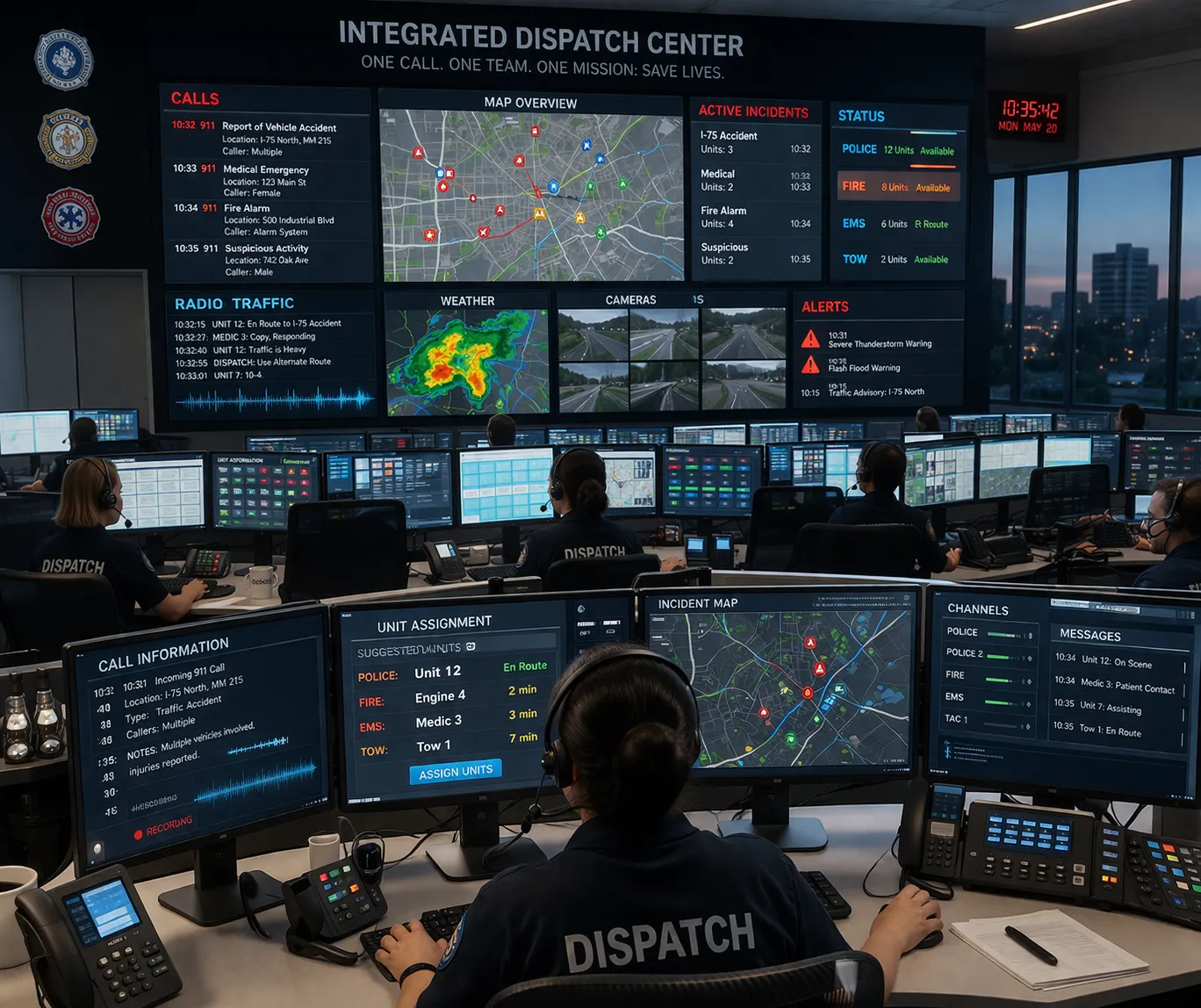
In larger facilities and public infrastructure, interference may occur deeper in the operational process rather than at the first call point. A dispatcher may be unable to reach field teams. A paging zone may fail to broadcast. A control room may lose visibility into alarm status. A radio channel may become unusable during active coordination. From a systems perspective, emergency communication must be understood as a process, not a single action. Interference at any point in that process — even far from the original caller — can reduce situational awareness and delay decision-making.
It is also important to draw a line between intentional interference and ordinary technical failure. Systems can go down because of poor maintenance, weak coverage, damaged cabling, battery loss, software faults, misconfiguration, or network congestion. These are reliability problems, and they need engineering, monitoring, and operational controls. Intentional interference is different — it involves deliberate action to prevent communication, degrade access to help, or disrupt coordination. The response to each is different. A design problem calls for redundancy and diagnostics. Deliberate disruption calls for security controls, event logging, and policy enforcement in addition to technical resilience. A truly resilient system assumes that failures can be either accidental or intentional, and it is built to withstand both.
When Seconds Count: How Disruption Shapes Incident Outcomes
The impact of interference is not abstract. It shows up in concrete ways during a real incident, and each effect compounds the others.
The first and most immediate effect is delayed reporting. When an emergency call cannot be placed, the clock starts running before responders even know an incident exists. A medical event, a fire, an assault, an equipment failure, or a roadside incident continues to escalate while the reporting path remains blocked. This is especially serious in isolated environments — highways, tunnels, campuses, industrial plants, ports, offshore facilities, mines, rail corridors, and large public venues — where the nearest help point may already be some distance away and every minute of delay narrows the window for effective intervention.
Even when a call does get through, partial or interrupted communication reduces dispatch accuracy. Operators may receive only fragments of information. They may know that something is wrong without knowing the precise location, the nature of the incident, or how many people are affected. That lack of detail slows dispatch decisions, makes it harder to choose the right resources for the first response, and can lead to under-resourcing or over-resourcing — both of which waste critical time.
Many emergencies involve more than one team. Security, medical staff, maintenance crews, public safety personnel, transport operations, and site supervisors may all need to coordinate through a shared communication framework. When interference disrupts that framework, teams tend to respond in parallel without alignment. They may duplicate the same task, miss critical instructions such as evacuation routes or area isolation updates, or operate with outdated situational awareness. The result is a response that is slower, less efficient, and more dangerous for both responders and the people they are trying to help.
Ultimately, the greatest impact falls on the person waiting for assistance. They may be unable to explain their condition, confirm their location, hear instructions, or know whether help is on the way. In many emergencies, even a short delay changes the outcome. This is why communication availability should be treated as part of the safety system itself — not as an optional convenience layered on top of operations. When the path to help is open, every other safety measure has a chance to work. When it is closed, nothing else matters as much.
Settings Where Emergency Communication Is Most Exposed
Interference can become a concern anywhere urgent reporting and rapid coordination are required, but some settings are more exposed than others because of their geography, their complexity, or the nature of the activities that take place there.
Residential and personal settings are the most familiar — a domestic dispute, a medical emergency at home, a situation where someone is being prevented from calling 911. But the same risk appears in institutional and commercial environments with far more complex communication infrastructure. Schools and campuses rely on intercoms, panic buttons, mass notification, and two-way radios. Hospitals and care facilities depend on nurse call systems, emergency codes, and coordinated staff communication. Transport hubs — airports, train stations, bus terminals — manage high volumes of people and need reliable paging, security, and emergency coordination.
Industrial and infrastructure settings present their own challenges. Warehouses, manufacturing plants, refineries, utilities, tunnels, mines, ports, and offshore platforms often cover large areas with limited cellular coverage, heavy equipment that can block signals, and hazardous conditions where a delayed response can escalate quickly. These environments typically rely on a mix of fixed help points, IP intercoms, two-way radios, alarm interfaces, and dispatch consoles — and each element in that mix is a potential point of interference or failure.
What connects all of these settings is a single principle: the path to help must remain open. The devices may differ, the networks may differ, the response teams may differ, but the requirement does not. Any environment where people could face an emergency and need to reach help quickly is an environment where interference matters.
Designing Resilience That Survives Both Accidents and Intentional Harm
Building a system that can withstand interference requires more than buying reliable equipment. It requires thinking about the entire communication path — from the person in distress to the responder on the scene — and designing each layer with the assumption that something, at some point, will go wrong.
Do not depend on a single path
Single-path systems are easier to break and easier to lose during a fault. Stronger designs include fallback options: fixed help points alongside IP endpoints, radio coordination alongside mobile access, alternate network routes, and backup power that keeps critical systems running when the mains go down. Redundancy does not eliminate every risk, but it dramatically lowers the chance that one damaged device or one failed link will stop the entire reporting process. The key is to ensure that the fallback paths are genuinely independent — not all running through the same switch, the same power source, or the same carrier.
Monitor continuously, not just after a failure
Emergency communication should not be tested only when something goes wrong. Organizations benefit from continuous supervision of device status, link availability, power condition, alarm reporting, and event history. With real-time visibility, teams can detect abnormal behavior earlier — a help point that has gone offline, a gateway that is rebooting repeatedly, a radio channel with unusual interference — and distinguish between routine faults, misconfiguration, and possible deliberate disruption. The goal is to find and fix problems before an emergency exposes them, not after.
Protect the endpoints and control who can change them
Help points, dispatch consoles, gateways, radio equipment, cabinets, and network interfaces should be physically protected and administratively controlled. The more open and unmanaged a critical endpoint is, the easier it becomes to disable, tamper with, or misuse. Good practice includes role-based access control so that only authorized personnel can change configurations, tamper detection on cabinets and enclosures, and clear procedures for maintenance, incident review, and system restoration. It also means training staff to recognize when something looks wrong — a cable that has been disconnected, a setting that has been changed, a device that is behaving unexpectedly — and to report it immediately.
Keep logs that tell the whole story
When a communication issue occurs, accurate event logs are invaluable. They show whether a call was attempted, whether a device went offline, when an alarm changed state, how operators responded, and whether any configuration changes were made. That record supports troubleshooting, accountability, training, and the ongoing improvement of the system design. It also helps organizations distinguish between an accidental failure and a possible deliberate interference — a distinction that matters for both technical remediation and any subsequent security or legal response.
The strongest emergency communication systems are not the ones with the most expensive equipment. They are the ones designed for clarity, redundancy, supervision, and fast recovery under stress. They assume that things will break — sometimes by accident, sometimes by intent — and they are built so that no single break can sever the path between someone in danger and the help they need.
FAQ
Can an accidental disconnection of an emergency phone be considered interference?
Generally, interference implies a deliberate act to block or hinder communication. An accidental disconnection — a cable knocked loose during cleaning, a power cord unplugged by mistake — is typically treated as a maintenance or reliability issue rather than interference. However, if the person who caused the disconnection knew or should have known that the device was for emergency use and failed to report or restore it promptly, the situation becomes more serious. Organizations should have clear procedures for reporting and restoring any disconnected emergency endpoint, regardless of intent.
How do emergency communication systems typically handle extended power outages?
Most professionally designed emergency systems include some form of backup power, such as uninterruptible power supplies (UPS) for network and dispatch equipment, battery-backed help points and intercoms, and in some cases backup generators for critical facilities. The duration of backup power varies by design — some systems are rated for minutes, others for hours or longer. Organizations should map their backup power coverage against their risk profile: a remote industrial site with slow emergency response times may need longer backup duration than an urban office building with nearby services. Regular load testing of backup power is essential, because a battery that has degraded without being tested can fail exactly when it is needed.
Can interference against one emergency channel affect multiple services at the same time?
Yes, and this is one of the most dangerous aspects of certain types of interference. A radio jammer, for example, does not distinguish between a security guard's handheld, a firefighter's radio, and a worker's mobile phone — it disrupts all signals in its frequency range within its effective radius. Similarly, disabling a core network switch or gateway can take down IP phones, intercoms, alarm reporting, and dispatch connectivity simultaneously. This is why redundancy across different communication technologies — wired, wireless, cellular, radio — is so important: an interference method that targets one technology may not affect another, giving responders an alternate path when the primary one is compromised.
What role does encryption play in protecting emergency communication from interference?
Encryption primarily protects the confidentiality and integrity of communication content — it prevents eavesdropping and makes it harder for an attacker to inject false messages or impersonate a responder. However, encryption does not by itself prevent jamming, physical disconnection, or equipment damage. It is one layer in a broader defense. Encrypted radio systems, for instance, can prevent an unauthorized person from transmitting on a tactical channel and sending false instructions, but they cannot stop a jammer from blocking the channel entirely. The most robust designs combine encryption for content protection with frequency agility, redundant paths, and physical security for endpoints and infrastructure.
How quickly should an organization detect and respond to a failure in its emergency communication system?
The ideal detection time is immediate — through continuous monitoring that alerts staff the moment a device goes offline, a link drops, or an alarm fails to report. In practice, organizations should set response time targets based on their risk level. A high-risk environment such as a chemical plant or a hospital may require acknowledgment within minutes and on-site investigation within a defined short window. Lower-risk settings may have longer targets, but no organization should rely on periodic manual checks alone — a system that is tested once a month could be down for weeks before anyone notices. The response should also include a documented escalation path: who is notified, what alternate communication methods are activated while the system is down, and how the incident is logged and reviewed afterward.