


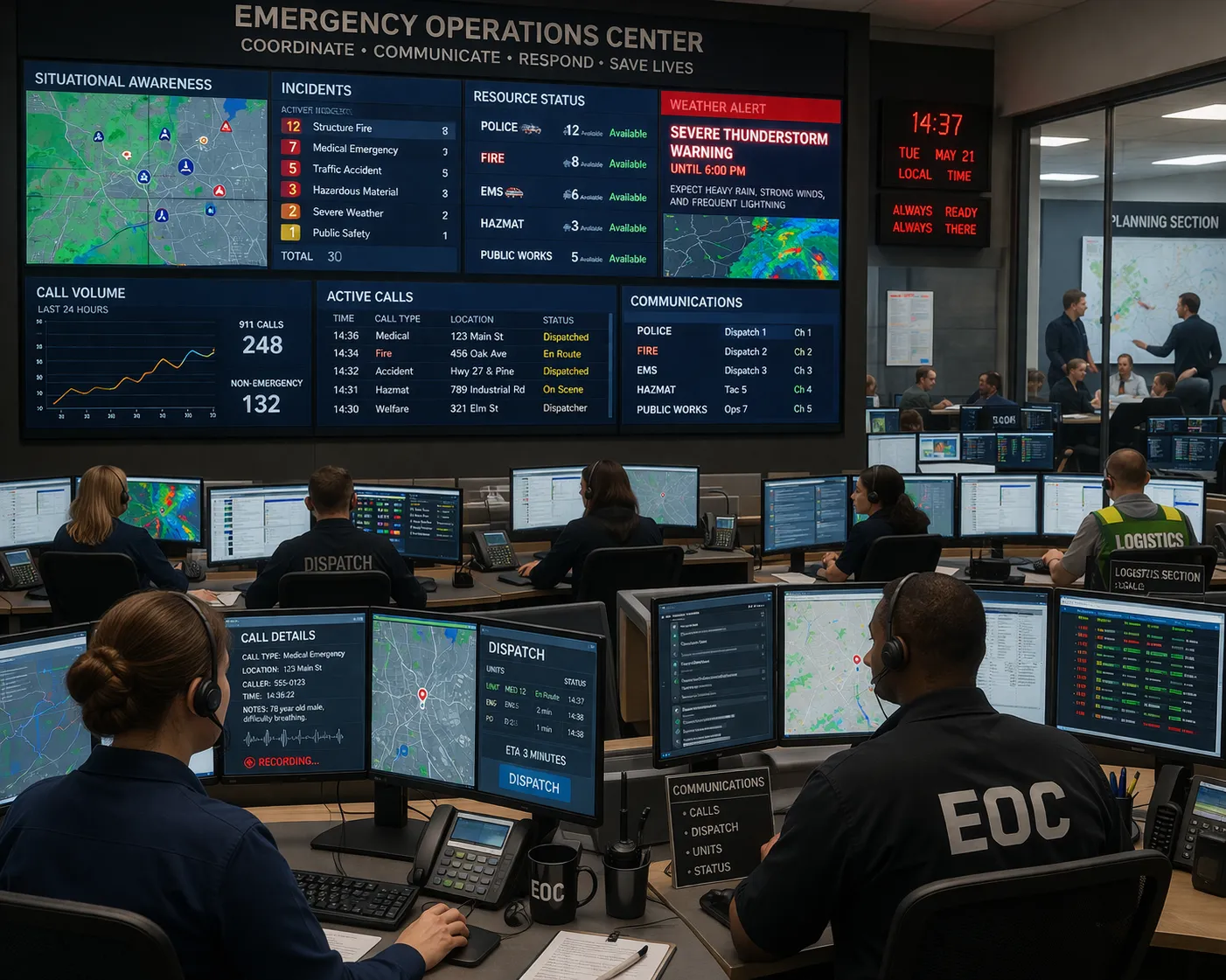
An Office of Emergency Management and Communications is typically the government function responsible for preparing for incidents, coordinating response actions, and keeping critical communication channels working when people need help most. In simple terms, it connects planning, dispatch, field coordination, and public safety communications into one operational structure.
In many cities and regions, this office works behind the scenes long before a major incident occurs. It helps build emergency plans, supports interagency coordination, manages communication workflows, and ensures that emergency calls, dispatch instructions, alerts, and field updates can move quickly from one point to another.
Why the Name Includes Both Emergency Management and Communications
Emergency management focuses on organized response
Emergency management is the part that prepares for storms, industrial accidents, public safety incidents, infrastructure failures, transport disruptions, and other emergencies. It covers preparedness, incident procedures, coordination rules, and the practical steps required to keep operations stable during disruption.
Introduction to related solutions:Emergency Communication System
That means the office is not limited to reacting after something goes wrong. It also supports prevention, planning, training, exercises, continuity, and recovery coordination so that responders and decision-makers are not starting from zero when an incident happens.
Communications keeps the response path open
Communications is the operational layer that allows emergency information to move from the public to the control room and from the control room to response teams. This may include emergency call handling, dispatch systems, radio coordination, intercom endpoints, public address systems, paging tools, mobile communication, and network interoperability between agencies.
Without dependable communications, even a well-written emergency plan can fail in practice. An incident can only be managed effectively when the call, alert, acknowledgment, dispatch, and response path remains available end to end.
An emergency plan defines what should happen. A communications system helps make sure it actually happens under pressure.
What an Office of Emergency Management and Communications Usually Does
Incident coordination and situational awareness
One of the office’s core responsibilities is to help different teams see the same situation and act from the same operational picture. During an emergency, that may involve collecting reports, confirming incident status, tracking resources, escalating priority events, and supporting decisions from a central operations environment.
This coordination role becomes especially important when multiple agencies must work together. Fire, police, medical teams, facility operators, transport staff, security personnel, and public works teams often need a common flow of information rather than isolated communication silos.
Emergency call handling, dispatch, and alerts
Many offices in this category are closely linked to emergency call intake, dispatch workflows, and public warning processes. Once a person reports an emergency, the information must be received clearly, classified correctly, routed quickly, and delivered to the right responders without delay.
That process may also include mass notification, zone-based paging, recorded announcements, emergency broadcasts, and status updates sent to command staff or related departments. The faster and more accurately that information moves, the better the response outcome tends to be.
Interoperability between systems and agencies
In real-world incidents, communication rarely stays inside one device type or one network. A modern emergency management and communications office often needs to bridge telephones, radio systems, SIP platforms, paging systems, intercom terminals, dispatch consoles, and mobile endpoints.
Interoperability is not just a technical feature. It is an operational requirement. When agencies cannot exchange information smoothly, response times lengthen, handoffs become messy, and field teams may receive incomplete or delayed instructions.
What Systems Commonly Support This Office
Control room platforms and dispatch consoles
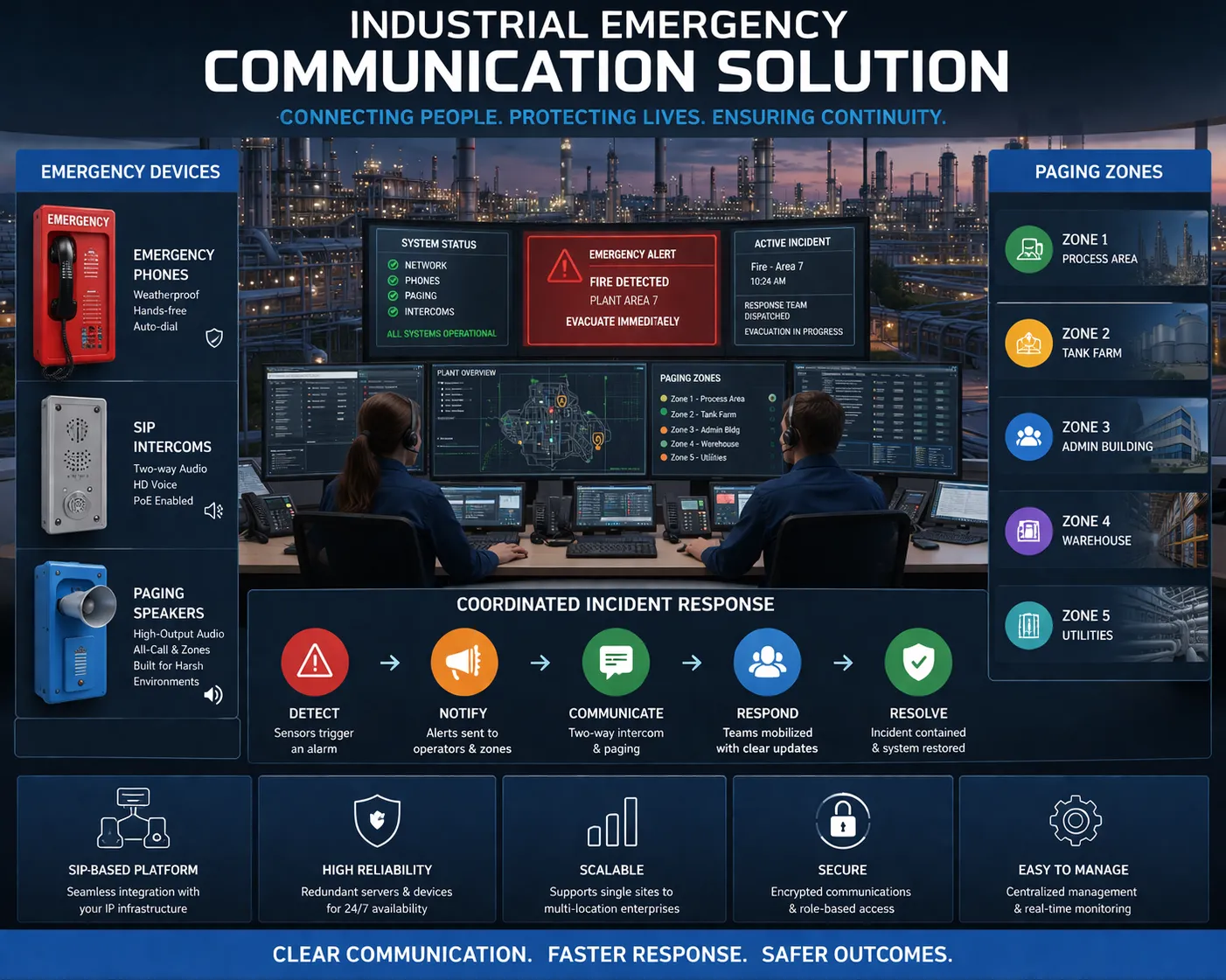
A central command or dispatch position is often where information is received, prioritized, and distributed. Operators may need to answer calls, view alarms, monitor communication channels, transfer incidents, page specific zones, escalate emergencies, and coordinate with multiple departments at the same time.
That is why dispatch software and operator consoles are so important. They give emergency personnel one place to manage communication tasks instead of switching blindly between disconnected tools.
Emergency phones, intercoms, PA, and paging
Field devices are equally important because they form the first point of contact in many emergencies. These can include roadside help points, tunnel emergency phones, campus call stations, industrial intercoms, waterproof or explosion-proof telephones, public address speakers, and panic or assistance points.
The role of these devices is simple but critical: allow a person in distress or a site operator to reach the control room immediately and clearly, even in noisy, outdoor, industrial, or high-risk environments.
IP, SIP, radio, and gateway integration
More organizations now build emergency communication around IP and SIP architecture because it is easier to scale, integrate, and manage across large sites or multiple locations. At the same time, many environments still rely on radio, analog lines, legacy paging, or mixed network conditions.
That is why gateways and open integration matter. They help connect old and new communication layers so that the office can maintain continuity rather than forcing every department to replace everything at once.
The value of an emergency communications office is not only in answering calls. It is in making sure the right information reaches the right people in time to act.
Why This Matters for Industrial and Large-Site Environments
Emergencies in complex sites require more than a single phone line
In offices, campuses, transport hubs, tunnels, industrial parks, utilities, and hazardous facilities, an emergency can involve multiple locations, multiple teams, and multiple communication methods at once. A single voice call may not be enough to coordinate evacuation, dispatch maintenance, notify security, and issue area-wide instructions.
These environments need a more structured response path that combines field reporting, control room decision-making, group paging, cross-team coordination, and dependable endpoint availability.
System resilience directly affects response quality
Emergency communications must continue to function under stress. Noise, weather, power issues, harsh environments, network disruption, and equipment damage can all affect whether help arrives quickly. For that reason, device reliability, network design, and platform interoperability are just as important as the message itself.
When communication endpoints are hardened for the environment and integrated into a unified platform, organizations are in a better position to reduce missed calls, delayed escalations, and fragmented response actions.
How Becke Telcom Supports Emergency Management and Communications Scenarios
For organizations that need dependable emergency communication across industrial or large-site environments, Becke Telcom provides solutions that help connect field devices, operator positions, paging systems, and response teams through a unified communication architecture.
Depending on the site, this can include industrial emergency telephones, SIP intercom terminals, IP paging, broadcast systems, operator dispatch consoles, communication gateways, and integrated command workflows. The goal is not simply to add more devices, but to create a response path that is easier to reach, easier to manage, and more dependable under pressure.
This kind of approach is especially valuable in transport, utilities, manufacturing, petrochemical, mining, campus, and other critical environments where communication continuity directly affects safety, coordination, and operational control.
Conclusion
An Office of Emergency Management and Communications is best understood as the function that helps emergency information move from planning to action. It brings together preparedness, call handling, dispatch, interoperability, and field communications so that incidents can be reported clearly, managed centrally, and responded to quickly.
As emergency environments become more connected and more complex, the role of this office becomes even more important. Strong planning matters, but strong communication is what turns planning into coordinated response.
If your organization is building or upgrading an emergency communication environment for a campus, industrial site, transport network, or public facility, Becke Telcom can support a more integrated path from incident reporting to command and response.
FAQ
Is an Office of Emergency Management and Communications the same as a 911 center?
Not always. In some jurisdictions, it may include or closely work with 911 call handling and dispatch functions. In others, it may focus more broadly on planning, coordination, public alerts, and interagency communication support.
What is the difference between emergency management and emergency communications?
Emergency management focuses on preparedness, coordination, and incident procedures. Emergency communications focuses on the systems and workflows that carry calls, alerts, dispatch instructions, and operational updates between people and agencies.
Why is interoperability important in emergency communications?
Because real incidents often involve multiple teams, networks, and device types. Interoperability helps emergency information move across those boundaries without unnecessary delay, confusion, or manual workarounds.
What kinds of devices are commonly part of an emergency communication solution?
Common devices include emergency telephones, SIP intercoms, public address speakers, paging endpoints, dispatch consoles, radios, gateways, and command software platforms that connect reporting points with response teams.







