


Many organizations used to run separate networks for voice, data, video, paging, and operational communication. That approach often resulted in duplicated infrastructure, disconnected management, and limited coordination between systems.
A converged network changes that model by bringing multiple services onto one managed IP-based infrastructure. Instead of treating telephony, intercom, paging, video, and business data as isolated platforms, a converged network allows them to operate through one shared architecture that is easier to manage, scale, and integrate.
For modern organizations, this is more than a technical upgrade. It is a practical way to reduce network silos, improve service coordination, and support a wider range of communication needs across offices, campuses, industrial facilities, transportation environments, and other multi-service sites.
Key Takeaways
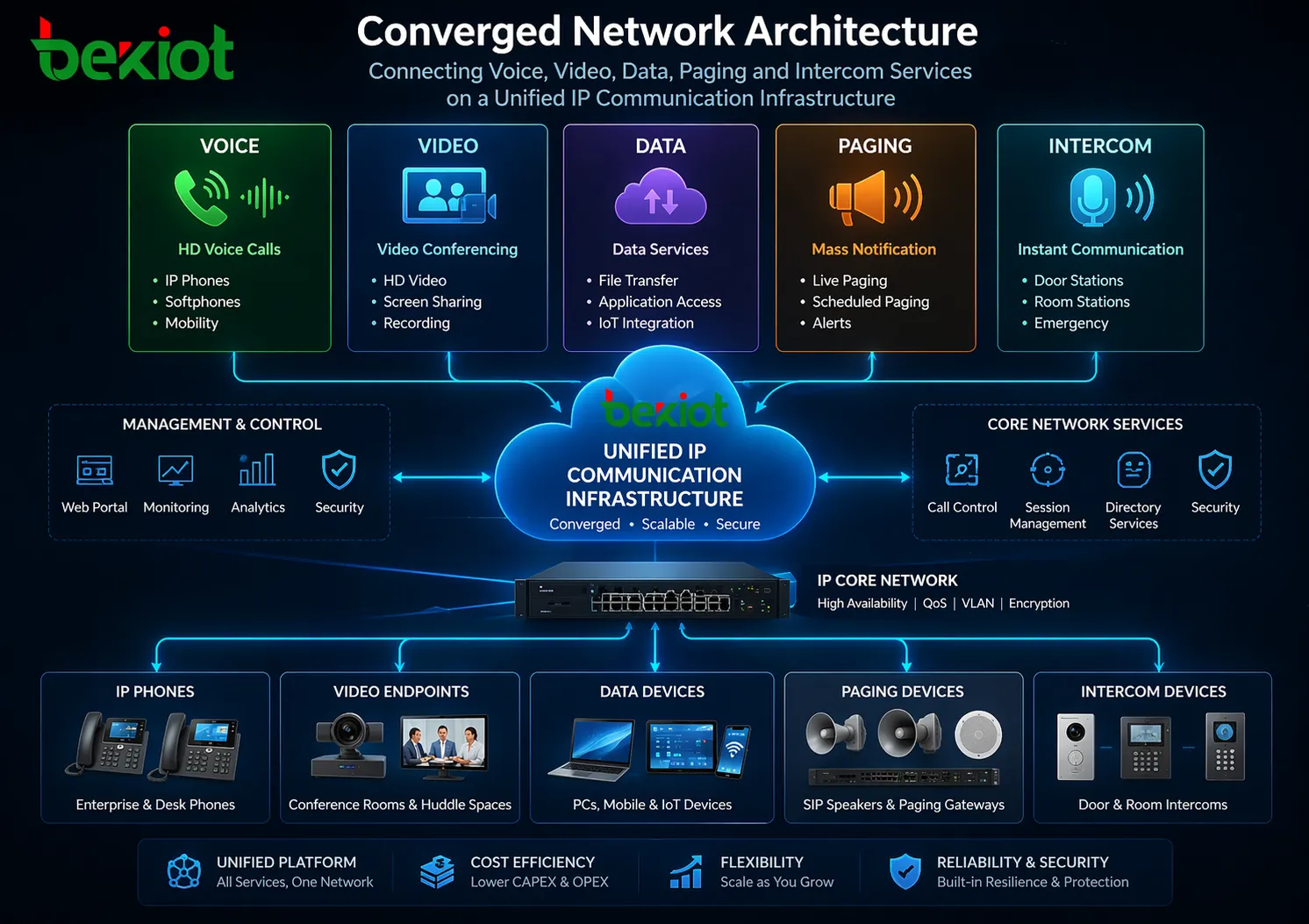
A converged network combines multiple communication and data services on one managed infrastructure. It can reduce complexity, improve interoperability, simplify expansion, and support services such as voice, video, data, paging, intercom, and IoT-related traffic.
At the same time, convergence also requires careful planning. Security, traffic prioritization, redundancy, compatibility, and operational risk must all be considered before deployment. When designed properly, a converged network becomes a more efficient and scalable foundation for both daily communication and time-sensitive operations.
What Is Network Convergence?
Network convergence is the process of combining separate network functions into one unified infrastructure. In practical terms, this means that services once delivered through different platforms can now share the same IP and Ethernet foundation while still being managed according to their own requirements.
In a converged network, voice calls, business data, video streams, paging traffic, intercom communication, and other service types travel through one coordinated environment rather than across multiple standalone systems. The services remain distinct in purpose, but they are no longer isolated in architecture.
This is why a converged network is often described as a shared communication backbone. It provides one structured platform that supports many traffic types, many devices, and many applications across the same network environment.
How Does a Converged Network Work?
A converged network typically runs on shared switching, routing, and IP transport infrastructure. Devices such as IP phones, SIP intercom stations, paging gateways, servers, operator consoles, wireless endpoints, and business applications all connect to the same managed network foundation.
The network does not treat every traffic type the same. Voice and intercom traffic usually need low latency and predictable delivery. Video often requires higher bandwidth. Business applications may need stable but less time-sensitive performance. As a result, converged networks rely on QoS policies, VLAN segmentation, access control, security controls, and bandwidth planning to keep each service operating correctly.
When these controls are in place, one infrastructure can support both communication traffic and operational traffic without forcing an organization to maintain multiple isolated systems.
A converged network does not merge all services into one identical stream. It places different services on one shared infrastructure while managing them according to different performance, security, and operational needs.
What Types of Data Can a Converged Network Carry?
A converged network can carry many types of traffic across the same infrastructure. The most common examples include voice data, video data, business data, intercom traffic, paging traffic, and device or sensor data associated with connected systems.
In communication-heavy environments, this may include VoIP calls, SIP signaling, public address traffic, emergency help point communication, live video feeds, operator dispatch data, and application-level information from control or management platforms.
In broader network environments, the same converged model can also support IoT-related traffic, cloud applications, digital service platforms, and operational workflows that depend on real-time coordination between devices and users.
Core Architecture of a Converged Network
Infrastructure Layer
The infrastructure layer includes switches, routers, uplinks, access devices, and physical transport resources that carry all supported traffic. In many deployments, this layer also includes resilient design features such as redundant paths, protected uplinks, or backup power support.
Power over Ethernet is often part of this architecture because it allows network-connected devices such as IP phones, intercom stations, and other endpoints to receive both connectivity and power through the same cable.
Control and Service Layer
This layer includes the platforms that manage communication and service delivery. It may contain IP PBX platforms, SIP servers, dispatch systems, paging controllers, management software, and integration interfaces for related applications.
In larger projects, this layer may also connect with video systems, alarms, access control, and other operational platforms so that communication is part of a broader site workflow rather than a standalone function.
Endpoint Layer
The endpoint layer includes the devices people use and the devices installed in the field. These may include desk phones, SIP intercom terminals, paging speakers, emergency telephones, operator consoles, voice gateways, mobile clients, and rugged communication devices for industrial environments.
This is where convergence becomes visible in daily operations. Different devices still serve different purposes, but they operate through one coordinated network model.
What Are the Benefits of a Converged Network?
Simpler Infrastructure
Converged networks reduce the need to build and maintain separate network systems for each service. This helps reduce duplicated cabling, repeated hardware layers, and fragmented administration.
For organizations with multiple communication needs, simplification alone can be a major advantage because it creates a cleaner operational structure.
Lower Operating Complexity
Managing several separate systems often means separate troubleshooting routines, separate upgrade paths, and separate support requirements. A converged network helps reduce this burden by centralizing more of the infrastructure and policy framework.
This makes long-term maintenance easier and gives network and communication teams better visibility across the environment.
Better Interoperability
Voice, paging, intercom, dispatch, and related services can work together more effectively when they share a common architecture. This improves coordination between field devices, users, operators, and central platforms.
It also makes it easier to integrate services that would otherwise remain isolated, especially in sites where communication must move quickly between departments or response teams.
Scalability for Growth
Converged networks make it easier to expand across new buildings, additional floors, remote sites, or larger service coverage areas. New endpoints and applications can be added to an existing structure instead of being deployed as separate systems every time requirements grow.
This supports a more practical long-term roadmap and reduces the chance of creating new silos later.
Support for Advanced Services
A shared IP infrastructure can better support advanced services such as VoIP, video collaboration, IP paging, SIP intercom, connected device integration, and other application-driven communication functions.
This is especially useful for organizations that need both day-to-day communication and more structured operational workflows across a wide site or multi-building environment.

What Are the Risks of a Converged Network?
Security Exposure
When more services share one infrastructure, the number of connected devices and access points often increases. This can create a broader attack surface if segmentation, authentication, monitoring, and access control are not designed properly.
Convergence can improve management consistency, but it also requires stronger overall security discipline.
Initial Design Complexity
Although a converged network can reduce long-term complexity, the design phase may be more demanding. Multiple traffic types, multiple platforms, and multiple service priorities must all be planned carefully to avoid conflicts or service degradation.
This is one reason why converged deployments benefit from strong network design and integration planning from the beginning.
Shared Dependency Risk
When several services rely on the same core infrastructure, failures in one area can have a wider operational effect if resilience is weak. A switching failure, routing issue, or server problem may affect several communication functions at once.
Redundancy, failover planning, and operational backup strategies are therefore especially important in communication-critical environments.
Compatibility and Vendor Constraints
Some converged deployments become too dependent on one technology stack or vendor ecosystem. This can reduce flexibility over time and make future upgrades, replacements, or integrations more difficult.
A more open and standards-based architecture can help reduce this risk.
Compliance and Policy Requirements
When one network carries more business, communication, and operational traffic, policy requirements may become more complex. This can matter in regulated industries or in environments where security, privacy, or service availability standards must be maintained carefully.
Convergence should therefore be planned with both technical and operational governance in mind.
A converged network can reduce infrastructure sprawl, but it must be designed so that simplicity at the platform level does not create hidden risks at the operational level.
Converged Network vs Traditional Separate Networks
Traditional network models often divide services by system type. Voice may run on one platform, data on another, paging on another, and video on yet another. While this can work in small or legacy environments, it often leads to duplicated infrastructure, isolated management, and limited interoperability.
A converged network keeps the services distinct in function but brings them together on one managed infrastructure. This makes it easier to coordinate services, enforce consistent policies, and support future expansion without rebuilding separate platforms every time a new need appears.
For larger, distributed, or multi-service environments, this difference becomes increasingly important because the operational cost of fragmentation tends to rise over time.
Real-World Use Cases for Converged Networks
Enterprise and Campus Environments
Office campuses, education facilities, and corporate sites often need voice, data, wireless access, paging, and internal communication to work together. A converged network helps support these services on one structured architecture while simplifying management across departments and buildings.
Healthcare and Public Facilities
Hospitals, clinics, and public service facilities often depend on fast internal communication, notification workflows, paging, and operational coordination. A converged network helps centralize these services while maintaining the priority control needed for reliable communication.
Transportation and Infrastructure Projects
Stations, tunnels, airports, and utility environments typically include distributed endpoints, public-facing communication, and operator-managed response workflows. A converged network helps connect these elements through a more unified communication backbone.
Industrial and High-Reliability Sites
Factories, ports, mines, processing facilities, and energy sites often require communication between control rooms, field devices, maintenance teams, and emergency points. In these environments, a converged network can support industrial telephony, SIP intercom, paging, gateway access, and dispatch communication through one managed structure.
How Becke Telcom Supports Converged Network Projects
Becke Telcom supports converged network projects with integrated communication solutions that combine IP telephony, SIP intercom, paging systems, emergency communication terminals, voice gateways, and dispatch platforms on one coordinated IP architecture.
This helps organizations reduce fragmentation between communication systems while improving operational visibility across buildings, production areas, public spaces, and remote sites. It also supports a more practical path to centralized communication for both routine operations and emergency response workflows.
For industrial facilities, transportation projects, campuses, healthcare environments, and other communication-critical sites, Becke Telcom can support a more unified communication model built on shared IP infrastructure.

Conclusion
A converged network is a shared infrastructure model that supports multiple communication and data services on one managed platform. It can simplify operations, improve interoperability, reduce infrastructure duplication, and provide a stronger base for real-time communication across different environments.
At the same time, convergence must be planned carefully. Security, service quality, compatibility, resilience, and long-term flexibility all matter. For organizations that need unified voice, video, data, paging, intercom, and operational communication, a well-designed converged network offers a more scalable and more coordinated path forward. Becke Telcom supports this direction with integrated communication solutions designed for reliable daily operation and structured response scenarios.
FAQ
What is the main purpose of a converged network?
The main purpose is to carry multiple services such as voice, video, data, paging, and intercom over one managed infrastructure instead of maintaining separate networks for each function.
What types of traffic can a converged network support?
It can support voice traffic, video traffic, business data, paging, intercom communication, IoT-related traffic, and operational platform data depending on the system design.
What is the biggest benefit of network convergence?
For many organizations, the biggest benefit is the reduction of infrastructure silos. This makes management easier, improves interoperability, and supports simpler long-term expansion.
What is the main risk of a converged network?
One of the main risks is that more services depend on the same core infrastructure. Without proper security, segmentation, and redundancy, failures or vulnerabilities can have a broader impact.
How can Becke Telcom help with converged communication deployment?
Becke Telcom can help by integrating IP phones, SIP intercoms, paging systems, emergency communication endpoints, voice gateways, and dispatch platforms into one coordinated IP-based communication solution.







