Most modern business and industrial networks carry far more than basic web and email traffic. On a single shared link, VoIP calls, security camera streams, file backups, industrial control signals and office applications can all compete for bandwidth at the same time. When network links are underutilized, this coexistence causes no obvious issues. The moment congestion hits — whether on a WAN uplink, a site-to-site VPN or a shared building backbone — delay-sensitive services start to degrade first. Voice calls break up, intercom pages drop out, and control messages get stuck behind bulk data transfers. This is the core problem that QoS prioritization is designed to solve.
Short for Quality of Service, QoS is not a single toggle feature but a set of coordinated mechanisms for managing how network resources are allocated when demand exceeds available capacity. Contrary to a common misconception, it cannot create additional bandwidth out of thin air. What it can do is establish clear rules for which traffic should be forwarded first, which should be guaranteed a minimum share of capacity, and which should be slowed or de-prioritized to protect more critical services.
Core Principles of QoS Prioritization
At its core, QoS prioritization moves away from the default “first-come, first-served” packet forwarding model and instead applies differentiated treatment based on business and operational importance.
The most persistent myth about QoS is that it serves as a substitute for sufficient network capacity. This is never the case. If a link is permanently overloaded to the point that even high-priority traffic faces sustained congestion, no amount of prioritization will deliver acceptable performance. QoS excels at handling temporary bursts, periodic peak loads and mixed-traffic environments where different services have very different tolerance for delay, jitter and packet loss.
For context, a large overnight backup job has no problem with slightly slower transfer speeds and minor delays. A live SIP intercom call or an industrial alarm message, by contrast, becomes effectively useless if packets arrive too late. QoS creates guardrails to ensure that the most latency-sensitive flows do not get pushed aside by less time-critical traffic.
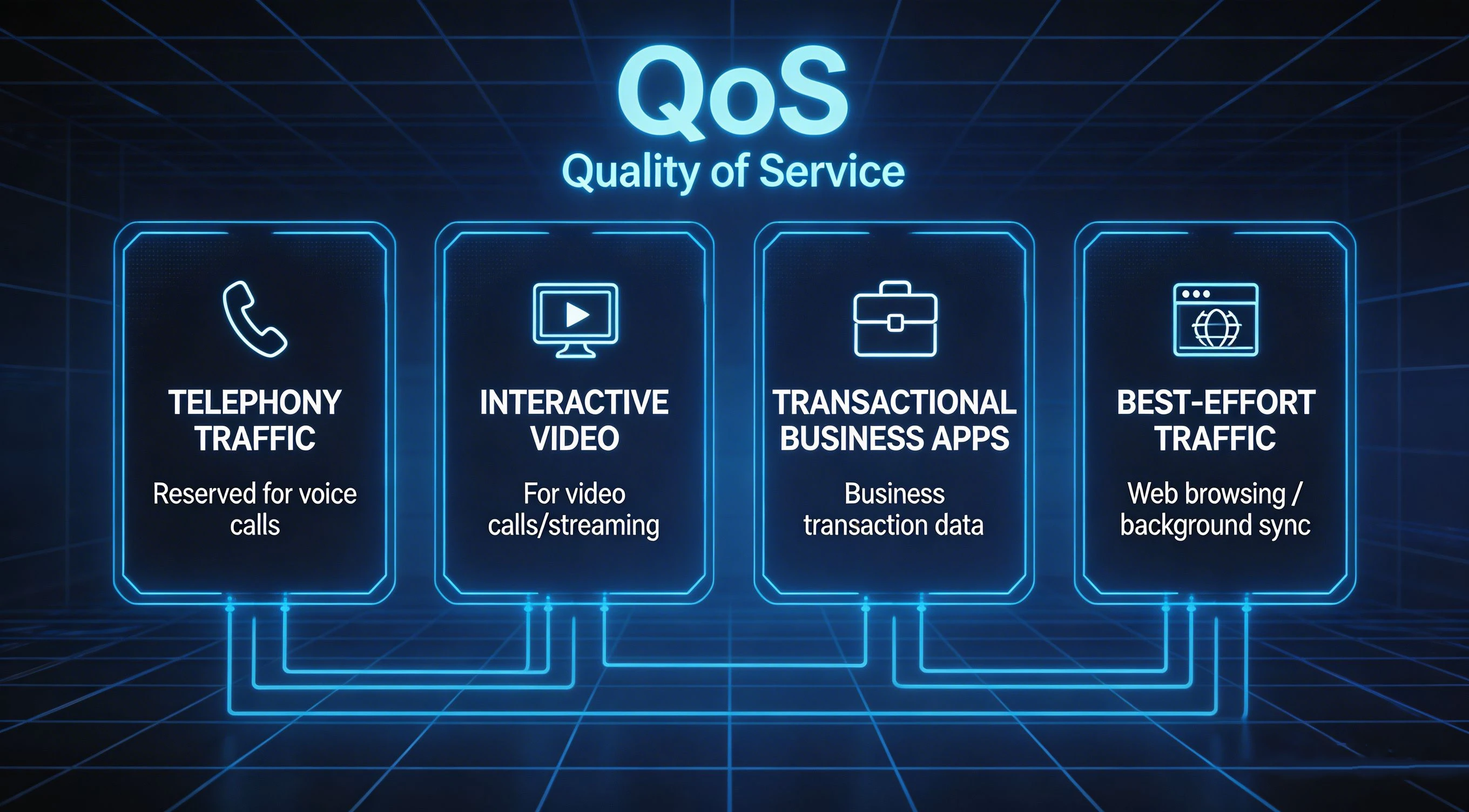
This is achieved through a structured service class system. Instead of treating every packet identically, networks group traffic into a small number of classes, each with its own forwarding rules. A typical set might include a real-time voice class, an interactive video class, a critical business/operations class, a standard best-effort class and a low-priority background class. Each class receives appropriate queuing, bandwidth allocation and drop behavior, rather than all traffic fighting for the same resources.

How QoS Prioritization Operates Across the Network
Classification and marking at the network edge
Before any prioritization can happen, the network first needs to identify what type of traffic each packet belongs to — a process called classification. Classification can be based on many criteria: VLAN tags, IP addresses, UDP/TCP port numbers, application layer signatures, or pre-existing DSCP values in the IP header.
Once traffic is classified, it is almost always marked with a consistent identifier, most commonly a DSCP value in the IPv4 or IPv6 header. This marking travels with the packet across the network, so every downstream switch, router and gateway can apply the correct forwarding treatment without re-classifying the traffic from scratch.
A fundamental principle of good QoS design is that classification and marking should happen as close to the edge of the network as possible. Access switches, IP phones, voice gateways and industrial edge devices are ideal points for this. Core network devices then trust these edge-applied markings and focus on scheduling and forwarding rather than deep packet inspection. Trust boundaries also matter: markings from managed voice equipment are typically trusted, while markings from unmanaged end-user devices may be ignored or rewritten.
Queuing and scheduling at congestion points
The most visible impact of QoS appears when traffic reaches an interface that cannot transmit packets as fast as they arrive. At this point, packets must wait in queues before being sent out. Without QoS, all packets sit in the same queue and are transmitted in arrival order, meaning large bursts of bulk data can delay small, time-sensitive voice or control packets.
QoS replaces this single-queue model with multiple queues, each assigned to a different service class. Strict priority queuing is typically used for the most delay-sensitive traffic, such as VoIP and emergency paging, ensuring those packets are always sent before any other class. For other important classes, weighted fair scheduling guarantees a minimum share of bandwidth, so they are not completely starved by background traffic.
This is the mechanism that directly preserves call quality and alarm delivery during peak load. Voice packets jump to the front of congested links, while file transfers and backups slow down slightly but continue running in the background.
Policing, shaping and congestion control
Beyond queuing, QoS also includes tools to prevent individual traffic classes from consuming more than their fair share of resources. Policing enforces a maximum rate for a given class, dropping or re-marking packets that exceed the limit. Shaping, by contrast, smooths out bursty traffic by buffering excess packets and releasing them at a steady rate.
These tools are most valuable at network edges — particularly WAN connections, internet handoffs and inter-site links — where a fast local LAN feeds into a much slower external link. Without shaping or policing, bursty LAN traffic can overwhelm the slower link and cause unexpected packet loss and jitter for real-time services.
When all these elements work together — classification at the edge, consistent marking, structured queuing and controlled rate limiting — QoS creates predictable, consistent performance even under variable load conditions.
Key Real-World Use Cases for QoS Prioritization
QoS is not an abstract networking concept; it solves very tangible problems across several common deployment scenarios. Three use cases in particular demonstrate its practical operational value.
First, enterprise unified communications and IP telephony remain the most widespread drivers for QoS deployment. VoIP calls and video meetings consume relatively little bandwidth, but they are extremely sensitive to jitter and packet delay variation. On networks without QoS, a single large file download or software update running across a shared WAN link can cause choppy audio, frozen video and dropped calls. QoS separates voice and video media streams from general data traffic, ensuring consistent call quality even during peak office hours. It also protects SIP signaling traffic, so call setup, transfers and hold functions remain reliable even when media paths are under load.
Second, IP paging, emergency intercom and public address systems depend heavily on predictable delivery. In hospitals, schools, manufacturing plants and transport hubs, delayed or garbled emergency announcements are not just an inconvenience — they can compromise safety. These systems often use one-to-many multicast or broadcast audio, which is particularly vulnerable to congestion on shared links. QoS prioritization ensures that paging audio, help-point intercoms and emergency gateway traffic take precedence over non-urgent traffic, so announcements arrive clearly and on time.
Third, converged industrial and operational technology networks rely on QoS to separate production-critical traffic from general IT traffic. Modern industrial networks increasingly carry SCADA polling, PLC communications, HMI data, alarm signals, CCTV video, voice dispatch and routine maintenance traffic all on the same infrastructure. Without prioritization, a routine firmware update or video backhaul could delay an alarm notification or control command. QoS rules ensure that operational and safety-related traffic always gets forwarding priority over administrative and background traffic.
Practical Best Practices for QoS Deployment
Well-implemented QoS delivers clear benefits, but poorly designed policies can create more problems than they solve. Three best practices help avoid the most common pitfalls and deliver stable, maintainable results.
First, keep the number of service classes small and practical. It is tempting to create a separate class for every application type, but overly granular policies quickly become difficult to troubleshoot, update and validate across multi-vendor networks. For most organizations, four to six well-defined classes are sufficient: real-time voice, interactive video, critical business/OT traffic, standard best-effort, and low-priority background. This structure is simple enough to manage consistently, while still providing meaningful differentiation for the most important services.
Second, resist the urge to assign high-priority status to too many traffic types. If every application is marked as critical, the priority queue itself becomes congested, and QoS effectively stops working. Strict priority queuing should be reserved only for narrow, extremely delay-sensitive flows — typically voice media, emergency paging and very specific industrial control signals. Everything else should use guaranteed bandwidth scheduling rather than absolute priority. This prevents the priority queue from becoming a bottleneck and avoids starving all other traffic.
Third, treat QoS as an ongoing operational process, not a one-time configuration task. Traffic patterns change over time: new applications are deployed, codecs are updated, link capacities are upgraded and business priorities shift. A policy that was perfectly aligned two years ago may now be misaligned with actual network use. Regularly monitoring interface utilization, queue drops, jitter levels and DSCP marking consistency allows teams to refine policies incrementally and keep QoS delivering value long after initial deployment.
FAQ
What is the difference between DSCP and CoS in QoS implementations?
DSCP operates at Layer 3 within the IP header and works across routed networks, while CoS (Class of Service) works at Layer 2 using 802.1p VLAN tags and only applies within the same broadcast domain. Both are used to mark traffic, but DSCP is required for end-to-end QoS across multiple network segments.
Does QoS prioritization add significant processing overhead to network hardware?
Basic classification and hardware-based queuing on modern enterprise switches adds negligible overhead, as these functions are built into switching ASICs. More complex deep packet inspection or per-flow policing at very high line rates can increase CPU load, but standard DSCP-based QoS is highly optimized on most business-grade equipment.
Is QoS equally effective on wired and wireless network links?
QoS principles apply to both, but wireless networks face additional constraints like shared airtime, signal interference and variable throughput. Wireless QoS (often using WMM or 802.11e) can prioritize traffic types, but it cannot guarantee the same consistent latency as a wired link with dedicated capacity.
What does end-to-end QoS mean for multi-site networks?
End-to-end QoS means consistent classification, marking and queuing policies are applied at every hop between two points — from the access switch at the originating site, across WAN links, through core routers and to the destination endpoint. Without this consistency, prioritization applied at one site can be lost or ignored at the next.
Can QoS eliminate all packet loss during network congestion?
No. QoS can drastically reduce packet loss for high-priority classes by protecting them from contention, but if congestion is severe and sustained, even prioritized traffic may eventually experience drops. It improves fairness and predictability, but cannot overcome a fundamental lack of link capacity.