


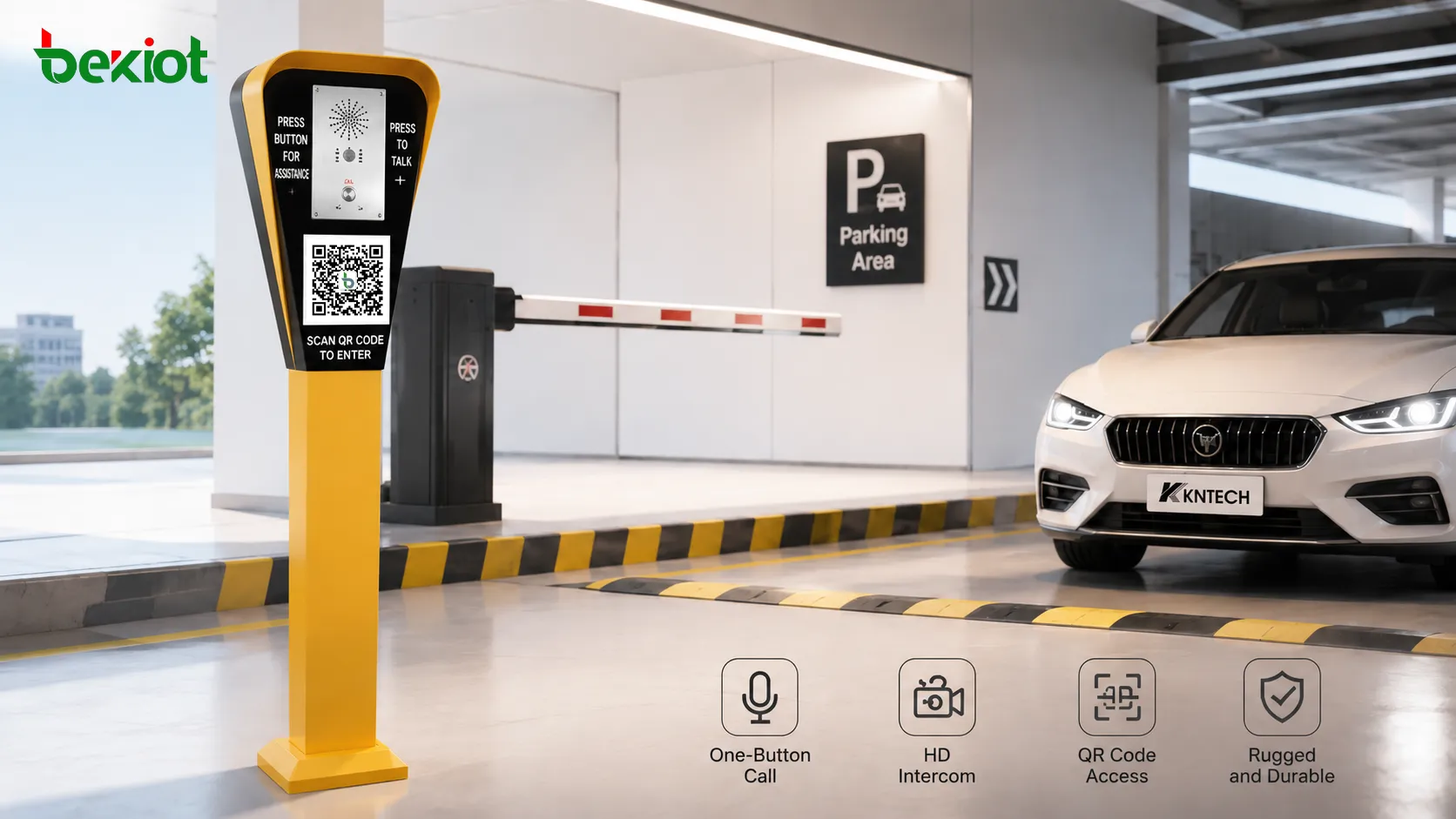
A Parking Lot Intercom System is a practical communication solution designed for parking entrances, exits, payment areas, underground garages, pedestrian routes, EV charging zones, and control rooms. It helps drivers, visitors, parking operators, and security teams communicate quickly when assistance is needed.
In modern parking facilities, communication is no longer limited to a simple help button. Parking operators need a connected system that supports remote assistance, access coordination, video verification, public announcements, service communication, and centralized operation. This is especially important for unattended parking lots, automated barriers, self-service payment machines, smart parking platforms, and large multi-zone parking environments.
Related Solution: Parking Lot Emergency Call Box System
Why Parking Facilities Need Intercom Communication
Unattended Parking Requires Remote Assistance
Many parking facilities now use license plate recognition, automated gates, QR code access, self-service payment, and remote management. These systems improve efficiency, but users may still need help when payment fails, a gate does not open, a ticket is lost, or access authorization is unclear.
A parking intercom system gives users a direct voice channel to the service desk or control room. Instead of waiting for on-site staff, drivers can receive guidance immediately through an intercom terminal installed at the right location.
Large Parking Areas Need Clear Communication Points
Parking garages, commercial parking lots, hospitals, campuses, airports, and transport hubs often include multiple entrances, exits, floors, stairwells, elevators, and pedestrian passages. Without fixed communication points, users may not know where to ask for help.
Intercom stations placed in key areas create a clear service network across the parking facility. Operators can quickly understand where the call comes from and provide instructions based on the user’s location.
Parking Operation Depends on System Integration
A parking facility may already include CCTV cameras, access control, parking barriers, payment systems, public address speakers, and a security office. If these systems work separately, operators must switch between different tools during daily operation.
A SIP-based parking intercom system can connect voice communication with video monitoring, PA announcements, dispatch consoles, and parking management workflows, making operation more efficient and coordinated.
What Is a Parking Lot Intercom System?
System Definition
A Parking Lot Intercom System is a voice communication system used to connect parking users with operators, security teams, or a remote service center. It is commonly installed at parking entrances, exits, ticket machines, payment kiosks, elevator lobbies, stairwells, pedestrian routes, and EV charging areas.
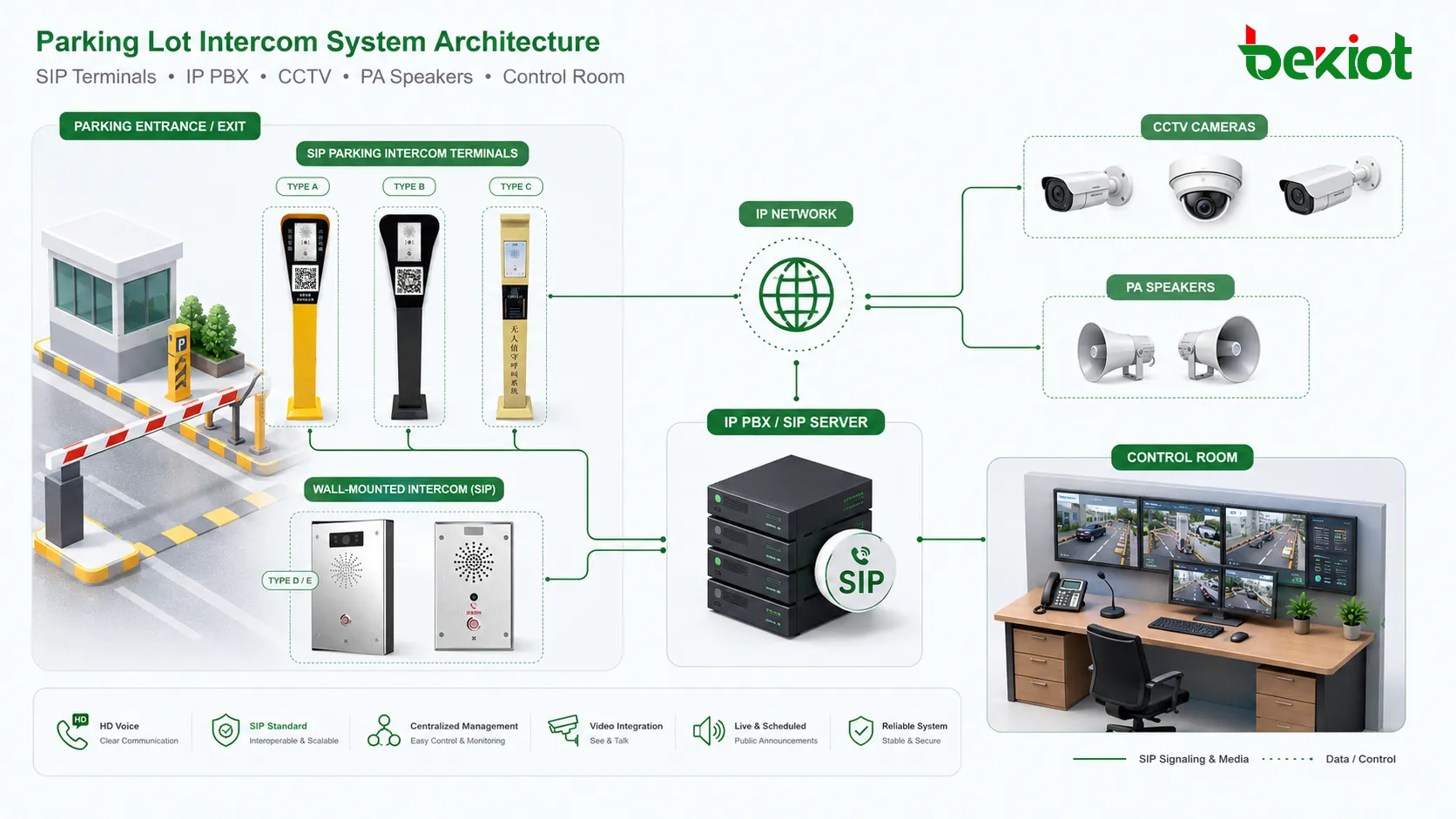
Modern systems usually use IP and SIP communication technology. This allows intercom devices to connect with IP PBX systems, VoIP phones, dispatch platforms, CCTV systems, public address systems, and centralized management software.
Difference from a Standalone Call Box
A standalone call box is usually focused on emergency help requests. A parking lot intercom system has a broader role. It supports daily parking assistance, entry and exit communication, payment support, remote customer service, service coordination, public announcements, and control room communication.
This makes it suitable not only for safety scenarios, but also for improving parking service efficiency and user experience.
System Architecture
Intercom Terminals
Intercom terminals are installed at key parking locations. Depending on the project, they may include a call button, speaker, microphone, camera, indicator light, weatherproof housing, vandal-resistant panel, or wall-mounted enclosure.
For outdoor parking lots and public parking areas, durability is important. Devices should be suitable for long-term use in rain, dust, temperature changes, and frequent public operation.
SIP Server or IP PBX
The SIP server or IP PBX manages communication between intercom terminals, control room phones, dispatch consoles, mobile clients, and other VoIP endpoints. It allows calls to be routed to the right operator or team based on time, location, or service requirement.
This architecture is suitable for single parking garages, commercial complexes, hospitals, campuses, transportation hubs, and multi-site parking operations.
Control Room Platform
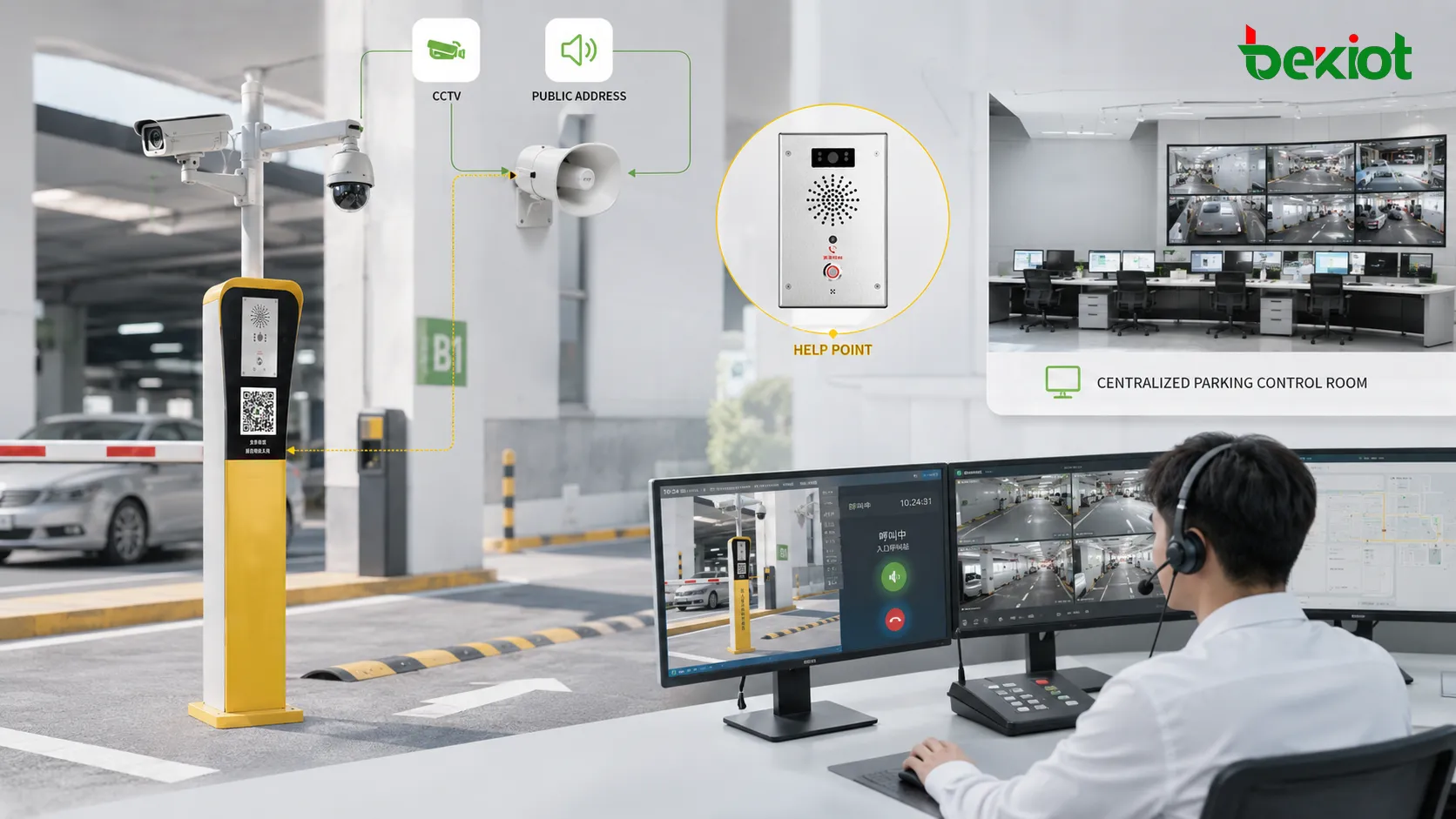
The control room platform helps operators receive calls, identify device locations, view related camera feeds, broadcast messages, and record operation history. For larger parking projects, it can also support centralized monitoring across multiple parking zones or sites.
Key Application Areas
Parking Entrance Intercom
At the entrance, drivers may need help with license plate recognition, visitor access, QR code scanning, membership verification, or barrier opening. An entrance intercom allows users to speak directly with the operator without leaving the vehicle lane.
Parking Exit Intercom
At the exit, common issues include payment failure, lost tickets, access disputes, or system errors. A parking exit intercom helps operators solve problems quickly and reduce congestion caused by blocked exit lanes.
Payment Kiosk Assistance
Self-service payment machines are convenient, but some users may still need support with payment methods, receipts, QR codes, or operation instructions. Intercom terminals near payment kiosks provide a direct service channel.
Underground Parking Communication
Underground parking garages may have weak mobile phone signals, limited visibility, and complex routes. Fixed intercom points provide reliable communication access for users who need service support or guidance.
EV Charging Area Communication
EV charging zones may involve charging faults, payment problems, parking conflicts, or user questions. Installing intercom terminals near charging areas allows operators to provide remote assistance more efficiently.
Security Room and Operations Center
The security room or operations center can manage calls from different parking zones, check linked video, coordinate staff, and make announcements when needed. This improves both service response and daily parking management.
Core Functions
Two-Way Voice Communication
Two-way audio allows users and operators to communicate clearly. Hands-free operation is especially useful for drivers, visitors carrying bags, elderly users, or people who need quick guidance.
Remote Service Support
Operators can provide remote instructions for entry, exit, payment, visitor access, vehicle location, or equipment issues. This reduces the need for staff to physically reach every parking point.
CCTV Linkage
When an intercom call is triggered, the system can display nearby camera video on the control room screen. This helps operators verify the situation and provide more accurate support.
Public Address Integration
The intercom system can work with PA speakers or SIP paging devices. Operators can broadcast parking guidance, traffic reminders, temporary notices, or evacuation instructions to selected areas.
Call Records and Operation Logs
The system can record call time, device location, operator response, and event handling history. These records help parking managers review service quality and improve operation processes.
Benefits of SIP-Based Parking Lot Intercom Systems
Improved User Experience
Drivers and visitors can quickly contact staff when they encounter problems. This improves service accessibility and reduces frustration in automated or unattended parking environments.
More Efficient Parking Operation
Operators can handle common parking issues remotely, such as entry problems, payment questions, barrier control, and visitor verification. This helps reduce labor pressure and improve response speed.
Easy Integration with Existing Systems
SIP-based intercom systems can connect with VoIP phones, IP PBX platforms, dispatch consoles, CCTV systems, access control, parking barriers, and public address systems.
Scalable for Multi-Zone Parking
Parking operators can add more intercom terminals as the facility expands. Multiple parking areas can also be managed through one centralized communication platform.
Suitable for Smart Parking Projects
For smart parking systems, intercom communication can become part of a larger digital operation framework that includes video monitoring, remote service, traffic guidance, access control, and centralized management.
Typical Deployment Scenarios
Shopping Mall Parking Lots
Shopping malls need intercom communication for customer service, payment support, entrance and exit assistance, and coordination with security teams.
Hospital Parking Facilities
Hospital parking areas serve patients, visitors, ambulances, medical staff, and logistics vehicles. Intercom systems help improve communication efficiency and support safer parking operations.
Campus and Business Park Parking
Schools, universities, office parks, and industrial campuses use parking intercom systems for visitor access, night-time service support, staff coordination, and centralized security management.
Transportation Hub Parking
Airports, railway stations, bus terminals, and metro stations often require parking communication integrated with CCTV, access control, public address, and operation centers.
Smart City Parking Networks
City parking operators can deploy intercom systems across multiple parking sites and manage them through a centralized platform, supporting unified service and remote operation.
How to Choose a Parking Lot Intercom System
Check the Installation Environment
Outdoor lots, underground garages, coastal areas, and public facilities may require weatherproof, dustproof, corrosion-resistant, or vandal-resistant terminals.
Confirm Communication Architecture
Operators should confirm whether the system will use SIP, IP PBX, VoIP phones, dispatch consoles, cloud management, or local control room deployment.
Plan System Integration
Before deployment, it is important to check whether the intercom system needs to connect with CCTV, access control, parking barriers, payment systems, PA speakers, or parking management software.
Consider Future Expansion
A good parking intercom system should support additional terminals, more parking zones, multi-site management, and future integration with smart parking platforms.
Becke Telcom Parking Communication Solution
For parking facilities that require SIP-based intercom communication, control room dispatch, PA integration, CCTV linkage, and flexible system expansion, Becke Telcom can provide parking communication solutions for garages, campuses, hospitals, commercial complexes, transportation hubs, and industrial parks.
The solution can include SIP intercom terminals, IP phones, dispatch consoles, IP paging devices, weatherproof communication terminals, and integration with existing VoIP or security systems. This helps parking operators build a practical communication network without replacing all existing infrastructure at once.
Conclusion
A Parking Lot Intercom System is an important part of modern parking operation. It supports remote assistance, entrance and exit communication, payment support, CCTV linkage, PA announcements, and centralized control room management.
For parking garages, shopping malls, hospitals, campuses, transportation hubs, and smart city parking projects, a SIP-based intercom system provides a scalable communication foundation for safer and more efficient parking management.
FAQ
What is a Parking Lot Intercom System?
A Parking Lot Intercom System is a communication system that allows drivers, visitors, and operators to communicate through intercom terminals installed in parking areas.
Where are parking intercom terminals usually installed?
They are commonly installed at entrances, exits, payment kiosks, elevator lobbies, stairwells, pedestrian routes, EV charging areas, and control room access points.
Can a parking intercom system connect with CCTV?
Yes. Many SIP-based parking intercom systems can connect with CCTV platforms so operators can view related video when a call is triggered.
Can the system support public address announcements?
Yes. It can integrate with PA or SIP paging systems for parking guidance, service reminders, traffic notices, and evacuation instructions.
Is SIP suitable for parking intercom systems?
Yes. SIP is suitable because it supports IP-based communication, flexible call routing, VoIP integration, centralized management, and scalable deployment.







