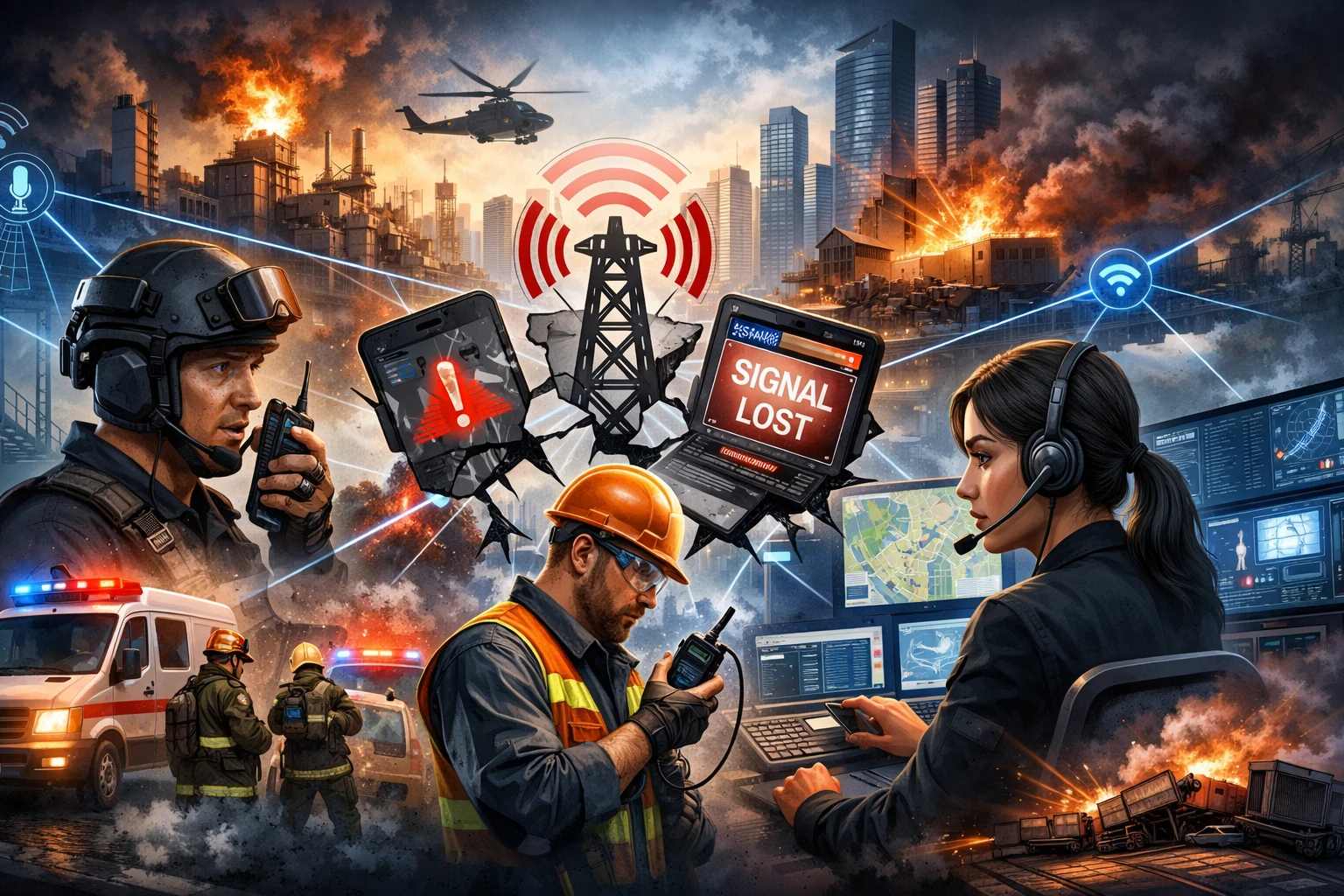
When a disaster damages cellular towers, fiber routes, power supply, and road access at the same time, rescue teams cannot rely on ordinary public mobile networks alone. The first communication challenge is not simply making phone calls. It is rebuilding a temporary command network that can support voice, video, location sharing, dispatch coordination, emergency alerts, and field-to-command information exchange.
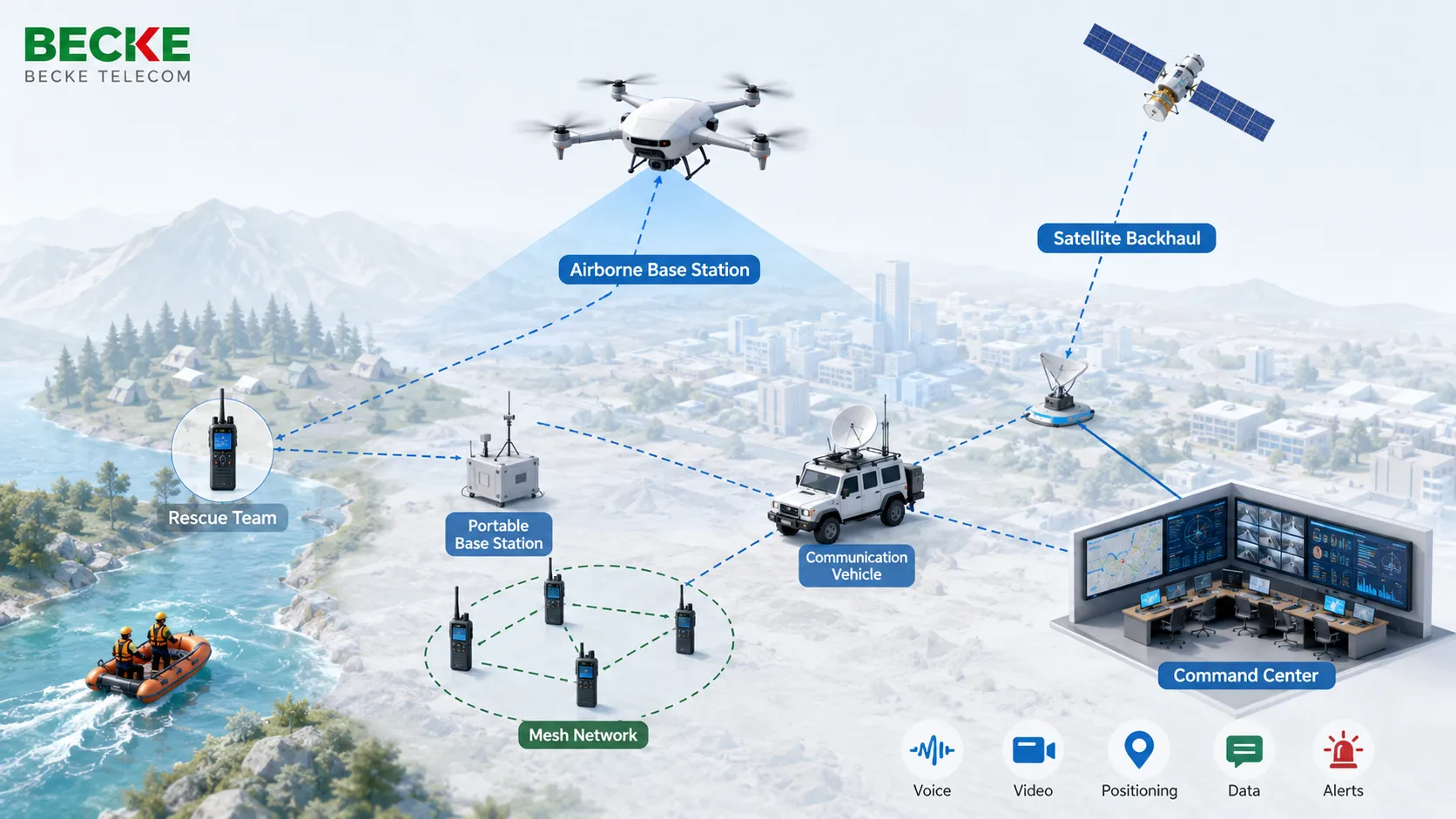
Modern emergency communication has moved far beyond the traditional image of rescue workers carrying a single radio into the mountains. A resilient disaster-response network now combines airborne base stations, satellite backhaul, portable cellular equipment, vehicle-mounted communication systems, Mesh ad hoc networking, satellite positioning terminals, rugged field devices, and command dispatch platforms. The goal is clear: restore usable communication within hours, even when the local infrastructure is completely offline.
Why Disaster Areas Need Independent Emergency Communication
In large-scale earthquakes, floods, landslides, wildfires, storms, or industrial emergencies, communication failure usually happens in layers. Cellular towers may lose power, fiber transmission may be cut, roads may be blocked, and fixed command facilities may be unable to reach rescue teams. When this happens, ordinary mobile phones, public internet access, and fixed broadband systems can become unreliable or completely unavailable.
Emergency communication systems solve this problem by creating an independent temporary network. This network does not depend on a single tower, one cable route, or one command node. Instead, it uses multiple transmission paths and multiple access layers, so rescue teams can continue communicating even if one link fails.
The core value of emergency communication is not only restoring a signal. It is restoring command capability, situational awareness, and coordinated rescue operations under damaged infrastructure conditions.
Airborne Base Stations for Rapid Coverage Recovery
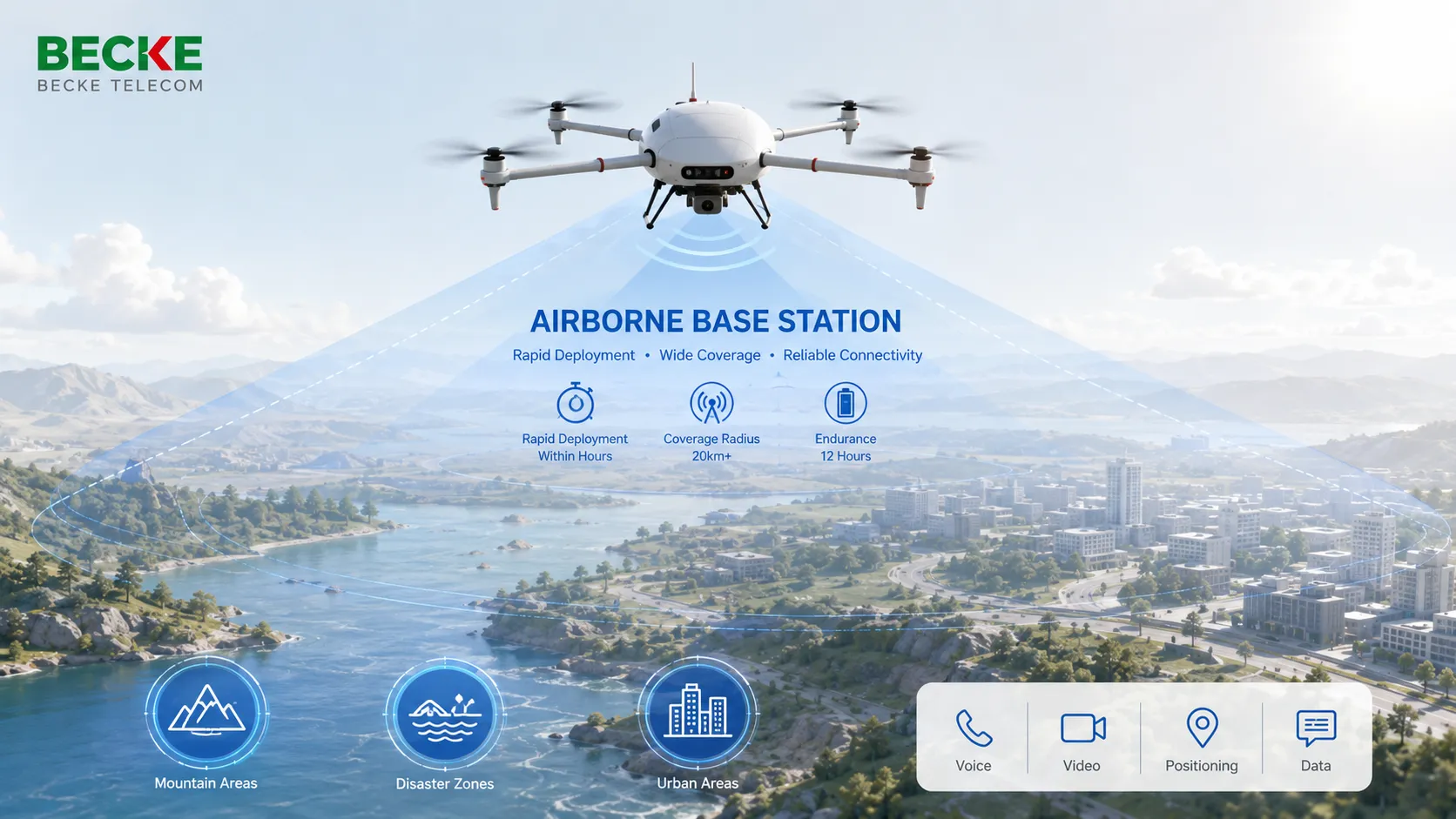
When ground infrastructure is damaged or inaccessible, airborne base stations can be one of the fastest ways to restore wide-area communication. A drone-mounted or aerial relay base station can fly above the disaster zone and provide temporary cellular coverage from the air. In typical emergency scenarios, this type of platform can be deployed within a few hours, operate at an altitude of around 3,000 meters, and cover a diameter of more than 20 kilometers, depending on terrain, frequency planning, antenna configuration, and backhaul conditions.
Airborne systems are especially useful when roads are blocked or the affected area is mountainous, flooded, or unsafe for vehicles. Some aerial communication platforms combine tethered power, onboard batteries, and satellite or microwave backhaul to maintain several hours of continuous service. A practical target for emergency response is to support around 12 hours of airborne operation, giving command teams enough time to establish a more stable ground network.
Portable Drop-In Base Stations
For smaller or hard-to-reach disaster zones, portable base stations can be delivered by rescue aircraft or carried by field teams. After landing or being placed at a safe location, some compact systems can automatically power on and establish local coverage within about three minutes. A practical field configuration may support approximately 1 kilometer of local coverage and hundreds of simultaneous users, making it suitable for rescue teams, medical points, temporary shelters, and on-site command posts.
Compared with relying only on satellite phones for individual point-to-point calls, a portable local base station can support group communication, mobile access, location updates, and field coordination much more efficiently. This is why rapid-deployment cellular coverage has become an important part of modern emergency communication planning.
Ground-Based Emergency Communication Systems
Airborne systems solve the first coverage gap, but ground systems provide stronger local capacity, more stable power, and better integration with command vehicles, field shelters, emergency operation centers, and rescue teams. Ground-based equipment is usually designed for all-terrain deployment, harsh weather, unstable power, and rapid installation.
All-Terrain Communication Vehicles
All-terrain emergency communication vehicles integrate base station equipment, satellite backhaul, antennas, battery storage, routing systems, and sometimes edge computing capabilities into a mobile platform. Lightweight tracked designs may weigh around two tons while still being able to cross deep obstacles, move through rough terrain, and climb steep icy or muddy slopes of up to about 45 degrees.
Once the vehicle reaches the affected area, the antenna system can be raised and service can often be activated within about 30 minutes. This allows the rescue site to transmit live video, voice, positioning data, and command information back to the command center. For disaster response, this is not just a communication tool; it becomes a mobile command infrastructure node.
Rugged Field Terminals
Emergency terminals must work in rain, mud, dust, shock, vibration, and extreme temperature conditions. For field rescue, rugged handheld terminals, digital radios, satellite-enabled devices, and portable dispatch terminals should support strong battery life, clear audio, simple operation, and fast network access. Many modern rescue terminals are designed with high ingress protection levels such as IP68, allowing them to remain operational in water, dust, and severe outdoor conditions.
In industrial rescue, tunnel emergency response, port operations, mining sites, and utility corridors, rugged SIP emergency phones, waterproof industrial telephones, explosion-proof call stations, and IP paging terminals can also be added to the communication layer. Becke Telcom can match these scenarios with SIP-based industrial communication terminals, emergency call points, IP speakers, paging gateways, and dispatch integration, helping projects connect field devices with a central command platform.
Mesh Ad Hoc Networking for Infrastructure-Free Communication
One of the biggest risks in emergency communication is a single point of failure. If one repeater, base station, cable, or command node goes down, the entire communication chain should not collapse. This is where Mesh ad hoc networking becomes valuable.
In a Mesh emergency network, every radio, relay, vehicle node, or handheld terminal can work as part of the network. There is no need for a fixed central node. If one node fails, other nodes can automatically select a new path and continue forwarding traffic. In practical field deployment, Mesh devices can automatically form a network within about five seconds after startup, reducing the need for complex engineering configuration.
Multi-Hop Relay for Mountains, Forests, and Blocked Roads
Disaster zones often include valleys, forests, tunnels, collapsed buildings, and damaged roads. Direct communication may not be possible between the front-line team and the command center. Mesh networking solves this through multi-hop relay. Signals can travel from one node to another, extending communication over several kilometers or even tens of kilometers depending on terrain, node spacing, antenna height, power level, and frequency environment.
This makes Mesh networking suitable for search and rescue, firefighting, flood control, mountain rescue, temporary shelters, industrial emergency response, and mobile command operations. When combined with RoIP gateways and SIP dispatch systems, radio users, IP phones, control room operators, and mobile command units can communicate across different networks without changing their existing field workflow.
Satellite Backhaul and Positioning for No-Signal Environments
When fiber and public mobile networks are unavailable, satellite communication becomes the key backhaul layer. Satellite links can connect the disaster zone with a remote command center, allowing voice, data, video, GIS, and emergency dispatch information to continue flowing even when all terrestrial infrastructure is damaged.
Satellite positioning and short-message capability are also important for field rescue. Terminals with satellite short-message and positioning functions can send coordinates back to the command platform even when there is no cellular signal. This gives command teams a reliable way to track rescue members, assign tasks, and reduce the risk of losing contact with teams operating in mountains, flooded areas, or collapsed zones.
Recommended Emergency Communication Architecture
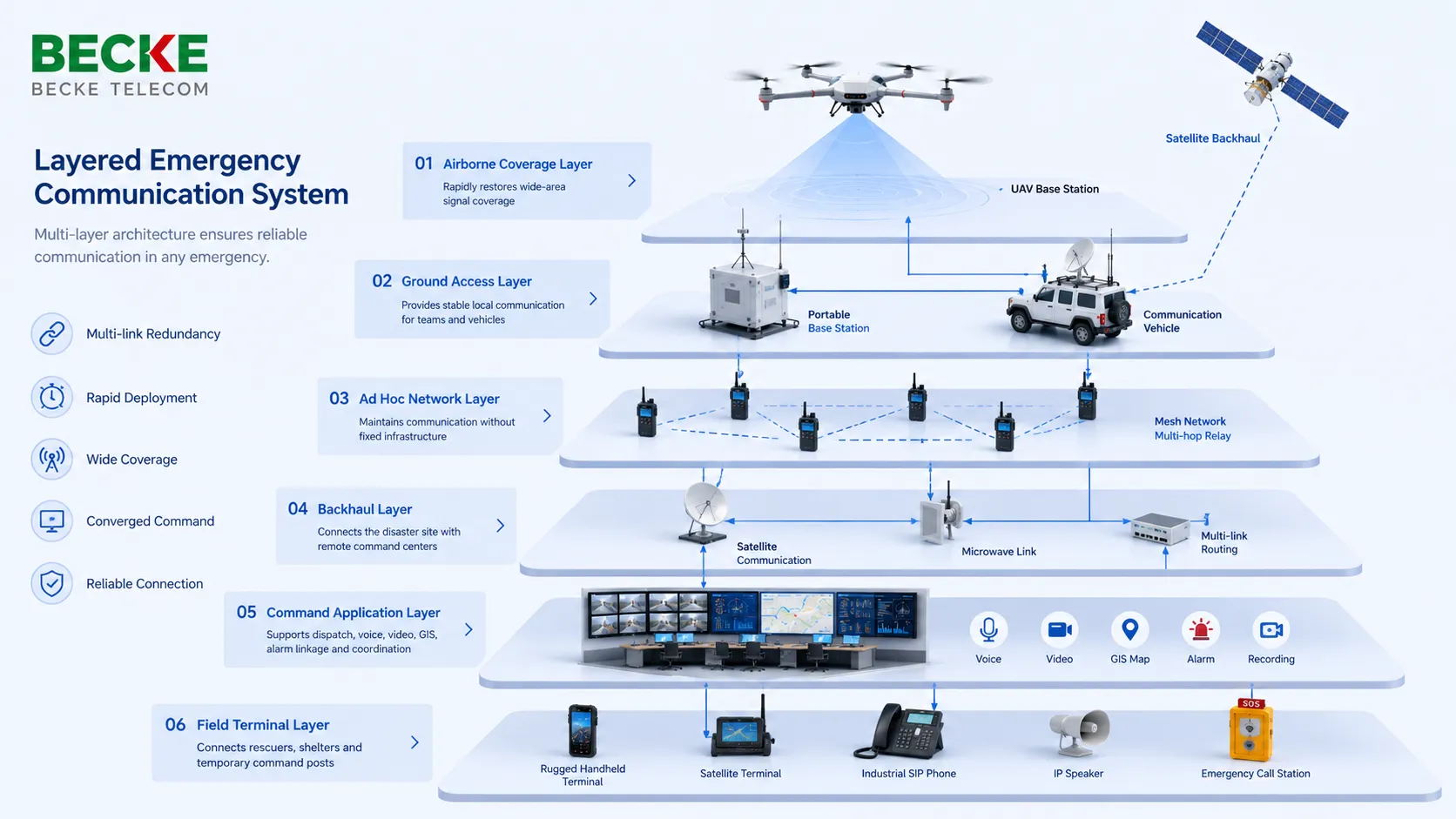
A strong emergency communication solution should not rely on one device or one link. It should be designed as a layered system. Each layer has a different role, and together they create a resilient communication environment for rescue operations.
| System Layer | Main Function | Typical Technologies | Becke Telcom Matching |
|---|---|---|---|
| Airborne Coverage Layer | Rapidly restores wide-area signal coverage when ground infrastructure is damaged | Drone base station, aerial relay, tethered platform, temporary cellular coverage | Integration with command dispatch and emergency communication platform |
| Ground Access Layer | Provides stable local communication capacity for rescue teams and command vehicles | Portable base station, emergency vehicle, rugged access node, local 4G/5G network | SIP dispatch access, field voice communication, emergency call linkage |
| Backhaul Layer | Connects the disaster site with remote command centers | Satellite communication, microwave link, fiber recovery link, multi-link routing | IP communication integration and multi-site dispatch interconnection |
| Ad Hoc Network Layer | Maintains communication when fixed infrastructure or central nodes are unavailable | Mesh network, multi-hop relay, portable radio node, field repeater | RoIP gateway integration for radio-to-IP dispatch communication |
| Command Application Layer | Supports dispatch, voice, video, GIS, alarm linkage, and rescue coordination | Command platform, GIS map, video dispatch, emergency notification, recording system | Converged communication platform with voice, paging, alarm, video, and GIS linkage |
| Field Terminal Layer | Connects rescue workers, vehicles, shelters, and temporary command posts | Rugged handheld terminal, satellite terminal, digital radio, mobile dispatch terminal | Industrial SIP phones, emergency call stations, IP speakers, SIP paging endpoints |
Key Technical Requirements for Emergency Communication Deployment
Fast Activation
Emergency systems should support quick startup and automatic network formation. Portable base stations should be ready within minutes, Mesh networks should self-organize rapidly, and command platforms should allow operators to view users, channels, locations, and video feeds without complicated manual setup.
Multi-Link Redundancy
No single communication path should become the only lifeline. A practical solution should combine satellite backhaul, local wireless access, Mesh relay, portable cellular coverage, and where possible recovered fiber or microwave links. If one path fails, another path should continue supporting basic command communication.
Rugged Environmental Protection
Disaster communication equipment must withstand water, dust, shock, vibration, heat, cold, and unstable power. Rugged terminals with high protection levels, sealed interfaces, strong antennas, and long battery life are more suitable for floods, mudslides, storms, mountain rescue, industrial sites, and remote field operations.
Voice, Video, Data, and Location Integration
Modern emergency response is no longer voice-only. Rescue teams need live video, location tracking, short messages, group calls, emergency alarms, GIS visualization, and event records. A unified emergency communication platform should integrate these functions into one operational workflow.
For projects that already use SIP phones, IP PBX, public address systems, CCTV, alarms, or two-way radios, Becke Telcom can provide a compatible integration path through SIP communication, RoIP dispatch, IP paging, emergency broadcasting, alarm linkage, and GIS-based command workflows. This allows organizations to modernize emergency communication without replacing every existing subsystem at once.
Application Scenarios
Emergency communication systems can be used in natural disaster response, public safety command, forest fire response, flood control, tunnel rescue, mining emergency response, oil and gas facilities, power plants, transportation hubs, temporary shelters, and large outdoor public events. In each scenario, the system must answer the same question: how can people communicate when ordinary networks fail?
For industrial and public safety projects, the communication design should also consider integration with public address systems, alarm systems, video surveillance, access control, dispatch consoles, and GIS platforms. A solution provider such as Becke Telcom can support this type of integrated emergency communication planning with SIP-based voice, broadcast, dispatch, alarm linkage, and command platform capabilities, without locking the project into a single device category.
Product Matching for Emergency Communication Projects
Different emergency communication projects require different device combinations. The following matching logic can help system integrators, public safety teams, and industrial operators select suitable communication components without overbuilding the system.
| Project Requirement | Recommended Device Category | Typical Value |
|---|---|---|
| Field rescue voice communication | Industrial SIP phones and rugged emergency call terminals | Provides reliable voice access from shelters, tunnels, stations, industrial sites, and temporary command points |
| Radio and IP network interconnection | RoIP gateway and SIP dispatch integration | Connects walkie-talkies, dispatch consoles, IP phones, and command centers into one communication workflow |
| Emergency announcement and public alerting | SIP paging gateway, IP speakers, horn speakers, and PA integration | Supports live paging, zone broadcast, alarm-triggered messages, and emergency notification |
| Centralized command and coordination | Converged communication and dispatch platform | Integrates voice, video, GIS, alarm events, recording, and multi-channel command communication |
| Harsh industrial environments | Weatherproof, explosion-proof, and vandal-resistant communication terminals | Improves communication reliability in mines, oil and gas sites, tunnels, ports, and energy facilities |
Future Trends in Emergency Communication
Lighter Equipment for Faster Field Deployment
Emergency equipment is becoming smaller, lighter, and easier to carry. Portable satellite communication devices, compact base stations, and backpack communication kits help front-line teams restore communication without waiting for large vehicles or complex installation teams.
Independent and Secure Communication Resources
Emergency networks require reliable control over critical chips, frequency resources, satellite access, encryption, and command applications. More organizations are moving toward independently controllable communication systems to reduce dependency risks during major emergencies.
Integrated Air-Ground-Satellite Networks
The future of emergency communication is an integrated network that combines satellite backhaul, ground Mesh networking, airborne base stations, portable field nodes, and command platforms. This approach creates multiple backup paths, so command communication can continue even if one layer is damaged or overloaded.
The best emergency communication system is the one that may not be used every day, but can immediately support rescue command, field coordination, and life-saving decisions when ordinary networks fail.
Conclusion
When cellular networks fail in a disaster area, rescue communication depends on a layered emergency network rather than one single device. Airborne base stations restore wide-area coverage, ground vehicles provide stable local capacity, Mesh networks keep teams connected without fixed infrastructure, satellite links provide long-distance backhaul, and rugged terminals keep rescue workers visible and reachable in the field.
For emergency planners, public safety agencies, industrial operators, and infrastructure owners, the key lesson is simple: communication resilience must be designed before the disaster happens. With SIP-based dispatch, RoIP gateway integration, emergency paging, industrial communication terminals, and converged command platforms, Becke Telcom can be lightly matched into this architecture as part of a practical emergency communication solution.
FAQ
What is an emergency communication solution?
An emergency communication solution is a temporary or backup communication system used when public networks, fixed lines, or normal infrastructure are damaged or unavailable. It usually combines portable base stations, satellite backhaul, Mesh networking, rugged terminals, and command platforms.
How can communication be restored when all base stations fail?
Communication can be restored through airborne base stations, portable base stations, satellite backhaul, all-terrain communication vehicles, and Mesh ad hoc networks. These systems can create temporary coverage without depending on damaged local towers or fiber routes.
Why is Mesh networking important in disaster rescue?
Mesh networking reduces single-point failure risk. Each node can relay traffic, and the network can automatically reroute communication if one node fails. This is useful in mountains, forests, tunnels, collapsed areas, and other difficult environments.
What data should emergency communication systems support?
A modern emergency system should support voice, video, location, short messages, alarm events, GIS map data, dispatch instructions, and recording. Voice alone is no longer enough for complex rescue operations.
How can Becke Telcom products fit into an emergency communication project?
Becke Telcom products can be matched at the SIP voice, RoIP gateway, IP paging, industrial terminal, emergency broadcast, alarm linkage, and command dispatch layers. They are suitable for projects that need to connect field communication devices with a control room or emergency command platform.
What should organizations consider before deploying an emergency communication system?
Organizations should consider activation speed, coverage range, satellite backhaul, Mesh relay capability, terminal ruggedness, power supply, interoperability with existing systems, command platform integration, and long-term maintenance.