


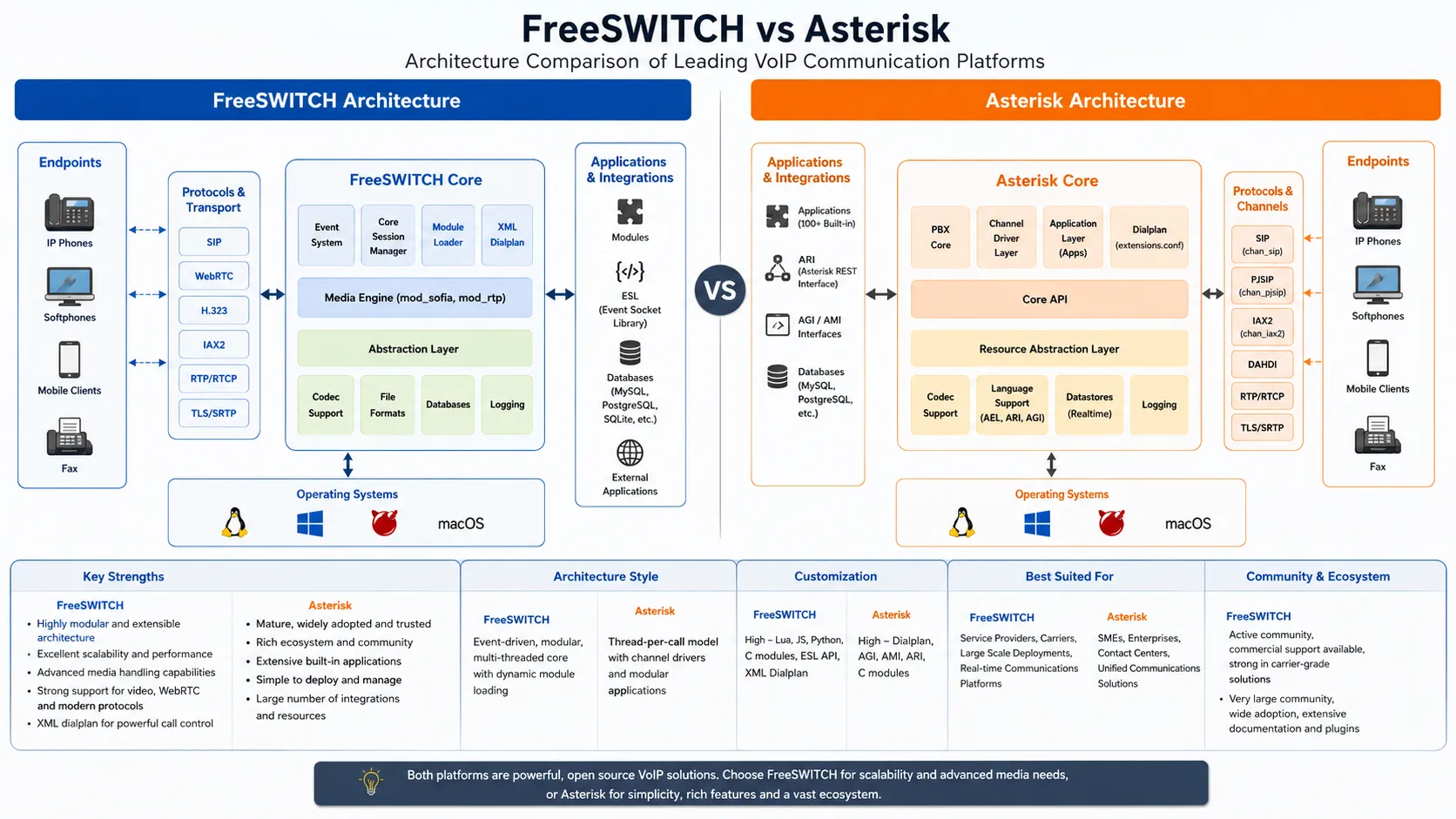
FreeSWITCH and Asterisk are two of the most influential open source platforms in the VoIP communication field. Both can be used to build SIP-based voice systems, IP PBX platforms, call routing services, conferencing systems, gateways, and customized communication applications. However, they are not the same type of tool in practical deployment. Asterisk is often selected for PBX-centered business telephony, while FreeSWITCH is often selected for scalable, programmable, and media-rich communication platforms.
The better choice depends on what the project needs to achieve. A small office phone system, a call center queue, a SIP trunking project, and a high-concurrency service platform may all require different design priorities. This comparison explains the differences from architecture, features, scalability, maintenance, application scenarios, and enterprise VoIP system planning.
Start with the Real Deployment Question
It Is Not Only a Software Choice
Many users search for FreeSWITCH versus Asterisk because they want to know which platform is better. In real projects, the more important question is what kind of communication system must be built. A simple IP PBX, a hosted VoIP service, a dispatch communication platform, a conference bridge, or an industrial emergency communication network will not have the same requirements.
Asterisk is widely recognized as a mature open source PBX and telephony toolkit. It is practical for extension management, voicemail, IVR, call queues, SIP trunking, call recording, and many traditional business phone system functions. FreeSWITCH is usually positioned as a flexible communication framework that can support softphones, PBX systems, conferencing, SIP services, WebRTC communication, and more customized media applications.
The Best Platform Depends on Project Priorities
If the main goal is to deploy an office phone system quickly, Asterisk may be easier to understand and operate. If the goal is to build a larger platform with high concurrency, multi-tenant service logic, real-time media handling, and external application control, FreeSWITCH may provide more architectural freedom. The decision should be based on scale, integration depth, development resources, endpoint types, security policy, and long-term maintenance planning.
The right VoIP platform is not always the one with the most functions. It is the one that matches the communication workflow, system scale, and maintenance capability of the organization.
Architecture and Design Philosophy
Asterisk: PBX-Centered Telephony Logic
Asterisk is often easier to explain as a PBX and telephony application framework. It connects SIP endpoints, trunks, dial plans, voicemail, IVR menus, queues, conference rooms, and external applications into a structured call flow. Its dialplan logic is familiar to many telephony engineers because it describes how calls are answered, routed, transferred, bridged, recorded, or sent to different applications.
This PBX-centered model makes Asterisk suitable for companies that mainly need a business phone system. Administrators can create extensions, define inbound and outbound routes, configure call groups, build IVR menus, connect SIP trunks, and manage common calling features. For many small and medium-sized deployments, this is exactly what is needed.
FreeSWITCH: Programmable Communication Framework
FreeSWITCH is often used when the communication platform needs to be more programmable and scalable. It can act as a SIP server, media server, softswitch, conference server, gateway component, or application-controlled communication layer. Its event-driven control capabilities make it suitable for systems where external applications need to manage calls, sessions, conferences, routing decisions, or dispatch workflows in real time.
This makes FreeSWITCH attractive for service providers, hosted communication platforms, large conferencing systems, WebRTC services, dispatch centers, and complex SIP environments. It can also be used to build PBX functions, but many teams choose it because they need more than a traditional PBX.
Feature Focus in Business Communication
PBX Functions and Office Calling
For typical office telephony, Asterisk has a strong advantage in practical PBX workflows. It is commonly used for extension dialing, ring groups, IVR, voicemail, call queues, call parking, call forwarding, call recording, SIP trunking, and inbound call routing. Many engineers are familiar with its configuration model, and there is a large amount of community knowledge around common business PBX use cases.
FreeSWITCH can also support PBX-style features, especially when deployed with a management interface or customized application layer. However, it is usually more attractive when the project requires flexible session control, media processing, conferencing, SIP interconnection, or platform-level development.
Media Handling and Conferencing
FreeSWITCH is often selected for media-rich environments such as audio conferencing, video communication, WebRTC applications, and large communication services. Its architecture is well suited to handling media sessions and integrating with external business systems that need to control communication behavior dynamically.
Asterisk also supports conferencing and media features, but many projects position it more naturally around PBX services and call routing. For a business that needs standard voice communication and call center functions, Asterisk may be simpler. For a platform that expects heavy media processing and customized session control, FreeSWITCH may be a better fit.
Gateway, Trunk, and Endpoint Integration
Both platforms can connect SIP phones, SIP trunks, gateways, analog adapters, and other telephony endpoints. In enterprise projects, this integration layer is just as important as the software platform itself. A complete VoIP system may include SIP phones, industrial telephones, paging gateways, analog gateways, SBC gateways, public address systems, and dispatch consoles.
For this reason, the platform should be selected together with the wider communication architecture. A software PBX without reliable endpoint planning, network design, codec policy, security controls, and failover strategy may still fail to deliver a stable communication experience.
Scalability and Performance Planning
Small and Medium Deployments
For small and medium businesses, Asterisk is often easier to deploy because the system goal is usually clear: replace a legacy PBX, manage extensions, connect SIP trunks, route customer calls, and provide common office calling features. In these cases, performance planning focuses on the number of users, expected concurrent calls, recording needs, codec selection, and trunk capacity.
Asterisk can be highly effective when the call flow is not overly complex and the organization needs a stable, familiar, and cost-conscious PBX solution. It can also be expanded with modules, external scripts, databases, APIs, and third-party management tools when customization is required.
Large Platforms and High-Concurrency Services
FreeSWITCH is often considered when the project moves beyond a single PBX. Hosted VoIP platforms, carrier-style SIP services, large conferencing platforms, multi-tenant systems, and communication applications with external control logic may benefit from its scalable and programmable design.
In these scenarios, system planning should include distributed deployment, load balancing, SIP routing, media resource allocation, database design, monitoring, failover, logging, and security policy. FreeSWITCH gives developers and system architects more freedom, but it also requires stronger engineering planning.
Ease of Deployment and Maintenance
Configuration and Learning Curve
Asterisk may feel more direct for teams that understand PBX concepts. The administrator can think in terms of extensions, trunks, inbound routes, outbound routes, IVR, voicemail, and queues. This makes it easier for traditional telephony engineers to map business requirements into configuration.
FreeSWITCH can be more flexible, but that flexibility may introduce a steeper learning curve. Teams may need to understand XML configuration, SIP profiles, dialplan logic, media behavior, event socket control, and application integration. For developers and platform architects, this flexibility is powerful. For a basic office phone system, it may be more than necessary.
Long-Term Operation
Long-term maintenance depends on staff skills and system complexity. Asterisk may be easier to maintain when the business uses common PBX features and has limited customization. FreeSWITCH may be easier to scale and integrate when the communication system is part of a larger software platform.
In both cases, stable operation requires proper monitoring, backup, security hardening, SIP trunk testing, endpoint provisioning, log management, and disaster recovery planning. Open source does not remove the need for professional system design; it simply gives the organization more control over how the system is built.
Typical Application Scenarios
Where Asterisk Is Often a Strong Fit
Asterisk is a strong fit for office IP PBX systems, small and medium business phone systems, call center queues, SIP trunk access, voicemail platforms, IVR menus, internal extension calling, and legacy PBX replacement projects. It is also useful when companies want to build practical telephony applications without designing a large service-provider platform.
Where FreeSWITCH Is Often a Strong Fit
FreeSWITCH is a strong fit for hosted VoIP services, large conferencing systems, WebRTC voice platforms, dispatch communication platforms, carrier-style SIP services, multi-tenant communication applications, and projects that require programmable session control. It is especially useful when the platform must integrate deeply with external software systems.
Where Both Can Be Used Together
Some deployments use both platforms in the same environment. For example, Asterisk may handle PBX features and office users, while FreeSWITCH handles conferencing, media services, high-volume call processing, or a customized application layer. They can be connected through SIP trunks or routing logic when the architecture is properly planned.
Side-by-Side Comparison
| Comparison Area | Asterisk | FreeSWITCH |
|---|---|---|
| Common positioning | Open source PBX and telephony toolkit | Open source communication framework and softswitch platform |
| Typical strength | Business PBX, extensions, IVR, voicemail, queues, SIP trunks | Scalability, media handling, conferencing, programmable call control |
| Best-fit users | SMBs, offices, call centers, PBX replacement projects | Service providers, platforms, developers, large-scale communication systems |
| Learning curve | Often easier for PBX-focused deployments | More flexible, but may require deeper technical planning |
| Customization | Strong for telephony applications and dialplan logic | Strong for external control, media services, and platform-level design |
| Deployment style | PBX-centered and feature-driven | Framework-centered and architecture-driven |
How to Choose for an Enterprise VoIP System
Choose Asterisk When the PBX Is the Core
Asterisk is usually a practical choice when the organization mainly needs internal extensions, SIP trunks, IVR, voicemail, call queues, call recording, office calling rules, and traditional PBX features. It is especially suitable when the deployment goal is clear and the system does not require a large multi-tenant or media-heavy architecture.
Choose FreeSWITCH When the Platform Is the Core
FreeSWITCH is usually a better choice when the system needs to operate as a communication platform rather than only a PBX. It is suitable for high-concurrency SIP services, conferencing, WebRTC voice systems, dispatch integration, multi-tenant communication, and external application control.
Evaluate the Complete Communication Environment
The software platform should not be selected separately from the endpoints and network. A reliable VoIP system may need SIP phones, operator consoles, industrial phones, paging gateways, SBC gateways, analog gateways, emergency intercoms, public address speakers, recording servers, and monitoring tools. Network quality, VLAN planning, QoS, firewall policy, NAT traversal, codec selection, and security controls should be considered from the beginning.
Asterisk may be the better PBX choice. FreeSWITCH may be the better platform choice. The correct answer depends on whether the project is mainly telephony operation or communication infrastructure.
Related VoIP Telephone System Solution
From Open Source Platform to Complete Deployment
For many enterprises, FreeSWITCH or Asterisk is only one layer of the system. The final solution must also connect users, endpoints, gateways, paging devices, trunks, and emergency communication workflows. This is where solution design becomes more important than software comparison alone.
Becke Telcom can be lightly considered in this type of project when a SIP-based communication environment needs industrial phones, IP phones, paging gateways, gateway integration, and dispatch-oriented communication terminals. For a broader deployment reference, visit VoIP Telephone System.
Final Verdict
There Is No Universal Winner
FreeSWITCH and Asterisk are both valuable open source communication platforms, but they solve different problems more naturally. Asterisk is often better for PBX-centered business communication. FreeSWITCH is often better for scalable, programmable, and media-rich communication platforms.
The Better Choice Is the One That Fits the Use Case
If the goal is to build a practical office phone system with extensions, trunks, IVR, voicemail, queues, and common PBX features, Asterisk may be the better choice. If the goal is to build a large SIP platform, conferencing service, WebRTC system, hosted VoIP environment, or dispatch communication layer, FreeSWITCH may be the better choice.
For complex enterprise projects, the decision should be made after evaluating system scale, call concurrency, endpoint environment, integration needs, IT skill level, maintenance plan, and future expansion. A well-designed VoIP architecture is more important than simply choosing the most popular platform.
FAQ
Is FreeSWITCH better than Asterisk?
FreeSWITCH is not simply better than Asterisk. It is often better for scalable communication platforms, conferencing, WebRTC, and programmable media services. Asterisk is often better for PBX-centered office phone systems and traditional business telephony.
Is Asterisk still good for modern VoIP systems?
Yes. Asterisk is still useful for IP PBX systems, SIP trunking, IVR, voicemail, call queues, call recording, and many business VoIP applications. It remains a practical choice when the organization needs a mature PBX toolkit.
Can FreeSWITCH be used as an IP PBX?
Yes. FreeSWITCH can be used to build IP PBX functions, especially when combined with a suitable management layer or customized configuration. However, it is often chosen for larger or more flexible communication platforms rather than only basic PBX replacement.
Can Asterisk and FreeSWITCH work together?
Yes. They can be connected through SIP trunks or routing logic. In some systems, Asterisk handles PBX features while FreeSWITCH handles conferencing, media processing, or high-volume call services.
Which platform is easier for beginners?
For beginners who want to build a traditional office PBX, Asterisk may be easier to understand. For developers building customized communication platforms, FreeSWITCH may be more powerful but usually requires deeper technical planning.
Which one is better for call centers?
Asterisk is often suitable for small and medium call centers that need queues, IVR, recording, and SIP trunking. FreeSWITCH may be suitable for larger or more customized call center platforms that require high concurrency, media control, or integration with external software.
Which one is better for conferencing?
FreeSWITCH is often favored for large conferencing and media-rich communication services. Asterisk can also provide conferencing features, but FreeSWITCH is commonly selected when conferencing is a core platform requirement.
Do enterprises need professional deployment support?
Yes. Whether the platform is Asterisk or FreeSWITCH, enterprises should plan SIP trunks, network quality, endpoint provisioning, security, failover, monitoring, and long-term maintenance. Professional deployment planning helps reduce call quality issues and operational risk.







