


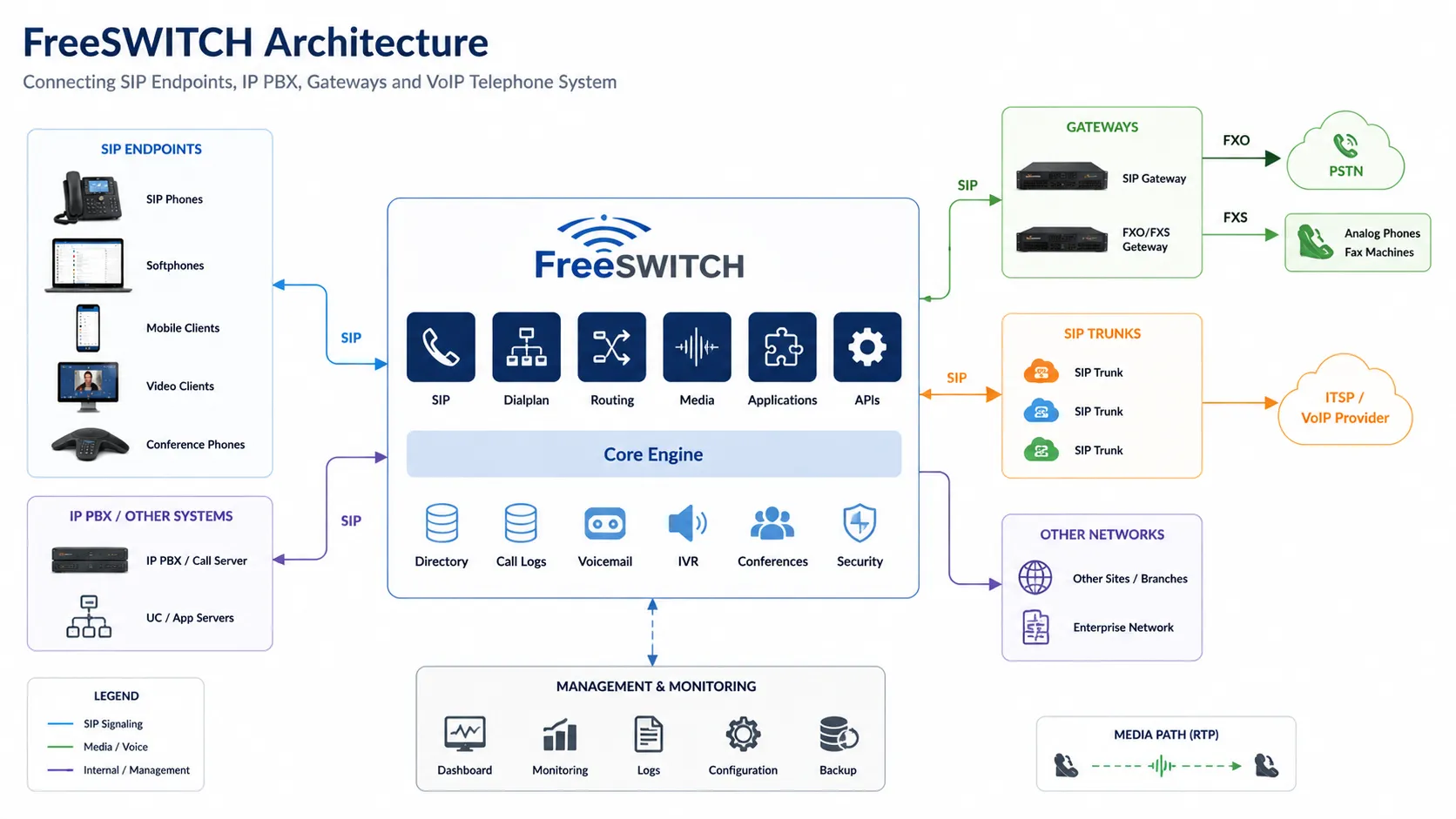
FreeSWITCH is an open-source communication framework used to build VoIP platforms, SIP routing systems, PBX services, conferencing platforms, IVR systems, contact center engines, and carrier-grade voice applications. Instead of being limited to one fixed phone system model, it provides a flexible switching core and a modular software structure that developers, service providers, and system integrators can adapt for different communication environments.
Understanding the Platform
A Flexible Communication Engine
FreeSWITCH can be understood as a software-based communication engine. It receives signaling requests, creates call sessions, applies routing rules, negotiates media, and connects different users, applications, and networks. In a business environment, it may work as the core of an IP PBX. In a service provider environment, it may support multi-tenant calling, SIP trunking, conferencing, and large-scale routing logic.
Its value comes from flexibility. A company can use FreeSWITCH to build internal extension calling, voicemail, IVR menus, call queues, recording, conference rooms, outbound routing, or gateway connectivity. A developer can also use it as a programmable telecom layer for custom voice applications, WebRTC services, dispatch platforms, or automated notification systems.
Where It Fits in a VoIP Network
In a typical VoIP network, FreeSWITCH sits between SIP endpoints, trunk providers, gateways, and communication applications. SIP phones, softphones, intercoms, industrial telephones, paging gateways, and dispatch consoles can register to the platform or connect through SIP trunks. The system then decides how each call should be handled according to dial plans, user permissions, media rules, and routing policies.
This makes FreeSWITCH useful for organizations that need more than basic calling. It can support communication scenarios where office telephony, industrial phones, emergency calls, public address paging, recording, and external carrier access must work together under one logical communication framework.
Core Architecture
Switching Core and Session Control
The switching core is responsible for creating, managing, bridging, and ending communication sessions. When a user places a call, the platform creates one or more call legs, processes signaling events, and determines how the session should continue. Depending on the configuration, the call may be routed to another extension, a SIP trunk, an IVR menu, a conference room, a voicemail box, or an external application.
This session-based design is important because modern communication is no longer limited to simple phone-to-phone calls. A single communication workflow may include ringing multiple devices, playing prompts, collecting DTMF input, starting recording, transferring the call, triggering a database lookup, or sending call events to a third-party platform.
Modules, Profiles, and Applications
FreeSWITCH uses a modular architecture. Different modules handle signaling protocols, media functions, dial plan logic, codec support, databases, language scripting, conferencing, call center features, and external control interfaces. This allows administrators to enable the functions they need without treating the system as a closed appliance.
SIP communication is commonly handled through SIP profiles, which define how endpoints and trunks connect to the platform. Internal profiles may serve registered extensions, while external profiles may connect to carriers, SBCs, or other SIP systems. Application modules then add practical services such as voicemail, conferencing, IVR, recording, call parking, and queue management.
Dial Plan and Routing Logic
The dial plan defines what happens when a number is dialed or when a call enters the system. It can match extension numbers, emergency numbers, trunk prefixes, service codes, inbound DID numbers, paging codes, and special routing patterns. Once a match is found, the dial plan can bridge the call, reject it, play audio, transfer it, set variables, or invoke an application.
For business communication, dial plan design has a direct impact on user experience and operational safety. A well-designed plan can separate internal calls, outbound calls, emergency calls, paging calls, operator calls, and department-level call flows. This is especially important for factories, campuses, hospitals, control rooms, and multi-site enterprises.
How Call Processing Works
From Registration to Call Setup
In a SIP-based deployment, phones and terminals usually register to the communication server with user credentials, domain information, and contact addresses. When a registered user dials another user, the system checks authentication, finds the destination, applies the dial plan, and sends SIP signaling to the target device or next-hop server.
For calls to the public telephone network, FreeSWITCH can route traffic through a SIP trunk, VoIP gateway, E1 or PRI gateway, GSM gateway, or another carrier-facing device. In this role, it acts as a bridge between internal IP communication and external voice networks.
Media Negotiation and Audio Handling
Voice communication depends on both signaling and media. Signaling decides who is calling whom, while media carries the audio stream. FreeSWITCH can negotiate codecs, bridge RTP streams, transcode when needed, play prompts, record calls, mix conference audio, and interact with media applications.
In many deployments, codec selection should be planned carefully. G.711 may provide simple compatibility and clear voice on reliable LAN networks. G.729 may be used where bandwidth efficiency is required. Wideband codecs such as G.722 can improve voice clarity when endpoints and the network support them. The best choice depends on bandwidth, endpoint compatibility, call quality expectations, and trunk provider requirements.
Important Features for Business Systems
PBX and Extension Calling
FreeSWITCH can provide the core services expected from an IP PBX, including extension dialing, inbound routing, outbound dialing, voicemail, ring groups, call forwarding, transfers, call recording, conferencing, and IVR. These features allow organizations to replace legacy PBX equipment with a software-based voice platform that can run on standard servers or cloud infrastructure.
For companies with multiple departments or locations, the platform can also support different numbering plans, routing policies, user groups, and trunk rules. This makes it suitable for office communication, multi-branch enterprises, service centers, and internal operation networks.
Conferencing, IVR, and Automation
Conferencing is one of the common application areas for FreeSWITCH. It can mix audio streams, manage participants, apply moderator controls, and support scheduled or on-demand meeting rooms. IVR functions can guide callers through voice menus, collect keypad input, and route calls to the correct department or service.
Automation is another important advantage. Call flows can interact with scripts, APIs, databases, CRM systems, ticketing platforms, alarm systems, and monitoring tools. For example, an incoming emergency call may trigger call recording, notify a dispatcher, open a camera view, and send event data to an operation platform.
Carrier and Gateway Connectivity
A complete VoIP system often needs to connect with outside networks. FreeSWITCH can be deployed with SIP trunks, PSTN gateways, E1 gateways, analog gateways, GSM gateways, or SBCs, depending on the existing infrastructure and regional telecom requirements. This helps organizations migrate from traditional telephony to IP-based communication without replacing every component at once.
Gateway integration is especially valuable when a project includes legacy phones, public telephone lines, analog paging equipment, radio systems, or industrial terminals. The goal is not only to make calls work, but to create a controlled, maintainable, and scalable voice network.
Deployment Models in Real Projects
Single-Site IP PBX Deployment
A small or medium business may deploy FreeSWITCH as a single-site IP PBX. In this model, office IP phones, softphones, SIP intercoms, and gateways connect to one server. The platform handles internal calls, outbound calls, voicemail, auto-attendant menus, and trunk routing.
This model is simple to manage and is suitable for offices, schools, hotels, warehouses, clinics, and small industrial facilities. The key design considerations are server reliability, backup strategy, SIP trunk quality, firewall rules, endpoint provisioning, and clear extension numbering.
Multi-Site and Distributed Networks
Larger organizations may use distributed nodes across headquarters, branch offices, factories, and remote facilities. Each site can manage local endpoints while inter-site calls are routed through SIP trunks, VPN links, or private WAN connections. This can reduce dependency on one central location and improve call survivability.
Multi-site design should consider numbering consistency, failover rules, bandwidth control, emergency call routing, time zones, call recording policies, and network security. In critical environments, local fallback calling can be important when WAN links are unstable.
Cloud and Hosted Communication Services
FreeSWITCH can also be used in hosted voice platforms, cloud PBX services, and multi-tenant communication systems. In this model, multiple customers or departments may share the same infrastructure while remaining logically separated by domains, user groups, routing rules, and access permissions.
Hosted deployments need careful planning for tenant isolation, security, monitoring, billing integration, carrier routing, scaling, and customer provisioning. A service provider may also combine FreeSWITCH with SBCs, databases, web portals, monitoring systems, and automated deployment tools.
System Integration and Related Solution Design
Connecting Phones, Gateways, and Applications
A FreeSWITCH-based communication environment is rarely just one server. In practical projects, it may connect desk phones, SIP intercoms, industrial telephones, softphones, paging gateways, voice gateways, SBCs, recording servers, dispatch consoles, and management platforms. The system design should define how each endpoint registers, how calls are routed, which devices have priority, and how emergency workflows are handled.
For organizations planning a complete upgrade, the IP PBX can be used as a practical reference for building a VoIP telephone system around SIP endpoints, IP PBX functions, gateways, paging, security policies, and operational communication workflows.
Paging, Dispatch, and Emergency Communication
In industrial and public facility environments, voice communication often needs to extend beyond normal telephone calls. A control room may need to call a workshop phone, broadcast a message to a zone, trigger an emergency announcement, contact field staff, or link a call event with CCTV and alarm systems.
In this type of scenario, FreeSWITCH can work as part of a broader communication layer. It may provide SIP routing and call control, while paging gateways, IP speakers, industrial telephones, dispatch platforms, and alarm linkage systems provide the operational interface. Becke Telcom can be lightly introduced in such projects through SIP-compatible industrial phones, paging gateways, and VoIP telephone system integration for factories, tunnels, campuses, and control rooms.
Security, Reliability, and Maintenance
Access Control and Network Protection
A VoIP platform must be protected from unauthorized registration, toll fraud, brute-force login attempts, malformed SIP traffic, and exposed management interfaces. Administrators should use strong passwords, network segmentation, firewall rules, IP allowlists, secure SIP trunk policies, and limited administrative access.
Where supported by endpoints and carriers, SIP over TLS and SRTP can help protect signaling and media. In internet-facing deployments, an SBC is often placed at the network edge to provide topology hiding, policy control, NAT traversal assistance, and traffic filtering.
Monitoring and Operational Stability
Reliable operation requires monitoring of registrations, call attempts, concurrent sessions, CPU usage, memory usage, disk space, database performance, trunk status, packet loss, jitter, and failed call causes. Logs and call detail records can help administrators understand abnormal call behavior and diagnose routing or media issues.
For business and industrial communication, maintenance planning should include configuration backup, version control, scheduled updates, test environments, failover procedures, and documentation of dial plans and trunk rules. The more critical the voice system is, the more important it becomes to test changes before applying them to production.
Application Scenarios
Enterprise Office Communication
In office environments, FreeSWITCH can support internal extension calling, call transfer, voicemail, conference rooms, auto attendants, and SIP trunking. It can help companies move from legacy PBX systems to IP-based calling while keeping familiar business phone functions.
When combined with desktop IP phones, softphones, mobile clients, and web applications, it can create a more flexible workplace communication system for hybrid offices and multi-branch organizations.
Industrial and Control Room Communication
In industrial facilities, communication systems must support high reliability, clear call routing, emergency access, and integration with site operations. FreeSWITCH can provide the SIP switching layer, while rugged telephones, SOS intercoms, paging speakers, and dispatch consoles handle field communication.
Typical sites include factories, power plants, tunnels, mines, ports, chemical plants, logistics centers, and utility facilities. The communication design should consider noise, dust, humidity, network redundancy, priority calling, emergency numbers, and local survivability.
Service Providers and Hosted Platforms
Service providers can use FreeSWITCH to build hosted PBX services, SIP trunking platforms, calling card services, conferencing systems, and custom voice applications. Its programmable nature makes it suitable for platforms that require flexible routing, customer separation, billing integration, and API-driven service logic.
In this environment, stability, scaling, fraud control, tenant management, and carrier interconnection are major priorities. A well-designed architecture may include load balancing, databases, SBCs, monitoring, automated provisioning, and redundant infrastructure.
Planning Checklist
Technical Items to Confirm
Before deploying FreeSWITCH, project teams should confirm the expected number of users, concurrent calls, SIP trunk requirements, endpoint types, codec strategy, network topology, firewall rules, NAT conditions, recording needs, voicemail requirements, and integration points. The dial plan should be designed before endpoint provisioning begins.
For industrial or emergency communication projects, the checklist should also include priority call handling, paging zones, alarm linkage, backup power, device protection ratings, local fallback routes, operator permissions, and maintenance responsibility.
Choosing the Right System Approach
FreeSWITCH is powerful, but it is not a one-click appliance by itself. It needs proper system design, configuration, security hardening, testing, and ongoing maintenance. Organizations with simple needs may use a packaged PBX interface built on top of FreeSWITCH, while organizations with complex workflows may require custom development and integration.
The best approach depends on the project goal. A basic office phone system needs stable extension calling and trunk access. A control room system needs dispatch logic, paging integration, emergency priority, and event linkage. A hosted provider needs multi-tenant management, carrier routing, monitoring, and scaling. Matching the architecture to the real use case is the key to long-term success.
FAQ
Is FreeSWITCH the same as a PBX?
FreeSWITCH can be used to build an IP PBX, but it is broader than a traditional PBX. It is a communication framework that can support PBX features, conferencing, IVR, routing, media handling, hosted voice services, and custom telecom applications.
Can FreeSWITCH work with SIP phones?
Yes. FreeSWITCH is commonly used with SIP phones, softphones, SIP trunks, gateways, and SIP-based communication devices. Proper registration settings, authentication, codecs, NAT handling, and dial plan rules are required for stable operation.
Can it connect to the public telephone network?
Yes. It can connect to the public telephone network through SIP trunks, PSTN gateways, E1 or PRI gateways, analog gateways, or other carrier interconnection devices. The exact method depends on the local telecom environment and project requirements.
Is FreeSWITCH suitable for industrial communication?
It can be suitable as the SIP routing and call control layer in industrial communication projects. For field deployment, it is usually combined with rugged SIP telephones, intercoms, paging gateways, dispatch platforms, alarm systems, and network protection measures.
What is the role of Becke Telcom in this type of solution?
Becke Telcom can provide SIP-compatible communication terminals and solution integration references for VoIP telephone systems, industrial phone networks, paging linkage, and control room communication scenarios. In a FreeSWITCH-related project, these products can work as endpoints or integration components rather than replacing the communication server itself.







