


Asterisk PBX is an open source communication platform used to build VoIP phone systems, IP PBX solutions, call routing platforms, voice gateways, IVR systems, conference services, and customized business communication environments. For many companies, system integrators, developers, and telecom engineers, Asterisk offers a flexible way to design a telephone system that can connect SIP phones, softphones, analog gateways, SIP trunks, paging devices, intercom terminals, and dispatch platforms under one unified communication architecture.
Understanding the Role of Asterisk in Modern Communication
An Open Source Platform for Voice Applications
Asterisk is not only a traditional PBX replacement. It is more accurately described as a software-based communication engine. Instead of relying only on fixed hardware switching equipment, Asterisk uses software logic to process calls, manage extensions, route voice traffic, connect trunks, and support different communication services. This makes it suitable for businesses that need a flexible telephone system instead of a closed and difficult-to-customize platform.
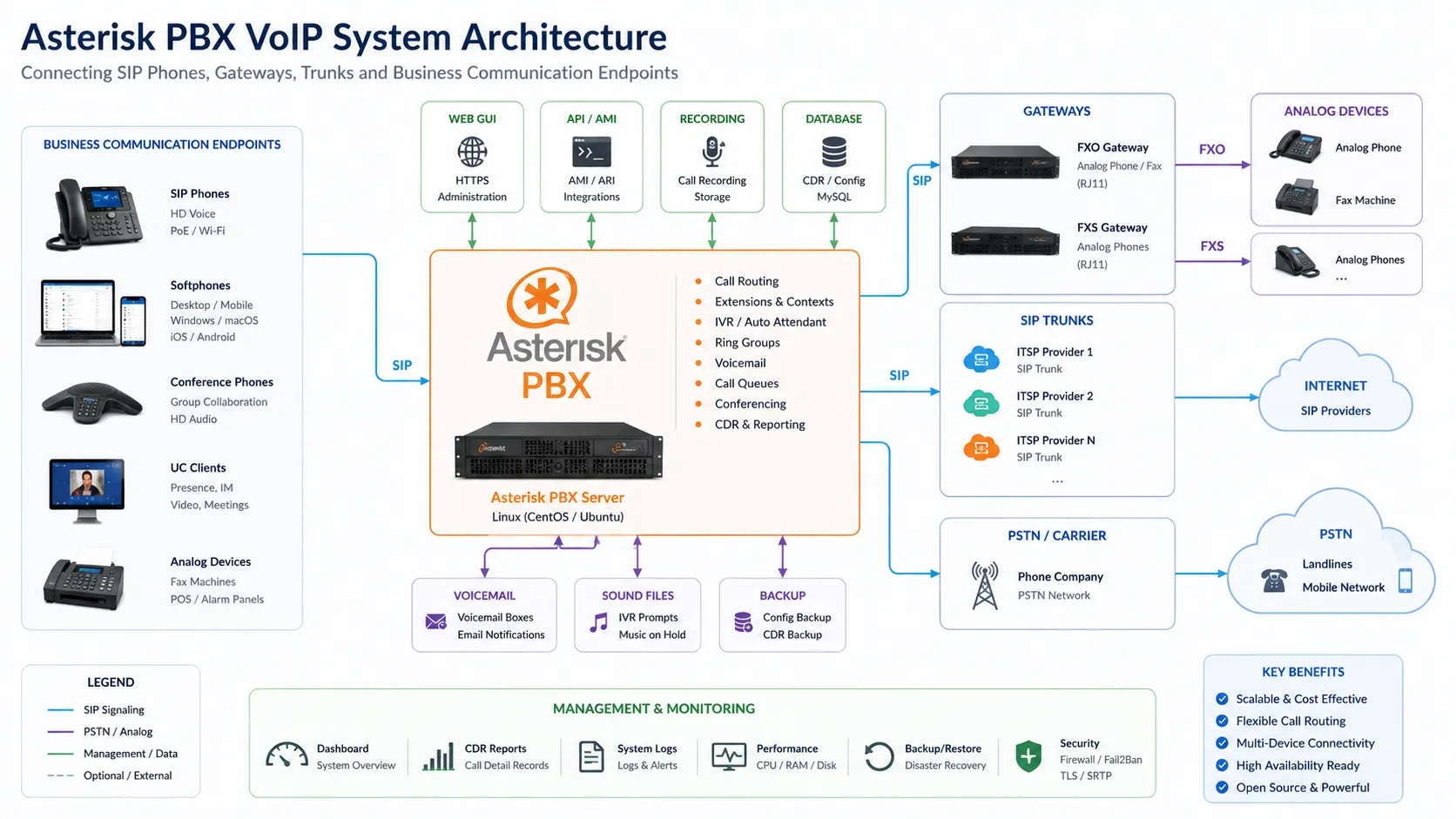
In a typical deployment, Asterisk works as the core call control server. SIP phones register to the server as extensions, SIP trunks connect the company to external telephone networks, and gateways can bridge analog lines, radio systems, paging amplifiers, or legacy telephone equipment. Because of its modular structure, Asterisk can be adapted for small offices, call centers, industrial facilities, campuses, hotels, public service sites, and customized communication projects.
Why Businesses Still Use It
Many organizations choose Asterisk because it gives them control over call routing, extension planning, voicemail, IVR menus, recording, time-based call rules, conferencing, queue management, and integration with third-party systems. Compared with a closed PBX, it allows technical teams to build communication workflows around real business operations.
For example, a company can configure internal extensions for office users, connect branch offices through SIP trunks, add emergency paging for warehouses, integrate SIP intercoms at entrances, and connect analog telephones through gateways. This flexibility is one of the main reasons Asterisk remains widely used in VoIP and IP PBX projects.
Asterisk is best understood as a flexible communication framework. It can act as an IP PBX, but it can also support gateways, IVR services, conferencing, call queues, paging workflows, and customized voice applications.
How the System Works
Call Control and Extension Registration
In an Asterisk-based VoIP system, each SIP phone, softphone, paging terminal, intercom station, or gateway can be assigned an extension. These devices register to Asterisk over the IP network. When one user calls another extension, Asterisk checks the dial plan, identifies the destination, and routes the call according to predefined rules.
This process allows the system administrator to define how calls behave. Internal calls can stay inside the local network. External calls can be sent through SIP trunks or PSTN gateways. Emergency calls can be routed to a control room, security desk, or dispatch console. Different departments can have different call permissions, ring groups, and failover paths.
Dial Plan Logic
The dial plan is one of the most important parts of Asterisk. It defines what happens when a user dials a number. A simple dial plan may only route extension-to-extension calls, while a more advanced plan can handle IVR menus, office-hour rules, call forwarding, emergency numbers, outbound prefixes, recording policies, and multi-branch routing.
For business communication, this is very valuable. A company can design call flows based on departments, working hours, service levels, locations, and security requirements. In an industrial site, for example, a call from an emergency phone may be routed differently from a normal office extension. A call from a warehouse paging microphone may trigger a broadcast zone instead of a normal one-to-one voice call.
Media Transmission over IP
Asterisk usually uses SIP for signaling and RTP for voice media. SIP is responsible for session setup, registration, call control, and call termination, while RTP carries the audio stream between endpoints. Depending on the network design, media may pass through the server or flow directly between endpoints.
Voice quality depends on codec selection, network bandwidth, packet loss, jitter, delay, firewall configuration, and QoS policy. In enterprise and industrial environments, proper VLAN planning, PoE switching, SIP security, and network monitoring can significantly improve system stability.
Main Functions for Business Phone Systems
IP PBX and Extension Management
The most common use of Asterisk is to build an IP PBX. Administrators can create internal extensions, assign users to departments, configure ring groups, manage voicemail, define call permissions, and connect external trunks. This allows businesses to replace traditional PBX hardware with a more flexible software-based telephone system.
In a multi-site company, Asterisk can also help connect different offices through IP networking. Branch extensions can call each other without relying on traditional long-distance telephone lines. With the right routing strategy, the system can reduce communication cost while improving internal collaboration.
SIP Trunk and Gateway Connection
Asterisk can connect to SIP trunk providers for inbound and outbound calling. It can also work with VoIP gateways, FXO gateways, FXS gateways, E1/T1 gateways, GSM gateways, and analog adapters. This allows companies to keep part of their existing telephone infrastructure while gradually migrating to IP-based communication.
Gateway integration is especially useful when a company has legacy analog phones, elevator phones, emergency phones, fax machines, public address systems, or special industrial endpoints that still require traditional interfaces. Asterisk can bridge these devices into a modern VoIP architecture.
IVR, Queues, Recording, and Conferencing
Asterisk supports common business call features such as IVR menus, call queues, voicemail, conference bridges, call recording, music on hold, caller ID handling, and time-based routing. These features are useful for customer service teams, internal help desks, technical support centers, and organizations that need structured call processing.
For example, an IVR menu can guide callers to sales, support, administration, or emergency service. A call queue can distribute incoming calls to available agents. Recording can support quality review, compliance, training, or incident investigation, depending on local regulations and company policy.
Deployment Architecture and Network Design
Small Office Deployment
In a small office, Asterisk may run on a dedicated server, mini PC, virtual machine, or cloud instance. SIP phones connect through the local network, while a SIP trunk provides external calling. The setup can be simple, cost-effective, and easy to expand when more extensions are needed.
This type of deployment is suitable for companies that need basic extension calling, voicemail, call transfer, ring groups, and outbound calling. It can also support remote extensions if VPN, SBC, or secure SIP access is properly configured.
Enterprise and Multi-Site Deployment
Larger organizations often require more complex architecture. Asterisk may connect multiple branches, redundant servers, SIP trunk providers, SBC gateways, call recording platforms, CRM systems, and network monitoring tools. In this situation, high availability, backup routing, security policy, and centralized management become important.
Multi-site deployment can also include different endpoint types. Office users may use desktop IP phones, managers may use softphones, reception areas may use video intercoms, warehouses may use paging terminals, and control rooms may use dispatch consoles. Asterisk can work as the core voice platform or as one component in a larger communication system.
Industrial and Public Facility Deployment
In industrial sites, transport facilities, tunnels, power plants, mines, ports, campuses, and emergency service environments, voice communication often needs to connect with more than office telephones. The system may include rugged SIP phones, weatherproof telephones, explosion-proof call stations, paging gateways, horn speakers, intercom panels, CCTV linkage, and alarm systems.
In these environments, Asterisk can provide SIP call control, while dedicated industrial communication devices handle harsh-site operation. For projects that need a complete VoIP telephone system design, system architecture planning, SIP endpoint selection, and gateway integration, Related Solution Introduction: VoIP Telephone System can be used as a practical reference for building a more complete communication solution.
Common Application Scenarios
Office Telephone System
Asterisk can be used to build a complete office phone system with internal extensions, department ring groups, voicemail, call transfer, conference calling, and SIP trunk connection. This is suitable for small and medium-sized businesses that want more flexibility than traditional PBX hardware.
With proper configuration, the system can support reception routing, manager extensions, remote users, meeting rooms, and customer service numbers. It also allows companies to adjust their call flow when the organization changes.
Call Center and Service Desk
Asterisk can support call queues, agent login, call recording, IVR navigation, queue announcements, and call distribution. These features make it useful for service desks, customer support teams, maintenance hotlines, and internal technical assistance centers.
When integrated with CRM or ticketing systems, call records and customer information can be connected to service workflows. This improves response efficiency and helps teams manage communication history more clearly.
Campus, Hospital, and Facility Communication
In campuses, hospitals, office parks, and public facilities, Asterisk can connect IP phones, nurse station phones, paging devices, emergency intercoms, and security office extensions. Different buildings or departments can be organized into extension groups and paging zones.
This type of system can support daily calling, emergency announcements, service desk communication, access point intercom calls, and internal coordination. When paired with paging gateways or SIP speakers, voice communication can extend from personal calls to public-area announcements.
Industrial Emergency Communication
Industrial communication projects often require reliable voice service in difficult environments. Asterisk can be used together with rugged SIP telephones, emergency call stations, analog gateways, PA systems, and dispatch platforms to support production coordination and emergency response.
Becke Telcom can be lightly introduced in this type of project as a provider of SIP phones, industrial telephones, gateways, and communication terminals that may be connected into VoIP and dispatch environments. The key is to match the endpoint, protection level, network design, and call workflow to the actual site conditions.
Benefits and Limitations
Flexible and Customizable
One major advantage of Asterisk is flexibility. It can be configured for many different call scenarios, from a simple office PBX to a complex multi-site voice system. Developers and system integrators can create custom call flows, connect external applications, and adapt the system to special project needs.
This makes Asterisk attractive for organizations that do not want to be locked into one closed platform. It also gives integrators more freedom when combining SIP phones, gateways, trunks, paging equipment, and business software.
Cost Control and Open Ecosystem
Because Asterisk is open source, companies can reduce dependence on proprietary PBX licenses. The total cost still depends on servers, gateways, phones, trunks, maintenance, integration, and technical support, but the software foundation gives more freedom in deployment and customization.
The open ecosystem also means that many SIP-compatible devices can be used with Asterisk. However, compatibility testing is still important. SIP standards provide the foundation, but real-world projects may require attention to codecs, DTMF mode, NAT traversal, registration behavior, transfer method, and firmware differences.
Technical Skill Requirements
Asterisk is powerful, but it is not always plug-and-play. A stable deployment requires knowledge of SIP, RTP, network routing, firewall behavior, Linux server operation, dial plan design, security hardening, backup strategy, and troubleshooting methods.
For business-critical systems, companies should avoid treating Asterisk as only a free PBX. Proper project design, endpoint testing, documentation, monitoring, and maintenance planning are essential. A poorly configured system can create voice quality problems, security risks, routing errors, or service interruptions.
Asterisk can reduce communication system cost and increase flexibility, but successful deployment depends on careful network design, SIP compatibility testing, security protection, and long-term maintenance.
Security and Maintenance Considerations
Protecting SIP Access
SIP systems are often exposed to risks such as unauthorized registration attempts, brute-force attacks, toll fraud, malformed SIP traffic, and weak password policies. Administrators should use strong authentication, restrict trusted IP ranges, close unused ports, enable firewall rules, and monitor abnormal call activity.
In distributed deployments, SBC gateways, VPNs, TLS, SRTP, and access control policies can help improve protection. Remote extensions should be carefully managed because they may create additional exposure if configured without security planning.
Monitoring and Backup
Asterisk systems should be monitored for server health, disk usage, registration status, trunk availability, call failure rate, voice quality, and abnormal traffic. Regular backups should include configuration files, dial plans, voicemail settings, recordings if required, and documentation of trunk and endpoint settings.
For important facilities, redundancy and failover planning may be necessary. A backup trunk, secondary server, UPS power protection, network redundancy, and emergency call routing plan can help maintain communication during equipment failure or network interruption.
Endpoint Compatibility Testing
Before full deployment, each type of SIP device should be tested with Asterisk. This includes IP phones, SIP intercoms, paging gateways, analog gateways, trunk providers, and dispatch terminals. Testing should cover registration, inbound calls, outbound calls, DTMF, transfer, hold, codec negotiation, NAT behavior, reboot recovery, and emergency call handling.
Compatibility testing is especially important in industrial and emergency communication projects because endpoints may be installed in remote, noisy, dusty, wet, or high-risk areas. Once installed, maintenance access may be more difficult than in an office environment.
How to Decide Whether It Fits Your Project
Good Fit Scenarios
Asterisk is a good fit when a company needs a flexible VoIP platform, customized call routing, SIP trunk connection, multi-branch extension calling, gateway integration, IVR service, or an open IP PBX architecture. It is also suitable for integrators who need to build communication logic around specific project requirements.
It can be especially useful when the telephone system needs to connect with other systems, such as CRM platforms, ticketing systems, paging systems, emergency intercoms, industrial telephones, and dispatch applications.
When a Managed Platform May Be Better
Asterisk may not be the best option for every organization. If a company has no technical team, no system integrator, and no ability to maintain Linux-based VoIP infrastructure, a managed cloud phone system or commercial UC platform may be easier to operate.
The choice depends on control, cost, customization, reliability expectations, support capability, and future expansion plans. Asterisk offers strong flexibility, but that flexibility should be supported by proper engineering and maintenance.
FAQ
Is Asterisk the same as an IP PBX?
Asterisk can be used as an IP PBX, but it is broader than that. It is an open source communication platform that can support PBX functions, gateways, IVR, conferencing, call queues, recording, and customized voice applications.
Does Asterisk support SIP phones?
Yes. SIP phones, softphones, SIP intercoms, SIP gateways, and SIP trunks can be connected to Asterisk when they are properly configured and tested. Compatibility depends on SIP settings, codecs, network design, and device behavior.
Can it connect to traditional telephone lines?
Yes. Asterisk can connect to traditional telephone lines through suitable gateways, such as FXO gateways, FXS gateways, E1/T1 gateways, or other telephony interface devices. This is useful for companies that want to keep legacy lines during VoIP migration.
Is Asterisk suitable for business use?
Yes, it can be suitable for business use when deployed and maintained correctly. It is widely used for office phone systems, call centers, SIP trunking, branch communication, and customized VoIP projects. For critical environments, proper security, redundancy, monitoring, and support are important.
Can Asterisk be used with paging or emergency communication systems?
Yes. Asterisk can work with SIP paging gateways, SIP speakers, intercoms, emergency phones, and dispatch platforms. The actual design depends on the paging zones, priority rules, endpoint compatibility, network stability, and emergency response workflow.
What should be checked before deployment?
Before deployment, check server performance, network quality, SIP trunk settings, endpoint compatibility, NAT traversal, firewall rules, security policy, codec selection, backup plan, and maintenance responsibility. A test environment is strongly recommended before moving to production.







