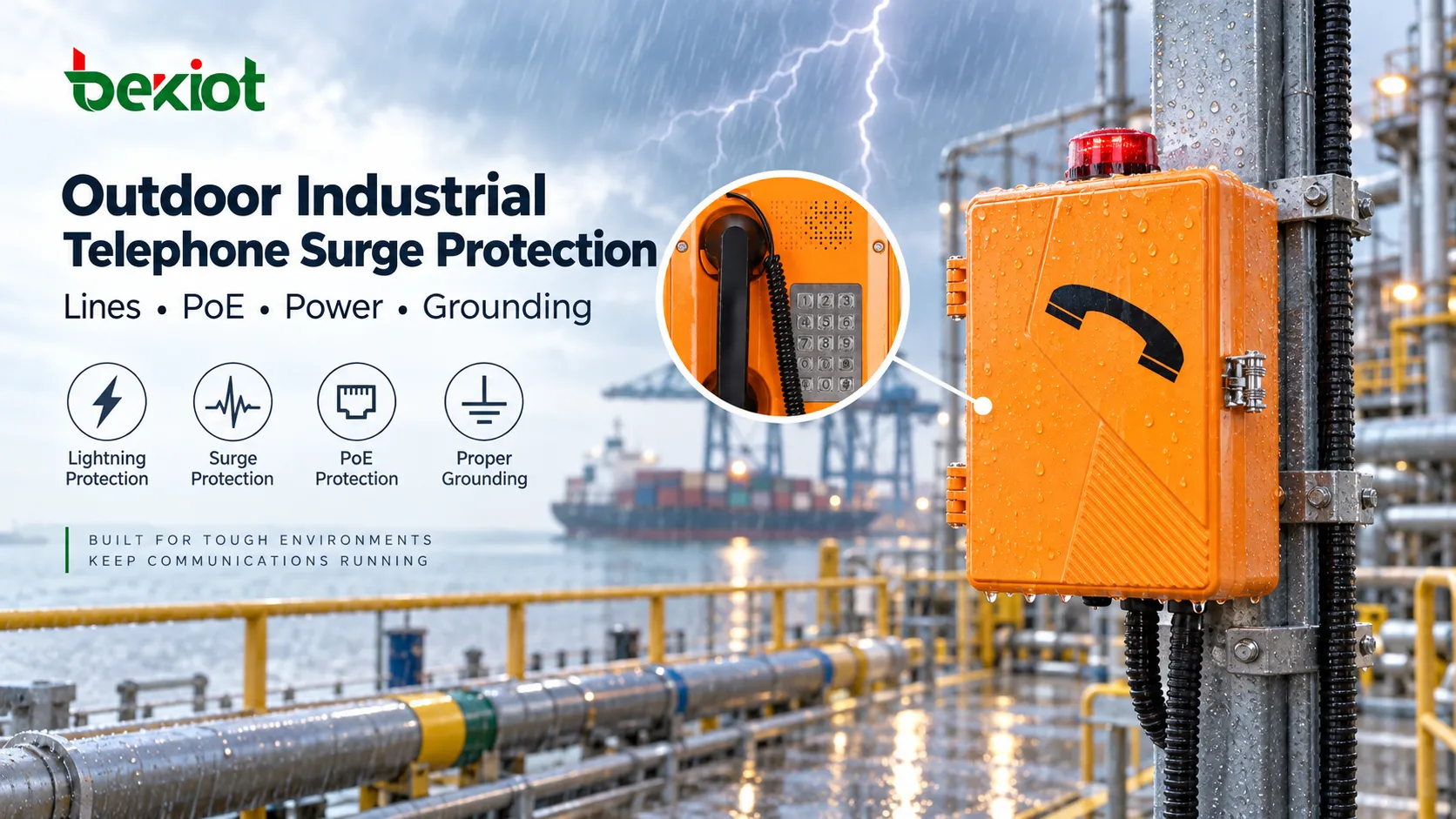
Industrial telephones installed at ports, mining and manufacturing sites, railway corridors, outdoor process areas and other exposed locations operate in some of the harshest environments in an industrial communications system. After thunderstorms, common faults include offline telephones, analog lines that no longer detect off-hook conditions, failed Ethernet ports on SIP terminals, abnormal PoE operation, and in severe cases, multiple devices on the same switch or communication path failing at the same time.
Field maintenance experience shows that many of these failures are not caused by the telephone itself. The more common cause is transient overvoltage entering sensitive electronics through long copper communication lines, PoE cabling, power circuits or grounding paths. Protecting an outdoor industrial telephone therefore requires more than installing a single surge protector. A coordinated design should consider line-entry methods, SPD placement, equipotential bonding and grounding, cable routing, power-system protection, and equipment location as one system.
Why Are Outdoor Industrial Telephones More Exposed to Lightning and Surges?
Industrial telephones are usually designed with higher ingress protection, more robust enclosures and wider operating temperature ranges than ordinary office phones. Some models are also designed for hazardous or dusty environments. These mechanical and environmental protections, however, do not automatically protect communication electronics from electromagnetic induction or transient overvoltage.
The main difference between indoor and outdoor installations is the cabling environment. Indoor telephone runs are typically short and contained within buildings. Outdoor industrial telephones may rely on copper cables extending tens or hundreds of meters across open cable trays, poles, site boundaries, steel structures and exposed plant areas. During lightning activity, these long conductive paths can pick up significant transient voltages.
Most lightning-related failures do not require a direct strike on the telephone. A nearby lightning discharge creates a rapidly changing electromagnetic field that can couple energy into exposed copper cables. At the same time, lightning current entering the ground can create substantial potential differences between different grounding points. Communication and power cables may then become part of the equalization path, exposing low-voltage electronic circuits to damaging current.
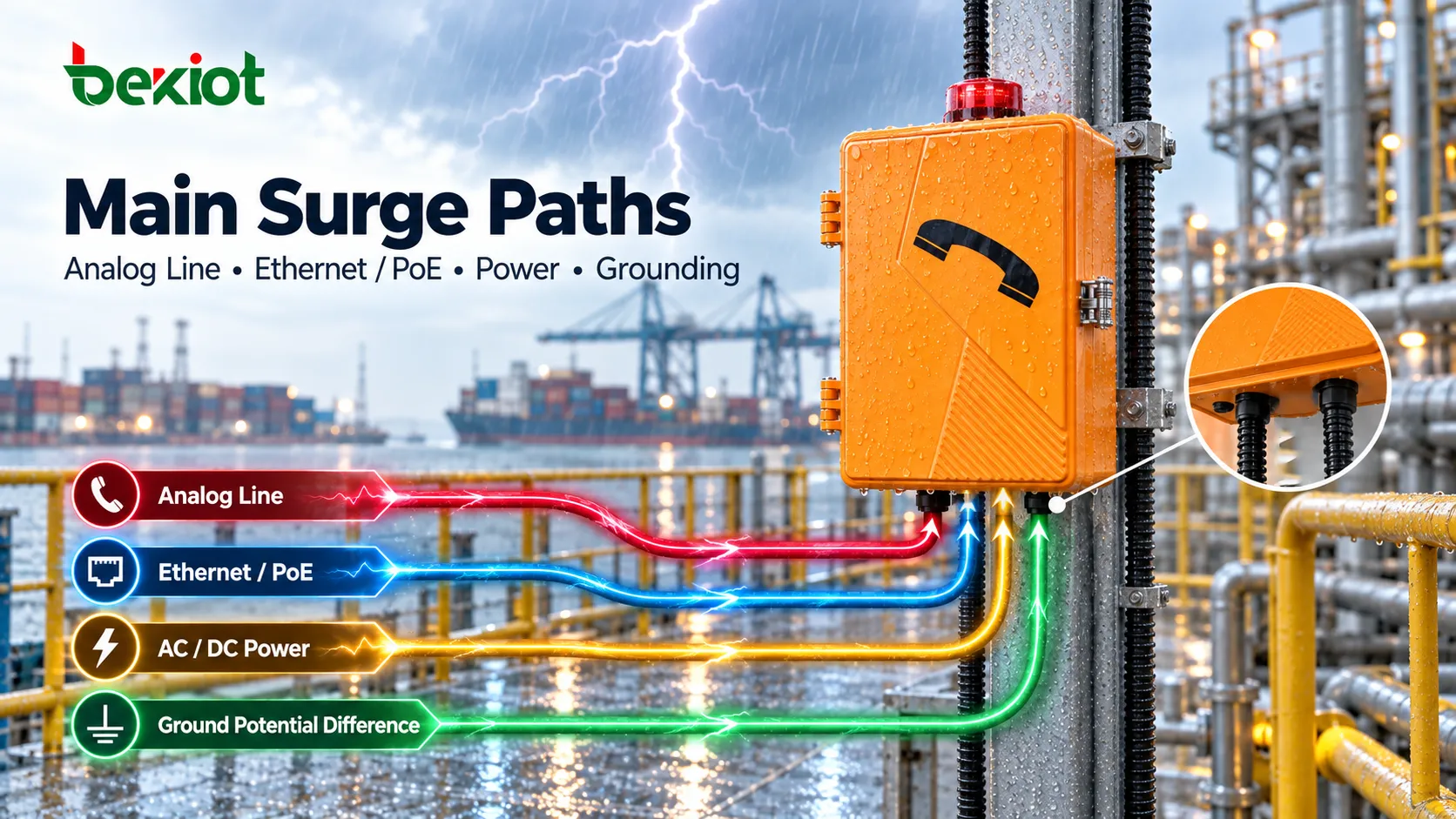
In practice, outdoor industrial telephones may be exposed through six main surge paths:
Traditional analog voice copper lines;
Industrial Ethernet data cabling;
PoE power pairs;
Independent AC or DC power circuits;
External audible/visual alarms, relay interfaces or remote-control wiring;
Potential differences between metal enclosures, cable shields and grounding systems.
Lightning and surge protection must therefore be treated as a complete system. Protecting only one interface while leaving other metallic paths unprotected can still allow surge energy to reach the equipment.
Which Types of Surges Should Be Distinguished First?
In field maintenance, many transient overvoltage failures are simply described as "lightning damage." That description is often too broad to support an effective protection strategy. Industrial communication systems should distinguish several different surge sources because the appropriate protection method can vary considerably.
Direct Lightning Strikes
A direct strike may hit a building, communications mast, cable-support structure, nearby metalwork or exposed line. The energy involved can be extremely high. A small SPD installed beside a single telephone cannot be expected to manage this type of event by itself. Protection needs to work with the site's external lightning-protection system, down conductors, grounding network and lightning protection zones.
Induced Surges
Induced surges are among the most common causes of faults affecting outdoor industrial telephones and can account for more than 80% of equipment failures associated with thunderstorm conditions. Even when lightning occurs some distance from the equipment, the rapidly changing electromagnetic field can induce high-frequency transient voltage in long exposed copper lines.
The longer the cable, the greater its exposed area and the more complex the surrounding metal infrastructure, the greater the potential for significant induced surge energy.
Ground-Potential-Difference Surges
When lightning current is discharged into the ground, different points across a site may momentarily rise to different electrical potentials. An outdoor telephone may be grounded locally while the equipment-room gateway or switch is referenced to another grounding point. The communication or power cable connecting the two locations can then form a current path between the different potentials.
This is one reason why simply giving every device its own separate ground connection does not necessarily eliminate lightning-related failures.
Power-System Switching Surges
Lightning is not the only source of transient overvoltage. Variable-frequency drives, large motors, contactors, high-voltage distribution equipment and switching operations can also create repetitive electrical transients. These surges may be lower in magnitude than a lightning event, but their higher frequency of occurrence can contribute to power-module aging, intermittent communication faults and audible noise over time.
The objective of a coordinated protection system is to control all of these transient events before excessive energy reaches the telephone electronics.
How Should Long Copper Lines for Analog Industrial Telephones Be Protected?
Traditional analog industrial telephones are particularly exposed because the telephone, line power, ringing voltage and voice signals all share a continuous metallic copper path. Long outdoor cable runs provide no inherent galvanic isolation and can carry surge energy directly toward both the field telephone and the FXS port in the equipment room.
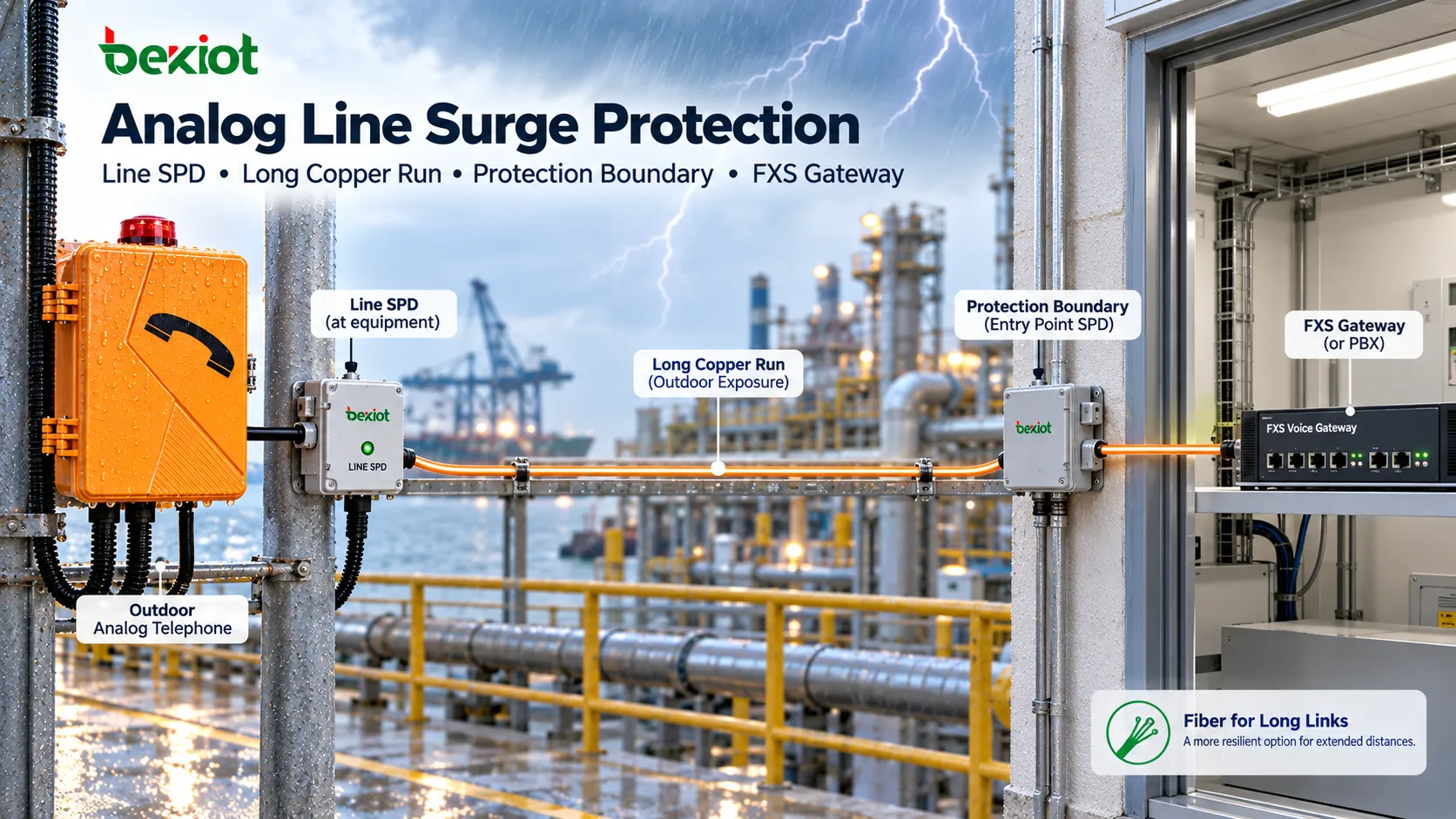
A typical analog industrial telephone path may look like:
Outdoor Analog Industrial Telephone → Field Copper Cable → Outdoor Junction Box → Distribution Frame → FXS Voice Gateway / PBX
Without suitable protection boundaries, transient energy can travel in either direction along this path and damage both the telephone and the central voice equipment.
A common protection approach is to install communication-line SPDs at appropriate cable-entry points, building boundaries and near sensitive equipment. Depending on cable length and the site's lightning protection zone concept, coordinated protection stages may be used to progressively discharge surge energy and limit the residual voltage reaching downstream equipment.
One important engineering rule is that a standard AC power SPD should not be used as a substitute for a surge protector designed for analog telephone lines. Power and voice circuits operate with different voltages, impedances and signal characteristics. An inappropriate SPD can interfere with normal telephone operation and may still fail to provide the required surge limitation.
An SPD used on an analog telephone circuit should not interfere with:
FXS line feed;
Normal ringing voltage;
Off-hook and on-hook detection;
DTMF dialing;
Two-way voice transmission;
Loop characteristics on long cable runs.
Protection at the equipment-room side becomes especially important when one multi-port FXS gateway serves dozens of outdoor telephones. A surge entering through one field circuit may damage more than a single port if sufficient energy reaches the gateway electronics.
For lightning-prone sites, inter-building links or very long exposed cable runs, a more robust long-term approach is to reduce continuous metallic paths wherever practical. Fiber can be used for the long-distance section, with electrical conversion taking place closer to the field equipment. Because optical fiber does not provide a conductive metallic path, it can significantly reduce surge transfer caused by induction and ground-potential differences.
How Should SIP Industrial Telephones and PoE Lines Be Protected?
Replacing an analog telephone with a SIP industrial telephone does not eliminate surge exposure. Ethernet twisted-pair cable is still a metallic conductive path, and a long outdoor run can pick up induced surge energy in much the same way as other copper communication lines.
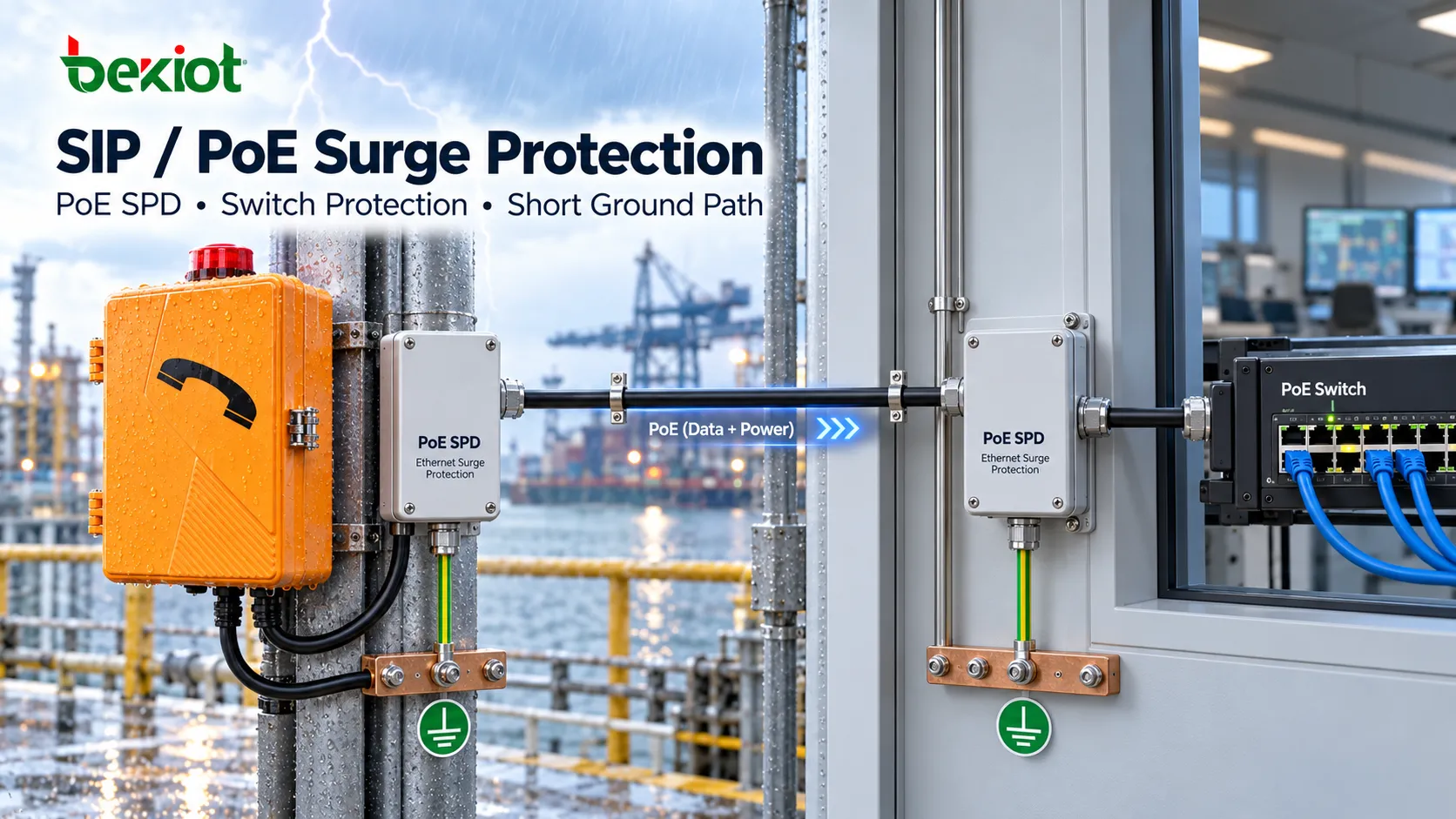
With PoE, the risk becomes more complex because data and power share the same cable. A single surge may damage both the Ethernet interface in the telephone and the PoE port in the upstream switch.
An Ethernet/PoE SPD should meet two fundamental requirements. First, it should not introduce unacceptable insertion loss or degrade the required Ethernet data rate. Second, its electrical characteristics should match the PoE system being used, including the operating voltage and applicable pair configuration.
For example, Fast Ethernet, Gigabit Ethernet and different PoE arrangements may place different requirements on the protection circuit. An RJ45 connector alone does not mean that a surge protector is suitable for every industrial Ethernet or PoE application.
Three locations deserve particular attention.
Protection at the Telephone-Side Cable Entry
Where a long outdoor cable enters an industrial telephone or field cabinet, the entry point represents an important surge boundary. An Ethernet/PoE SPD compatible with the installed network and PoE system can be placed at the appropriate protection point according to the site's lightning-zone design.
Protection at the Equipment-Room or Switch Side
Where an outdoor Ethernet cable enters a control room, communication room or building, protection should also be considered for the internal network. The objective is not only to protect one telephone, but also to prevent a surge from reaching a PoE switch and other devices connected to the same network infrastructure.
The SPD Grounding Path
Selecting the correct SPD is only part of the solution. A long, coiled or unnecessarily bent grounding conductor can significantly reduce surge-diversion performance. In a high-frequency transient event, conductor inductance becomes important.
The SPD should be installed close to the intended protection boundary and connected to the equipotential bonding system through a short, direct and low-impedance path, in accordance with the site's overall electrical and lightning-protection design.
If a SIP industrial telephone uses fiber for the communication path, the optical link provides useful galvanic isolation for data transmission. However, the telephone or local media-conversion equipment still requires power, so the AC, DC or PoE power path must still be assessed separately.
What Else Should Be Protected on Industrial Telephones with Independent AC or DC Power?
Outdoor industrial telephones may be powered by PoE, AC mains, or dedicated 24 VDC or 48 VDC supplies. Protecting only the communication line leaves a clear vulnerability when the terminal uses an independent power circuit.
Industrial power systems are exposed to both lightning-induced surges and switching transients. Power-side surge protection should therefore form part of the site's coordinated electrical protection scheme rather than being treated as an isolated accessory installed only beside the telephone.
For industrial telephones powered from a field cabinet or centralized supply, the design should verify:
Whether appropriate upstream SPDs are installed in the distribution system;
Whether additional protection is required at the field cabinet or equipment level;
Whether the maximum continuous operating voltage of a DC SPD matches the actual DC system;
Whether polarity and grounding arrangement are compatible with the protection device;
Whether SPD failure status can be indicated locally or reported remotely.
In large facilities with significant lightning exposure, coordinated protection stages are important. The upstream protection stage is intended to handle higher-energy events, while protection closer to the equipment further limits the residual transient voltage.
Installing multiple unrelated SPDs without checking their coordination is not necessarily safer. Incorrectly matched protection stages can create undesirable interaction, abnormal impedance or unreliable operation.
Why Can Grounding and Equipotential Bonding Matter More Than Buying a More Expensive SPD?
A surge protective device works by providing transient energy with a controlled low-impedance path. If the grounding and bonding system does not provide an effective path, even a high-performance SPD may not limit the voltage at the protected equipment as expected.
A common problem at outdoor industrial sites is fragmented grounding. Telephone poles, outdoor junction boxes, communication cabinets, SPDs and equipment-room switches may all be grounded independently without a clearly coordinated equipotential system.
During a lightning event, these separate grounding points can rise to different potentials. The resulting voltage difference may then drive current through communication or power cabling, which helps explain why equipment can still fail even though individual surge protectors are installed.
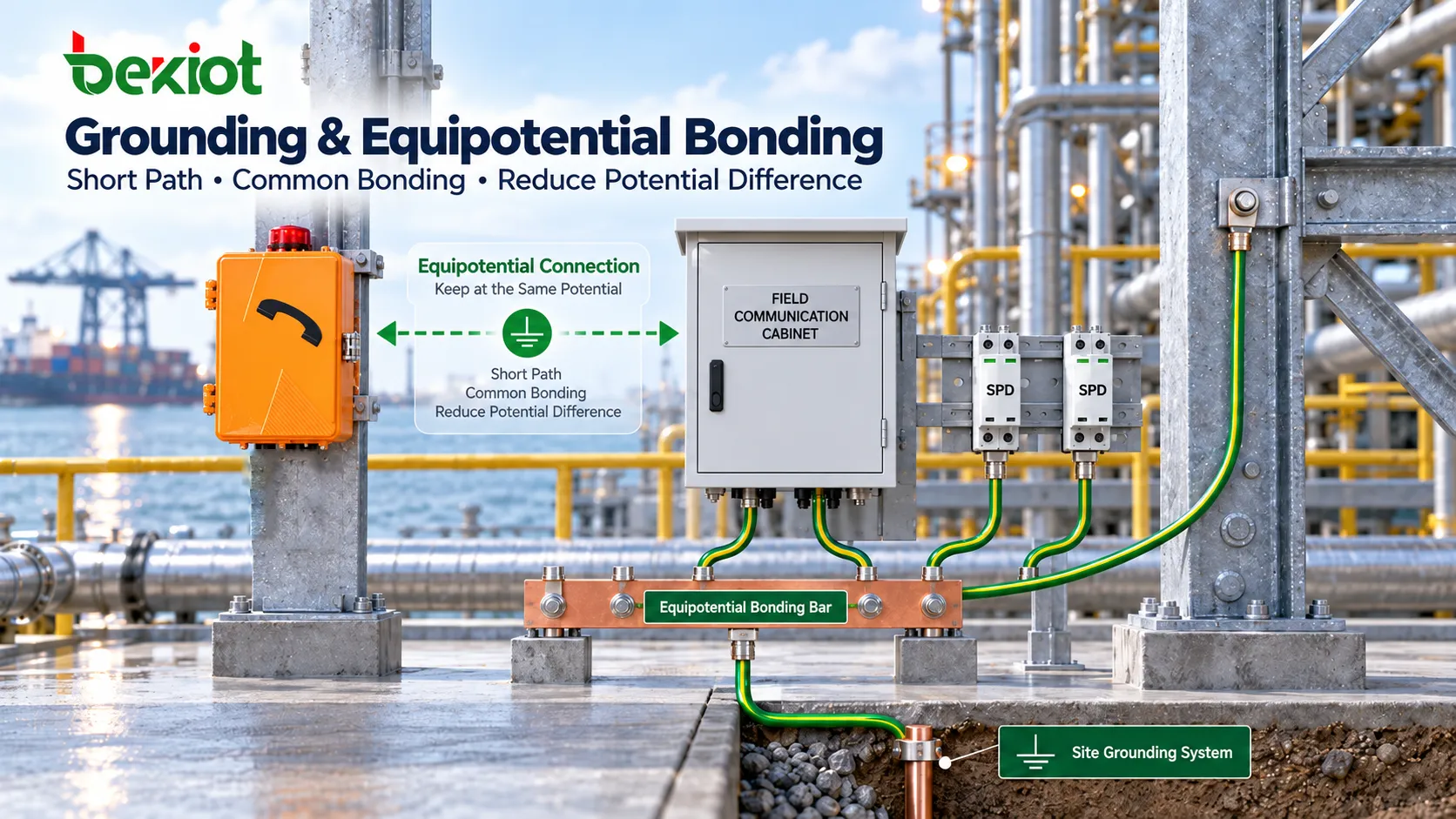
A more effective design incorporates the industrial telephone and its supporting equipment into a common equipotential bonding and grounding system rather than treating each component as an isolated protection problem.
Important considerations include:
Reliably bonding metal telephone enclosures and protective housings to the protective grounding system;
Providing equipotential bonding for outdoor cabinets, junction boxes and metal structures;
Keeping SPD grounding connections to the equipotential bar as short as practical;
Terminating cable shields according to the project's shielding and grounding design;
Coordinating communications grounding with the building lightning-protection grounding system;
Avoiding unnecessary large ground loops that can introduce circulating currents and interference.
Inter-building copper links deserve particular attention because the two buildings may experience different ground potentials during a lightning event. Where practical, replacing the metallic inter-building link with fiber provides a much clearer electrical boundary.
How Does Cable Routing Affect Lightning Risk?
Lightning protection for outdoor industrial telephones is not only an equipment-selection issue. Cable routing and installation practice can materially influence the amount of surge energy coupled into a communications circuit.
Long communication cables installed as isolated overhead runs or routed for long distances along the outside of large steel structures can have greater exposure to electromagnetic coupling. Good routing practice can reduce this risk before any SPD is considered.
Reduce Unnecessary Outdoor Copper Cable Length
Where the site already has a fiber backbone, the IP network can be extended to a nearby protected field cabinet, with only a short copper connection used between that cabinet and the industrial telephone. This is generally preferable to running hundreds of meters of exposed Ethernet copper directly from a central equipment room.
Avoid Long Parallel Runs with High-Power Cables
Communication and power cables should be routed and separated according to the site's electrical and low-voltage installation requirements. Avoiding unnecessarily long parallel runs with high-power circuits helps reduce electromagnetic coupling and interference.
Create a Clear Protection Boundary at Building Entrances
The point where an outdoor copper cable enters a control room or communication building provides a natural protection boundary. SPD placement, cable termination, grounding and cabinet layout should be coordinated at this point.
Do Not Treat a High IP Rating as Surge Protection
An IP66 or IP67 rating describes protection against dust and water ingress. It does not mean that Ethernet, PoE, analog or power interfaces can withstand the surge levels expected on an outdoor line.
Likewise, an explosion-proof enclosure is designed primarily to manage ignition hazards in classified environments. Explosion protection should not be confused with lightning or surge immunity.
What Additional Issues Apply to Explosion-Proof Industrial Telephones?
When an industrial telephone is installed in a hazardous area such as a petrochemical plant, oil and gas facility, coal-chemical site or combustible-dust environment, surge-protection work also has to preserve the explosion-protection design.
A standard plastic SPD enclosure should not simply be added inside a hazardous location, nor should the original cable-entry arrangement be modified without considering its effect on the certified installation.
A common engineering approach is to place PoE switches, voice gateways, surge protective devices and other general-purpose communications equipment in a safe area or in an appropriately certified cabinet, while keeping the explosion-proof telephone itself inside the hazardous area.
Any additional surge-protection work should preserve the original:
Explosion-protected cable entries;
Sealing gland arrangement;
Enclosure integrity;
Grounding connection;
Installation method required by the equipment certification.
Lightning protection for telephones in hazardous areas sits at the intersection of communications engineering, electrical engineering and explosion-protection requirements. Critical installations should therefore be designed around the site's actual hazardous-area classification and lightning protection concept rather than modified informally during installation.
If the Telephone Still Works After a Thunderstorm, Is the Protection System Fine?
Not necessarily. Surge protective devices are exposed to cumulative stress. After repeated surge events, their protective characteristics can deteriorate even though the telephone continues to operate normally.
Lower-energy transient events can also cause partial or latent damage rather than an immediate complete failure. Typical symptoms include:
SIP telephones restarting intermittently;
PoE negotiation becoming unstable;
Ethernet links negotiating at a lower speed;
Reduced ringing performance on analog FXS circuits;
Noise appearing during calls;
Relay or external I/O ports behaving abnormally;
Devices going offline more frequently during or after thunderstorms.
At lightning-prone industrial sites, SPD condition should therefore be included in routine communications maintenance. Inspection can cover SPD status indicators, remote failure contacts, terminal tightness, grounding connections, cable condition, cabinet water ingress and actual telephone call tests.
If one area repeatedly experiences damaged Ethernet or FXS ports, repeatedly replacing the telephone or gateway may not solve the underlying problem. Cable length, SPD placement, grounding practice and ground-potential differences between locations should be reviewed as part of the wider system.
FAQ
Does an Industrial Telephone with an IP66 or IP67 Rating Still Need Surge Protection?
Yes, surge protection should still be evaluated according to the installation environment. IP ratings define enclosure protection against dust, water and foreign-object ingress. They do not provide protection against lightning-induced transients, ground-potential differences or power-system switching surges reaching the communication and power interfaces.
If a SIP Industrial Telephone Uses PoE, Is Protecting the Switch Enough?
No. The outdoor Ethernet cable can carry surge energy toward both the telephone and the switch. Depending on cable length and the site's lightning-protection zones, protection may be required at the field-side cable entry, the building entrance and the equipment-room side so that both ends of the circuit are considered.
Can Analog Telephone Lines and Ethernet Use the Same SPD?
They should not normally be treated as interchangeable applications. Analog voice, Ethernet/PoE and power circuits operate with different voltages, frequencies, impedances and signaling characteristics. Protection devices should be selected specifically for the type of circuit being protected.
Does Using Fiber Mean an Industrial Telephone No Longer Needs Lightning Protection?
Fiber removes the continuous metallic data path and is highly effective at reducing surge transfer caused by electromagnetic induction and ground-potential differences. However, the telephone, media converter, switch or field cabinet still requires power. Power-side surge protection and grounding therefore remain necessary.
Is a Thicker SPD Grounding Conductor Always Better?
Conductor cross-section is important, but it is not the only factor. During a fast transient, connection length, routing, bends and inductance can be equally important. The SPD-to-equipotential connection should generally be kept short and direct while using the conductor size specified by the equipment manufacturer and the project's lightning-protection design.
Should an SPD Be Inspected Even If the Industrial Telephone Was Not Damaged After a Thunderstorm?
For critical communication points and lightning-prone areas, periodic inspection is advisable. An SPD can deteriorate without immediately causing the telephone to fail. Checking the SPD status, grounding path, wiring condition and actual communication functions can identify problems before the next surge event.
Reliable outdoor industrial telephone operation depends not only on the terminal itself, but also on field cabling, network architecture, power distribution, surge protection and grounding design. Becke Telecom provides industrial telephones, explosion-proof telephones, SIP voice access products and related industrial communication solutions, with equipment selection and system support for different site environments.