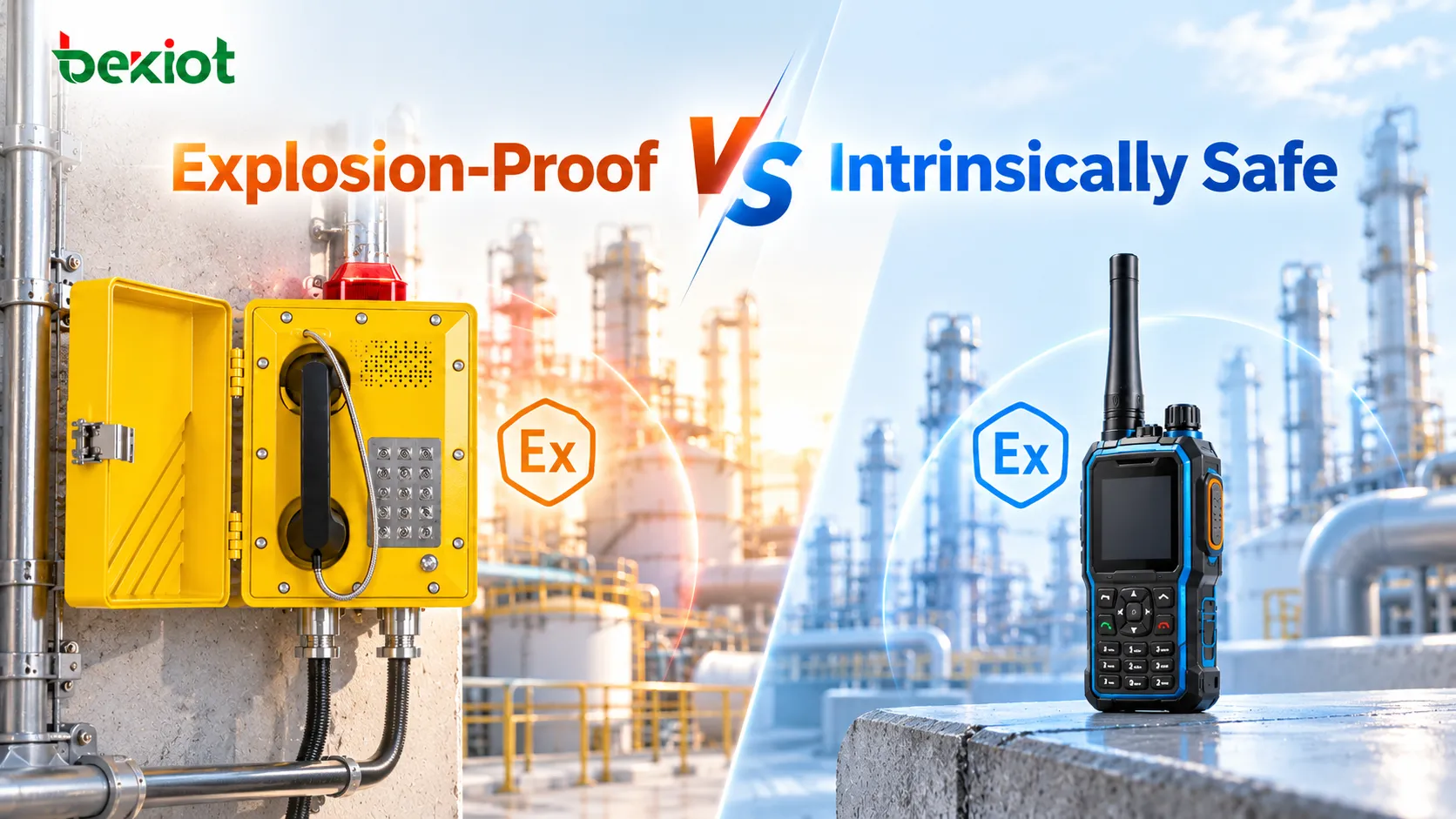
Calling an IECEx device “explosion‑proof” isn’t wrong, but it misses what the certificate actually proves. IECEx is an international conformity framework that confirms equipment won’t become an ignition source in a flammable atmosphere — not because of a heavy enclosure alone, but through a range of protection concepts: flameproof housings that contain an explosion, intrinsically safe circuits that never spark, pressurized rooms that keep gas out, and more. If you’ve ever stared at a marking like Ex db IIC T4 Gb and wondered which piece of it keeps people alive, this is for you.
For anyone specifying gear in oil and gas, chemical processing, grain handling, or dusty factories, IECEx is the common language that turns a pile of national rules into a single, testable promise. But the promise only holds when the full marking is read, the zone matches, the temperature limit is respected, and the installation details haven’t been overlooked. Let’s walk through what the system actually does — and where the real traps sit.
Why
The reason IECEx still dominates procurement conversations is straightforward: when a single ignition source can shut down a platform or empty a plant, you don’t gamble on a sales brochure. IECEx gives project teams a structured way to trust a device — design review against IEC 60079 standards, production quality audits, and a certificate that can be traced back to an accredited test lab. It’s not a “one‑and‑done” label; it’s a living reference that installers, inspectors, and maintenance crews all lean on.
In global projects where equipment crosses borders and supply chains mix manufacturers, that common language prevents the kind of mismatches that surface only during a turnaround or, worse, after an incident. It also covers more than hardware: the IECEx scheme includes service facilities and personnel competence, which means the repair shop’s skill is evaluated as seriously as the enclosure itself.
Basics
At its core, IECEx is a conformity assessment system built around the IEC 60079 family. It doesn’t dictate a single protection method; it provides a rulebook for flameproof (Ex d), intrinsic safety (Ex i), increased safety (Ex e), pressurization (Ex p), encapsulation (Ex m), dust protection by enclosure (Ex t), and several others. Each protection concept tackles ignition risk differently, and the certificate tells you exactly which one was used — and under which assumptions.
That’s why the phrase “explosion‑proof certification” can mislead. A device certified for dust protection via Ex t isn’t “explosion‑proof” in the flameproof sense; it’s a completely different strategy. The real value of IECEx is that it forces the manufacturer to declare the protection philosophy in a standardized, auditable way, so the engineer on the receiving end knows what they’re really depending on.
Certify
Getting an IECEx certificate isn’t a paperwork exercise. The process pulls together a technical assessment, type testing against the relevant IEC 60079 standards, a factory audit of production quality, and ongoing surveillance. Two documents become key: the Ex Test Report (ExTR), which captures the lab data, and the Certificate of Conformity (CoC), which publicly lists the approved model, the manufacturer, the exact marking string, and any conditions of use.
When a contractor asks for the “IECEx cert,” they’re really asking for the CoC — and specifically for the model variant that will show up on site. The system also links to installation and inspection standards like IEC 60079‑14 (design and erection) and IEC 60079‑17 (inspection and maintenance), because a certified device installed with the wrong cable gland or an unapproved stopping plug can lose its protection integrity before it ever powers on.
Marks
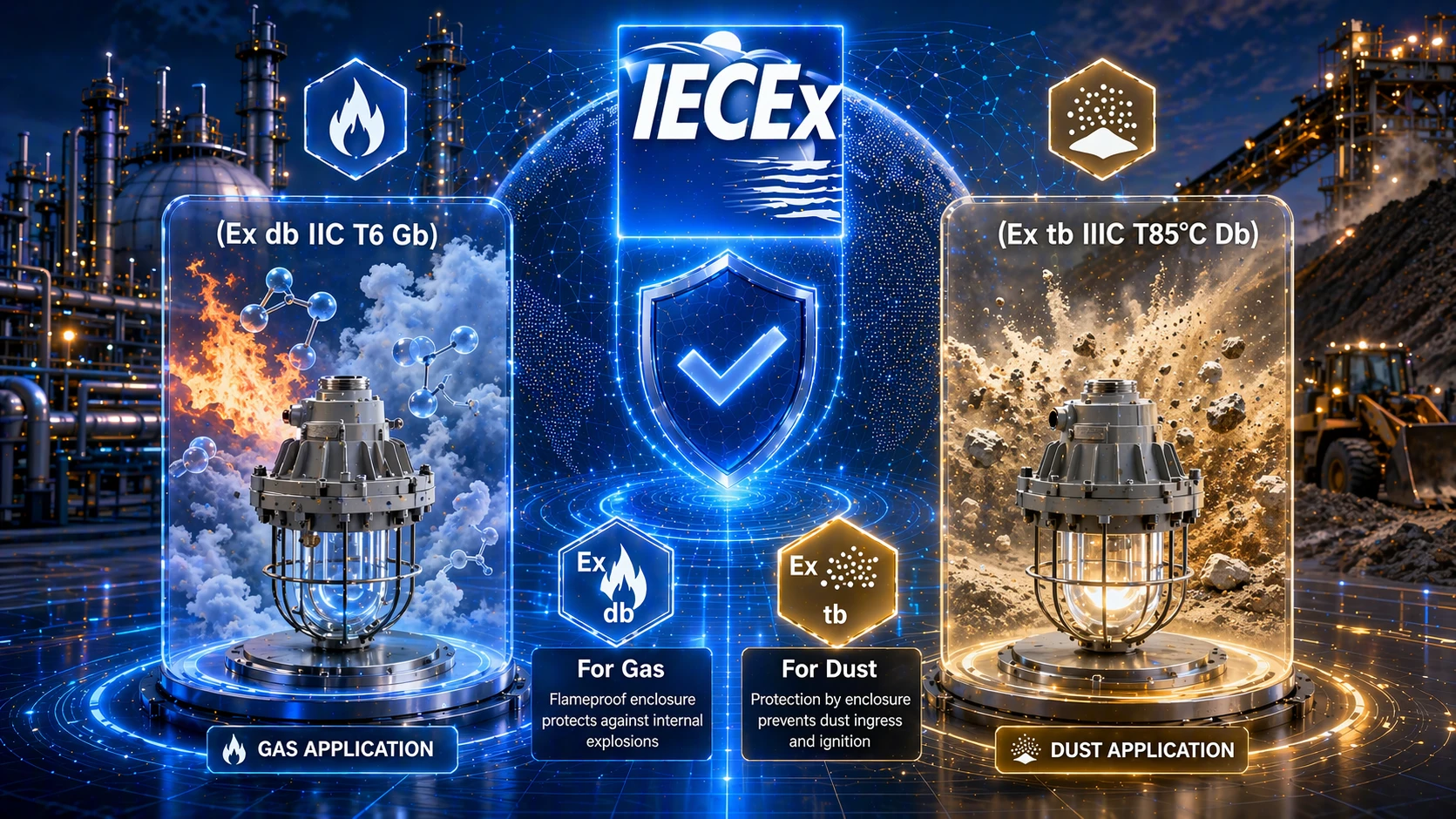
The marking string is the sharp end of the certification. A label like Ex db IIC T6 Gb unpacks as follows: Ex confirms explosive atmosphere protection; db is a flameproof enclosure with a higher protection level; IIC groups the gas by ignition energy (IIC is the most demanding, covering hydrogen and acetylene); T6 caps the surface temperature at 85 °C; and Gb is the Equipment Protection Level suited for Zone 1, where a hazard is likely in normal operation.
For dust, you might see Ex tb IIIC T85°C Db. The group IIIC means conductive dust, and the explicit surface temperature limit replaces the T‑class system. Getting comfortable with these strings isn’t academic — it’s the only way to confirm that the device on the pallet matches the zone drawing on the wall.
Temp
Ignition doesn’t need a spark; a hot surface can do the job just as effectively. That’s why the temperature class (T1–T6) or the stated maximum surface temperature is one of the most overlooked safety gates. A unit with a T3 rating (200 °C maximum) might be perfectly fine in a propane environment but completely wrong where ethylene or hydrogen is present, even if the enclosure is certified flameproof.
In dust applications, the problem shifts to layers and clouds: a surface that’s safe in clean air can become a hazard when a thick layer of grain dust insulates it and raises the effective temperature. The rating has to account for both the ambient conditions and the surrounding material’s ignition characteristics — not just the number stamped on the housing.
ATEX
People often treat IECEx and ATEX as interchangeable, but they’re built on different legal rails. ATEX is a European directive that governs the entire hazardous‑area lifecycle, from equipment design to workplace safety. IECEx is an international certification system that focuses on equipment, services, and personnel competence. Many products carry both marks, which is convenient — but a piece of equipment that sails through IECEx may still need a separate ATEX conformity path to be placed on the EU market.
For export projects, the safer habit is to ask which framework the local authority or end‑user contract requires, and not assume one automatically satisfies the other. Dual certification closes gaps, but it doesn’t erase the difference in documentation and legal responsibility.
Pick
Selection has to start with the hazardous area classification drawing, not with a catalogue page. You need to know whether the hazard is gas, vapour, mist, or dust; which zone it occupies; the substance group; and the ignition temperature or dust layer condition. Only then does the equipment marking become a matching exercise.
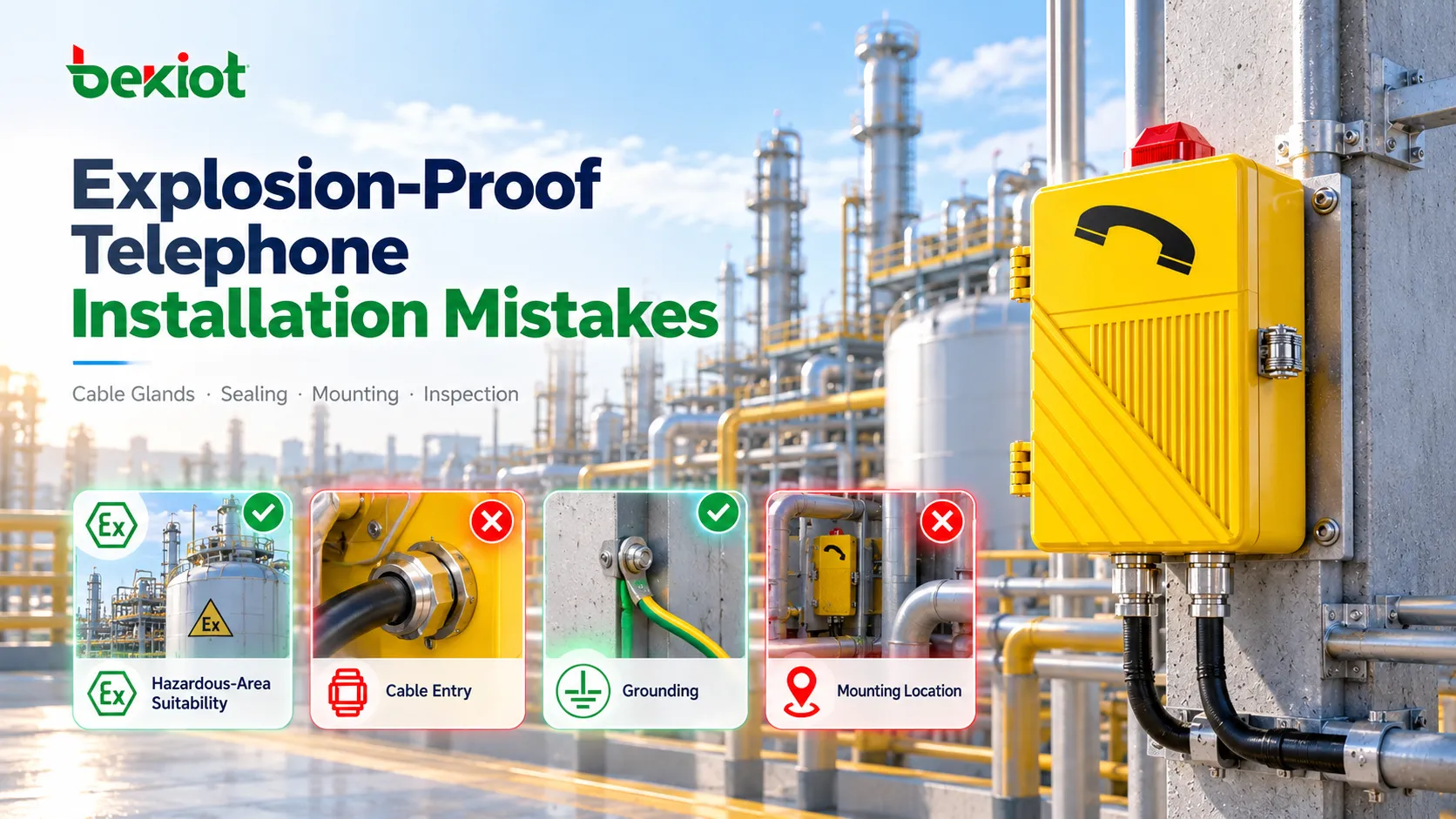
The most common field problem isn’t a missing certificate; it’s a certified device paired with the wrong gland, an incompatible barrier, or a missing stopping plug. Even an Ex db motor can turn into a liability if the cable entry isn’t sealed to the same flamepath requirements. That’s why selection has to cover the complete assembly — the main device, its wiring accessories, its mounting, and its environmental seals — not just the box with the label.

Life
Certification doesn’t freeze on the day of commissioning. Corrosion, vibration, loose bolts, hardened seals, dust accumulation, and unauthorized tweaks can all eat away at the protection over time. This is where IECEx’s service facility and personnel schemes earn their place: a repair performed without understanding the original flamepath geometry or the intrinsic‑safety barrier limits can render the equipment non‑compliant, even if it still “works.”
Smart operators treat the certificate as a living file, keeping installation drawings, inspection reports, repair logs, and gland‑tightening schedules under the same document control as the original CoC. Long‑life assets need a refresh plan for seals, sight glasses, and protective coatings — not because the standard suddenly changed, but because real‑world conditions are tougher than the test lab.
FAQ
What does an “X” at the end of an IECEx certificate number mean?
The “X” indicates that the certificate carries one or more specific conditions of use that must be followed for the equipment to remain safe — for example, a restricted ambient temperature range or a mandatory mounting orientation. Always read the certificate schedule that explains that “X” before you install.
Can I mix ATEX‑ and IECEx‑certified components in the same installation?
Technically possible, but you need to verify that the interconnection complies with the relevant installation standard (IEC 60079‑14 or the local equivalent) and that each device’s protection concept remains valid when linked. The overall system, not just individual parts, must meet the zone requirements.
Why do some IECEx labels show two temperature classes?
You’re probably looking at equipment rated for both gas and dust. Gas atmospheres use T‑classes, while dust environments usually show a maximum surface temperature. The marking lists both because the same housing was evaluated against two different hazard profiles — read the string that matches your zone.