When an explosion-proof telephone moves from a factory prototype to an overseas project site, engineers first look at enclosure design, cable entries, temperature class, and ingress protection. Certification bodies focus more closely on test reports, drawings, materials, and manufacturing consistency. Procurement teams want to know whether the certificates will be accepted in the destination market. Once the equipment reaches the hazardous area, however, the site safety team has a more practical concern: will the telephone remain safe and reliable after installation? These stakeholders approach the same product from different angles, but they eventually arrive at the same question: are international explosion-proof telephone standards a common safety baseline, or have they become a technical barrier to global trade?
The answer is rarely at either extreme. In petrochemical plants, oil and gas facilities, mines, pharmaceutical production, fuel storage and transfer sites, offshore platforms, and combustible-dust environments, explosion-protection standards establish an essential safety framework. But when different markets require different certification routes, documentation packages, testing procedures, and local approvals, the same standards can also become a significant cost of entering international projects. As fixed communication devices installed directly in hazardous areas, explosion-proof telephones sit exactly at the intersection of safety compliance and market access.
The Debate Begins at the International Project Site
An explosion-proof telephone is an industrial communication device designed for hazardous or potentially explosive atmospheres. Its basic function appears straightforward: a field operator lifts the handset, presses a button, and contacts the control room or dispatch center. Once that terminal is installed in an area containing flammable gas, hydrocarbon vapor, combustible dust, solvents, or hazardous process materials, however, the evaluation criteria used for an ordinary telephone are no longer sufficient.
In domestic projects, buyers are usually familiar with local regulations, certification documents, and acceptance procedures. International projects are different. The same telephone may face completely different market requirements. A European installation may specify ATEX compliance, a multinational EPC project may request IECEx certification, while a North American project may be based on Class/Division or Zone hazardous-location classifications.
These systems are related, but they are not automatically interchangeable.
This is where explosion-protection standards take on two different roles. From a safety perspective, they define requirements for equipment design, manufacturing, testing, marking, and documentation, reducing the risk of products that look rugged but have not been properly evaluated for hazardous environments.
From a trade perspective, the same standards can introduce repeated certification, additional testing, local representatives, certificate conversion, longer approval cycles, and higher project costs. The real issue is therefore not whether explosion-protection standards are necessary, but how they are applied.
A well-coordinated certification system helps buyers eliminate unsafe products. A fragmented approval environment, on the other hand, may force equipment that has already undergone rigorous testing to repeat expensive evaluation before it can enter another market.
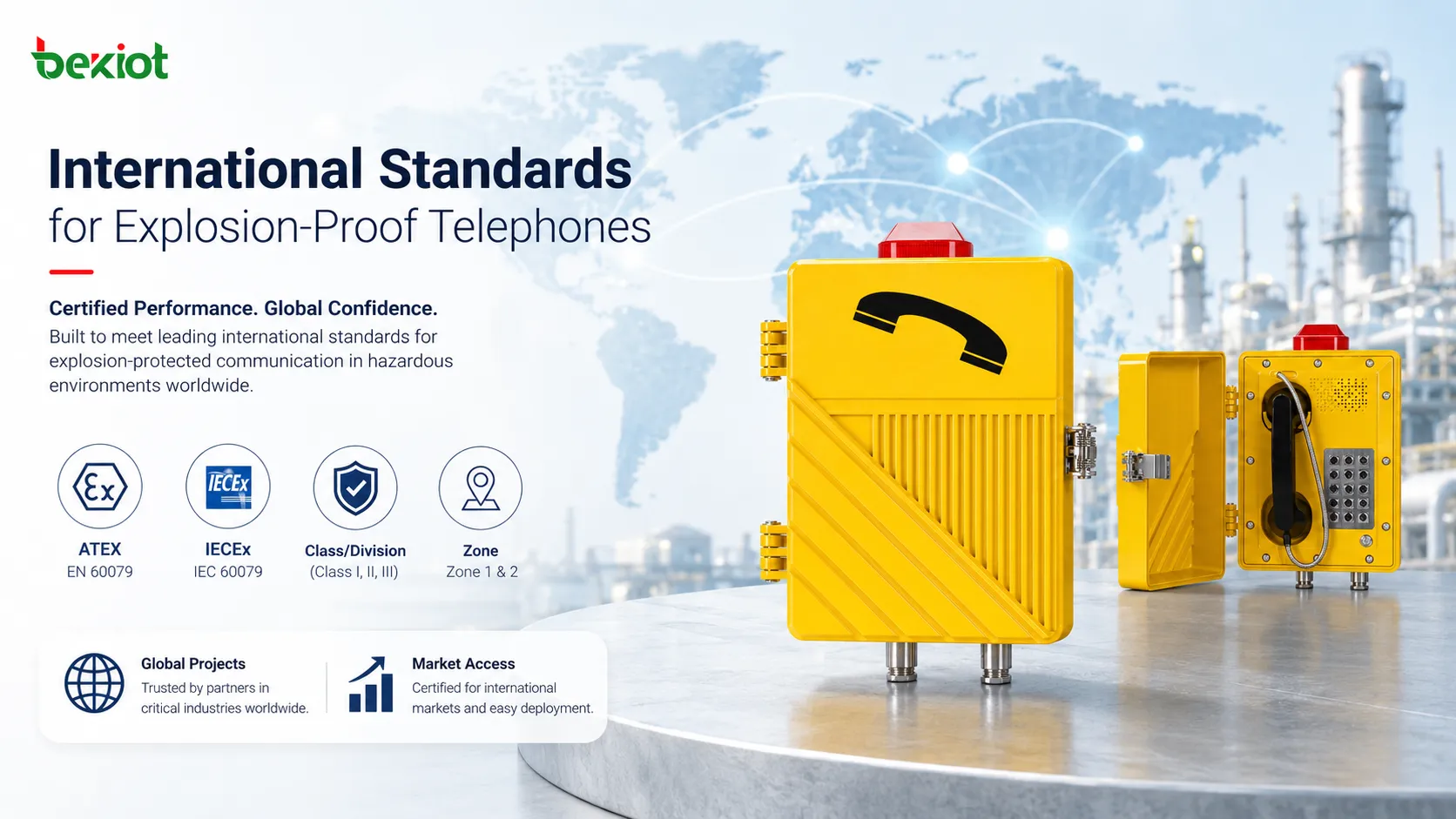
Major Certification Systems Serve Different Regulatory Purposes
IECEx is one of the most widely recognized international certification systems for equipment used in explosive atmospheres. Its equipment certification scheme is designed for electrical and mechanical equipment used in hazardous areas and relies on certificates, test reports, and quality assessments to demonstrate conformity with applicable requirements.
For multinational engineering projects, one of the key strengths of IECEx is that it provides a technical language that can be understood by engineering teams working across different countries and regulatory environments.
ATEX, by contrast, is a critical compliance framework for the European Union. Directive 2014/34/EU covers equipment and protective systems intended for use in potentially explosive atmospheres and establishes common requirements for placing relevant products on the EU market and putting them into service.
For manufacturers exporting explosion-proof telephones to Europe, ATEX is therefore more than a technical design standard. It is part of the market-entry process and may involve CE marking, conformity assessment, technical documentation, and manufacturer responsibility.
North American hazardous-location practices use a different regulatory language. In the United States, hazardous locations may be classified using the traditional Class/Division approach, while Zone-based classifications are also permitted under applicable conditions. Equipment, wiring methods, and installation practices must be suitable for the classified location and comply with the applicable local regulatory and certification framework.
These systems should not be treated as competing definitions of “better” or “worse.” They developed under different legal systems, industrial histories, and regulatory approaches.
IECEx places strong emphasis on international certification coordination. ATEX is closely tied to EU market compliance. North American hazardous-location requirements are integrated with local electrical codes, occupational safety rules, and nationally recognized certification practices.
For an explosion-proof telephone manufacturer, the first step in entering a new market is therefore not choosing a certificate by name, but understanding which regulatory language the actual project uses.
How Explosion-Proof Standards Establish a Safety Baseline
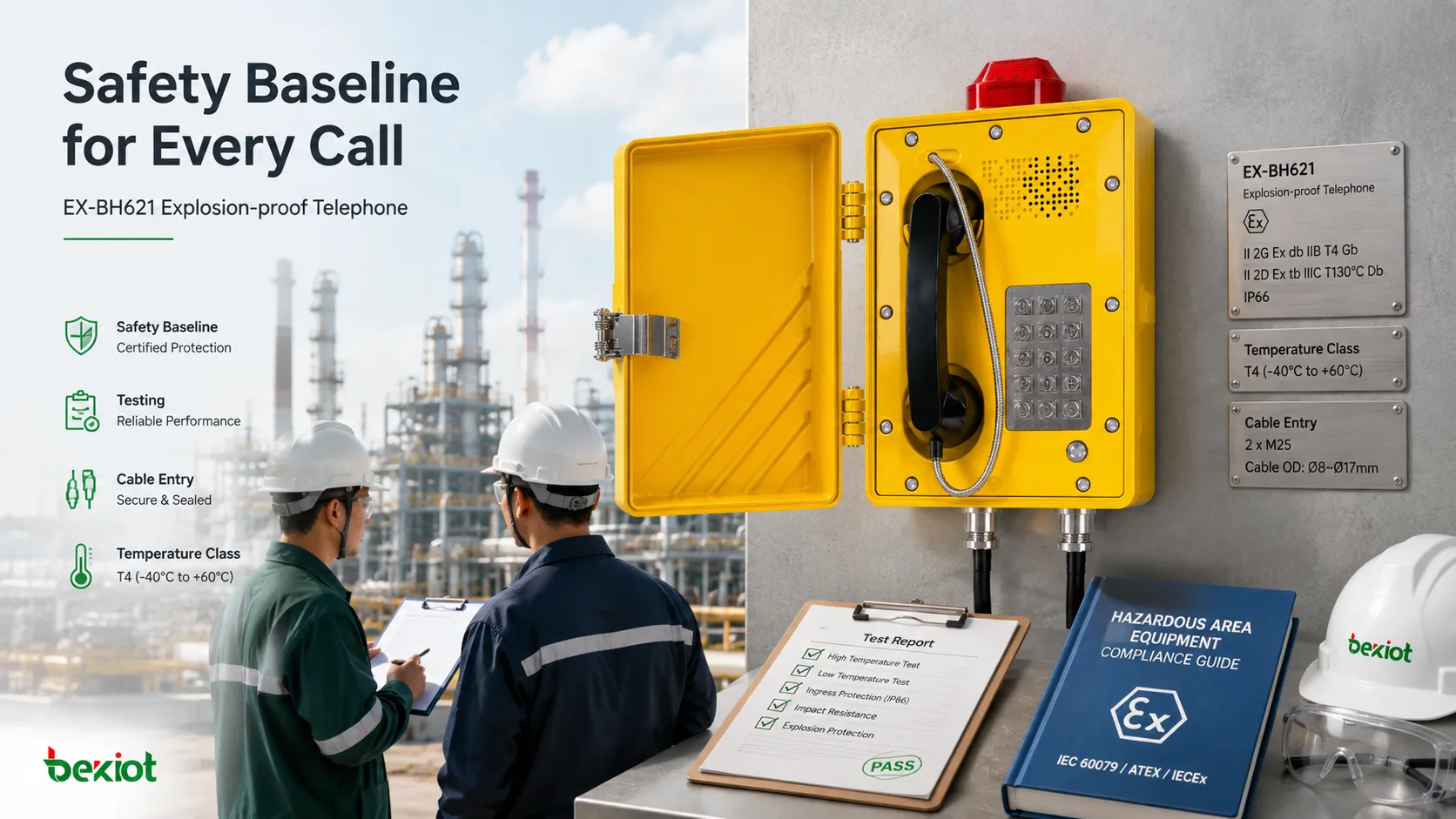
The primary role of explosion-protection standards is to create a verifiable safety baseline. Hazardous-area equipment cannot be accepted simply because it appears heavy-duty or because the manufacturer claims it is suitable for explosive environments.
Standards break the safety problem into specific technical requirements, including equipment category, hazardous-area classification, protection concept, temperature class, gas or dust group, enclosure construction, electrical clearances, grounding, sealing, cable entries, material stability, marking, and installation documentation.
For explosion-proof telephones, these requirements affect many seemingly small design details.
The enclosure must satisfy both environmental and explosion-protection requirements. Cable entries cannot become weak points in the protection concept. Keypads, handsets, hook switches, speaker openings, warning beacons, and internal circuitry all need to remain consistent with the certified protection method.
Surface temperatures must remain below permitted limits under specified normal and abnormal operating conditions. Installation instructions must also clearly explain how the certified protection concept is to be maintained after the equipment is installed.
Standards also establish responsibility boundaries.
The manufacturer is responsible for designing and producing the device according to the certified construction and for providing the required documentation. The certification body is responsible for testing and assessment. The purchaser must verify that the selected equipment matches the hazardous-area classification. The installer must follow the approved installation instructions, while the facility owner remains responsible for inspection and maintenance during operation.
Without this structure, responsibilities can become blurred and difficult to trace after an incident.
In hazardous-area communication projects, an explosion-proof telephone rarely operates as an isolated device. It may connect to a dispatch platform, SIP server, analog PBX, public address system, voice recording platform, or alarm integration system.
Explosion-protection certification does not normally validate every function of the wider communication system. Instead, it provides the safety foundation that must be satisfied before those integration capabilities are considered. The field terminal must first be suitable for the classified area; only then does it make sense to evaluate communication protocols, dispatch functions, or system integration.
How Certification Becomes a Market-Entry Barrier
A common technical language can reduce safety risk, but it can also make market entry more difficult. Trade barriers are rarely created by one individual requirement. They usually result from several compliance steps being added together.
Key questions include whether the destination market recognizes an existing certificate, whether local testing is required, whether a domestic certification body must participate, whether a manufacturer declaration is accepted, whether documents need local-language translation, whether factory audits are required, and whether the market specifies its own marking or nameplate rules.
For explosion-proof telephone manufacturers, the most immediate consequences are additional cost and longer product lead times.
A single model intended for multiple regions may require several technical documentation packages, multiple rounds of sample testing, different nameplate versions, multilingual installation manuals, and different combinations of certification documents.
Small-volume projects face an additional commercial problem: certification costs can exceed the profit available from the project itself.
Certification also affects purchasing decisions. A product may be technically suitable for a site but excluded from the tender because it lacks the exact certification requested in the project specification. Another product may be more expensive but carry broader certification coverage and therefore present less delivery and approval risk.
In that sense, certification documents gradually become a form of market-entry ticket.
This does not automatically make the system unfair. Hazardous-area equipment requires strict control, and market access cannot be determined only by price and delivery time.
The problem begins when effective recognition between certification systems is limited, or when project specifications mechanically require one certificate name without considering technically equivalent compliance evidence. Under those conditions, a safety mechanism can begin to restrict competition unnecessarily.
What Certification Bodies Examine on an Explosion-Proof Telephone
The certification focus for an explosion-proof telephone is very different from that of an ordinary electronic telephone.
A conventional telephone may be evaluated for electrical safety, communication performance, EMC, materials, and product life. An explosion-proof telephone must additionally demonstrate that its use in the designated hazardous area will not create an unacceptable ignition risk.
The enclosure, internal circuits, terminal chamber, cable entries, handset assembly, and user interface may all fall within the certification assessment.
Telephone terminals also have a particular characteristic: they are frequently handled by users.
Operators lift and replace the handset, press keys, pull on handset cords, open protective doors, and work near the speaker area. Certification therefore cannot consider only the equipment in a static condition. Long-term mechanical operation must not compromise the protection concept.
Hinges, latches, seals, screws, terminal blocks, and external accessories should not be replaced casually with parts outside the approved design.
Explosion-proof telephones are also commonly installed outdoors or in partially exposed locations. As a result, projects often evaluate environmental protection alongside explosion protection, including IP rating, corrosion resistance, impact resistance, UV stability, temperature range, dust protection, and maintenance accessibility.
Strictly speaking, these performance requirements are not identical to explosion-protection certification, but in real project acceptance they are often reviewed together.
Communication functionality can also affect the certification boundary.
Analog telephones, SIP telephones, explosion-proof telephones with visual or audible alarms, paging-capable telephones, and terminals integrated with PA or alarm systems may use different internal circuits and interfaces. When a product is upgraded, the manufacturer needs to determine whether the modification remains within the certified construction.
A certified model cannot simply be converted into another electrical design through an uncontrolled product modification.
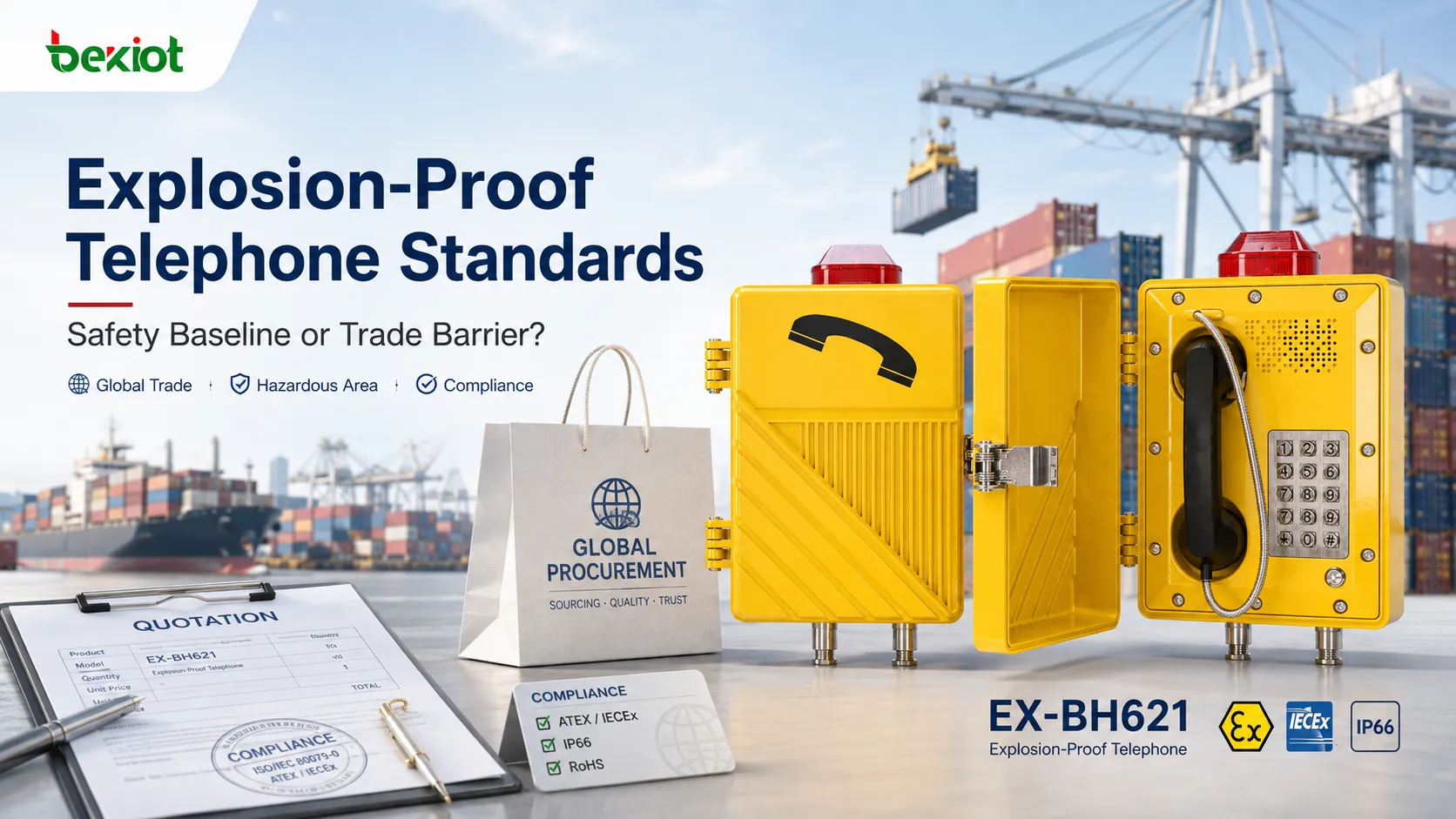
Becke Telcom's EX-BH621 explosion-proof telephone can be considered a representative product type for fixed hazardous-area voice communication projects. When selecting this type of equipment for an international project, engineers should verify certification scope, exact model consistency, installation method, communication interface, environmental protection, and local market-entry requirements rather than relying only on product appearance or a single specification.
Buyers Need to Read the Certificate, Not Just Ask Whether One Exists
Many projects use “explosion-proof certificate available” as an initial purchasing filter. A certificate, however, is not a simple pass-or-fail label. It must be reviewed in detail.
Does the certificate cover the exact model being offered? Is the protection concept appropriate for the classified area? Do the equipment group, category, temperature class, gas or dust group, and environmental limits match the site requirements? Is the certificate still valid? Does the listed manufacturing location correspond to the actual product and quality system?
These questions should be part of the technical review.
Certification must also be matched to the site hazardous-area classification. “Hazardous area” is not a single universal category. Gas type, dust type, frequency of exposure, temperature conditions, and environmental conditions may vary significantly from one installation to another.
A telephone installed in a tank farm, compressor area, loading terminal, underground mine, combustible-dust workshop, or pharmaceutical solvent area may require different markings and protection characteristics.
Buyers should also be alert to differences between the certified configuration and the delivered configuration.
For example, a certificate may cover a base telephone model, while the supplied unit includes an additional paging amplifier, warning beacon, different cable entry, special coating, or modified keypad assembly. The supplier must clearly explain whether those changes remain within the certified scope.
Modifications to hazardous-area equipment cannot be treated in the same way as ordinary customization.
Certificate review should ideally be completed early in the project. Discovering after delivery that a certificate is not accepted by the local approval authority can lead to product replacement, additional certification, installation delays, and costly site modifications.
For international explosion-proof telephone projects, certification review belongs in the procurement and engineering phase, not as a post-delivery corrective action.
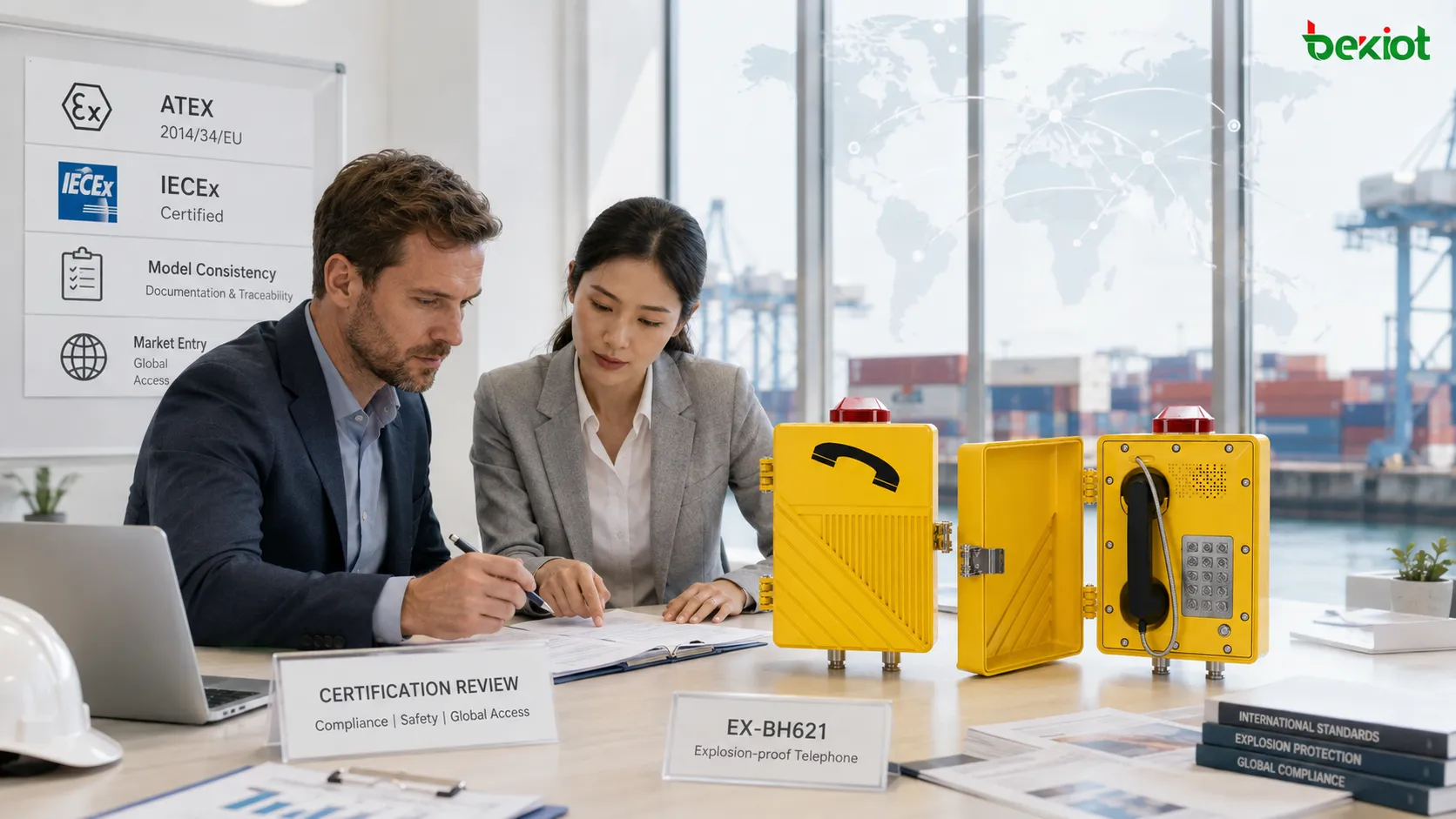
How Manufacturers Can Reduce International Compliance Friction
The most effective strategy for manufacturers dealing with international explosion-protection standards is not to treat certification as a final paperwork exercise. Target markets should be considered during product planning and engineering from the beginning.
Enclosure construction, termination methods, materials, interface options, nameplate space, mounting accessories, and product-family architecture should all be designed with future certification and market expansion in mind.
A platform-based product strategy can significantly reduce certification friction.
If a common platform can support analog, SIP, beacon-equipped, paging-enabled, or alternative mounting versions with clearly controlled design boundaries, later certification work becomes easier to manage.
The opposite approach creates risk. If every customer order requires major temporary modifications, differences between the certification documents and the actual product can quickly accumulate.
Technical documentation management is equally important.
Drawings, bills of materials, exploded views, circuit diagrams, nameplate layouts, user instructions, installation manuals, maintenance requirements, quality records, and engineering change records should remain consistent.
International customers and certification organizations are particularly concerned about situations where “the documents show one design, while the delivered product uses another.”
For safety-related communication equipment, document discipline is itself a competitive capability.
Manufacturers also need a clear way to communicate certification status to customers.
Marketing materials should not treat ATEX, IECEx, and other certification systems as interchangeable, nor should vague wording be used in place of an actual certification scope.
A more professional approach is to explain which regions and applications are currently covered, which local requirements still need confirmation, which optional accessories may affect certification, and which technical documents should be prepared before project approval.
Standards Also Shape the Direction of Product Innovation
International explosion-protection standards influence how quickly explosion-proof telephones can evolve.
Hazardous-area telephones are no longer limited to a heavy enclosure surrounding a basic telephone circuit. Increasingly, projects request SIP communication, device monitoring, remote management, alarm integration, paging, call recording, cybersecurity features, and integration with dispatch platforms.
The more functionality a product includes, the more carefully the certification boundary must be controlled.
A new network interface may affect power requirements, electrical isolation, and internal circuit design. Adding a visual alarm requires evaluation of the light source, electronics, and thermal behavior. Adding paging amplification changes the amplifier, power, and thermal design. Remote management features need to be introduced without changing the certified hardware structure in an uncontrolled way.
Innovation cannot bypass the safety baseline.
That does not mean standards prevent innovation. In many cases, they provide the boundaries that make innovation manageable.
Manufacturers know which parts of the design must remain tightly controlled, which functions can be added through modular architecture, and which changes require additional assessment. Without standards, innovation can become uncontrolled modification. With standards, new features have to become verifiable engineering solutions.
Standardized innovation is also more sustainable for users.
Industrial customers do not want a terminal that offers new features but cannot be approved, maintained, or traced throughout its lifecycle. The future competitiveness of explosion-proof telephones will increasingly come from delivering better communication capability within a controlled compliance framework, not simply from adding more functions to a product list.
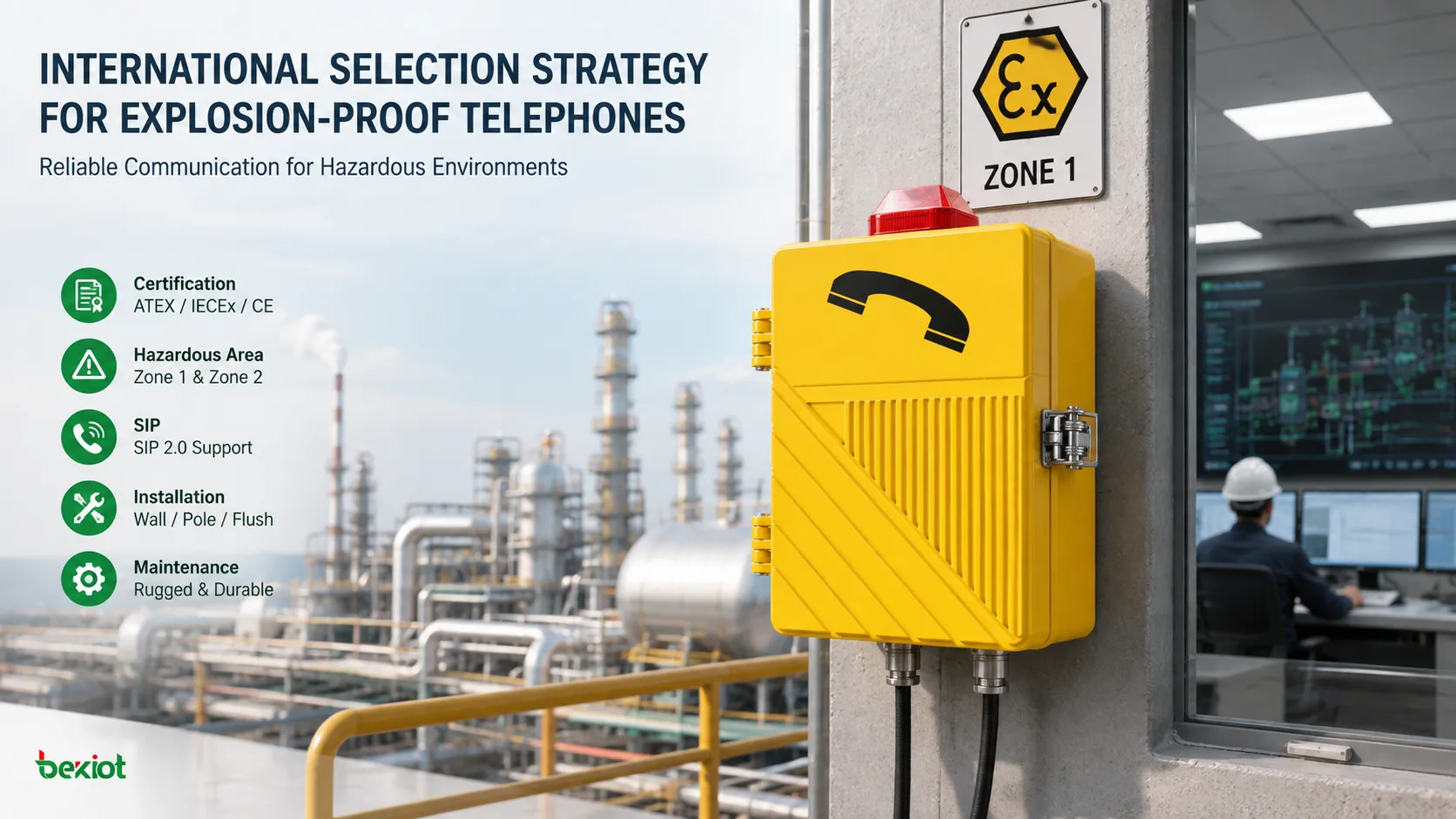
A Practical Selection Strategy Works Better Than a Certificate-First Approach
International explosion-proof telephone projects are easier to manage when the selection process is divided into three levels.
The first level is regulatory and market access: which certification systems are recognized by the destination country, project owner, or EPC contractor?
The second is hazardous-area suitability: do the area classification, gas or dust group, temperature conditions, and environmental exposure match the certification scope?
The third is communication-system compatibility: do the telephone interface, power supply, platform protocol, dispatch integration, recording, and maintenance requirements fit the project?
Many purchasing problems are caused by putting these questions in the wrong order.
A project may select a product based on appearance and price before checking certification. Another may confirm all communication functions first and only later discover that the certificate does not cover the required configuration. In some cases, equipment is ordered before anyone verifies the local documentation requirements.
These approaches push certification risk into the final delivery stage.
A more reliable process is to confirm certification, hazardous-area classification, system interfaces, installation requirements, and maintenance strategy during the solution-design stage.
EPC contractors can reduce risk further by using a standardized review checklist covering product model, certification system, certificate number, hazardous-area suitability, protection concept, temperature class, IP rating, mounting method, cable entries, communication interface, power supply, accessory configuration, manual language, spare-parts requirements, and local acceptance criteria.
End users should also avoid treating certification as the only product-selection criterion.
A certificate demonstrates conformity with specific safety requirements. It does not automatically prove that the telephone provides clear speech in a high-noise environment, remains easy to maintain outdoors, or integrates efficiently with the dispatch system.
Explosion-proof telephone selection should therefore also consider voice intelligibility, user experience, mounting position, system integration, and long-term maintenance capability.
How Can Safety and Global Trade Be Balanced?
Balancing safety requirements with international market access requires cooperation between standards organizations, certification bodies, manufacturers, buyers, EPC contractors, and facility owners.
Clearer standards make safety responsibilities easier to understand. Better recognition between certification systems reduces unnecessary duplication. Professional project specifications create fairer supplier comparisons. Transparent manufacturer documentation gives buyers greater confidence in technical decisions.
For standards organizations and regulators, the key challenge is maintaining the required safety threshold while reducing unnecessary repetition.
Hazardous-area equipment should not face lower safety requirements simply to simplify trade. At the same time, certificate transparency and technical alignment between certification systems can make products that have already undergone rigorous evaluation easier to understand and compare internationally.
For manufacturers, international capability involves much more than obtaining a single certificate.
Sustainable compliance requires traceable product design, controlled suppliers, demonstrable manufacturing consistency, maintained technical documentation, clear customer communication, and disciplined management of certification boundaries.
Competing in the global explosion-proof telephone market therefore depends not only on manufacturing capability but also on compliance-management capability.
Buyers, meanwhile, should use standards as safety-screening tools rather than purely exclusionary conditions.
Projects should define the safety requirements that must be met, but where regulations allow, suppliers should also be able to demonstrate technically equivalent or otherwise acceptable compliance routes.
This approach protects site safety while reducing the risk that overly mechanical certificate requirements unnecessarily restrict legitimate competition.
Conclusion
International explosion-proof telephone standards are, first and foremost, a safety baseline.
They create a verifiable framework for enclosure construction, electrical design, cable entries, temperature control, product marking, technical documentation, and manufacturing consistency. For petrochemical, oil and gas, mining, pharmaceutical, fuel-storage, offshore, and combustible-dust applications, this baseline is essential.
At the same time, certification requirements can become a barrier in cross-border projects. Different regions may impose different requirements for certificates, testing, documentation, marking, factory audits, and local recognition, creating additional cost for both manufacturers and buyers.
The central question is therefore not whether standards are necessary, but whether they are applied in a clear, proportionate, and transparent way.
Becke Telcom provides communication products for hazardous-area and industrial environments, including the EX-BH621 explosion-proof telephone for field voice communication, control-room contact, and industrial dispatch integration.
For international projects, certification requirements, hazardous-area classification, communication interfaces, installation conditions, and long-term maintenance documentation should be confirmed early in the design stage so that safety compliance and project delivery can remain aligned.
Frequently Asked Questions
Why are international explosion-proof telephone standards important?
Explosion-proof telephones are commonly installed in areas where flammable gases, vapors, or combustible dust may be present. International standards define requirements for equipment construction, electrical design, marking, documentation, and manufacturing consistency, helping reduce the risk that the communication terminal itself becomes an ignition source.
Are IECEx and ATEX the same thing?
No. They are related but not equivalent. IECEx is an international certification system for equipment used in explosive atmospheres, while ATEX is the European Union regulatory framework for equipment and protective systems intended for potentially explosive environments. Project engineers should confirm which certification route is accepted in the destination market.
Does an explosion-proof certificate allow a telephone to be used in every country?
Not necessarily. Individual countries and projects may impose additional market-entry requirements, certification-body rules, documentation-language requirements, or installation standards. The certificate must be reviewed together with local regulations and the project owner's technical specifications.
Is certification alone enough when selecting an explosion-proof telephone?
No. Certification is the foundation for hazardous-area safety, but projects should also evaluate speech intelligibility, environmental protection, mounting location, communication interfaces, dispatch-platform compatibility, maintenance accessibility, and long-term spare-parts support.
Do international standards limit innovation in explosion-proof telephones?
Standards introduce design boundaries and additional verification requirements, but they can also make innovation more controlled and sustainable. Explosion-proof telephones can incorporate SIP communication, alarm integration, device monitoring, and dispatch-system connectivity, provided that new functions are developed within the applicable certification and safety framework.