


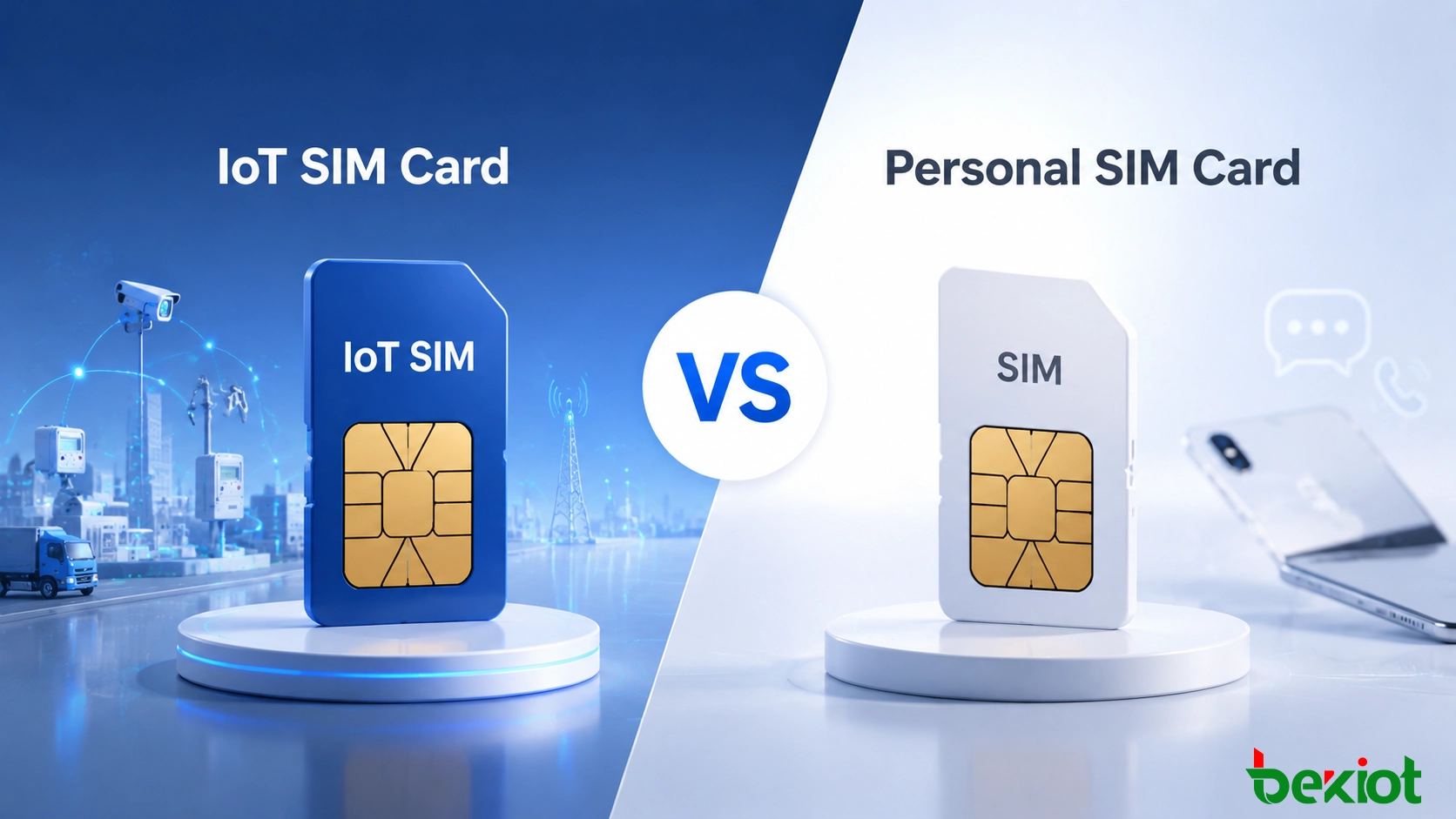
IoT SIM cards and personal mobile SIM cards both connect devices to cellular networks, but the SIM itself is only part of the difference. In many cases, the physical card uses familiar mobile-network technology. What changes is the subscription model, management platform, service policy and operating environment built around it.
A personal SIM is normally assigned to one person and managed through a consumer account. An IoT SIM service is designed to support connected equipment that may operate unattended for years, including industrial sensors, vehicle terminals, security systems, smart meters and remote monitoring equipment.
For a short pilot with only a few devices, a personal data SIM may provide a quick way to test cellular coverage. Once a project expands, however, individual accounts, consumer data plans and manual activation processes become difficult to control. Enterprises then need to evaluate connectivity as part of the complete device lifecycle rather than as a collection of separate mobile subscriptions.
Key Differences at a Glance
The most useful comparison is not simply “consumer card versus industrial card.” Enterprises should compare the complete service behind each connection: how subscriptions are activated, how usage is monitored, how traffic is secured and what happens when devices are deployed across different regions.
| Comparison Area | Personal Mobile SIM | IoT SIM Service |
|---|---|---|
| Primary user | Individual mobile subscriber | Connected device, machine or enterprise asset |
| Typical traffic | Voice, messaging and personal internet access | Telemetry, status data, alarms, positioning and equipment communication |
| Account structure | Usually managed as an individual line | Multiple subscriptions may be managed under one enterprise account |
| Activation and suspension | Normally handled per subscriber | Bulk and remote controls may be available through a management platform |
| Usage monitoring | Consumer billing and data-usage records | Device-level dashboards, alerts, usage rules and APIs may be provided |
| Data plans | Designed around personal monthly usage | May include low-data plans, shared pools or usage-based billing |
| Network access | Usually standard public mobile internet access | Private APN, VPN or restricted routing may be available |
| Form factors | Removable SIM or consumer eSIM | Removable SIM, industrial SIM, embedded MFF2, eSIM/eUICC or iSIM |
| Deployment period | Based on personal subscription use | Designed for equipment that may remain deployed for several years |
| Geographic operation | Based on the subscriber's home plan and roaming terms | Regional, multi-country or multi-network options may be available |
These capabilities vary between mobile operators and managed-connectivity providers. An IoT SIM should not be assumed to include private networking, international roaming, static addressing or operator switching unless those functions are explicitly included in the service agreement.
Why Consumer SIMs Become Difficult to Scale
A personal SIM can be practical during laboratory testing, prototype development or a temporary installation. The device receives mobile data access without requiring a dedicated enterprise connectivity contract, allowing engineers to verify modem compatibility and basic coverage.
The limitations appear when the deployment grows. A network of hundreds or thousands of devices may be spread across factories, vehicles, energy facilities, outdoor cabinets and remote sites. If every connection is managed as an individual mobile subscription, even routine changes require extensive manual work.
Operations teams need to know which SIM belongs to which device, where the asset is installed and whether the subscription is active. They must also distinguish between a device fault, a coverage problem, an expired account and abnormal data consumption. Consumer account portals are rarely designed to provide this level of fleet visibility.
Common scaling problems include:
Maintaining separate subscriber accounts and billing records.
Activating, suspending or replacing connections individually.
Matching SIM identifiers with devices, locations and asset records.
Detecting unexpected traffic before it creates additional cost.
Applying the same access policy across all deployed terminals.
Managing devices that are inaccessible or expensive to visit.
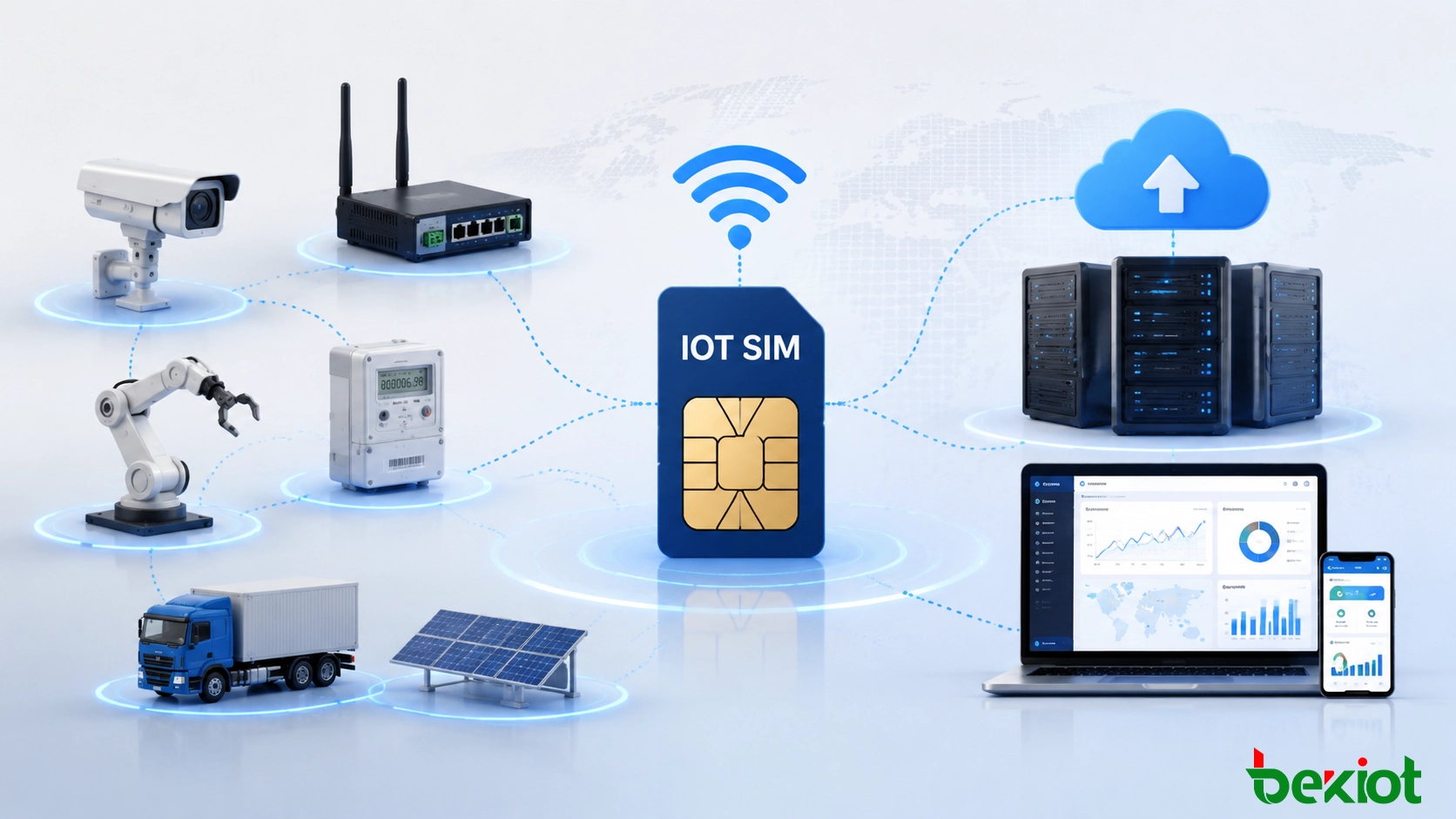
A managed IoT connectivity service addresses these issues by organizing subscriptions around assets and business applications. Administrators may be able to activate groups of SIMs, set usage thresholds, receive abnormal-traffic alerts and access connectivity records through a portal or API.
Management, Security and Cost Considerations
Control the Connection Throughout the Device Lifecycle
An IoT device passes through several operating stages: production, installation, activation, normal service, maintenance and retirement. Connectivity requirements change during those stages. A device in storage may need to remain inactive, while a newly installed terminal may require limited access until commissioning is complete.
An enterprise management platform can associate a SIM identifier with a device serial number, customer account, installation site or business service. This makes it easier to understand which asset is consuming data and whether its communication pattern matches the intended application.
Depending on the service provider, administrators may also be able to:
Activate or suspend multiple subscriptions remotely.
Apply data limits and usage alerts to defined device groups.
Review connection history and last-known network activity.
Integrate SIM status with asset-management or support systems.
Use APIs to automate activation, monitoring and incident handling.
Restrict service according to device identity or expected behavior.
Evaluate the Total Cost of Operation
The lowest monthly data price does not always produce the lowest project cost. Connectivity planning must also account for activation fees, roaming charges, platform costs, field replacement, technical support and the labor required to manage each subscription.
Personal packages often include voice minutes, messaging or consumer data allowances that an industrial sensor does not need. IoT plans may be structured around small periodic messages, high-volume video transmission, mobile assets or pooled data shared by a fleet. The correct plan depends on the actual traffic profile.
Before selecting a service, measure how often the device connects, how much data each session uses and whether firmware updates will be delivered over the cellular link. A sensor sending several short reports per day has a very different cost profile from a camera, vehicle terminal or industrial router.
Security Requires More Than SIM Authentication
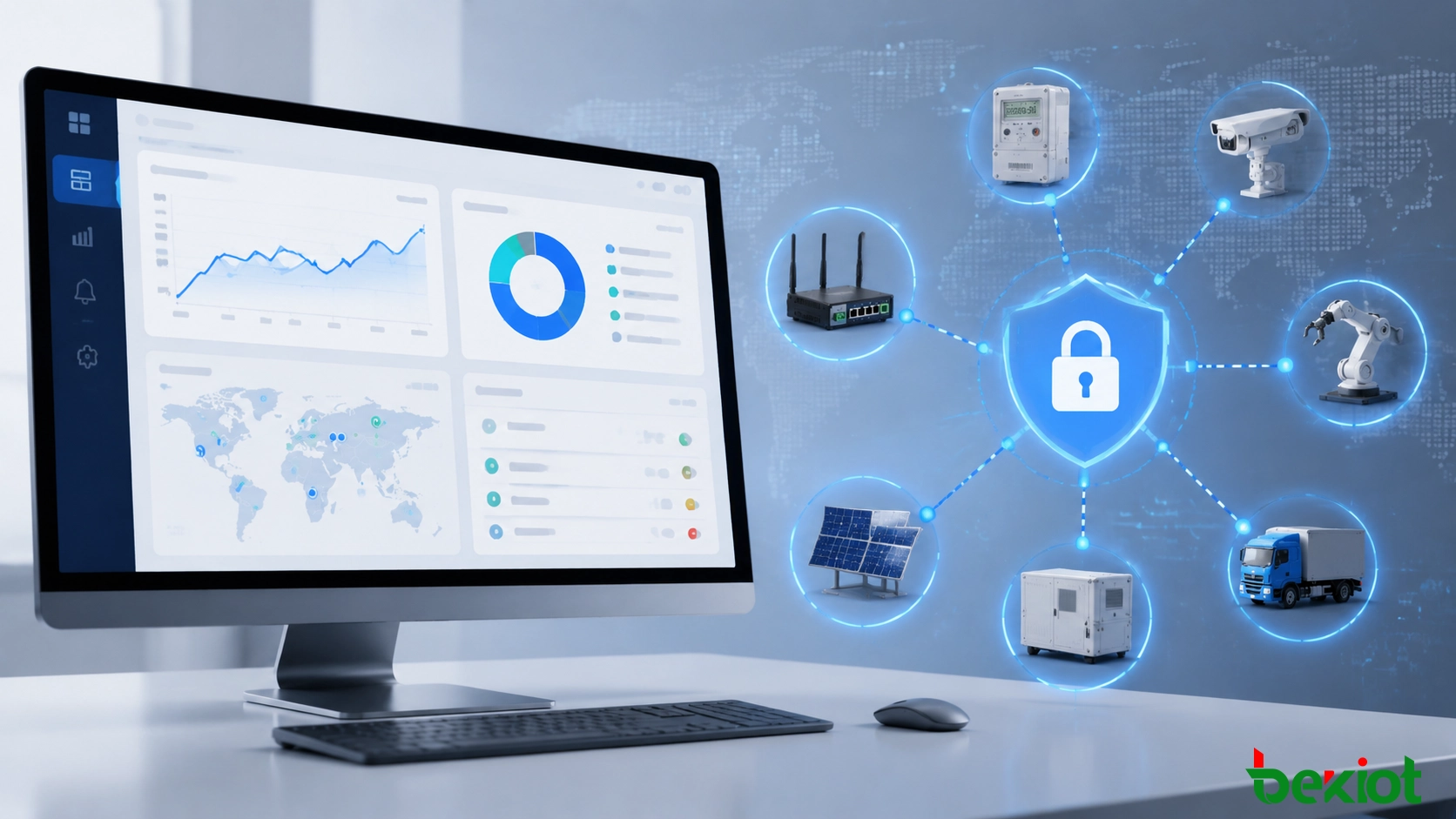
A SIM authenticates the device subscription to the mobile network, but it does not secure the entire IoT application by itself. Application data still needs appropriate encryption, device authentication, credential protection and server-side access control.
Some managed IoT services offer private APNs, VPN connections, restricted destination lists, IMEI association, traffic filtering or anomaly alerts. These controls can reduce exposure and help separate IoT traffic from general public internet access. Availability and implementation differ by provider.
Private network routing does not replace application-layer security. Sensitive data should still be protected with suitable encryption and authenticated protocols between the device, gateway and application platform.
Where Each SIM Type Fits
A personal SIM is not automatically the wrong choice. It can be reasonable for a prototype, a temporary demonstration or a small number of devices that remain under direct staff control. The limitations should simply be understood before the same arrangement is expanded into production.
A dedicated IoT connectivity service becomes more valuable when devices are unattended, widely distributed or expected to remain in service for several years. It is also relevant when the organization needs centralized billing, automated controls or integration with an existing operations platform.
Manufacturing and Industrial Monitoring
Cellular connectivity can link production equipment, environmental sensors and remote control cabinets where wired infrastructure is unavailable or unsuitable. Usage alerts can also help identify a terminal that begins transmitting significantly more data than expected.
Transportation and Logistics
Vehicle tracking, route monitoring, onboard terminals and cargo sensors operate across changing coverage areas. These applications may require roaming arrangements, multi-region support and clear control over data consumption.
Energy and Utilities
Smart meters, substations, pipelines and distributed monitoring equipment are often installed across wide geographic areas. Long deployment periods, difficult site access and low routine data usage make lifecycle management an important part of the connectivity plan.
Security and Public Infrastructure
Alarm panels, parking systems, information displays, lighting controllers and outdoor monitoring equipment can use cellular communication as a primary connection or an independent backup path. The service should be selected according to required availability and expected data volume.
The phrase “IoT SIM” should not determine the decision on its own. Device location, modem support, application traffic and service-management requirements provide a more reliable basis for selection.
Planning the Connectivity Architecture
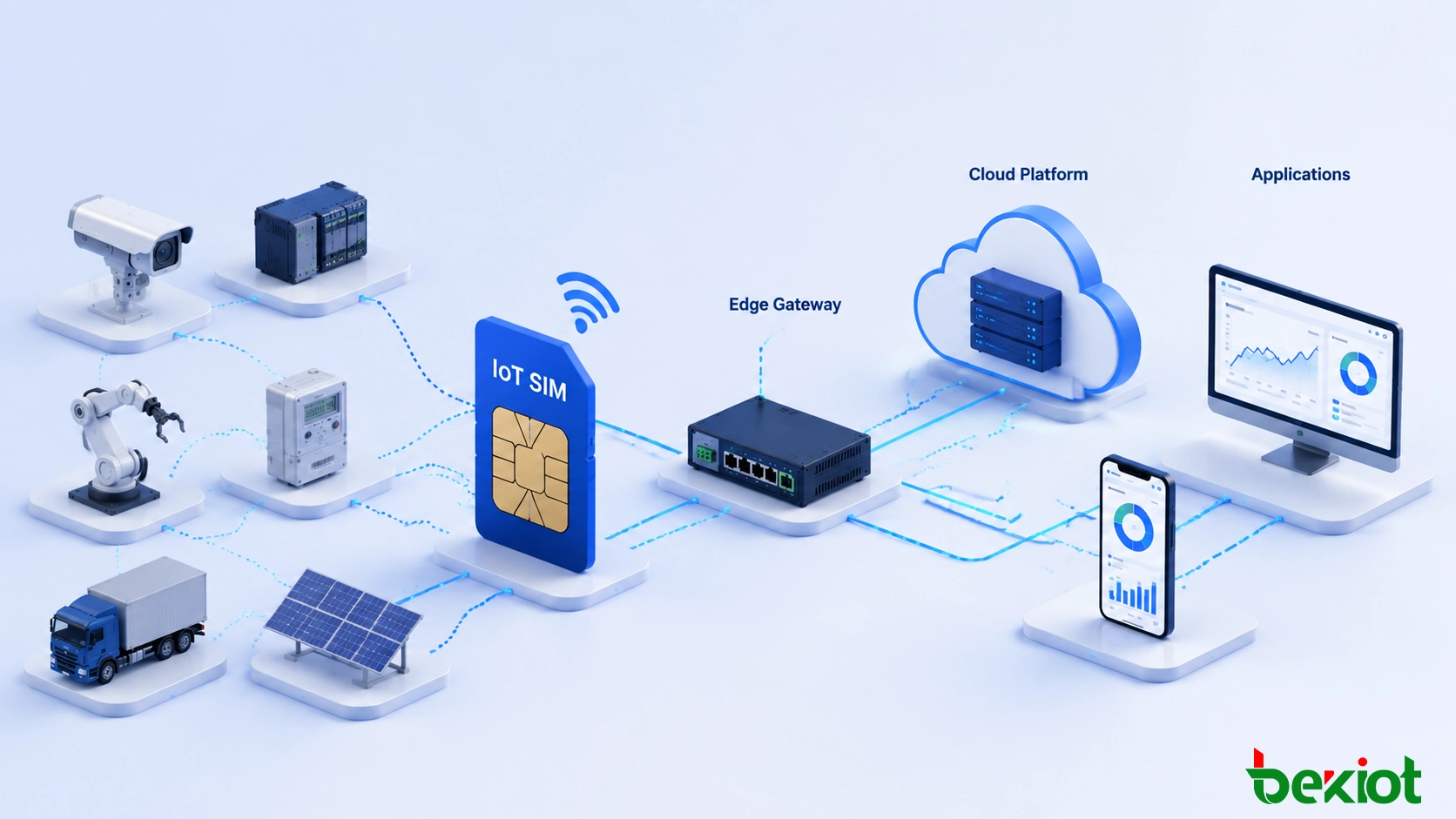
The SIM connects the device to a mobile network, but it does not define the complete communication architecture. A production system normally includes four connected layers.
Device layer: sensors, controllers, routers, cameras, vehicle terminals and industrial equipment that generate or consume data.
Connectivity layer: the modem, SIM profile, radio access network, APN and traffic-routing service.
Platform layer: connectivity management, device management, data processing, alerting and integration services.
Application layer: dashboards, asset-management systems, maintenance tools and business applications used by operations teams.
The device modem must support the cellular technologies available in the deployment area. Depending on bandwidth, latency and power requirements, this may include LTE, 5G, LTE-M or NB-IoT. Network availability and supported frequency bands should be verified with the actual device hardware.
Cloud platforms provide centralized data storage and business integration, while edge systems process selected information closer to the equipment. Edge processing can reduce cellular traffic and allow local actions to continue when a cloud connection is temporarily unavailable.
For example, an industrial gateway may evaluate machine alarms locally and send only events and summarized operating data to the cloud. Firmware files, video streams and diagnostic logs can then be transferred under controlled conditions rather than continuously using mobile data.
International deployments require additional checks. Permanent roaming restrictions, local data-residency rules, operator availability and subscription-localization requirements differ between countries. A global SIM or multi-network service should be reviewed against the locations where devices will actually operate.
Deployment and Ongoing Operations
Connectivity should be tested as part of the device rather than evaluated as a separate mobile service. Antenna placement, enclosure materials, modem firmware, power conditions and the surrounding environment all affect communication performance.
Before production deployment, confirm:
The number and geographic distribution of connected devices.
The mobile technologies and frequency bands supported by each modem.
Signal coverage at the exact installation position.
Normal, peak and firmware-update data consumption.
Required APN, VPN, IP addressing and routing arrangements.
Roaming and local-network restrictions in each operating country.
The process for activation, suspension, replacement and retirement.
Alert thresholds for offline devices and abnormal traffic.
Fallback behavior when the cellular or cloud connection is unavailable.
Pilot testing should use representative equipment in the real deployment environment. A coverage check performed with a smartphone does not prove that an enclosed industrial modem with a different antenna will achieve the same result.
After installation, operations teams need a consistent response process. When a device stops reporting, they should be able to determine whether the subscription is active, whether the modem recently registered with the network and whether other devices in the same area are affected. This information helps avoid unnecessary site visits.
The final choice between a personal SIM and an IoT SIM service should therefore reflect the full operating model. Personal subscriptions can support controlled tests and small temporary projects. Managed IoT connectivity is generally more appropriate when equipment must be deployed, monitored and maintained as a long-term enterprise asset.
FAQ
Can a Personal SIM Be Used During an IoT Pilot?
Yes. A personal data SIM can be used to check modem operation, application communication and local coverage during an early test. Before production deployment, review account management, usage policy and whether the operator permits the intended device application.
Do All IoT SIM Cards Support Voice and SMS?
No. Some subscriptions provide data only, while others support SMS or voice services. The supported functions depend on the operator, network technology, SIM profile and commercial plan.
What Is the Difference Between an IoT SIM, eSIM and eUICC?
An IoT SIM describes the connectivity service or intended application. An eSIM commonly refers to an embedded SIM implementation, while an eUICC is a secure component that can support remote management of operator profiles. An IoT service may use a removable SIM or an embedded eUICC.
Can an IoT Device Switch Between Mobile Operators?
It depends on the service. Some solutions support roaming, multiple operator identities or remote eUICC profile management. A standard single-operator SIM does not automatically provide unrestricted operator switching.
What Happens If an IoT Device Remains Inactive?
Inactivity policies vary. A subscription may continue generating charges, enter a suspended state or be terminated after a defined period. Enterprises should confirm inactivity rules and use platform alerts to track devices that stop communicating.







