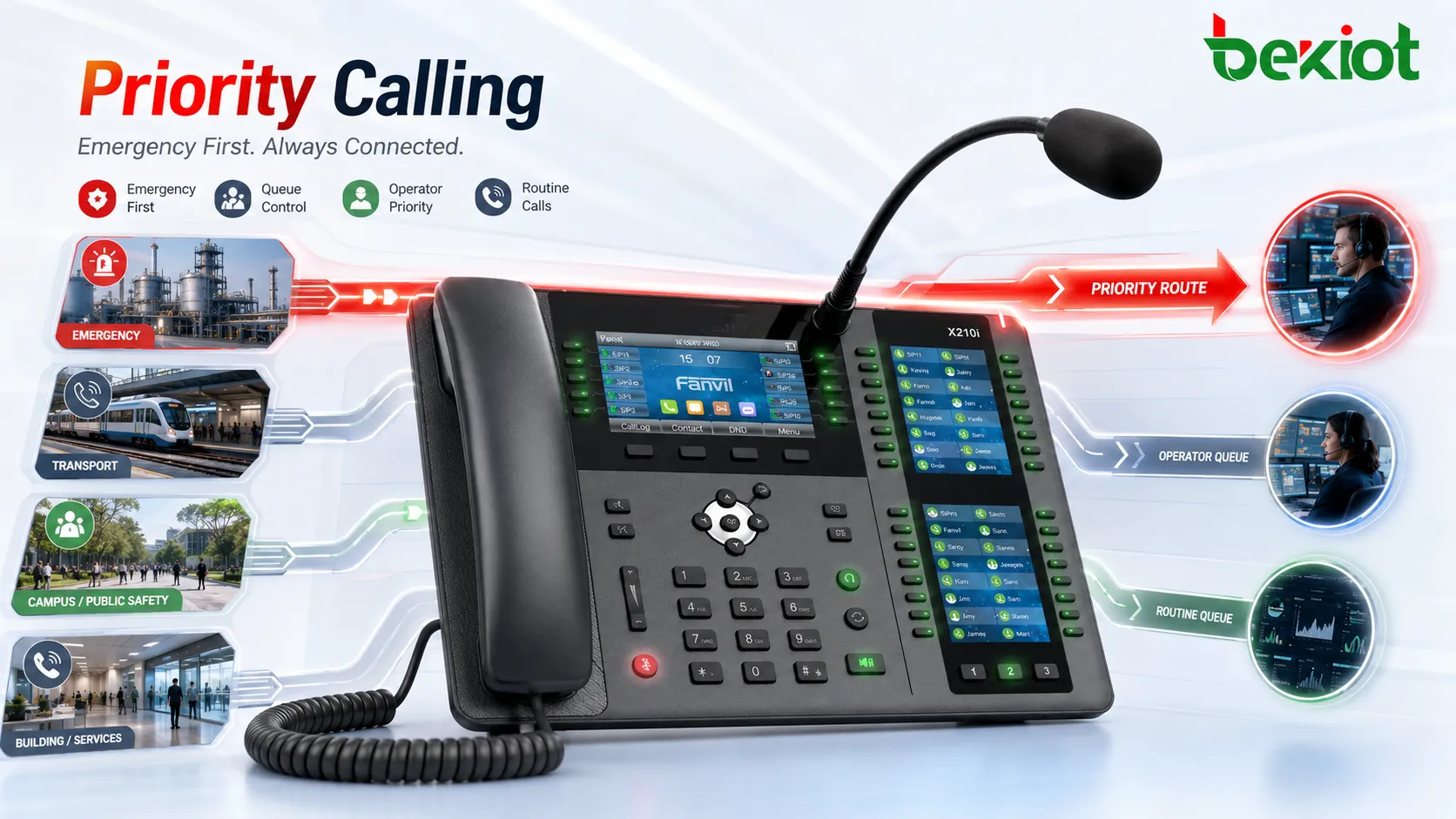
Priority calling is a communication mechanism that allows important calls to receive faster access, stronger routing protection, or higher handling rights than ordinary calls. It is used in dispatch systems, IP PBX platforms, emergency communication networks, industrial telephone systems, public safety centers, transportation control rooms, campus security networks, healthcare facilities, and large multi-site organizations. The purpose is simple: when a call is truly urgent, the system should not treat it like a routine conversation.
However, “priority” is not created by a single button. It is achieved through a complete set of rules, including who is allowed to place a high-priority call, which destination should answer first, how the call is routed, whether it can bypass queues, whether it can interrupt lower-priority communication, and how the system records the event. A reliable priority calling design combines platform logic, endpoint behavior, network quality, user permissions, and operating procedures.
Why urgent calls need order
In ordinary communication, every call may appear equal. A user dials a number, the platform routes the call, and the destination answers or does not answer. This model works in office environments, but it is not always enough for emergency response, industrial dispatch, facility security, transportation operations, or command center communication.
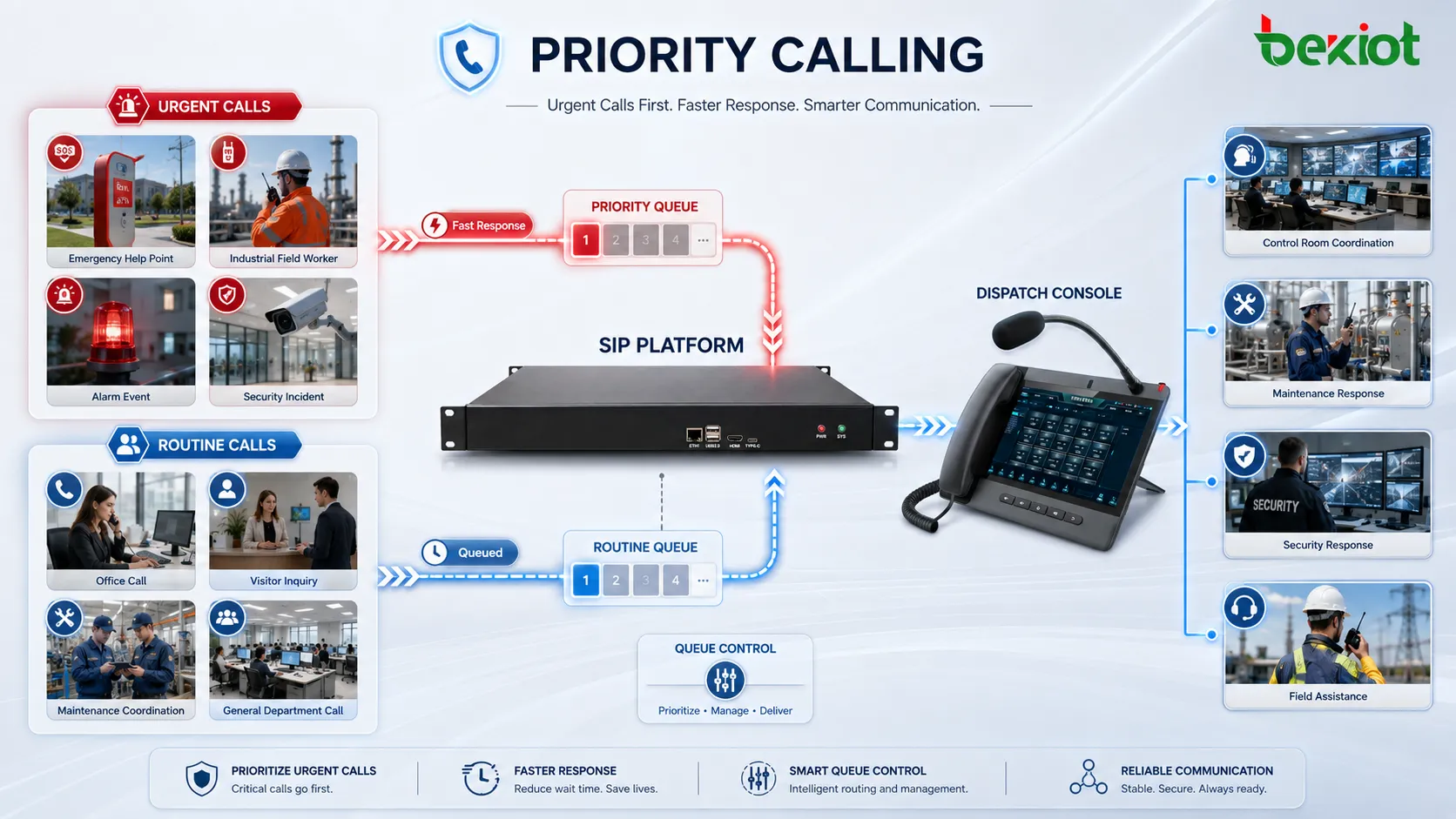
In critical environments, different calls carry different levels of importance. A routine maintenance call should not delay a fire alarm report. A visitor inquiry should not block an emergency help point. A general department call should not occupy the only available operator when a field worker is reporting equipment danger. Priority calling introduces order into these situations.
The purpose is not to make all calls louder, faster, or more aggressive. The purpose is to make sure that urgent communication reaches the correct resource before less important traffic. This protects response time, reduces uncertainty, and helps operators handle incidents according to real risk.
Priority calling is especially useful when communication resources are limited. There may be only a few dispatch operators, a limited number of trunks, a small group of emergency response staff, or a shared paging system. Without priority rules, the system may process calls in the order they arrive, even when later calls are more urgent. With priority logic, the platform can treat emergency or command communication differently.
What call priority means
Priority in communication can have several meanings. It may mean that a call is routed faster. It may mean that the call bypasses a queue. It may mean that the call can ring multiple destinations at the same time. It may mean that the call is allowed to interrupt lower-priority audio. It may also mean that the call receives network-level voice protection or special handling by the dispatch platform.
Because the word has different meanings, system design must define priority clearly. A platform should not simply mark a call as important without deciding what that importance changes. Does the call reach the operator first? Does it override a busy state? Does it trigger a different ringtone? Does it activate recording? Does it alert supervisors? Does it use a backup route if the first path fails?
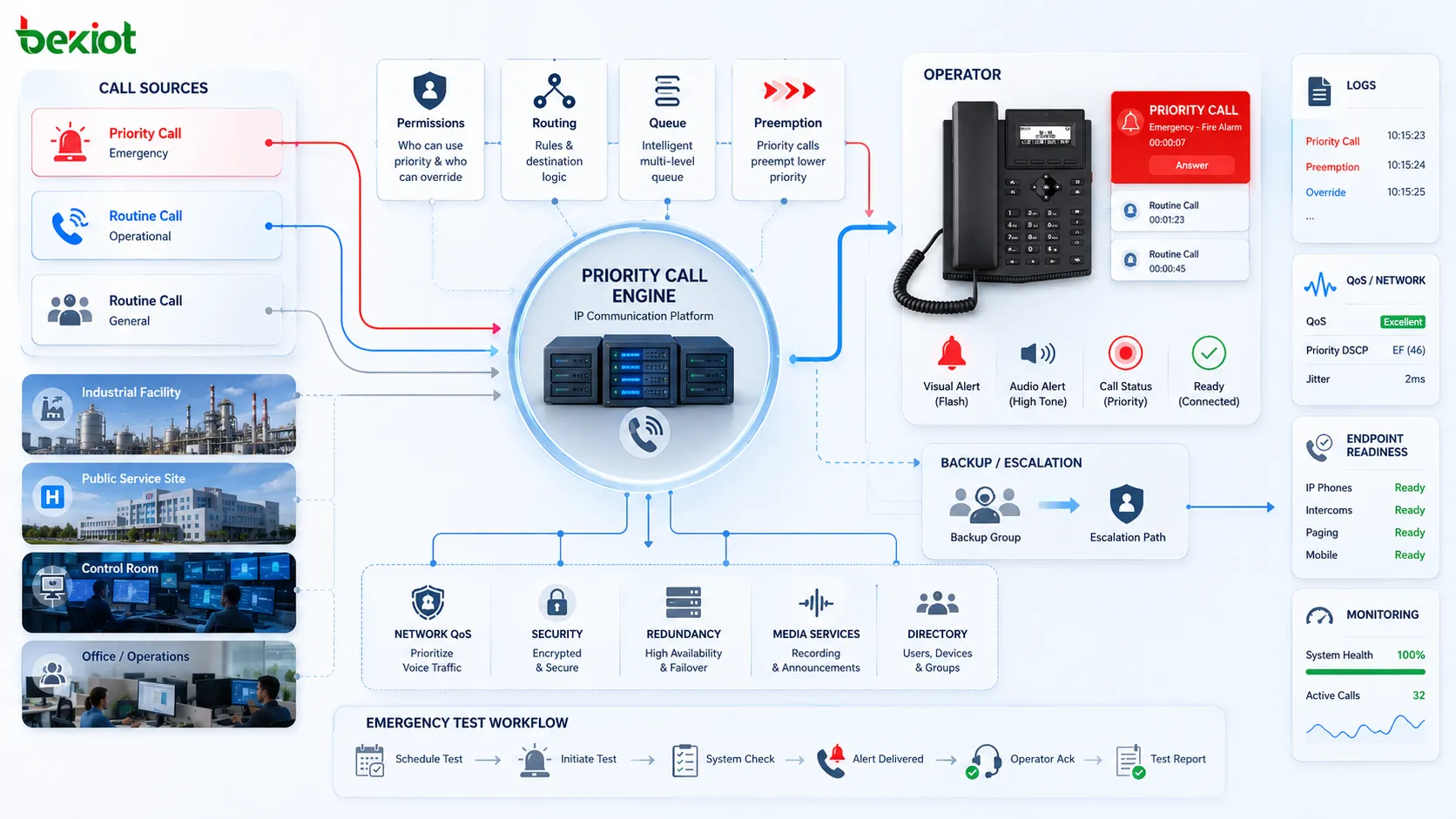
In practical systems, priority is often built in layers. The first layer is user authority: who is allowed to place or receive a high-priority call. The second layer is routing behavior: where the call goes and what alternatives are available. The third layer is queue and conflict handling: what happens when resources are busy. The fourth layer is media handling: whether the audio path receives stronger protection. The fifth layer is operation management: how the call is logged, reviewed, and controlled.
A good design makes these layers visible to administrators and understandable to operators. If priority logic is hidden or inconsistent, users may not trust the system during real events. Clear definitions prevent confusion and make maintenance easier.
How access rights are defined
User roles and authority levels
Priority calling begins with identity. The system must know who is placing the call and what level of authority that user has. A control room supervisor may have higher rights than a normal office extension. A fire command terminal may have higher rights than a public reception phone. An emergency call box may have predefined high priority even when the caller is unknown.
Role-based access helps prevent misuse. If every user can mark every call as urgent, the system loses the ability to distinguish real emergencies. Priority becomes noise. A proper design assigns priority rights according to job role, location, device type, emergency procedure, and organizational responsibility.
Device-based priority
Some priority calls are based on the device rather than the user. For example, a tunnel emergency phone, elevator help phone, explosion-risk-area telephone, guard booth terminal, or control room hotline may always be treated as important. The platform identifies the endpoint and applies a predefined priority rule.
Device-based priority is useful because emergency users may not log in or authenticate manually. A person pressing a help point button should not need an account to receive urgent treatment. The device location and function already indicate the risk level.
Call type and dial code
Priority can also be triggered by the number dialed. A call to an emergency code, command center, safety desk, or dispatch group may automatically receive higher handling. The same phone may place normal calls to ordinary extensions and high-priority calls to emergency numbers.
This method is flexible, but the dial plan must be clear. Emergency numbers should be short, easy to remember, and difficult to confuse with routine codes. If users must dial long or complicated numbers during stress, the priority function may not be effective.
How routing gives faster paths
Priority calling usually requires special routing rules. A routine call may ring one destination and follow a normal timeout. A high-priority call may ring several operators at once, use a shorter timeout, escalate faster, or move to a backup group automatically. Routing is where the concept of priority becomes a practical response path.
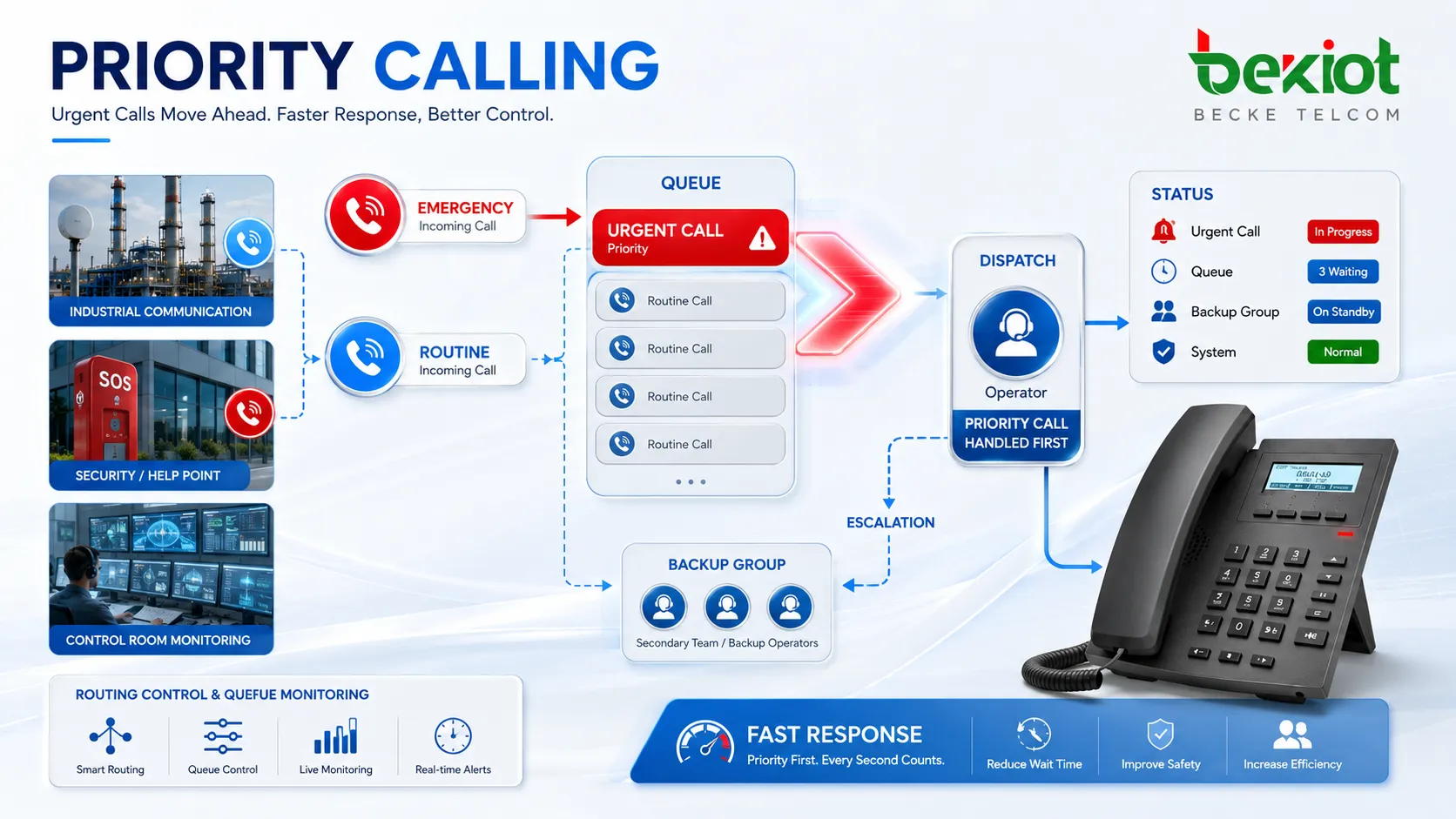
For example, an emergency help point may first call the control room. If nobody answers within a short time, the system may forward the call to the security office, then to a duty manager, and then to a mobile or radio gateway group. A routine call might simply go to voicemail or wait for a callback. The difference is not only the destination; it is the urgency of the routing behavior.
Routing can also consider time schedules. During working hours, priority calls may go to the main dispatch desk. At night, they may go to a duty room or remote monitoring center. During weekends or holidays, they may follow a different escalation tree. A good priority design reflects how the organization actually operates.
Multi-site routing is another important issue. In large organizations, a call from one building or branch may need local handling first, then regional backup, then central command support. The system should identify where the call comes from and route it to the right response team. Location-aware routing reduces delay and avoids sending urgent calls to people who cannot act.
How queues handle conflicts
Queues are necessary when many calls arrive at the same time. In a normal queue, calls may be handled in arrival order. In a priority calling system, higher-level calls can move ahead of lower-level calls. This does not necessarily mean that ordinary callers are ignored. It means the system recognizes that some calls require faster attention.
Queue priority can be simple or complex. A basic system may divide calls into emergency, important, and normal. A more advanced platform may use multiple levels, such as life safety, security incident, equipment failure, supervisor command, routine service, and administrative call. The number of levels should match operational reality. Too many levels may confuse users and administrators.
Conflict handling should also define how operators see incoming calls. A high-priority call may show a different color, ringtone, flashing alert, screen pop-up, location label, or event type. The operator should not need to guess which call is urgent. Visual and audio cues help the operator respond correctly.
Queue rules should avoid unfair or endless blocking. If high-priority traffic is frequent, lower-priority users may never reach operators. This may indicate poor capacity planning or excessive use of priority status. Monitoring queue statistics helps administrators adjust staffing, routing, and priority definitions.
How preemption should work
Preemption means that a higher-priority call can interrupt, release, or override a lower-priority communication resource. This is one of the strongest forms of priority control and should be used carefully. It may be necessary in emergency command, industrial dispatch, public safety, transportation, and mission-critical communication, but it can also disrupt normal communication if poorly designed.
Preemption can happen in several ways. The system may disconnect a lower-priority call so a critical call can use the line. It may place the lower-priority call on hold. It may interrupt a routine broadcast with an emergency announcement. It may force an operator console to alert immediately even when the operator is handling another task. It may also seize a trunk or gateway channel for emergency use.
Clear rules are essential. The system should define which priority levels can preempt which lower levels, whether the lower-priority user hears a tone or message, whether the interrupted call can resume, and whether the action is logged. Without these details, preemption may create confusion or disputes after an incident.
Preemption should not be used as a substitute for capacity. If a system frequently needs to interrupt calls because resources are insufficient, the real problem may be trunk capacity, operator staffing, channel planning, or system architecture. Preemption is a safety mechanism for exceptional situations, not a normal traffic management method.
How audio paths stay clear
Priority calling is not only a routing issue. The audio path must also remain usable. An emergency call that reaches the correct operator but suffers from packet loss, delay, jitter, echo, or low volume may still fail. For SIP and IP communication systems, media quality is part of priority design.
Network planning can protect voice traffic through QoS, VLAN separation, bandwidth reservation, controlled routing, and monitoring. These measures help reduce the chance that urgent calls are affected by ordinary data traffic. In multi-site systems, WAN links and VPN paths should also be reviewed because emergency calls may cross several network segments.
Codec selection and packet handling matter as well. A system should use codecs that match the network and endpoint capability. Jitter buffers, packet loss concealment, echo cancellation, and gain control can improve listening quality, but they cannot fully repair a badly designed network. Priority calling should be supported by stable transport.
Local audio design also matters. Emergency phones, industrial telephones, dispatch consoles, and public help points should have clear microphone pickup and sufficient speaker or handset output. A high-priority call should not depend on a weak microphone placed in a noisy environment. Endpoint acoustic design and installation location directly affect call effectiveness.
Where scenarios use it
Industrial dispatch and safety
In industrial sites, priority calling can support equipment failure reports, fire alarms, gas leakage reports, injury calls, control room commands, and maintenance escalation. Field telephones, SIP intercoms, dispatch terminals, and alarm-linked call points may all require different priority levels.
The system can route emergency field calls to the control room first, then escalate to safety officers or maintenance teams. Calls from hazardous zones may display location information so operators know where the incident is happening. If combined with paging or alarm systems, the priority call can become part of a wider response workflow.
Transportation and tunnel systems
Metro stations, railways, road tunnels, airports, bus depots, and traffic control centers often use priority calling for emergency assistance, operation command, passenger help, platform incidents, and maintenance coordination. In these environments, response time and location accuracy are important.
A passenger help point may be treated as higher priority than a routine staff call. A tunnel emergency phone may trigger immediate operator alert and location display. A dispatcher may have authority to interrupt routine channels during an incident. These rules help keep communication aligned with public safety needs.
Healthcare and campus security
Hospitals, clinics, schools, and campuses may use priority calling for nurse station emergencies, security alerts, public assistance, entrance intercoms, elevator phones, and emergency help stations. Priority rules help urgent calls reach security desks, duty rooms, or emergency response teams faster.
These environments often include users who are not trained communication operators. A visitor, patient, student, or staff member may need help quickly. Device-based priority and simple call buttons can reduce the need for user knowledge. The platform handles the priority in the background.
Public facilities and buildings
Large buildings, commercial complexes, parking garages, hotels, government facilities, and utility sites may need priority calling for emergency points, service desks, security rooms, equipment areas, and building management centers. The system should distinguish between routine service communication and urgent safety communication.
Priority rules can also support after-hours operation. If the local desk is unmanned, emergency calls can automatically route to a remote monitoring center or duty manager. This keeps emergency access available even when staffing changes.
What endpoints must support
Endpoints are where users actually interact with the priority calling system. A platform may have advanced rules, but the endpoint must still support the required behavior. This may include emergency buttons, hotline dialing, speed dial keys, visible call status, strong ringtones, clear labels, hands-free operation, handset pickup, speaker output, and reliable network registration.
For SIP endpoints, the device should work predictably with the platform. It should register reliably, support the selected codec, handle call waiting or auto-answer rules if required, and respond correctly to priority paging or dispatch commands. If the system uses special signaling or platform-defined priority fields, endpoint compatibility should be tested before deployment.
Physical design is also important. An emergency endpoint should be easy to find and operate. Buttons should be visible. Labels should be understandable. The device should give feedback when a call starts, rings, connects, or fails. Users under stress should not need to interpret complex screens or hidden functions.
For outdoor, industrial, tunnel, or public areas, durability affects priority communication. A priority call feature is meaningless if the device is offline because of water ingress, vandalism, cable damage, corrosion, power failure, or poor installation. Endpoint reliability is part of the priority system.
How platforms control rights
The communication platform is responsible for enforcing many priority rules. It should define user roles, device profiles, dial plan behavior, queue order, routing sequences, escalation rules, recording policies, and permission boundaries. Administrators should be able to configure these rules clearly.
Rights management should be simple enough to maintain. If priority configuration is too complex, administrators may make mistakes. If it is too loose, users may overuse urgent call levels. If it is too rigid, legitimate emergency communication may be delayed. The platform should balance control with usability.
Audit logs are important. When a high-priority call is placed, preempts another call, triggers an escalation, or activates an emergency route, the system should record what happened. Logs help review incidents, improve procedures, and resolve questions after an event. They also discourage misuse because actions are traceable.
Integration with other systems can strengthen control. Access control, alarm platforms, GIS maps, dispatch screens, video systems, and incident management tools can provide context. For example, a priority call from a specific help point can display location, nearby camera, event type, and response procedure. Priority becomes more useful when it carries context, not only a higher rank.
What weakens the design
One common weakness is unclear priority definition. If users and administrators do not know what high priority actually changes, the function becomes symbolic. The design should state exactly how each level affects routing, queue position, override rights, notifications, and logging.
Another weakness is too many priority levels. Complex hierarchies may look professional but become difficult to operate. If users cannot understand the difference between level three and level four, they may choose incorrectly. A small number of meaningful levels is often better than a large number of unclear categories.
Overuse is also dangerous. If many calls are marked urgent, true emergency calls may still compete with excessive priority traffic. Permission control, training, and log review help prevent this problem. Priority should be reserved for communication that genuinely requires faster handling.
Weak network and endpoint design can also defeat the function. A high-priority call may be routed correctly but fail because of packet loss, power failure, offline endpoints, poor microphone quality, or wrong configuration. Priority design must include infrastructure readiness.
Finally, some systems are configured once and never reviewed. Sites change. Departments move. Operators change shifts. New devices are added. Emergency procedures are updated. Priority routes and groups must be maintained over time, or they may no longer reflect the real organization.
How readiness is tested
Testing should begin with simple call behavior. Each priority endpoint or authorized user should be tested to confirm that the call reaches the correct destination. The platform should show the right caller identity, location, priority level, and call status. The operator should be able to distinguish the call from routine traffic.
Routing and escalation should be tested under realistic conditions. What happens if the first operator is busy? What happens if nobody answers? Does the call move to the backup group? Does the system use the correct timeout? Does after-hours routing work? These questions should be answered before a real incident occurs.
Queue behavior should also be tested. Administrators should simulate multiple ordinary calls and then place a high-priority call. The result should match the design. If the priority call does not move ahead, the queue rule may be incorrect. If it interrupts too aggressively, the preemption policy may need adjustment.
Audio quality should be tested during real operating conditions. The caller should be heard clearly, and the field user should hear the response. If the call is used in an industrial or public environment, testing should include normal background noise, distance, echo, and device position.
Logs and reports should be reviewed after testing. The system should record priority call events in a way that helps maintenance teams verify operation. If the logs are incomplete, administrators may have difficulty analyzing real incidents later.
Final notes for design
Priority calling is achieved by combining authority, routing, queue control, preemption, endpoint behavior, network protection, platform logging, and operating procedures. It is not created by a label alone. A call becomes truly prioritized only when the system changes how it is handled in a predictable and useful way.
The best design starts by defining real communication risks. Which calls must always reach an operator? Which devices represent emergency locations? Which users can override routine communication? Which routes should be used during working hours and after hours? Which actions must be recorded? These questions turn priority calling from a vague feature into a practical system function.
Priority also requires restraint. If everything is urgent, nothing is urgent. The system should protect critical communication without disrupting normal operation unnecessarily. Clear permissions, simple levels, reliable endpoints, stable networks, regular testing, and ongoing maintenance are the foundation of effective priority calling.
Frequently Asked Questions
What does priority calling mean?
Priority calling means that selected calls receive higher handling than ordinary calls. This may include faster routing, queue preference, escalation, preemption, special alerts, or protected media handling.
How is a priority call triggered?
It can be triggered by user role, device type, dialed number, emergency button, dispatch console action, alarm linkage, or platform rule. The correct method depends on the communication system design.
Can priority calls interrupt other calls?
Some systems support preemption, which allows a higher-priority call to interrupt or override lower-priority communication. This should be controlled carefully and used only where operationally necessary.
Does priority calling require SIP?
No. Priority concepts can exist in analog, digital, radio, and IP systems. However, SIP platforms often provide flexible routing, queue, permission, and integration options for implementing priority logic.
What should be tested before deployment?
Testing should include call routing, queue behavior, escalation, preemption rules, endpoint status, audio quality, network performance, permission control, after-hours routing, and event logging.