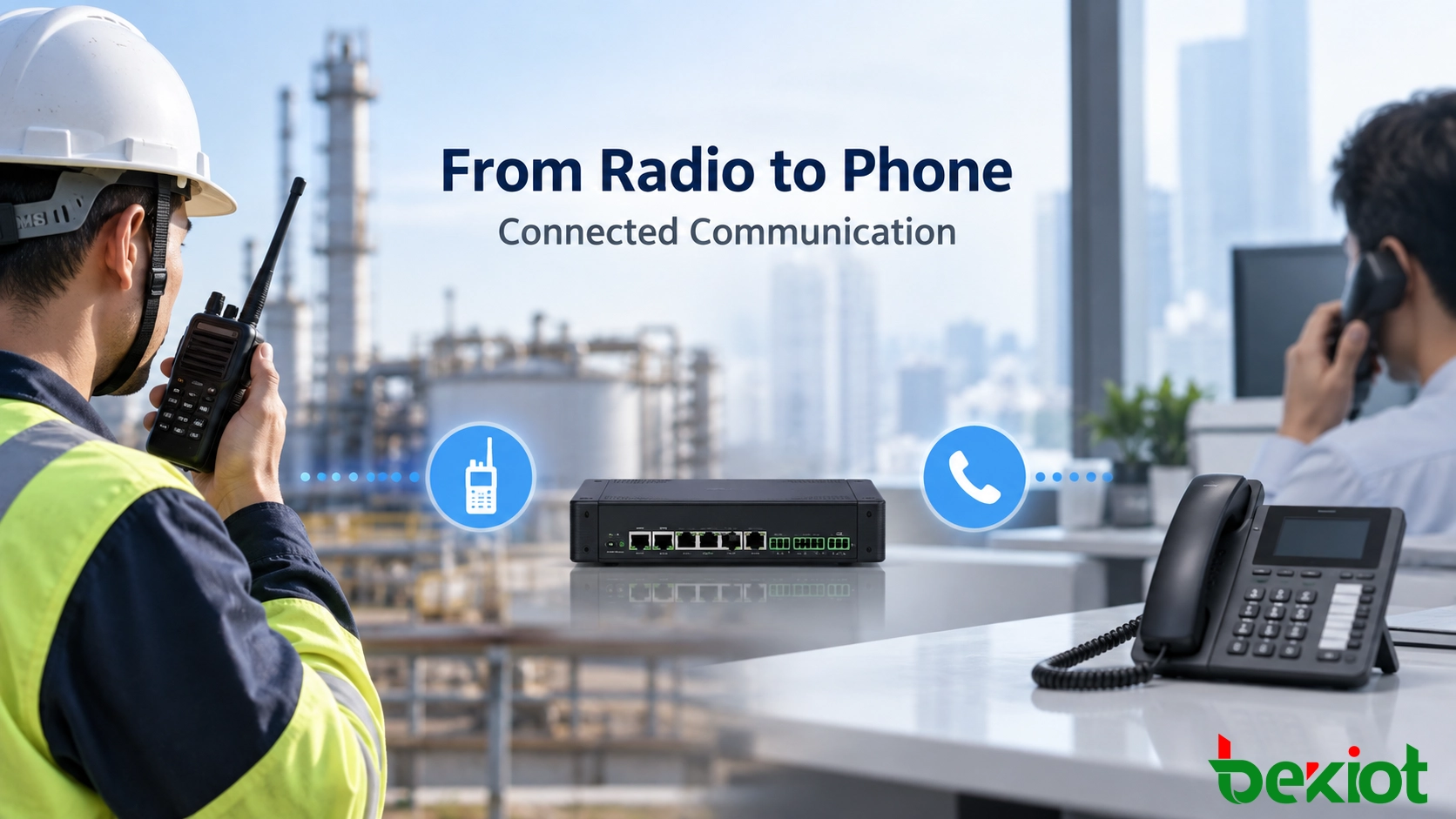
A two-way radio normally communicates with another radio on a channel or talk group. A telephone works differently: the user enters a destination number, the switching system interprets that number, and the network establishes a point-to-point call. Connecting these two communication methods therefore requires more than simply linking their audio interfaces.
A practical radio-to-phone calling solution must answer three questions: how the radio user enters a telephone number, how that number becomes a telephone call, and how a half-duplex radio conversation is coordinated with a full-duplex telephone connection. Depending on the radio system, these functions may already exist inside a digital trunked network or may be added through a radio-to-SIP gateway.
Dialing Begins with Signaling
Before considering gateways or IP networks, it is useful to understand what telephone dialing actually does. Dialing does not directly create a voice path. Its first purpose is to tell the communication system which destination the caller wants to reach.
Early telephone networks depended on operators who manually connected calls. Rotary telephones later introduced pulse dialing, where each digit was represented by a specific number of electrical interruptions. Dialing the number 5, for example, generated five pulses that the exchange counted and interpreted.
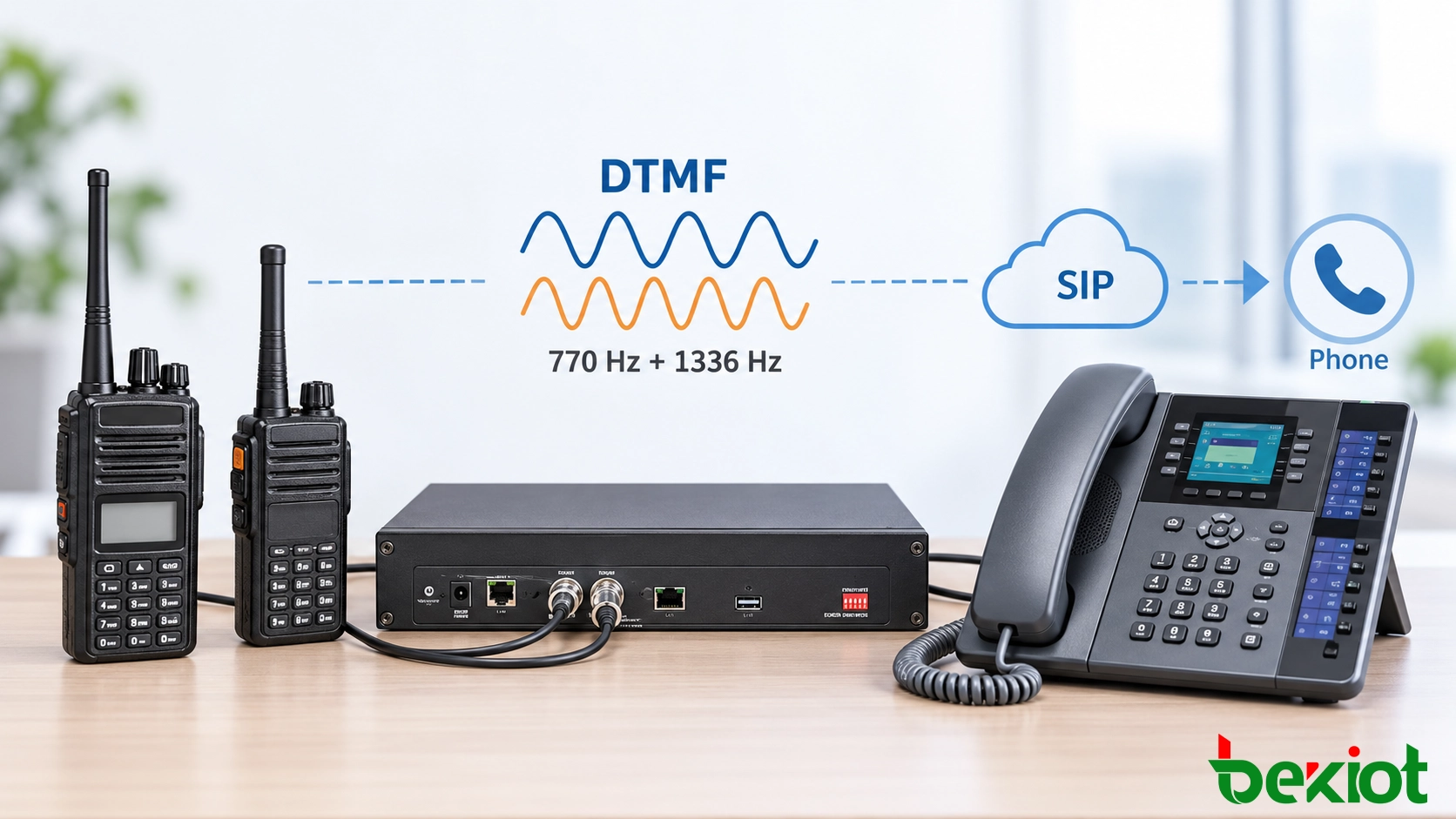
A major change came in 1963, when Bell Labs introduced Dual-Tone Multi-Frequency signaling, commonly known as DTMF. Instead of producing pulses, every key generates two frequencies at the same time: one from a low-frequency group and one from a high-frequency group.
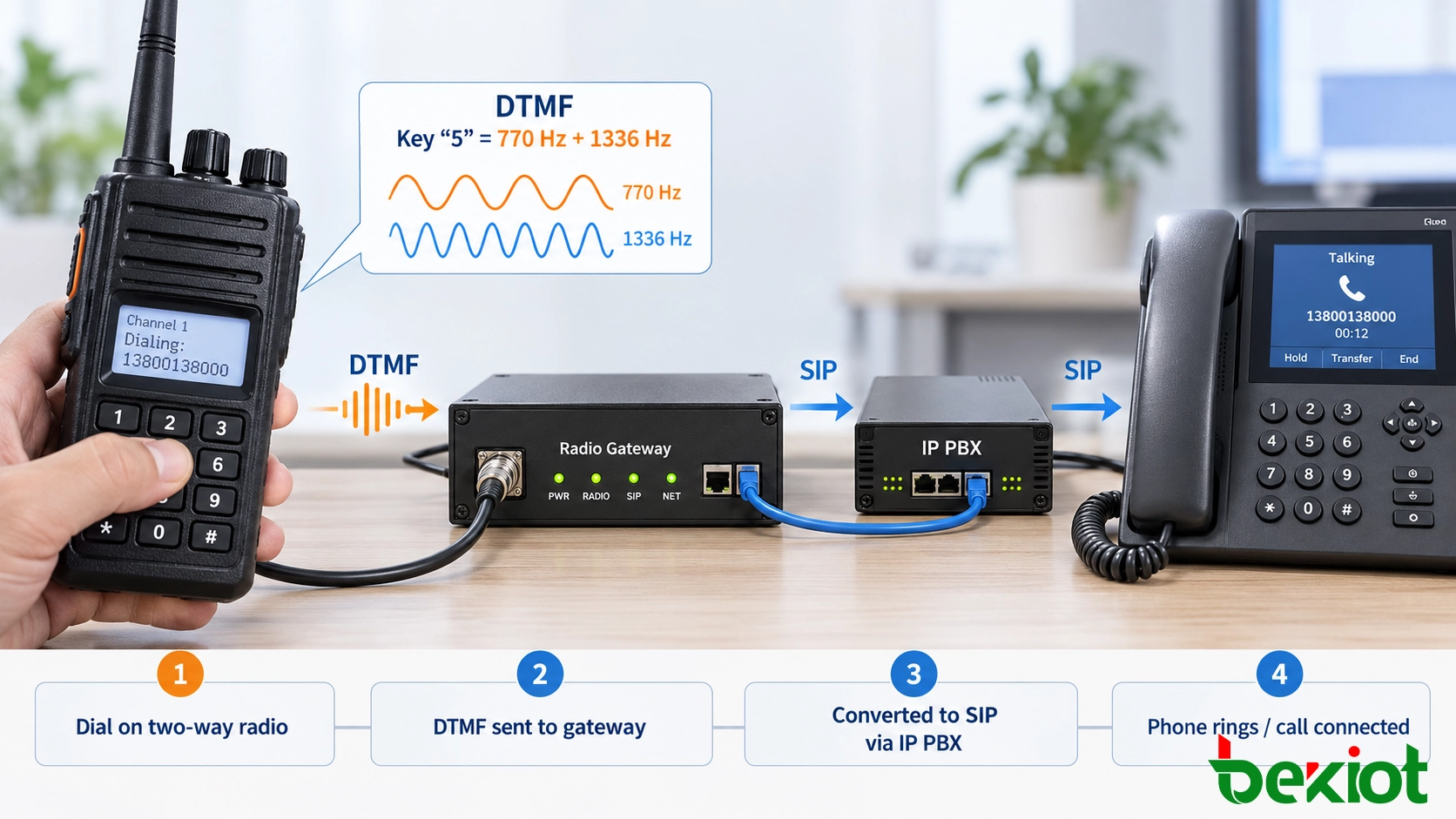
Pressing the number 5, for example, produces 770 Hz and 1336 Hz simultaneously. Because each key uses a unique frequency pair, a DTMF receiver can identify digits quickly and reliably.
Modern IP telephony uses SIP for call establishment, but DTMF remains important in many communication systems. In a radio-to-phone application, DTMF can provide the bridge between a radio keypad and the telephone numbering environment. The radio generates the digits, the integration system detects them, and those digits are then used to create the required SIP call.
Two Radio Environments Require Different Approaches
Not every radio system needs the same architecture. The first design decision is to identify whether telephone interconnection is already supported by the radio infrastructure or must be introduced externally.
Trunked Radio Networks
Digital trunked technologies such as PDT, DMR trunking and TETRA can provide telephone interconnection functions through their core network infrastructure. Depending on the system configuration, telephone interfaces or interworking functions may already allow authorized radio users to dial telephone destinations.
In this environment, radio-to-phone communication can operate as a native service. The radio terminal sends the dialing information to the trunked network, and the network handles routing toward the telephone system. An additional external radio gateway may therefore not be necessary.
Conventional Radio Systems
Conventional analog radios, standalone digital radios, mobile radios and many base stations do not have a telephone switching core behind them. They communicate on assigned channels but have no direct method for generating a SIP call toward an IP PBX.
This is where a radio-to-SIP integration layer becomes necessary. A gateway connects to the radio equipment through suitable audio and control interfaces. Radio audio can then be carried across the IP network while PTT and related control signals are coordinated separately.
The advantage of this approach is that the existing radio network does not need to be redesigned simply because telephone connectivity is required. Radios can continue using their established frequencies, channels and operating procedures while the gateway introduces access to the SIP communication environment.
What the Radio Terminal Must Support
The ability to connect radio audio with a telephone platform does not automatically mean that every radio can dial arbitrary numbers. The terminal itself must provide a practical way for the user to send destination information.
For direct number dialing, two capabilities are especially important.
Number entry: the user needs a keypad or another interface that allows a destination number to be entered.
DTMF transmission: the radio must be capable of generating DTMF tones that can be detected by the integration system.
If a radio has both capabilities, the user can potentially enter different telephone numbers according to the dialing permissions configured in the system.
A radio without a keypad can still participate in telephone communication. The operating model simply changes. The radio can be assigned a predefined hotline, fixed extension or preset call destination. Pressing a programmed key or triggering a defined call procedure can then establish the connection without requiring the field user to enter the entire number.
This distinction is important during system design. A project should not specify unrestricted radio-to-phone dialing unless the actual field terminals are capable of supporting the required user interaction.
From DTMF Digits to a SIP Call
The most useful way to understand the solution is to follow one call from beginning to end. Consider a field operator who wants to contact an office extension from a conventional radio.
The user enters the destination. The radio generates the corresponding DTMF tones for the telephone number.
The digits are detected. The integration system monitors the radio audio, identifies the DTMF sequence and collects the required number.
A telephone call is created. The collected number is converted into the signaling required by the SIP environment. A SIP INVITE can then be sent toward an IP PBX, softswitch or unified communications platform.
The platform applies its dial plan. The SIP system determines whether the destination is an internal extension, another communication service or an authorized external telephone route.
The called party answers. Once the call is accepted, an RTP media session carries voice between the SIP side and the radio integration point.
Talk control continues during the call. The integration system manages radio transmission and reception so the telephone user and radio user can take turns speaking.
To the operator, the process can resemble a normal telephone call: enter a number, wait for connection and begin speaking. Technically, however, several different signaling and media processes are being coordinated in the background.
Why Talk Control Is More Complex Than Dialing
Establishing the SIP call is only part of the problem. Radio and telephone users do not normally communicate in the same way.
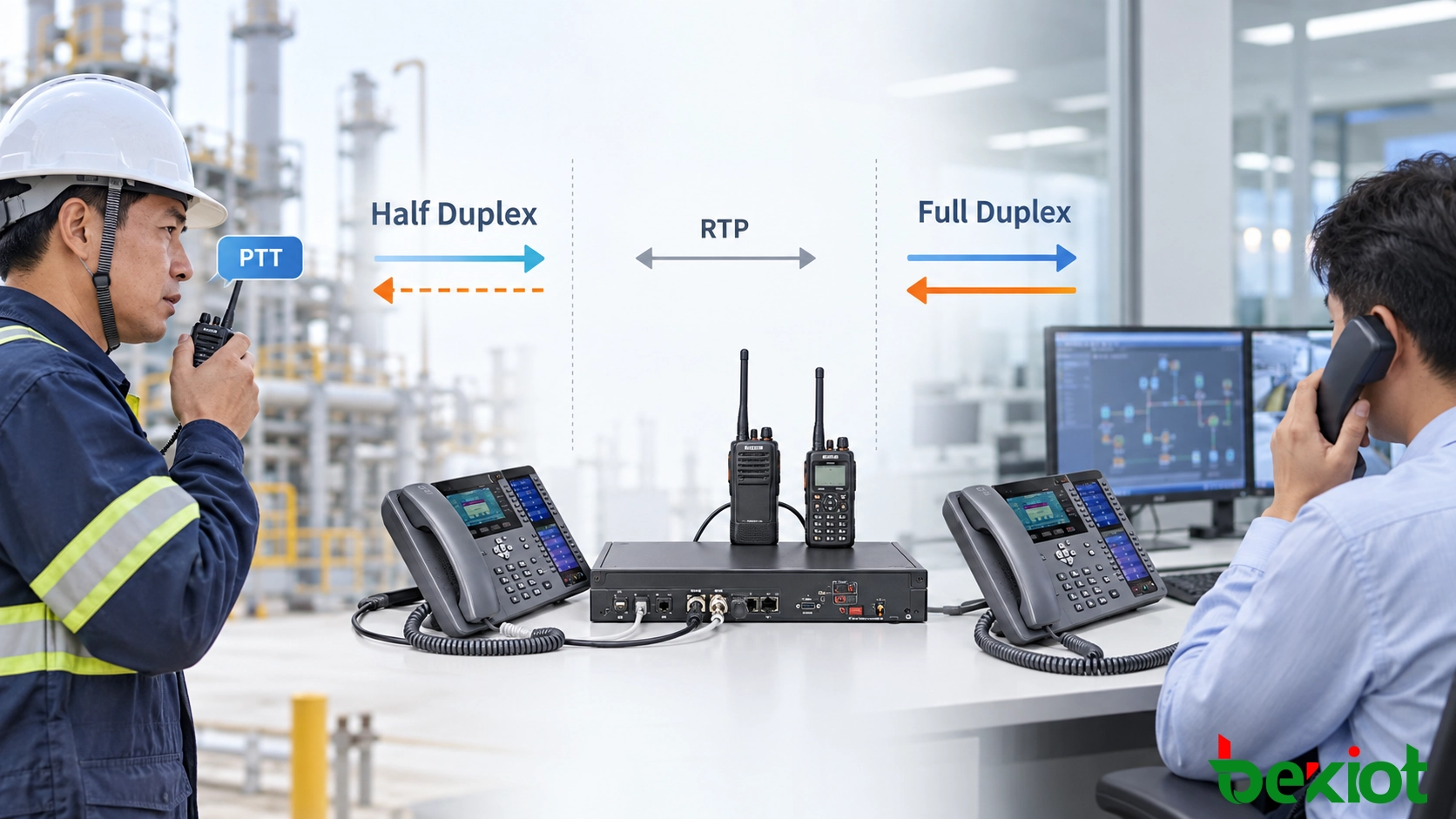
A telephone conversation is generally full duplex. Both parties can transmit and receive audio at the same time. A conventional two-way radio channel is normally half duplex. One side transmits while the other side listens, and the direction changes according to PTT operation.
The integration layer must therefore control when telephone audio is transmitted onto the radio channel and when the radio side is allowed to transmit back toward the telephone user.
PTT control is central to this process. Depending on the radio equipment and architecture, the system can use physical PTT control, carrier detection, COR/COS information, VOX, voice activity detection or other signaling methods to manage the radio path.
Correct timing matters. If the telephone side continuously occupies the radio transmission path, the field user may not obtain an opportunity to transmit. If PTT activation or release is too slow, the beginning or end of spoken sentences can be clipped.
For this reason, audio quality alone should not be used to judge whether a radio-to-phone integration is successful. Talk-control behavior, switching delay and user operating procedures are equally important.
Call Direction Can Be Designed Around the Workflow
Technically allowing a field radio to enter arbitrary telephone numbers does not always mean it is the best operating method. In many industrial and command environments, field personnel use radios because communication must remain fast and simple.
Asking an operator to activate the correct radio function, enter several digits, wait for call establishment and then manage PTT may introduce unnecessary steps. The required call direction should therefore be selected according to the real operating workflow.
A maintenance team, for example, may only need to reach one control-room extension. In that case, a predefined hotline can be more efficient than unrestricted dialing. A dispatcher, by contrast, may need telephone access to multiple radio channels and therefore benefit from channel extensions defined in the IP PBX.
Telephone-to-radio access is often particularly practical. An office user can dial an extension assigned to a radio resource. The communication system then establishes the connection to the required channel without asking the field radio user to dial anything.
A mature design can support several methods at the same time:
radio keypad dialing to authorized telephone destinations;
one-key hotline calling from selected radio terminals;
telephone extensions mapped to individual radio channels;
dispatcher-controlled radio and telephone interconnection;
predefined emergency routes for critical operating scenarios.
The objective is not to make a radio behave exactly like a telephone. It is to give users the shortest practical path to the person or communication resource they need.
Shared Channels Change the Meaning of a Phone Call
Another important consideration is privacy. A telephone call is normally understood as communication between two endpoints. A conventional radio channel is a shared communication resource.
If telephone audio is transmitted onto a conventional radio channel, other radios monitoring that channel may also receive the conversation. Likewise, transmissions from other authorized radio users on the channel may enter the connected telephone call.
This behavior is not necessarily a fault. In operational environments such as maintenance, security or emergency response, group awareness can be useful. However, it must be considered when telephone conversations contain sensitive or personal information.
Digital radio systems can provide individual-call or private-call functions when supported by the network and terminals. Conventional systems may instead require separate channels, controlled routing or operational policies to keep different types of communication separated.
Numbering permissions should therefore be designed together with radio channel policy. Simply allowing every channel to call every telephone destination can create both security and operational problems.
Planning the Solution Before Deployment
A radio-to-phone project should begin with the communication workflow rather than with individual devices. The engineering team first needs to understand what users are expected to accomplish.
Important questions include:
Which radio users need to initiate telephone calls?
Do their radios contain numeric keypads?
Can the terminals generate usable DTMF signaling?
Should users dial arbitrary numbers or only predefined destinations?
Which radio channels need telephone access?
Does the existing radio system already support telephone interconnection?
Will calls remain internal to the IP PBX or reach external telephone networks?
How should PTT control and radio activity detection operate?
Should telephone audio be available to an entire radio channel or only selected users?
Network conditions should also be evaluated. SIP signaling and RTP media depend on the IP path between the integration point and the communication platform. Excessive latency, packet loss or unstable connectivity can affect call setup, voice quality and talk-control timing.
Before commissioning, the project should test both directions of communication. Testing should include dialing accuracy, call setup, PTT switching, first-word clipping, call release, unauthorized destination blocking and recovery after temporary network interruption.
The result should be an operating method that feels natural to both field and office users. A technically connected system is not sufficient if the call procedure remains too complicated for everyday use.
FAQ
Can a radio call an external mobile phone?
Yes, provided that the connected telephone platform has an authorized route to the mobile or public telephone network. The radio-to-SIP connection establishes access to the telephone platform, while the IP PBX or telecommunications service determines whether the requested external number can be reached.
Can the same radio channel have its own SIP extension?
Yes. A radio resource can be associated with a dedicated extension or routing rule. This allows telephone users or other SIP endpoints to reach a particular radio channel through a predictable number.
Can several radios share one telephone connection?
They can when those radios operate on the same shared channel or talk resource. In that case, the telephone connection effectively becomes part of the channel conversation. Projects that require individual communication should use an architecture that supports separate radio resources or individual calling.
Can radio-to-phone calls be recorded?
Yes, if the communication platform or recording system receives the required SIP/RTP media. Recording design should also consider which direction of the call must be captured and any applicable privacy or compliance requirements.
Does DTMF always have to travel as an audible tone?
Not necessarily. Different sections of the communication path can handle digit information in different ways. DTMF may originate as audio on the radio side and later be represented through SIP-compatible signaling within the IP environment. The exact method depends on the integration design.
What happens if a radio user enters an unauthorized number?
The telephone platform can apply dial-plan restrictions, user permissions or destination rules. This makes it possible to allow radio users to reach approved extensions while blocking international, premium-rate or other unauthorized destinations.
A two-way radio can therefore call a telephone number when the complete communication path supports three essential functions: the radio can provide destination information, the integration layer can translate that information into telephone signaling, and the system can coordinate PTT-based radio communication with the telephone media session.
The most effective deployment does not try to turn every radio into a conventional telephone. Instead, it uses DTMF, SIP routing and controlled radio interworking to provide the specific telephone access required by field users, dispatchers and control-room personnel.