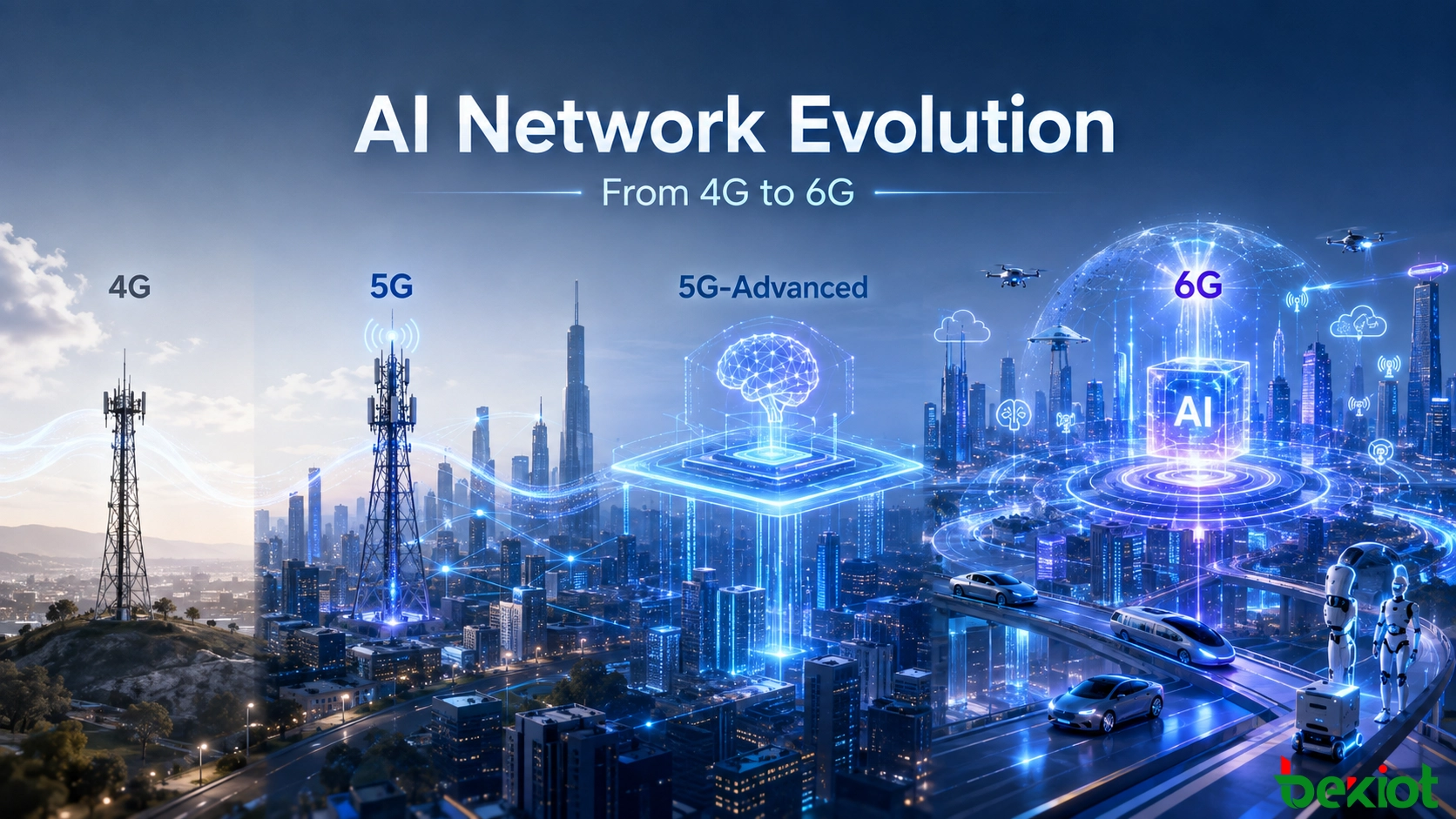
Artificial intelligence did not suddenly enter telecommunications with the arrival of generative AI. Its influence on mobile networks has been developing for more than a decade, closely following the evolution from 4G to 5G, 5G-Advanced, and eventually 6G. What has changed most is not simply the number of AI models deployed in the network, but the role intelligence plays inside the communications architecture.
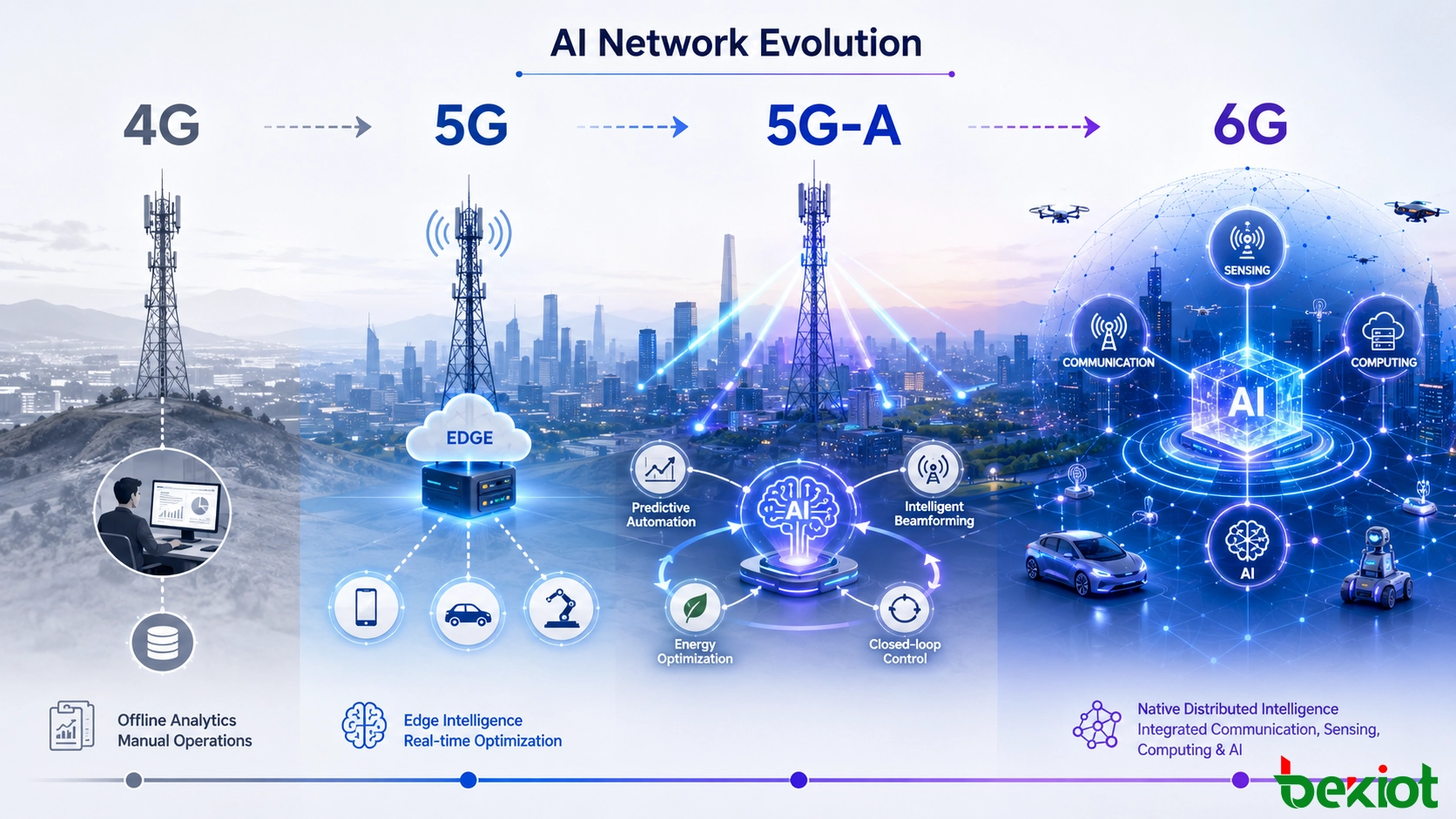
In 4G, AI was largely an offline analytical tool. With 5G, intelligence moved closer to the radio network and began assisting real-time optimization. In 5G-Advanced, AI is becoming part of an end-to-end operational framework capable of prediction, resource coordination, and automated recovery. The longer-term 6G vision goes further by treating intelligence as a native architectural capability rather than an external function added after the network has already been designed.
This evolution changes the purpose of the network itself. A mobile infrastructure that once focused primarily on transporting data is gradually becoming capable of sensing conditions, analyzing behavior, predicting demand, allocating resources, detecting abnormal states, and adjusting itself according to service requirements.
From Assistance to Native Intelligence
The relationship between AI and mobile communications can be understood as a progression through four distinct stages. Each generation increases both the depth of intelligence and the speed at which AI can influence network behavior.
| Network Stage | Role of AI | Typical Functions | Level of Automation |
|---|---|---|---|
| 4G | Offline analytical assistant | Traffic statistics, alarm classification, complaint labeling, periodic reports | Primarily manual |
| 5G | Network optimization assistant | Load balancing, user steering, mobility prediction, interference optimization | Local and partially automated |
| 5G-Advanced | End-to-end intelligence layer | Fault prediction, intelligent beamforming, energy optimization, adaptive resource scheduling | Proactive and increasingly closed-loop |
| 6G | Native network foundation | Distributed intelligence, autonomous learning, semantic communication, global resource coordination | Designed for high-level autonomy |
The key transition is from AI outside the network to AI inside the network control process. Early systems analyzed historical information after events had already occurred. More advanced architectures increasingly use real-time information to influence what the network does next.
That difference is fundamental. Offline analytics can explain yesterday's congestion. Closed-loop intelligence can detect increasing load, predict what is likely to happen, adjust resources, and evaluate whether the change actually improved the service.
4G: Analytics Without Closed-Loop Control
The primary objective of the 4G era was high-speed mobile broadband. Network architecture, radio equipment, transport resources, and operations processes were designed mainly around moving increasing volumes of data efficiently.
Artificial intelligence had very little influence on the underlying communications architecture. Most intelligent processing took place in centralized IT or cloud environments rather than inside radio access or edge infrastructure.
Typical applications included traffic statistics, alarm classification, complaint analysis, and periodic network reports. These tools could help engineers understand what had happened, but they normally operated after the event rather than participating directly in network control.
Optimization therefore depended heavily on engineering teams. Cell parameters, neighboring-cell relationships, power thresholds, interference problems, and other radio settings frequently required manual analysis and adjustment.
This approach worked reasonably well when network behavior was relatively predictable, but it became increasingly inefficient in locations where demand changed significantly over time. Business districts, railway stations, transport hubs, and other areas can experience strong traffic fluctuations. A configuration that performs well during quiet periods may be unsuitable during a sudden peak.
Without distributed edge computing and intelligent functions close to the base station, AI could not continuously analyze local conditions and immediately modify network behavior. There was no mature real-time cycle connecting data collection, intelligent analysis, decision-making, and automated execution.
As a result, the main value of AI during this stage was operational visibility rather than autonomous optimization. It helped organize information for engineers but had limited ability to directly improve the network in real time.
5G Brings Intelligence to the Edge
The transition to 5G significantly changed the operating environment. High-definition video, cloud gaming, large-scale IoT deployment, and rapidly increasing device density introduced more dynamic traffic patterns and more complex radio conditions.
Traditional optimization based primarily on manual engineering and fixed algorithms became increasingly difficult to scale. One important architectural change was therefore the movement of computing capability closer to the network edge.
With intelligence deployed nearer to radio access infrastructure, network data could be collected and analyzed with millisecond-level responsiveness. AI systems could continuously observe information such as channel quality, interference conditions, user mobility, and cell load rather than relying exclusively on periodic offline analysis.
This enabled several practical optimization functions.
Cell load balancing: traffic can be distributed more effectively when neighboring cells experience different levels of demand.
Intelligent user steering: users can be guided toward more appropriate network resources according to current conditions.
Mobility prediction: movement patterns can help the network prepare for handovers before service quality deteriorates.
Interference optimization: intelligent analysis can identify changing radio conditions and support more adaptive interference management.
These capabilities are particularly useful in dense urban areas, metro systems, campuses, transportation environments, and other locations where user density and movement patterns change continuously.
However, intelligence in conventional 5G should still be viewed as an additional optimization capability rather than a completely AI-native architecture. The underlying protocols and hardware architecture were not originally designed around autonomous decision-making across every network domain.
This limits how far automation can go. Routine congestion, mobility, and interference problems may be handled effectively, but unusual situations such as large-event traffic surges, extreme weather, or complex building obstruction can still require engineering intervention.
The operating model therefore remains largely human-led with AI assistance. Intelligence improves efficiency, but engineers still provide the final safety net for conditions that fall outside established optimization patterns.
5G-A Moves Toward Proactive Autonomy
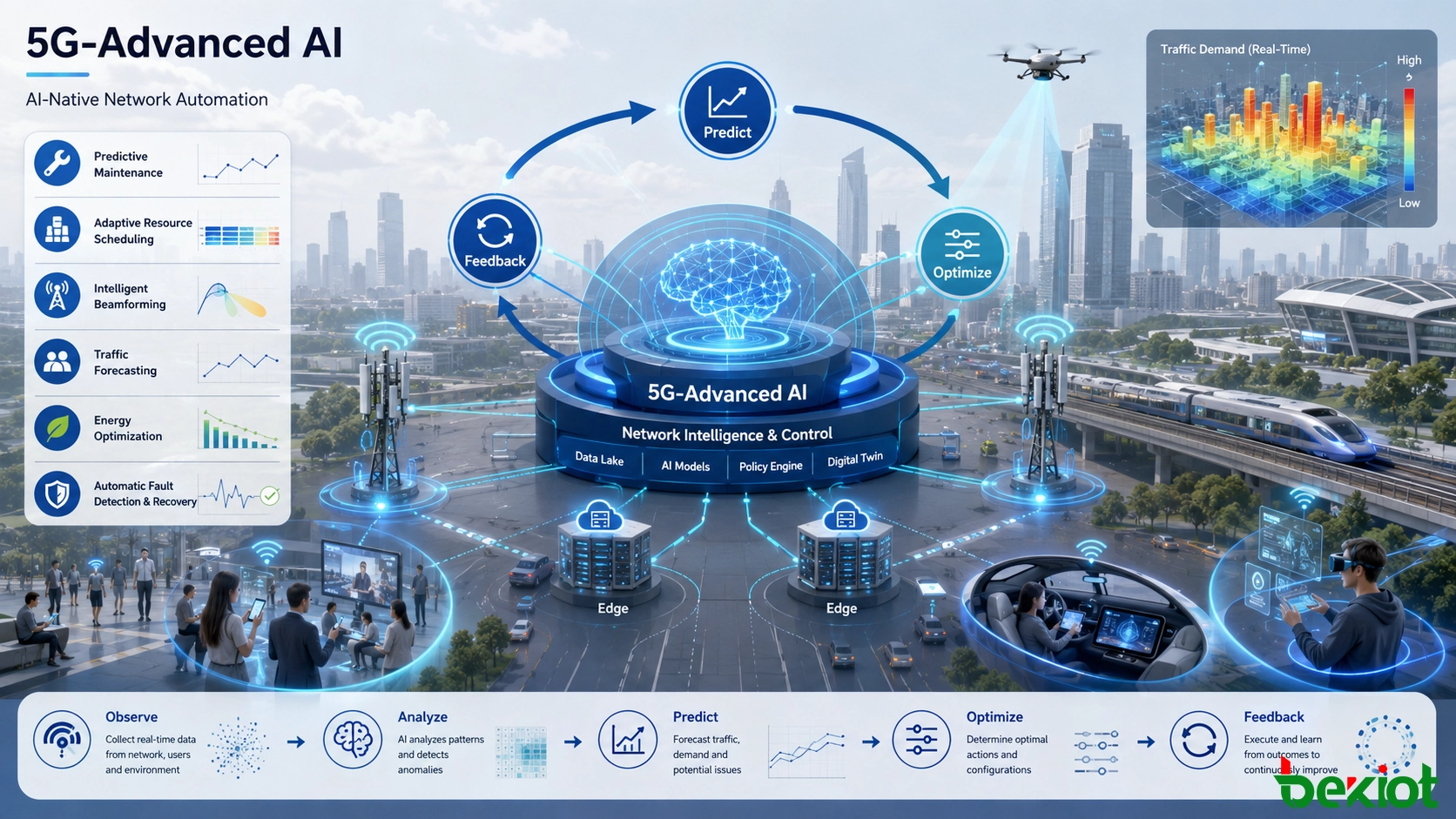
5G-Advanced represents a deeper integration between communications infrastructure and artificial intelligence. Instead of limiting AI to isolated optimization tasks, intelligence can be distributed across the radio access network, transport infrastructure, and core network.
The important change is the move from reactive management toward proactive operation. Traditional maintenance often begins after a performance problem or equipment failure has already affected the network. An intelligent architecture can use accumulated operational data to identify patterns that appear before the fault becomes visible to users.
Potential equipment aging, transmission degradation, increasing congestion, and other abnormal trends can therefore be analyzed earlier. The objective is to identify developing problems and perform intervention before they become service-affecting failures.
Predictive network operations
Historical and real-time data can be combined to recognize abnormal behavior. Instead of treating every alarm as an isolated event, intelligent analysis can examine the relationship between equipment status, traffic changes, performance indicators, and previous faults.
This changes network maintenance from a simple alarm-response process into a more predictive operational model.
Smarter radio resource use
AI-assisted beamforming can improve how radio energy is directed toward users. By adapting signal transmission according to current radio conditions, the network can concentrate resources where they are needed while reducing unnecessary interference.
The same principle applies more broadly to spectrum management. Radio resources become increasingly dynamic rather than remaining fixed according to static assumptions about demand.
Experience and energy optimization
Traffic does not remain constant throughout the day. Commercial districts, residential areas, transportation hubs, industrial sites, and campuses all have recognizable demand patterns.
AI can learn these patterns and help the network adjust resources accordingly. Capacity can be concentrated during peak periods while unnecessary resources can be reduced when demand falls. The aim is to improve service experience while also controlling energy consumption.
Adaptive industry connectivity
Private and industry-oriented networks often have requirements very different from ordinary consumer broadband. Industrial control, healthcare, and low-altitude connectivity applications may prioritize latency, reliability, isolation, or predictable resource availability.
Intelligent orchestration can help adjust network slices and available resources according to these service requirements while also responding to interference and changing operational conditions.
This stage also introduces a broader relationship often described through two complementary directions: AI4Net and Net4AI.
AI4Net means using artificial intelligence to improve the communications network itself through better efficiency, performance, maintenance, and resource control. Net4AI describes the opposite direction: an increasingly intelligent and capable network provides the connectivity and computing foundation needed by AI-enabled services and devices.
The result is a reinforcing cycle. AI improves network operation, while the improved network supports a larger range of intelligent applications.
6G Starts with Intelligence Built In
The longer-term 6G concept represents a more fundamental architectural change. Instead of designing a conventional communications network first and adding intelligence later, the network is envisioned with distributed intelligence, autonomous learning, and coordinated decision-making included from the beginning.
Communication, sensing, computing, and artificial intelligence become increasingly integrated. The network is no longer responsible only for delivering bits from one endpoint to another. It also participates in understanding the environment, distributing computing tasks, coordinating resources, and supporting intelligent machines.
Distributed intelligence across the network
Future intelligence is unlikely to exist in one centralized location. Different decisions have different latency, privacy, computing, and resource requirements.
A multi-level architecture can therefore distribute intelligence across terminals, edge nodes, base stations, and cloud infrastructure. Fast local decisions can be made closer to the user, while larger-scale coordination can use broader network information.
This creates a system in which resources can be coordinated according to the needs of individual services rather than being controlled independently within isolated network layers.
Semantic communication changes the goal
Traditional communication systems focus on transmitting bits accurately. Semantic communication explores a different concept: transmitting the information that is meaningful to the application rather than always transferring every piece of raw data.
For intelligent machines, this can be particularly important. Two AI systems may not need to exchange every original data sample if the task can be completed by sharing selected features, intent, or semantic information.
Reducing redundant information could make communication more efficient for future XR services, autonomous vehicles, intelligent robots, and other applications that may generate enormous volumes of interactive data.
RIS makes the environment programmable
Reconfigurable Intelligent Surfaces, or RIS, introduce another important concept. Traditional radio engineering largely accepts the physical propagation environment as something the network must work around.
RIS changes that assumption by allowing electromagnetic propagation to be dynamically influenced. Combined with intelligent control, reflective surfaces can adjust signal paths to improve coverage, reduce interference, or help reach areas that are difficult to serve through conventional propagation alone.
Instead of improving connectivity only by adding more transmitting hardware, parts of the radio environment itself can become controllable.
Autonomy moves beyond fixed rules
Earlier generations depend heavily on parameters, thresholds, and rules created in advance by engineers. A more intelligent 6G architecture aims to reduce this dependency.
The network would increasingly learn from changing conditions, coordinate resources across domains, and adapt its operating behavior according to service requirements and environmental conditions.
The long-term objective is a communications infrastructure that can organize, optimize, and recover with significantly less manual intervention.

What This Evolution Changes
The move toward intelligent communications has consequences far beyond adding AI software to existing network-management platforms. It changes how the infrastructure should collect information, distribute computing resources, execute decisions, and evaluate performance.
Intelligence must follow the workload
Centralized cloud computing remains valuable for model training and large-scale analysis, but not every network decision can wait for a distant data center. Mobility, interference, radio scheduling, and other time-sensitive processes may require intelligence closer to the point where the data is generated.
The evolution from 4G to 5G therefore demonstrates an important architectural principle: computing capability must be distributed according to response-time requirements.
Data becomes an operational resource
AI cannot optimize a network that it cannot observe. Radio conditions, traffic demand, equipment status, mobility patterns, and service behavior become critical inputs to intelligent decision-making.
The value of this information also increases when different domains can be analyzed together. An isolated radio indicator may explain only one part of a problem, while combined information from access, transport, core, and service layers can provide a more complete operational picture.
Closed-loop operation becomes essential
The evolution toward autonomy requires more than generating recommendations. Intelligence needs to become part of a repeatable cycle:
observe current network conditions;
analyze patterns and detect changes;
predict likely service or equipment impact;
select an appropriate response;
apply the change to network resources;
measure the result and continue learning.
This closed-loop approach is what separates analytical intelligence from operational intelligence. The network does not merely describe its condition; it increasingly participates in improving that condition.
Optimization becomes multi-objective
Future networks cannot optimize only for maximum throughput. They must balance coverage, latency, reliability, energy consumption, spectrum efficiency, service requirements, and resource availability.
AI becomes useful because these objectives often change according to location and time. The best resource configuration for a crowded transportation hub may be very different from the best configuration for an industrial private network or a low-traffic residential area at night.
Intelligent scheduling allows network behavior to become more closely aligned with actual operating conditions.
Strategic Takeaways for Network Planning
The progression from 4G to 6G shows a consistent direction: artificial intelligence is moving from the edge of telecommunications operations toward the center of network architecture.
In 4G, intelligent tools mainly helped engineers understand historical network behavior. In 5G, edge computing allowed AI to participate in faster and more localized optimization. 5G-Advanced expands this approach across more network domains and introduces stronger capabilities for prediction, self-optimization, energy management, and automated resource coordination.
The 6G vision extends the concept further by making intelligence native to the communications architecture. Distributed learning, semantic communication, programmable radio environments, and coordinated communication-computing resources point toward infrastructure that is designed not only to carry intelligent services but to operate intelligently itself.
This also changes the basis of competition in telecommunications. Network capability will increasingly be measured not only by peak rate, bandwidth, coverage, or hardware performance, but also by how effectively the infrastructure can understand demand, schedule computing and communication resources, adapt to different scenarios, and operate autonomously.
5G-Advanced is therefore an important transition rather than simply an incremental radio upgrade. The operational data, intelligent models, automation experience, and application scenarios accumulated during this stage can provide practical foundations for more deeply integrated intelligence in future 6G systems.
As communication, sensing, computing, and intelligence continue to converge, the network is gradually changing from a passive transport infrastructure into an active digital foundation capable of supporting increasingly autonomous devices, applications, and industries.
FAQ
Why is edge computing important for intelligent mobile networks?
Many radio and mobility decisions must be made quickly. Moving computing resources closer to the access network reduces the distance between data collection, analysis, and action, making real-time optimization more practical than relying only on centralized offline processing.
Why is 5G-Advanced considered an important bridge toward 6G?
It provides a practical environment for expanding AI across radio, transport, and core-network operations while accumulating operational data, automation experience, intelligent models, and industry use cases that can support future native-intelligence architectures.
Which environments benefit most from adaptive optimization?
Locations with highly variable demand or complex mobility patterns can benefit significantly. Examples include dense urban areas, transportation systems, campuses, industrial environments, and locations where traffic changes sharply according to time or events.
Why will computing resources become increasingly important in network planning?
Future services depend on both connectivity and intelligent processing. As AI functions become distributed across terminals, edge infrastructure, radio nodes, and cloud systems, the ability to coordinate computing resources becomes increasingly connected to service quality.
Will future networks completely eliminate human operation?
The direction is toward higher levels of automated analysis, prediction, optimization, and recovery. However, the progression from 5G toward more autonomous architectures is gradual, with each generation increasing the range of decisions that can be handled intelligently rather than changing the entire operating model at once.