


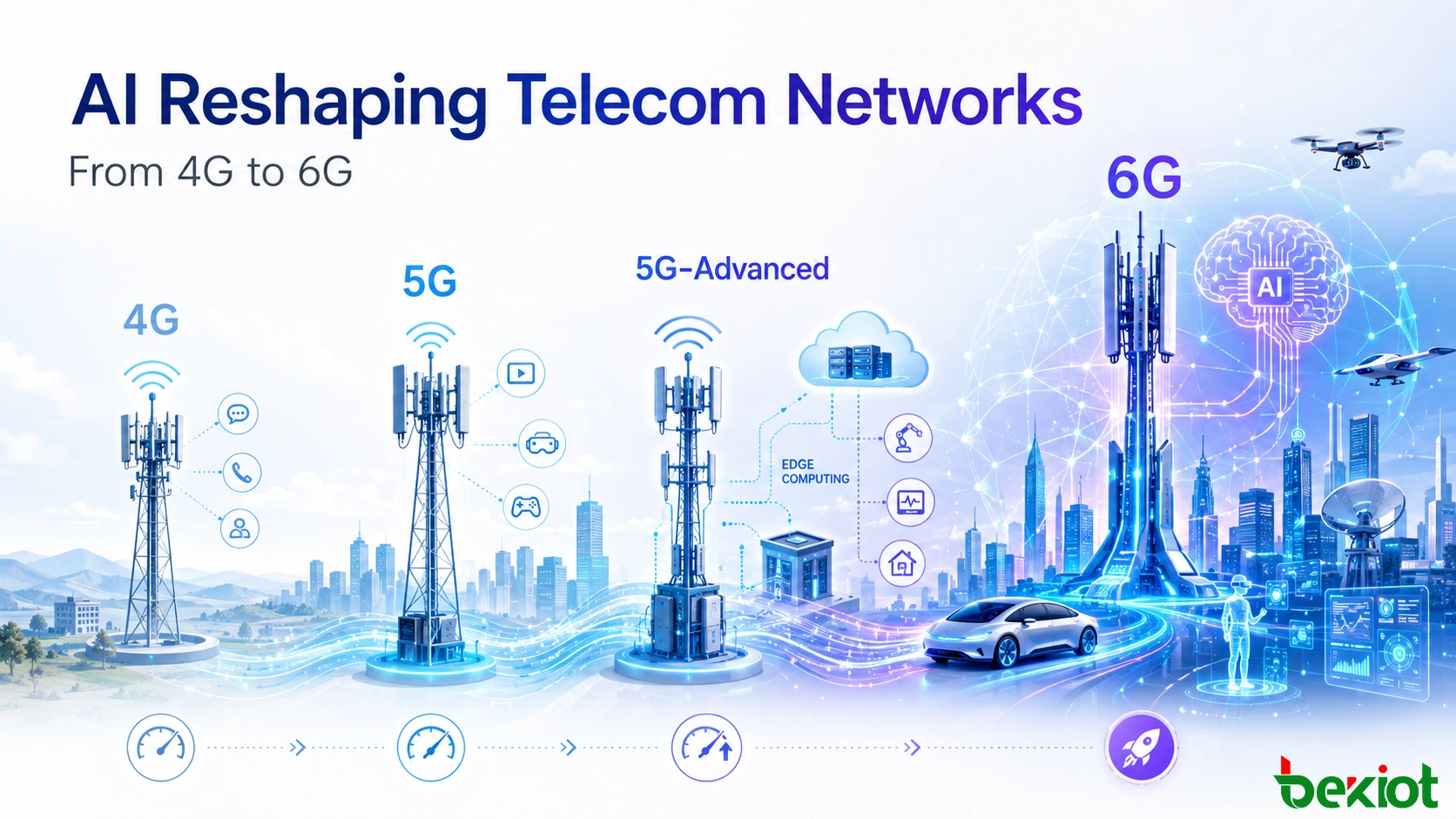
Artificial intelligence is changing mobile networks at a much deeper level than adding smarter monitoring software. Across more than a decade of mobile-network evolution, AI has moved from offline data analysis in the 4G era to real-time optimization in 5G, deeper closed-loop intelligence in 5G-Advanced, and the emerging vision of AI-native 6G. The network itself is gradually changing from a passive data transport system into an infrastructure capable of sensing conditions, predicting changes, allocating resources, identifying faults, and adapting its behavior.
For operators and enterprises, this transition changes how networks should be designed and managed. Future performance will depend not only on bandwidth, radio coverage, and hardware capacity, but also on how effectively computing resources, data, AI models, radio resources, and operational policies can work together. Understanding this progression helps explain why AI is becoming a fundamental part of network architecture rather than simply another software feature.
How Network Intelligence Has Evolved
The relationship between AI and mobile communications has developed alongside each generation of network technology. The important change is not simply that algorithms have become more sophisticated. Intelligence has progressively moved closer to the network itself, while the time between observing a condition and responding to it has become shorter.
| Network Stage | Role of AI | Typical Capabilities | Operating Model |
|---|---|---|---|
| 4G | Offline analytical tool | Traffic statistics, alarm classification, reporting, complaint analysis | Human-led optimization |
| 5G | Network optimization assistant | Load balancing, mobility prediction, interference analysis, user distribution | Human-led with AI assistance |
| 5G-Advanced | Integrated operational intelligence | Predictive maintenance, adaptive optimization, intelligent resource scheduling, energy management | Increasingly closed-loop operation |
| Future 6G | Native architectural capability | Distributed intelligence, autonomous learning, semantic communication, intelligent radio environments | Toward highly autonomous networking |
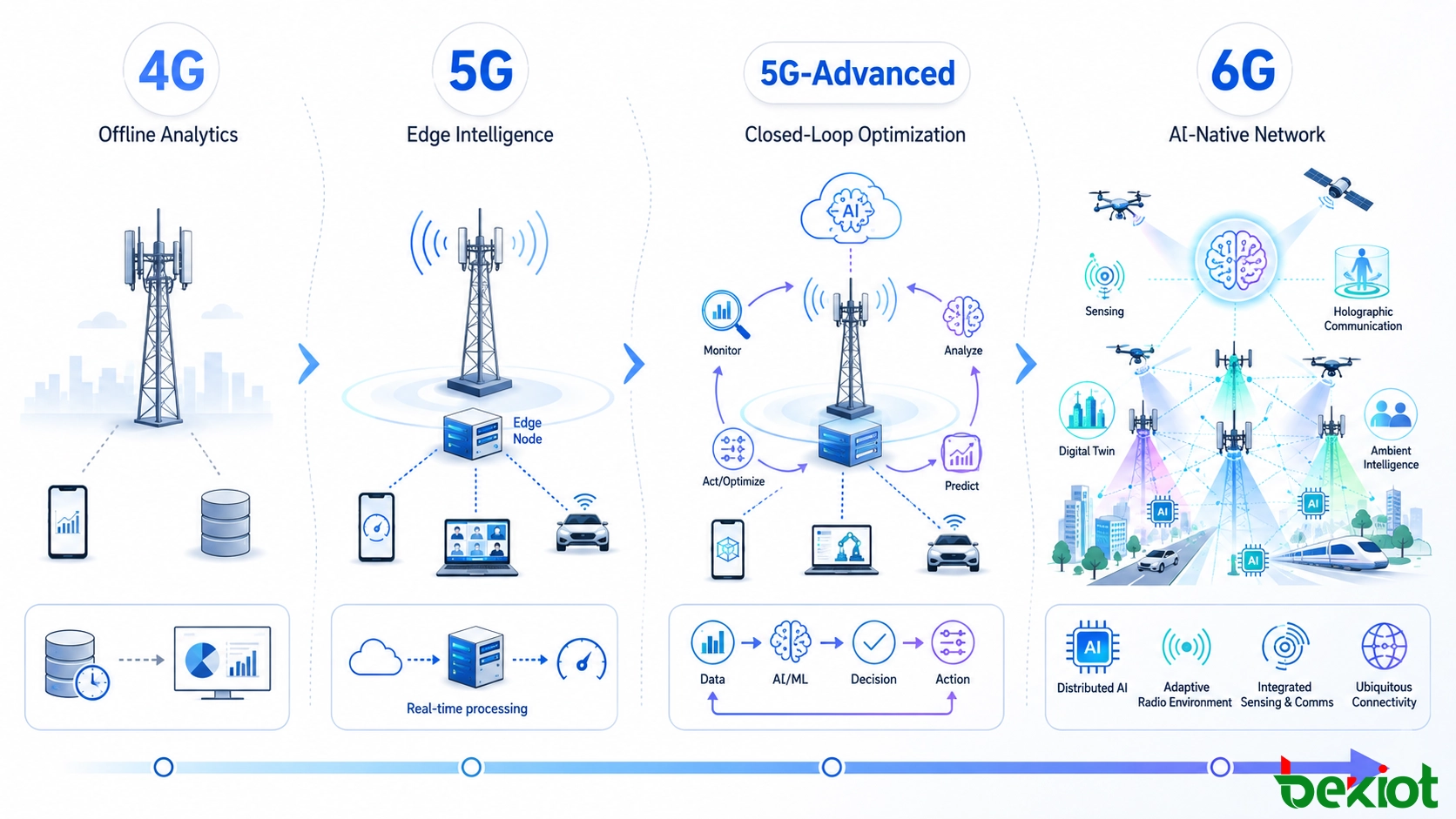
This progression can be summarized as a shift from AI being placed outside the network toward intelligence becoming part of how the network operates. In 4G, AI mainly interpreted historical data. In 5G, intelligence moved closer to radio resources and began influencing optimization. With 5G-Advanced, AI can participate across more of the operational chain. Future 6G concepts go further by considering intelligence during the design of protocols, resource management, computing, and radio architecture.
Why 4G Could Only Assist
The main objective of the 4G era was to expand mobile broadband and provide faster internet access. Network architecture, base stations, transport infrastructure, and operational procedures were primarily designed around reliable data transmission rather than embedded intelligence.
AI therefore operated mostly outside the active network. Typical applications included backend traffic statistics, alarm classification, customer complaint labeling, periodic reporting, and historical trend analysis. These functions could help engineers understand what had happened, but they generally did not change network behavior while an event was occurring.
Network optimization remained highly dependent on engineering teams. Cell parameters, neighboring-cell relationships, power thresholds, interference conditions, and mobility settings were adjusted through engineering tools and operational experience. When traffic changed sharply between daytime and nighttime, or when commercial districts and transport hubs experienced predictable peaks, network resources often continued operating according to predefined configurations.
The architectural limitation was important. Without widely distributed edge computing and intelligent processing close to radio equipment, AI could not continuously collect local conditions, make rapid decisions, adjust parameters, and verify whether those adjustments improved performance. Intelligence mainly supported analysis rather than creating a complete optimization loop.
This period nevertheless created an important foundation. Operators accumulated large quantities of network performance data, alarms, traffic records, and operational experience. Those datasets later became valuable when computing resources moved closer to the network and machine-learning models became capable of acting on information much faster.
Edge Intelligence Changes 5G
The 5G era introduced a much more demanding operating environment. High-definition video, cloud applications, connected devices, industrial terminals, and increasingly diverse service requirements produced a larger number of variables for engineers to manage. Traditional optimization based primarily on fixed algorithms and manual intervention became more difficult to scale.
One of the important changes was the movement of computing capability toward the network edge. Instead of sending every dataset to a distant central platform for later processing, edge systems can analyze information closer to users and radio resources. This makes much faster observation and response possible.
AI-assisted systems can continuously examine information such as channel conditions, interference levels, user distribution, mobility patterns, and cell loading. With sufficiently responsive edge processing, some analysis can operate on millisecond-level timescales rather than depending entirely on delayed offline reports.
This creates practical opportunities for automated optimization. A system may identify uneven traffic between neighboring cells and support load balancing, estimate the movement of a user before a handover occurs, direct users toward more suitable resources, or recognize patterns associated with interference.
Dense urban districts, transportation systems, campuses, stadium surroundings, and other high-traffic locations can particularly benefit from this approach because network conditions change rapidly and are difficult to manage using static settings alone.
However, intelligence in conventional 5G should not automatically be treated as fully autonomous networking. Many underlying protocols and hardware platforms were not originally designed around AI-controlled operation. AI often assists selected functions while engineers continue to define policies, validate results, and intervene when conditions fall outside expected patterns.
Large events, severe weather, unusual building environments, unexpected radio interference, or sudden changes in traffic can still produce situations where trained models do not have enough context to make a reliable decision. Human supervision therefore remains an important part of practical 5G operations.
5G-Advanced Builds a Deeper Feedback Loop
5G-Advanced represents another step because intelligence can be introduced across more parts of the end-to-end network rather than being restricted to isolated optimization functions. Radio access, transport, core-network functions, operational platforms, and computing resources can increasingly exchange data that supports coordinated analysis and decision-making.
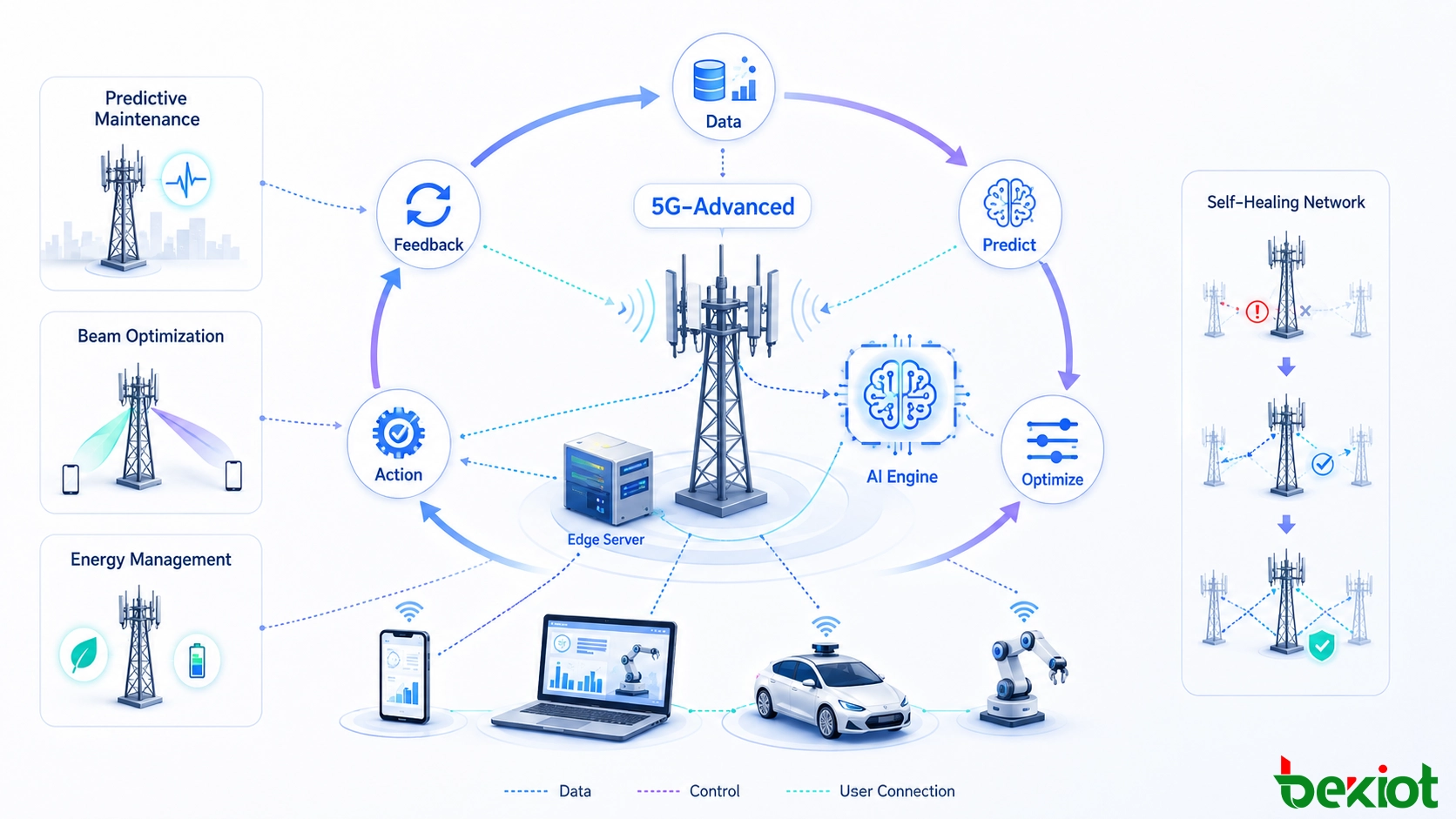
The result is a gradual transition from reactive maintenance toward predictive operation. Instead of waiting for an equipment failure, severe congestion, or degraded service to become visible to users, analytical models can look for patterns that indicate increasing risk.
Equipment behavior, link conditions, traffic development, historical alarms, and other operational information can be evaluated together. When the system identifies a developing abnormality, it can recommend or initiate action before the condition becomes a major service problem.
Radio optimization is another important area. AI-assisted beam management can help focus radio resources according to changing user distribution and propagation conditions. Intelligent interference management can improve how spectrum resources are used, while traffic prediction can support more dynamic allocation of capacity.
Energy efficiency can also become part of the same decision process. Mobile traffic follows recognizable patterns across business districts, residential areas, transportation hubs, campuses, and industrial zones. By learning these patterns, an intelligent system can identify periods when some resources can operate at reduced energy levels while maintaining required service performance.
In private-network scenarios, the same approach can support different operational priorities. Industrial automation may emphasize predictable latency and reliability, healthcare applications may require stable service for critical communications, while low-altitude connectivity and mobile robotics may introduce rapidly changing coverage and mobility requirements.
The broader concept can be viewed as a two-way relationship between AI and the network. AI for Networks, often described as AI4Net, uses artificial intelligence to improve network operation. Networks for AI, or Net4AI, considers how the communication infrastructure can provide connectivity, computing, and resource coordination for AI applications running across devices, edge nodes, and cloud platforms.
6G Is Being Designed Around Intelligence
The long-term 6G vision goes beyond adding more AI functions to an existing communications architecture. Current concepts increasingly consider communication, sensing, computing, and artificial intelligence as closely related capabilities that may be designed together from the beginning.
This distinction matters. Earlier generations were primarily communication networks that later gained intelligent functions. An AI-native architecture instead assumes that distributed learning, intelligent decision-making, resource coordination, and autonomous adaptation can be fundamental network capabilities.
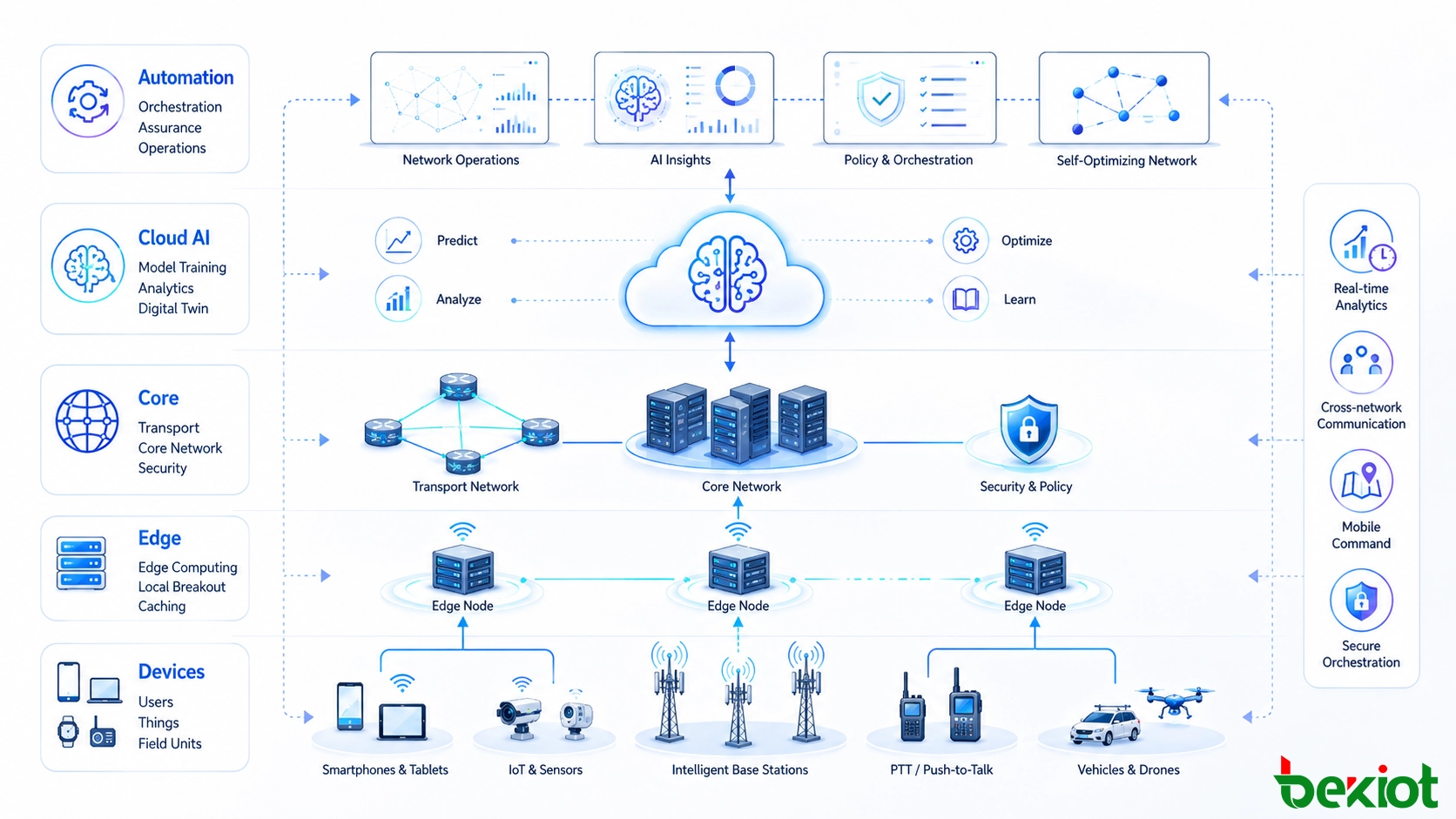
One expected direction is multi-level intelligence distributed across terminals, edge nodes, base stations, and cloud platforms. A local device may make an immediate decision using nearby data, an edge system may coordinate resources across a limited area, while higher-level systems analyze wider network conditions and long-term trends.
This hierarchy can reduce the need to send every decision to a centralized platform. It can also allow the network to respond differently depending on how quickly a decision must be made and how much data is available at each location.
Semantic Communication
Semantic communication is one of the concepts frequently associated with future intelligent networks. Conventional communication focuses on transmitting bits accurately from one point to another. Semantic approaches investigate whether communicating systems can exchange the information that is most meaningful for a task rather than always transmitting every original data element.
For machine-to-machine applications, this could reduce unnecessary data transmission when both sides understand the objective and the relevant features. Such an approach may become valuable for applications involving extended reality, autonomous systems, robots, and large numbers of intelligent devices.
Intelligent Radio Environments
Reconfigurable Intelligent Surfaces, commonly abbreviated as RIS, represent another emerging direction. Rather than treating the wireless environment as completely fixed, an RIS can be designed to influence how electromagnetic waves propagate.
AI could help determine how such surfaces should be configured according to users, obstacles, interference, and service requirements. In suitable environments, this concept may help improve coverage in difficult areas or influence propagation without relying only on additional conventional radio infrastructure.
These technologies remain part of the developing 6G landscape rather than a finished universal network architecture. Their importance lies in the larger design direction: future networks are expected to become more capable of adapting communication resources, computing resources, and the radio environment according to application requirements.
Building an AI-Driven Network Strategy
The transition toward intelligent networking does not require operators to replace an entire network at once. A more practical approach is to introduce intelligence where reliable data, clear operational objectives, and controllable network functions already exist.
The first requirement is visibility. AI cannot make useful decisions without dependable information about traffic, radio conditions, equipment status, faults, user behavior, and resource utilization. Data therefore needs to be collected consistently, synchronized where necessary, and connected with the operational context in which it was generated.
The second requirement is distributed computing. Some decisions can tolerate seconds or minutes of delay and may be processed centrally. Others, particularly those related to mobility or radio optimization, may require processing much closer to the network edge. An effective architecture therefore needs to determine which intelligence belongs in the cloud, regional infrastructure, edge nodes, or network equipment.
A third requirement is controlled automation. Predicting a problem is different from allowing a model to change live network parameters. Operators need policies that define which actions can be executed automatically, which require approval, and which must remain under direct engineering control.
Closed-loop operation can then be introduced gradually. The system first observes a condition, analyzes available data, selects an action, applies the change, measures the result, and uses that outcome as additional information for future decisions.
Security also becomes more important as decision-making becomes distributed. AI models, APIs, network telemetry, edge platforms, and automated control interfaces can all become part of the operational security boundary. Authentication, authorization, data integrity, model governance, logging, rollback mechanisms, and human override should therefore be considered as part of the architecture rather than added after deployment.
Another important issue is energy consumption. AI models require computing resources, and additional computing can itself consume significant energy. An intelligent-network strategy should therefore evaluate the total benefit of an optimization rather than assuming that more AI processing automatically creates a greener network.
The most useful performance indicators may also change. Traditional networks are often measured through throughput, latency, availability, coverage, and packet-level performance. Intelligent networks may require additional measures such as prediction accuracy, automation success rate, recovery time, energy saved per workload, model reliability, and the percentage of operations that can be completed without manual intervention.
Final Notes
The evolution from 4G to future 6G shows a consistent direction. In 4G, AI mainly helped engineers interpret historical network data. In 5G, edge computing brought intelligence closer to live radio operations. 5G-Advanced expands that role across more of the network and creates stronger links between prediction, optimization, energy management, and automated control. Future 6G concepts aim to make intelligence part of the architecture itself.
This changes what network competitiveness may mean. Capacity, coverage, bandwidth, and radio performance will remain important, but they will increasingly operate alongside distributed computing, intelligent resource scheduling, model quality, automation, and network autonomy.
The transition will not happen through one algorithm or one network upgrade. It depends on a combination of communication infrastructure, computing capacity, operational data, AI models, automation policies, and engineering governance. Networks that can coordinate these elements effectively will be better positioned to support the growing number of intelligent devices, autonomous systems, industrial applications, and digital services expected in the next generation of connectivity.
FAQ
What happens if the data used by network AI is incomplete or inaccurate?
Poor-quality telemetry can lead to misleading predictions or inappropriate optimization decisions. Network AI therefore requires data validation, time synchronization, anomaly detection, and clear information about where and how each dataset was generated. Data quality should be treated as part of network reliability rather than only as an analytics issue.
Can operators introduce AI without replacing existing network infrastructure?
In many cases, yes. Intelligence can be introduced first through monitoring platforms, analytics, edge computing, orchestration systems, and selected software-controlled functions. The degree of automation that can be achieved depends on whether existing equipment provides sufficient data, programmable interfaces, and safe control mechanisms.
Is semantic communication simply another form of data compression?
Not exactly. Compression attempts to represent the same information using fewer bits, while semantic communication focuses on whether the receiver can obtain the information needed for a specific task. The two concepts can overlap, but semantic communication places greater emphasis on meaning and task relevance.
What should be tested before enabling autonomous network actions?
Operators should validate the model under normal, abnormal, and previously unseen conditions, define safe operating boundaries, test rollback procedures, and establish clear manual override mechanisms. Autonomous control should be introduced only after the consequences of incorrect decisions are understood and containable.







