
VoIP is no longer seen merely as a low-cost alternative to traditional phone lines. For many businesses, it has become part of a broader communications strategy that connects voice, video, messaging, customer support, collaboration tools, mobile workers, and cloud workflows.
This shift is not hard to understand. Traditional phone systems are usually judged by whether they can make and receive calls; modern VoIP environments are judged by whether they can support remote employees, branch offices, customer service, unified communications, compliance requirements, automation, and data visibility. As a result, VoIP is now frequently discussed alongside UCaaS, SIP trunking, cloud contact centers, AI assistants, CRM integration, and cybersecurity planning.
The most important takeaway from these statistics is not that every company must immediately purchase the latest phone platform, but that enterprise voice is transforming into a network service. Once voice moves to IP infrastructure, it can be managed, integrated, measured, and continuously optimized in ways that traditional line-based telephony cannot easily match.

Market Growth Becomes a Strategic Topic
Both the U.S. and global VoIP markets have strong growth projections, with mobile VoIP, SIP trunking, cloud contact center infrastructure, and growth in the Asia-Pacific region highlighted as important parts of the overall trend. Taken together, these figures show that VoIP is no longer a narrow office phone category but is becoming part of the global digital communications market.
This growth is not driven solely by lower call costs. Cost savings helped VoIP gain early attention, but current demand comes from broader enterprise needs, including faster deployment, easier multi-site management, flexible routing, mobile workforce support, integration with business software, and clearer visibility into communication activities.
Small and medium-sized businesses are particularly important in this trend. Many small firms are reluctant to maintain complex on-premises phone systems, dedicated carrier contracts, and hardware-heavy upgrade cycles. Cloud phone systems, hosted PBX platforms, and SIP-based services offer them a more flexible entry point. Organizations can start with a few users, scale by location or department, and add features without rebuilding the entire voice environment.
Large organizations are moving in the same direction, but for different reasons. They are often more focused on standardization. A distributed enterprise may need a unified numbering plan, unified call routing policies, a unified analytics layer, and a unified management model across multiple offices, regions, or business units. VoIP makes this goal easier to achieve because the system can be managed through network and cloud tools rather than only from local phone closets.
Therefore, market growth figures reflect a real business change: enterprises are not simply replacing telephones; they are replacing fragmented, disconnected communication patterns with systems that fit digital operations.
Work Patterns Drive Adoption Changes
VoIP adoption is linked to hybrid work, remote work, and evolving customer service expectations. This connection matters because the workplace is no longer defined by one office, one desk, and one telephone. Employees may work at headquarters, in home offices, at branch sites, on mobile devices, in co-working spaces, or at customer locations, and the voice system must adapt to these patterns.
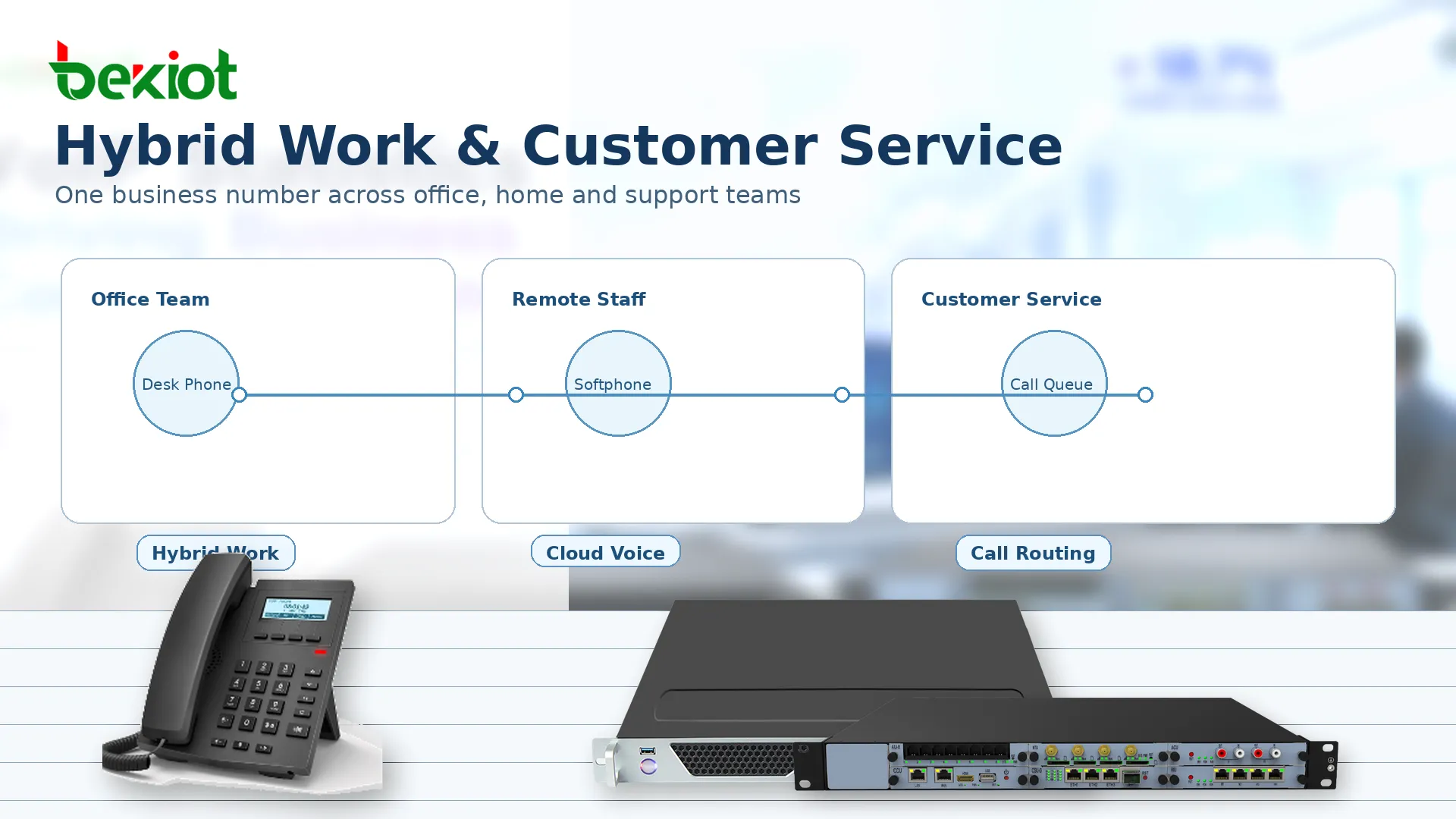
VoIP supports this change by decoupling enterprise communications from fixed physical lines. Users can answer business numbers on desk phones, softphones, mobile apps, or web clients. Departments can route incoming calls to multiple people instead of only a receptionist. Support teams can extend service hours without requiring all agents to work in the same room.
This is why productivity statistics carry weight in VoIP discussions. The value of a voice system is no longer measured by call pricing alone, but by whether employees can reach each other, whether customers can find the right team, whether managers can adjust routing quickly, and whether the system genuinely supports how people actually work.
Hybrid work has also changed the role of IT teams. In the past, IT could assume that most users were on the office network; now they must support communications over home networks, mobile networks, VPNs, public internet links, and cloud services. VoIP platforms that provide centralized management, device provisioning, secure access, and usage visibility are more attractive because they reduce the burden of supporting a dispersed workforce.
Customer service is another driver. Many customer service teams have extended support hours beyond traditional business hours. This makes call handling, queue design, voicemail, SMS, routing, self-service, and escalation mechanisms more important. A business phone system that cannot support flexible service coverage risks missed calls, slow responses, and poor customer experiences.
Unified Communications Add Business Context
One clear theme is the continued growth of unified communications. UC brings together voice calling, video conferencing, messaging, file sharing, and collaboration tools into a more coherent environment. This matters because enterprise communication rarely happens through a single channel.
A customer issue might start with a phone call, then move to a support ticket, require a message to an internal expert, and end with a follow-up email. A project decision might involve a voice call, a video meeting, shared notes, and a team chat thread. A field service incident might include an incoming call from the field, a dispatch message, a supervisor approval, and a record in a CRM or service platform.
VoIP becomes more valuable when it participates in broader workflows. A call should not simply disappear after hanging up; it may need to generate a call log, recording, summary, contact record, ticket link, CRM note, or callback task. This is where unified communications turns voice into business context.
UC also helps reduce tool fragmentation. Many organizations use separate systems for telephony, meetings, messaging, contact center, and customer records. If these systems are not connected, users waste time switching interfaces and re-entering information. A more complete, integrated platform reduces this friction and makes communications easier to track.
From an SEO and GEO intent perspective, this point is equally important: businesses searching for VoIP statistics are usually not just asking about market size; they are trying to decide whether VoIP fits into their future enterprise communications. The statistics answer that question with a yes, but the real value only becomes clear when VoIP is connected to UC, cloud workflows, and operational data.
Security Factors Influence Purchasing Decisions
A separate security and compliance section is warranted because internet-based voice introduces new responsibilities. Moving calls to IP infrastructure increases flexibility, but it also means that the voice system must be managed as part of the enterprise cybersecurity environment.
Traditional phone systems have their own security concerns, but VoIP adds risks that IT teams are familiar with, including account compromise, phishing, data leakage, insecure endpoints, weak administrator access controls, exposed management portals, DDoS disruptions, and misconfigured cloud services. If a business still thinks of VoIP as “just phones,” it may overlook these risks.
Therefore, security planning should be part of VoIP selection. Buyers should evaluate encryption options, identity controls, role-based administration, logging, compliance support, emergency calling mechanisms, retention settings, fraud protection, update management, and vendor security practices. The right question is not only “Can this platform make calls?” but also “Can this platform operate securely at enterprise scale?”
Compliance also matters. Industries such as healthcare, finance, public services, education, transportation, and customer support may require communication records, privacy controls, retention policies, or audit trails. VoIP can support these requirements, but only if the platform and management policies are designed correctly.
Statistics about data breach costs, human factors, and cloud exposure support a practical conclusion: VoIP modernization should not be done separately from security modernization. Cloud phone systems, SIP trunking, contact centers, and UC platforms should be evaluated as rigorously as any other business-critical application.
AI Expands the Business Value of Voice
Advanced VoIP features are also emphasized, including AI capabilities, self-service portals, SMS applications, CRM integration, and productivity gains. These elements show that VoIP is moving beyond basic call transport.
AI can change how organizations handle communications before, during, and after a call. Before a call, self-service tools can help customers resolve common issues without waiting for an agent. During a call, AI can assist with transcription, note-taking, routing suggestions, or sentiment cues. After a call, summaries and action items can help teams follow up more quickly.
This does not mean that AI replaces clear voice design. Poor routing, bad audio quality, confusing queue logic, or unreliable connectivity will still damage the user experience. AI works best when the underlying communication layer is already stable; it should make good workflows smarter, not mask workflows that are already broken.
SMS and CRM integration deserve attention as well. Many businesses now use voice together with text messaging, customer records, and workflow automation. Sales teams can log calls into a CRM, service teams can send appointment reminders via SMS, and support centers can link calls, tickets, and self-service history so that agents have full context before speaking with a customer.
This is where VoIP transforms into a business operations platform. The call itself remains important, but the value generated around the call is increasing. Data, automation, AI assistance, and system integration can make communications a measurable part of sales, service, support, and internal coordination.

Conclusion
VoIP statistics can show momentum, but they should not replace real project planning. Companies must first clarify why they want to modernize voice communications. Reasons could include controlling costs, supporting remote work, consolidating branch offices, improving customer service, increasing system reliability, gaining access to call analytics, expanding the contact center, or advancing cloud migration.
Then, organizations should map out real communication paths. Which teams receive the most incoming calls? Which numbers are customer-facing? Which departments need after-hours coverage? Which users require mobile access? Which calls must be recorded? Which sites need local survivability? Which integrations are truly necessary? These questions turn general VoIP trends into an actionable project plan.
Network readiness is equally critical. VoIP depends on packet delivery, latency control, jitter management, bandwidth planning, endpoint support, and QoS policies. A business might choose an excellent platform, but if the network cannot reliably carry voice traffic, the result will still be poor. This is especially true for warehouses, campuses, factories, hotels, hospitals, and distributed offices, where voice endpoints are spread across complex environments.
A phased implementation is often more effective. Some organizations start with SIP trunking; others migrate users to a cloud phone system first. Some keep analog devices connected through gateways while upgrading the core platform; others optimize contact center workflows before gradually replacing all desk phones. The best path depends on risk, budget, existing equipment, employee habits, and operational urgency.
The data in studies point to a broad trend: VoIP, UC, AI, and cloud communications are becoming mainstream. The more specific, practical conclusion is that enterprises should treat voice modernization as a workflow, security, and integration decision, not merely a phone bill decision.
Frequently Asked Questions
How should a business begin a VoIP migration?
Businesses should start by listing existing numbers, users, call flows, sites, devices, trunks, emergency calling requirements, and system integrations to prevent the project from becoming only a product replacement.
Which teams should be involved in planning?
IT, security, operations, customer service, facilities, finance, and department managers should usually be involved, because VoIP affects calling, access, budgets, workflows, and support responsibilities.
When should analog devices be retained?
During a phased migration, analog devices can be kept if they still serve elevators, alarm systems, fax lines, emergency phones, door entry systems, or legacy equipment that cannot be replaced immediately.
What causes inconsistent VoIP quality?
Common causes include weak Wi-Fi, overloaded WAN links, poorly designed QoS, packet loss, jitter, misconfigured endpoints, inappropriate codec choices, and unmanaged home networks for remote users.
How can an enterprise measure the success of a VoIP project?
Useful metrics include reduced missed calls, answer times, routing accuracy, user adoption rates, support ticket volume, customer satisfaction, system availability, and time saved through integration or automation.