


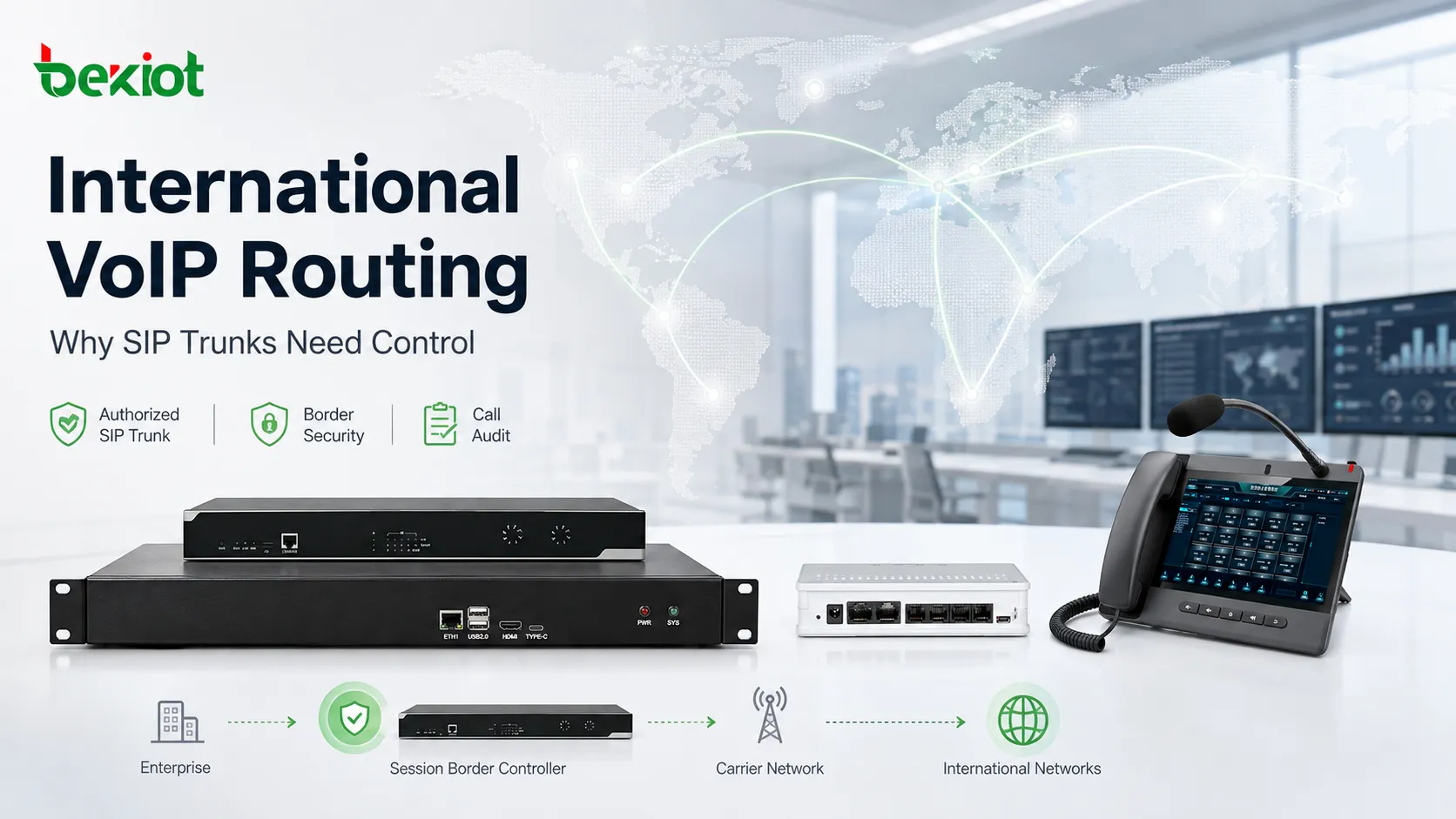
Mumbai police recently reported a case involving the alleged routing of international VoIP calls through unauthorized SIP/Trunk connections, with the calls said to have bypassed prescribed routes and terminated as local traffic. The real issue for the communications industry is not whether VoIP itself is secure. It is a more fundamental question: once voice becomes fully IP-based, who is allowed to establish a trunk, where calls enter the network, which boundaries they cross, and where they ultimately terminate all have to be controlled through architecture, permissions, and auditing rather than relying on the natural constraints of traditional telecom networks.
A Routing Bypass Incident Does Not Mean VoIP Is the Problem
SIP and VoIP are both mature communications technologies. Enterprises routinely use SIP trunks to connect IP PBXs, contact centers, cloud communications platforms, and carrier voice networks. The problem has never been that voice travels over IP. The real issue is whether the voice path is authorized, identifiable, and compliant with local telecom regulations and carrier interconnection rules.
Technically, a SIP trunk turns the physical trunk lines of the traditional telephone network into logical IP-based connections. This gives enterprises considerable flexibility: numbers can be centrally managed, multiple branches can share voice resources, additional channels can be added without deploying large amounts of new physical cabling, and cloud PBXs can interconnect more easily with on-premises telephony systems.
That flexibility also changes the risk boundary. In the past, an external line was typically tied to a clearly defined physical port and carrier circuit. Today, a SIP account, a set of credentials, an IP address, or a misconfigured routing policy can determine where a large volume of calls is sent.
So when an enterprise sees that “the SIP trunk is registered” or “international calls can be completed,” that only proves the connection works. It does not prove that the entire voice-routing design is correct. What really needs to be verified is whether call ingress, egress, number presentation, carrier interconnection, access rights, and routing changes are all under control.
For systems handling cross-border voice traffic, this information also affects billing, source identification, regulatory traceability, and incident investigation.
A professionally managed VoIP system therefore needs to move beyond the question of “Can the call go through?” and answer a more important one: “Can we explain why this call took this route?”
Why International Voice Requires Strong Route Traceability
A typical internal enterprise call may pass only through an IP PBX and a few LAN components. International voice traffic usually involves more layers, including enterprise communications systems, carrier networks, international interconnects, and the destination country's local network. The longer the path and the more systems involved, the more important routing identity becomes.
Under normal conditions, different networks interconnect through authorized relationships, and the origin of an international call should remain correctly represented throughout the communications path. If an intermediate node bypasses the approved route or converts traffic that originated internationally into another form of source identity, the issue is no longer just about voice quality or protocol compatibility.
The first impact is on source transparency. If dispatch operators, carriers, and audit systems see call numbers, routes, and actual ingress points that do not match, reconstructing the real communications path becomes difficult.
The second issue is billing and settlement. International, domestic, and inter-carrier traffic typically follows different settlement models. Unauthorized changes to the termination path can alter the commercial relationships that would normally apply to the call.
The third issue is regulatory traceability. When cross-border communications need to be reviewed for lawful monitoring or incident investigation, administrators must be able to determine which network carried the call into the country, which service entities handled it, and which network ultimately terminated it. If the traffic leaves the expected routing framework, that visibility may be lost.
This is why large enterprises should not think of a SIP trunk as simply “a phone line that runs over the internet.” It is an important boundary between the enterprise communications environment and the external public voice network.
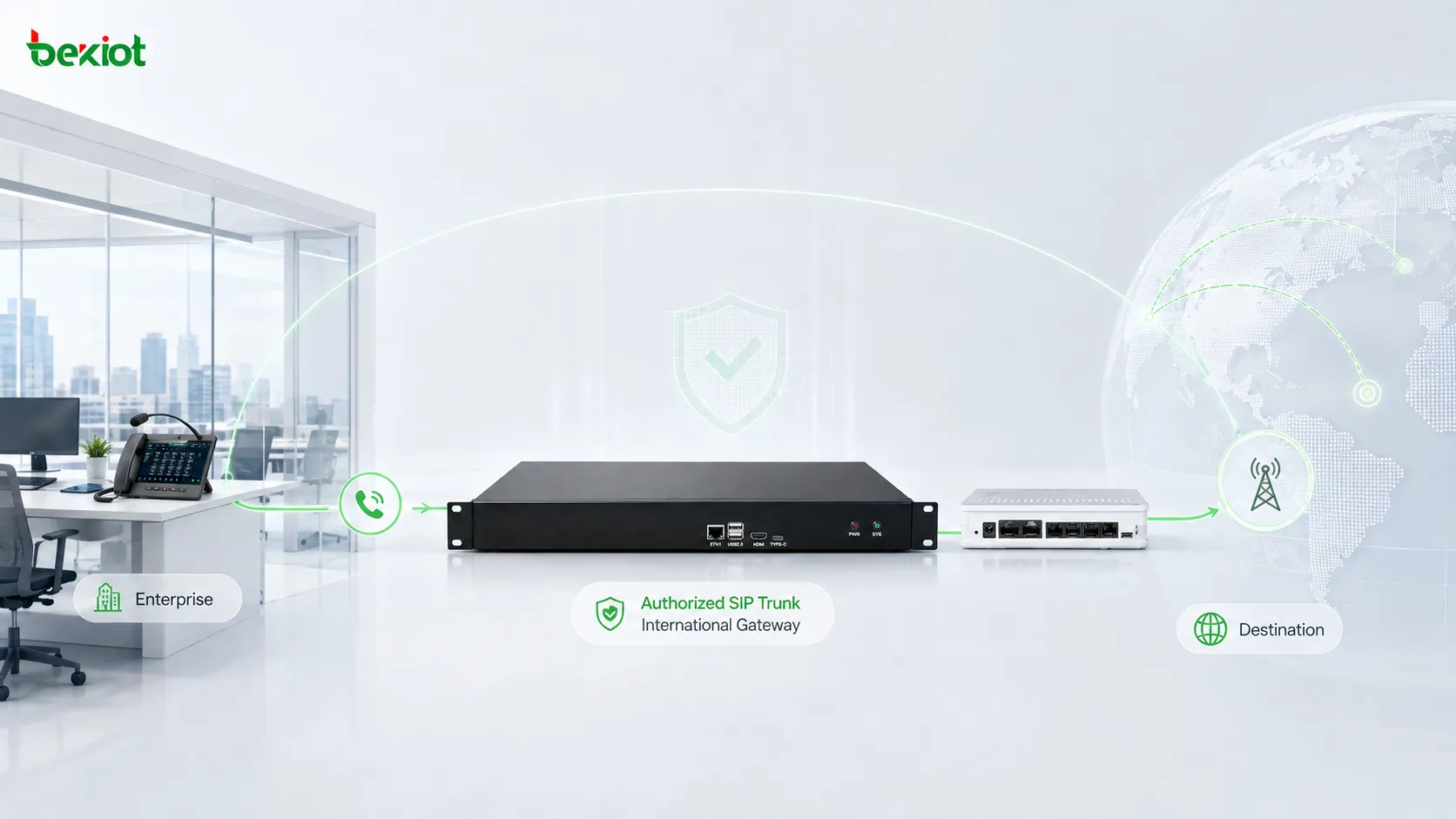
The Real SIP Trunk Risk Is Often at the Communications Boundary
Many enterprises focus their VoIP security efforts on IP PBX passwords, extension registration, and telephone endpoints, while overlooking the fact that a trunk usually has far greater privileges than an individual extension.
A normal extension may only be allowed to dial a limited set of destinations. A SIP trunk, by contrast, often serves as the main external ingress and egress path for the entire organization. If trunk credentials, permitted IP ranges, or routing policies are compromised or misconfigured, the impact may extend across the whole voice platform rather than a single telephone.
The first common risk is unclear identity and permission boundaries. Test accounts that remain active after deployment, partner access that is never revoked, and credentials shared between multiple systems all make later investigation more difficult. When something goes wrong, administrators may not even be able to answer a basic question quickly: “Who created this route?”
The second risk comes from unnecessary network exposure. Publishing SIP services directly to the public internet without clear access controls, source restrictions, and border protection leaves the platform continuously exposed to scanning, abnormal registration attempts, and automated calling activity.
A third problem is overly permissive routing. During testing, administrators may allow broad number ranges, destinations, or source networks to use the same trunk for convenience. If these temporary rules are not removed after deployment, they gradually become legacy configurations that nobody fully understands and nobody wants to change.
There is also a more subtle risk: the communications platform itself may not be compromised, but third-party access may become uncontrolled. Cloud communications providers, system integrators, remote maintenance teams, and carrier interfaces may all require access at different stages of the project. If those permissions do not have a defined lifecycle, the communications boundary expands over time.
SIP trunk security is therefore not just about using a strong password. What really needs to be managed is who can connect, where they are allowed to connect from, which destinations they can call, which routes they can modify, and whether every change is recorded.
VoIP Protection Needs to Shift from Individual Devices to Border Control
An IP PBX can be free of obvious vulnerabilities and still sit inside an insecure voice architecture. Modern enterprise VoIP increasingly needs to manage its voice boundary in the same disciplined way that data centers manage internet access.
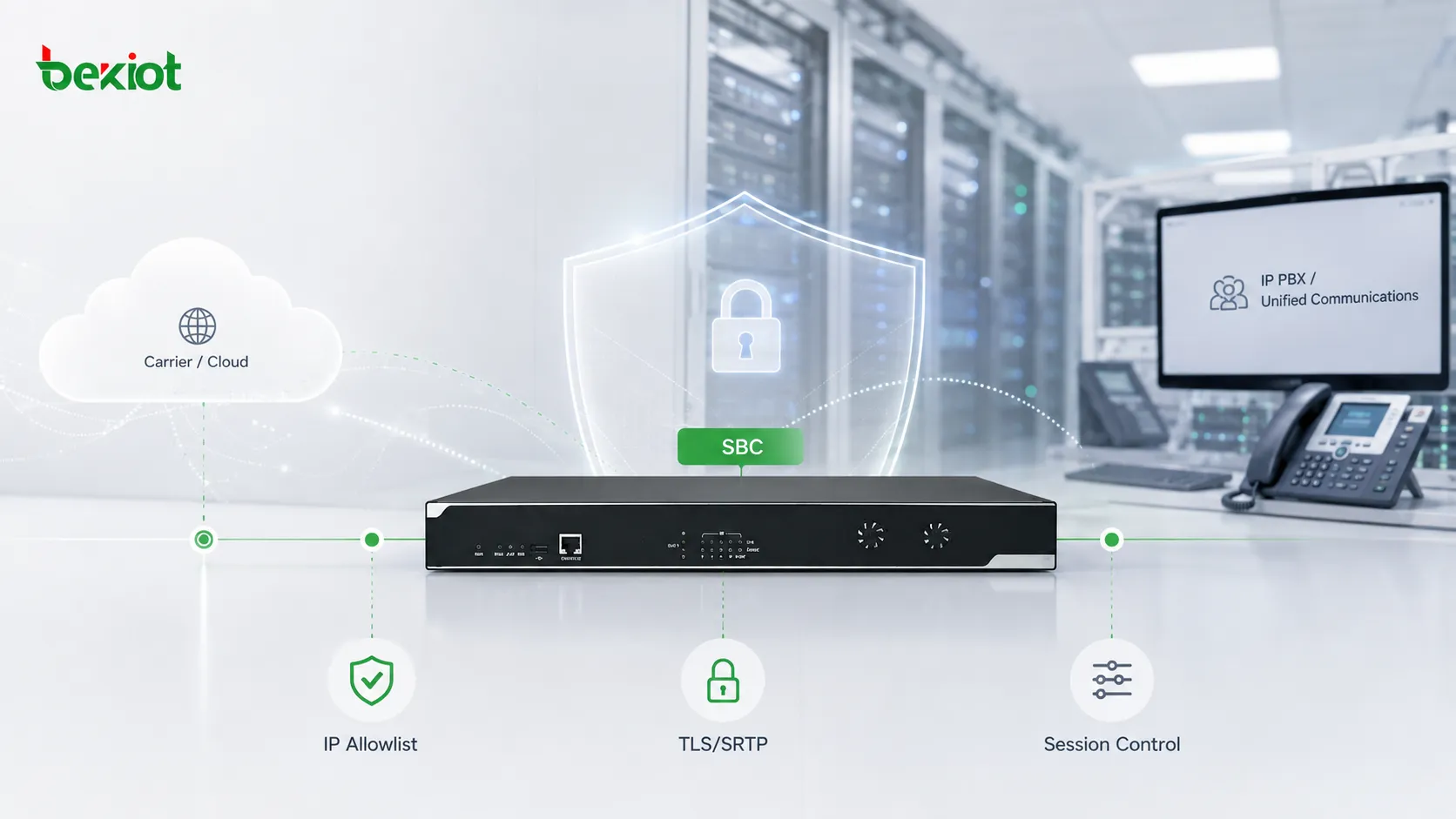
An SBC, or Session Border Controller, is a common component in this architecture. It sits between the enterprise voice environment and carriers, cloud communications services, or other SIP networks, controlling session establishment, signaling sources, media paths, and access policies.
The role of an SBC goes beyond solving NAT traversal or interoperability issues between different SIP vendors. More importantly, it creates a clear boundary in front of the core PBX. External networks do not need direct visibility into every internal extension or voice server, and internal systems do not need to accept SIP requests indiscriminately from any source.
Additional controls can be applied at this boundary, including source IP restrictions, trunk authentication, access control, session limits, and abnormal behavior detection. Where a trunk is provided by a known carrier with fixed network addresses, the accepted source range should be narrowed to what the service actually requires rather than left unnecessarily open for convenience.
Encryption mechanisms such as TLS and SRTP are also valuable. TLS can protect SIP signaling in transit, while SRTP protects media streams and reduces the risk of direct interception or modification along the network path.
However, encryption should not be confused with routing authorization. Encryption protects the transport of a call; it does not automatically determine whether the route itself is legitimate. A misrouted call protected by TLS is still a misrouted call.
Network segmentation also matters. Voice servers, SBCs, management platforms, and ordinary office endpoints should be separated according to their actual roles and privileges. Management interfaces in particular should not be exposed to the same access scope as every business endpoint.
The objective is not to keep adding more security appliances. It is to make sure that every time external voice traffic crosses into the enterprise, it does so through a clearly defined and controlled boundary.
Call Data Often Reveals Problems Before the Firewall Does
Voice systems have one advantage over many ordinary IT systems: almost every business interaction leaves behind recognizable traffic patterns.
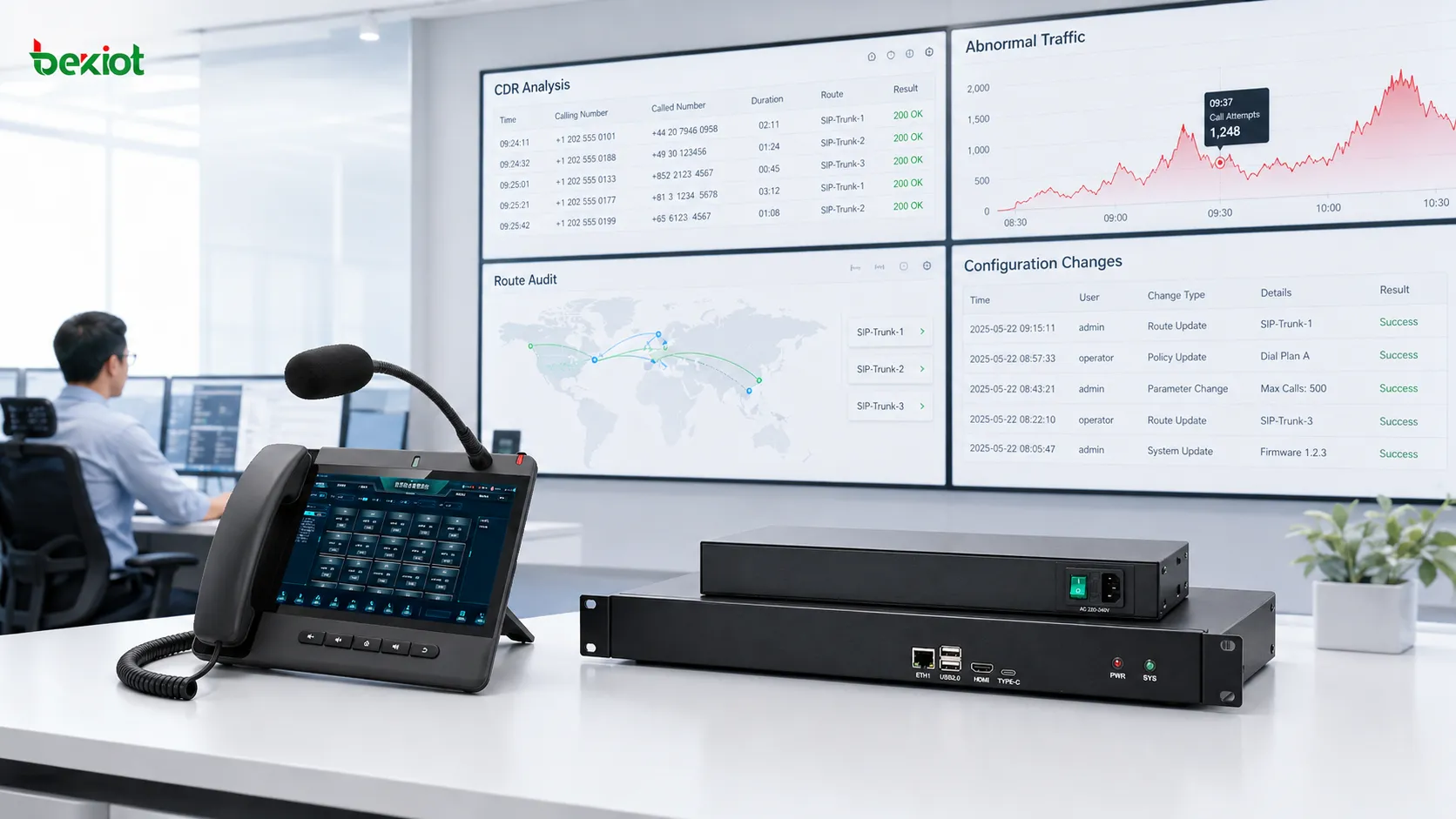
Call Detail Records (CDRs), SIP logs, trunk session counts, destination distribution, call duration, and failure rates can all help operations teams determine whether current traffic matches normal business behavior.
For example, a company that normally communicates with only a few countries may suddenly see large volumes of calls to unfamiliar international destinations outside business hours. A trunk that usually carries little traffic may begin operating at full channel capacity for an extended period. A branch office may generate far more outbound traffic than its historical baseline.
None of these signals automatically proves fraud, but each is a strong reason to investigate further.
The problem is that many organizations keep CDRs but only review them when reconciling invoices at the end of the month. Logs may also exist on the server without any alerting rules. Simply having records is very different from operating an auditable communications environment.
A more mature approach is to establish a baseline for normal voice activity and then monitor for behavior that deviates significantly from business patterns. Operations teams do not need to listen to individual calls. They can identify anomalies by examining volume, timing, destinations, routing behavior, and account activity.
Configuration changes should also be part of the audit trail. Who added a trunk? Who changed an international routing rule? What did the configuration look like before and after the change? Why was the change made?
When these questions can be answered, a VoIP platform moves from merely “having logs” to being able to support accountability, investigation, and post-incident review.
Enterprises Should Reorder Their Priorities When Building International VoIP
Many VoIP projects follow the same sequence: get the calls working first, optimize voice quality second, and add security and operations controls later. In a small closed LAN, this approach may appear to work for some time. Once public SIP trunks, cross-border voice, and third-party cloud communications are introduced, however, adding security and compliance only after deployment can make remediation significantly more expensive.
A better approach is to identify carriers and trunk sources during the architecture stage, define which systems are allowed to interconnect with public voice networks, and then establish the SBC and network boundary design.
Numbering plans, international calling permissions, and outbound routing policies should be designed at the same stage rather than accumulated gradually through temporary production changes.
Procurement should also look beyond channel capacity and per-minute pricing. Enterprises need to understand what authentication methods, IP restrictions, call records, anomaly alerts, and technical support a provider offers, and whether enough routing data can be supplied when a dispute or investigation occurs.
Third-party system integration should be governed in the same way. Access granted temporarily during installation and commissioning should not automatically become permanent. After engineers leave the site, service providers change, or a project is handed over, trunk accounts, remote access, and management privileges should all be reviewed again.
Security incidents do not reduce the value of international VoIP. The technology still simplifies multi-site voice interconnection and makes it easier for IP PBXs, contact centers, mobile clients, and cloud communications services to work together.
But the more flexible a communications system becomes, the more clearly its boundaries must be defined.
The real question for enterprises is not whether they should use VoIP. It is how to ensure that every external voice path has a known source, defined permissions, a complete record, and a responsible owner.
When a SIP trunk is managed as a critical enterprise communications boundary rather than as an ordinary network connection, VoIP flexibility and operational control can exist at the same time.
FAQ
Does Every Enterprise Using SIP Trunks Need a Dedicated SBC?
Not necessarily. Some IP PBXs, cloud communications platforms, and carrier services already include certain session-border functions. The key is to verify whether the system provides source restrictions, session control, topology hiding, logging, abnormal traffic protection, and the interoperability features required by the deployment. If these capabilities are missing, a dedicated SBC can provide significant value.
Do TLS and SRTP Prevent Unauthorized International VoIP Routing?
No. TLS and SRTP primarily protect signaling and media while they are being transmitted. They do not replace routing authorization, carrier compliance, or enterprise access control. A call can be securely encrypted and still be sent through an incorrect or unauthorized route, so encryption and routing governance need to be managed separately.
Does an Abnormal Caller ID Automatically Mean VoIP Fraud?
No. Call forwarding, number normalization, PBX configuration, and carrier interconnection methods can all affect Caller ID presentation. When an abnormal Caller ID appears, a more reliable investigation combines SIP signaling, CDR data, trunk origin, and the actual business call flow rather than relying on the displayed number alone.
Why Can a SIP Trunk That Works in the Lab Still Create Risk in Production?
Lab environments usually contain only a few accounts, fixed IP addresses, and simple routing rules. Production networks introduce public access, third-party maintenance, multiple branches, dialing permissions, and years of configuration changes. The risk often comes from how the system is operated over time rather than from the initial call test itself. Production acceptance should therefore verify permissions, routing policies, logging, alerting, and configuration-change controls in addition to basic call quality.







