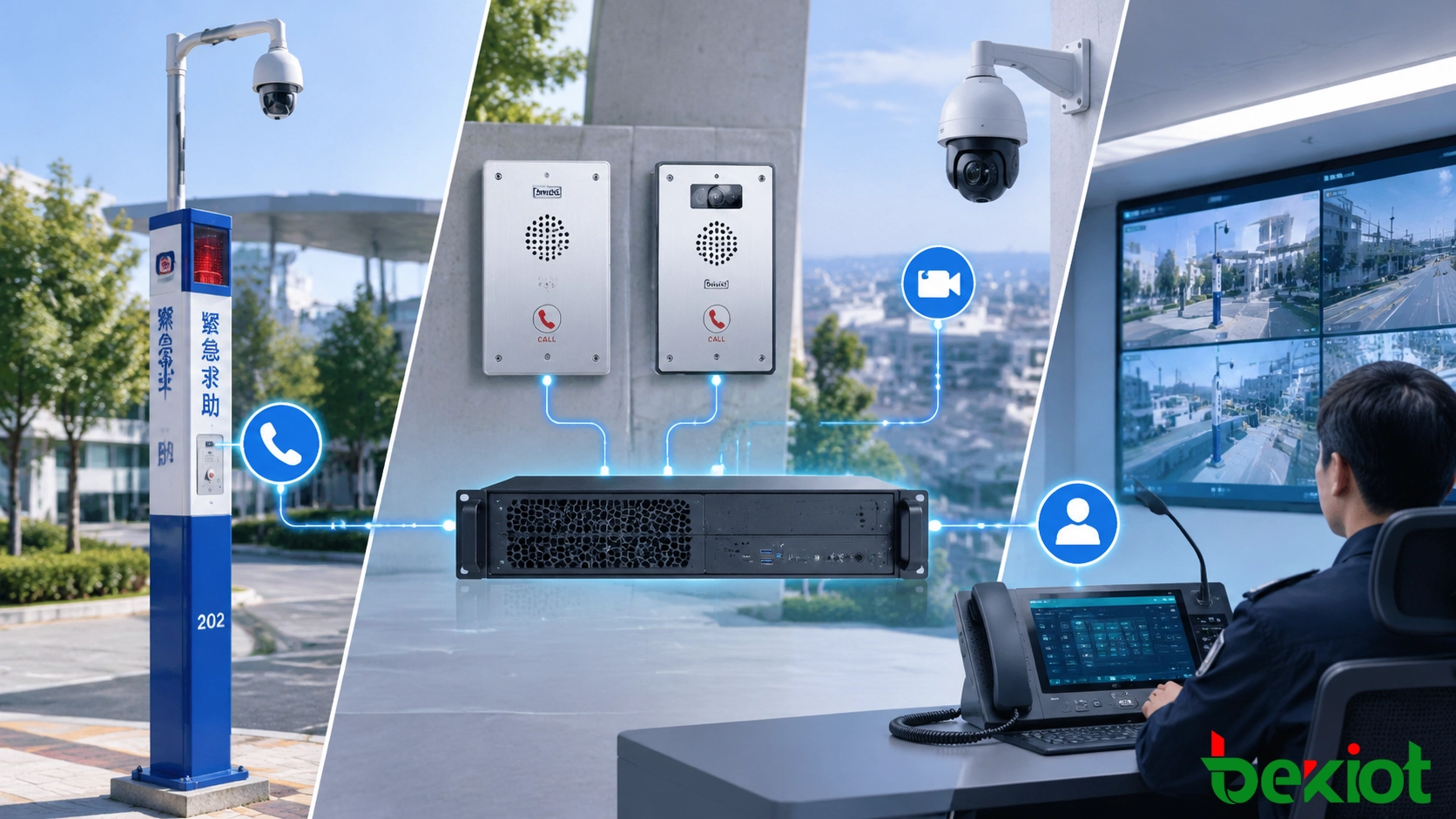
Emergency communication systems are increasingly designed as connected platforms rather than isolated devices. In industrial facilities, transportation infrastructure and public buildings, an emergency event often requires multiple systems to work together. A person may activate an emergency intercom, a control room may receive a SIP call, nearby cameras may provide visual verification, and security personnel may need alarm information before deciding on the appropriate response.
SIP emergency intercoms provide the communication path between field locations and control centers. CCTV systems provide visual awareness, while alarm platforms provide event detection and notification. Through proper integration, these systems can exchange information and support a coordinated workflow for incident handling.
The purpose of integration is not simply to connect devices. A complete design should define how events are generated, how information is transferred, which resources are associated with each event and how operators manage the response process. Depending on project requirements, the system may involve SIP signaling, IP PBX platforms, CCTV management systems, alarm interfaces, relay control and software APIs.
How SIP Emergency Intercoms Connect Different Security Systems
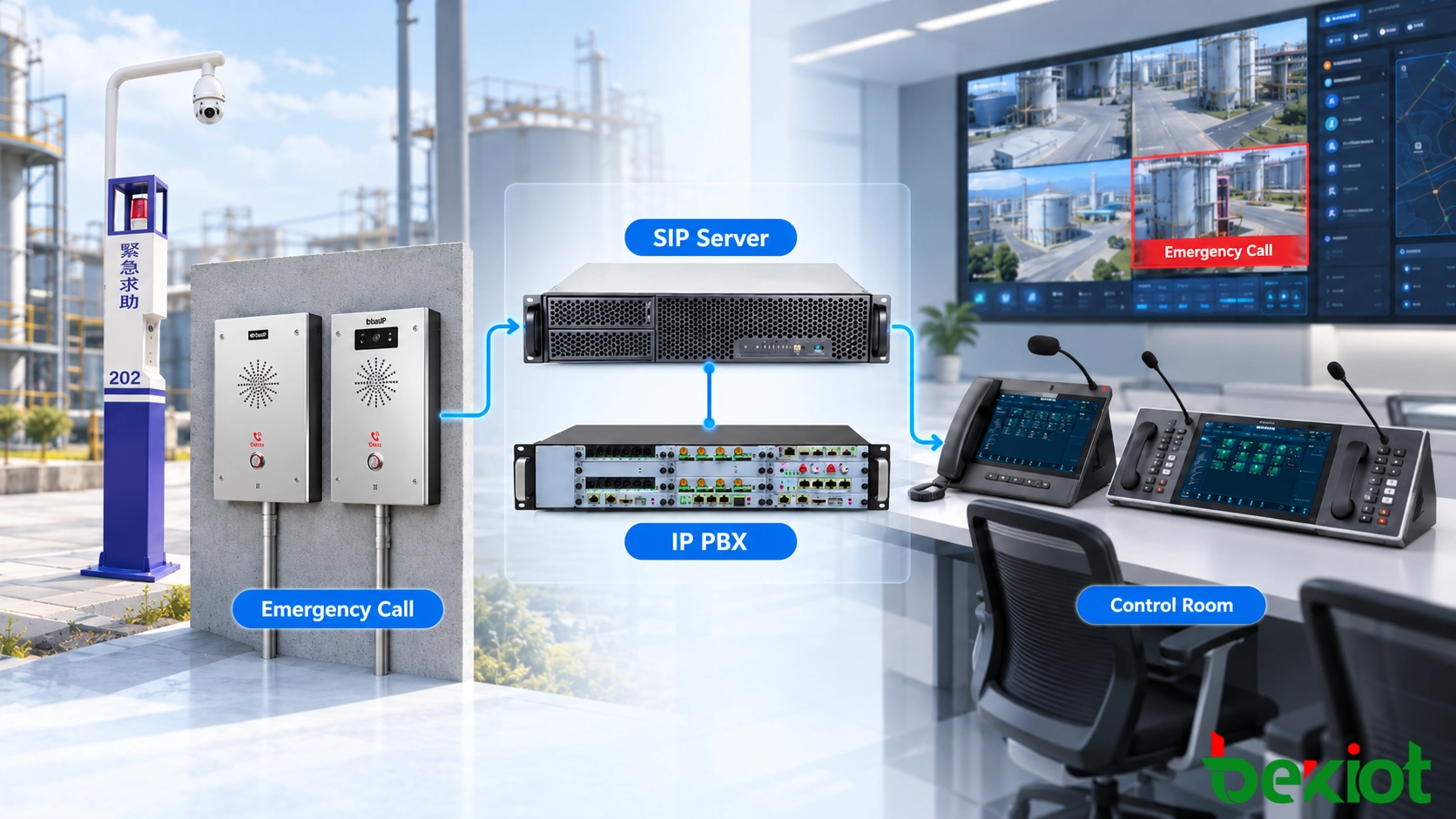
SIP emergency intercom integration involves several functional layers working together. Each subsystem performs a specific role, while event information is exchanged through defined communication interfaces.
At the field level, emergency communication devices provide direct access for users who need assistance. These devices may be installed at entrances, platforms, production areas, restricted zones or remote operating locations where immediate communication is required.
The communication layer manages voice sessions and call control. SIP servers, IP PBX systems or dispatch platforms handle device registration, extension management, call routing and communication between field terminals and operators.
The security layer provides additional information related to the incident. CCTV platforms provide video resources, alarm systems provide detection information and command platforms combine different data sources into an operational interface.
A typical integrated architecture includes:
SIP emergency intercom terminals installed at field locations.
SIP server or IP PBX platform for communication management.
CCTV platform for video monitoring and verification.
Alarm system for event detection and notification.
Dispatch console or control room platform for operator response.
The key part of integration is event correlation. Instead of treating each device as an independent system, the platform creates relationships between the event source, physical location and available response resources.
For example, an emergency communication point installed at an industrial entrance can be associated with:
The assigned SIP extension.
Nearby fixed cameras or PTZ cameras.
The related alarm zone.
The responsible operator group.
The predefined response procedure.
This approach allows operators to receive useful information immediately after an event occurs instead of manually searching for related systems.
Emergency Event Workflow from Detection to Operator Response
A reliable emergency communication system should define the complete workflow from event generation to final response. Without clear logic, operators may need to manually identify locations, search camera views or determine responsible personnel during critical situations.
A typical integrated workflow includes several stages.
Event Generation at the Field Location
An emergency event can be generated from different sources, including SIP emergency buttons, help points, alarm inputs, access control events or external sensors. The event source provides the initial information required for further processing.
Each communication point should have identifiable configuration information, such as device ID, SIP extension, installation location and priority level. This information allows the platform to determine the correct response path.
Event Processing and Resource Association
After receiving the event, the communication or security platform processes the information according to predefined rules. The system may determine which operator should receive the call, which cameras should be displayed and whether additional notifications are required.
This process is commonly known as event correlation. It connects different information sources around the same incident instead of handling each signal independently.
A typical event relationship may include:
Emergency intercom identification.
Physical location information.
Associated camera resources.
Alarm status information.
Response priority.
Communication and Response Handling
When the event reaches the control room, the operator can establish voice communication through the SIP connection. At the same time, related video and alarm information can support decision-making.
The response process may include:
Confirming the situation through voice communication.
Checking related camera views.
Communicating with personnel at the location.
Escalating the event when required.
Recording communication and event information.
Integrating SIP Emergency Intercoms with CCTV Video Systems
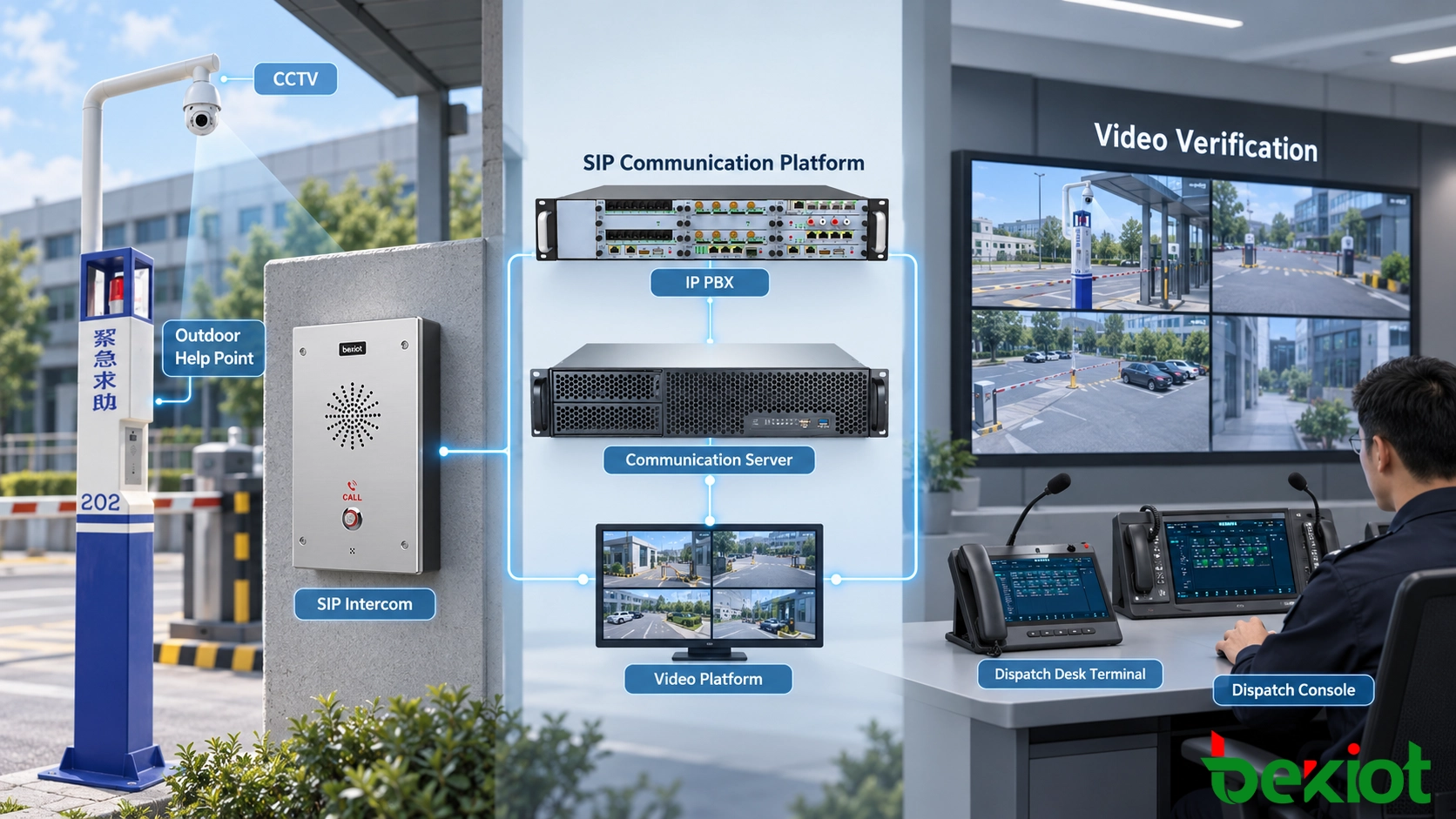
CCTV integration adds visual verification capability to emergency communication workflows. Voice communication confirms that a connection has been established, but video information helps operators understand the surrounding environment and evaluate the situation before taking further action.
The relationship between SIP emergency intercoms and CCTV systems is normally created through location mapping rather than direct device-to-device control. During system configuration, each emergency communication point is associated with one or more cameras covering the same area.
Camera Association and Location Mapping
Large facilities may contain hundreds or thousands of cameras. Searching manually for the correct camera during an emergency can increase response time. Location-based mapping allows the platform to identify related video resources automatically.
A camera association record may include:
Emergency intercom ID.
Physical installation location.
Associated camera channels.
PTZ preset positions.
Video recording rules.
Video Verification During Emergency Calls
When an emergency call is received, the security platform can display the associated camera view or activate predefined monitoring actions. Operators can communicate with the caller while checking the surrounding environment through video.
For example, an emergency communication point at a parking entrance can be linked with nearby cameras. When assistance is requested, the security operator can communicate with the user while viewing the entrance area and evaluating the situation.
Video Protocols and Platform Compatibility
CCTV integration depends on the capabilities of the video management platform. Common technologies include ONVIF for device compatibility, RTSP for video streaming and APIs for advanced event exchange.
Before deployment, engineers should verify compatibility between the SIP communication platform, CCTV system and camera infrastructure to ensure reliable operation.
Connecting Alarm Systems and External Security Platforms
Alarm systems provide another important source of emergency events in integrated security environments. Unlike SIP emergency intercoms, which are usually activated by a person requesting assistance, alarm systems often detect abnormal conditions automatically through sensors, monitoring equipment or dedicated control panels.
Connecting alarm systems with SIP communication platforms allows detected events to become actionable communication workflows. Instead of only generating an alarm indication, the system can provide direct voice communication between the affected area and the responsible operator.
The integration method depends on the type of alarm equipment and the required response process. Common approaches include digital inputs, relay interfaces, software APIs and communication protocols supported by security platforms.
Alarm Input and Event Triggering
Many industrial communication terminals and emergency devices provide input interfaces for external signals. These inputs can receive status information from emergency buttons, sensors, access control systems or alarm panels.
When an input changes state, the communication platform can execute predefined actions, including:
Initiating a SIP emergency call to a control center.
Sending event information to a security management platform.
Activating external warning devices.
Starting a predefined response workflow.
For example, an industrial facility can connect an external alarm output with an emergency communication terminal. When a machine or process alarm occurs, the control room can receive notification and establish direct voice communication with the affected area.
Alarm Priority and Escalation Logic
Different alarm events may require different response levels. A routine assistance request and a safety-critical industrial alarm should not necessarily follow the same communication path.
A properly designed system can define priorities according to event type, location and operational requirements.
Typical priority levels may include:
General assistance request.
Security-related emergency.
Industrial safety alarm.
Large-scale notification event.
Priority configuration helps ensure that critical events receive immediate attention while maintaining normal communication operations.
Integration with Security Management Platforms
Large facilities often use centralized security management platforms to combine information from multiple subsystems. Through API integration, SIP communication events, alarm conditions and video information can be presented through a unified operator interface.
This approach is especially useful for sites with multiple buildings, distributed communication points or complex security procedures.
System Architecture and Deployment Considerations
A reliable SIP emergency intercom integration project requires careful planning of communication architecture, network design and operational procedures. The objective is not only to make different systems communicate, but also to ensure that the complete workflow remains stable during real emergency situations.
SIP Communication Infrastructure
The SIP communication layer provides the foundation for voice interaction between emergency terminals and control locations. Depending on the project scale, the architecture may include IP PBX systems, SIP servers, gateways, dispatch consoles or unified communication platforms.
The SIP communication system should define:
Device registration method.
Extension numbering plan.
Call routing rules.
Emergency call priority.
Recording requirements.
For large deployments, centralized SIP management helps maintain consistent configuration across multiple sites and communication points.
Network Reliability and Quality Requirements
Because emergency communication depends on network availability, infrastructure planning is a critical part of system design.
Engineers should consider:
Network segmentation through VLANs.
Voice traffic prioritization using QoS.
PoE power supply for field communication devices.
Bandwidth requirements for video transmission.
Network redundancy for critical applications.
A stable network ensures that voice communication, video verification and event transmission can operate together without unnecessary delays.
Communication Records and Event History
Emergency systems often require records for incident analysis, compliance and operational improvement. Depending on the architecture, different types of information can be stored:
SIP call records.
Alarm event history.
Operator actions.
Related video recordings.
Combining communication, alarm and video records provides a clearer understanding of what happened during an incident and how the response process was executed.
Industrial Environment Requirements
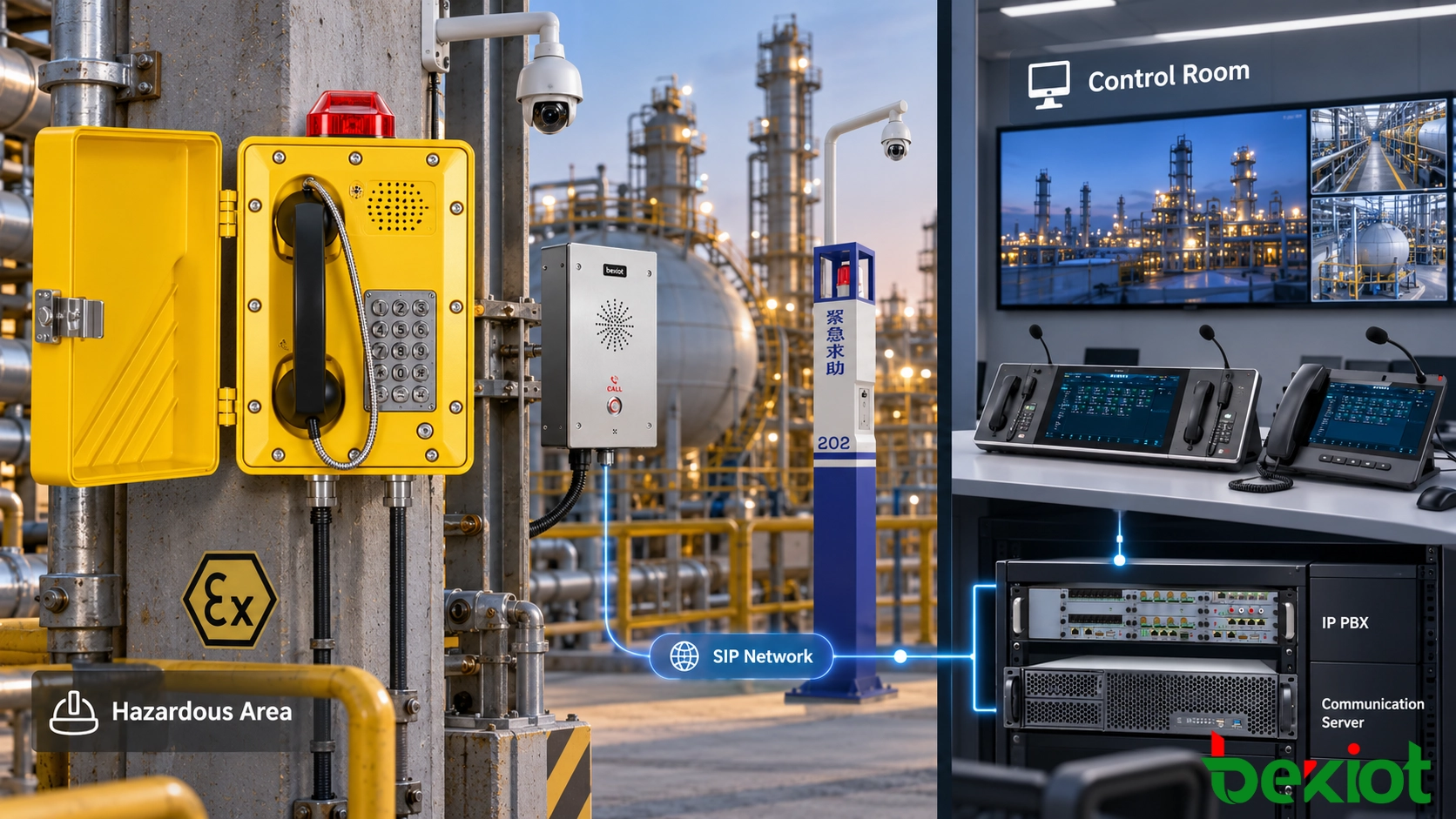
Many SIP emergency communication systems are installed in demanding environments, including factories, energy facilities, chemical plants and hazardous areas.
In these applications, equipment selection must consider environmental conditions such as dust, moisture, vibration, temperature changes and hazardous area requirements.
For hazardous industrial environments, Becke Telcom explosion-proof communication products such as EX-BH621 explosion-proof telephone can be integrated into SIP-based communication architectures. These devices allow field personnel to communicate with control rooms while meeting the requirements of demanding industrial locations.
The selection of industrial communication equipment should always be based on project requirements, environmental conditions and applicable safety standards.
Applications of Integrated Emergency Communication Systems
The combination of SIP emergency intercoms, CCTV and alarm systems is widely used in environments where fast communication and situational awareness are required. Each application has different operational requirements, but the basic integration principle remains the same: detect the event, provide information and support an appropriate response.
Transportation Facilities
Railway stations, tunnels, airports and parking facilities often require emergency communication points distributed across public areas. Integrating intercoms with CCTV allows operators to verify assistance requests, monitor the surrounding environment and coordinate responses more efficiently.
Typical applications include passenger assistance points, platform emergency terminals, tunnel communication stations and parking area help points.
Industrial and Energy Facilities
Industrial plants, power facilities and energy sites often contain remote operating areas where direct communication with control rooms is required.
By combining SIP emergency communication, alarm monitoring and video systems, operators can communicate with field personnel while receiving additional information about the operating environment.
In oil and gas facilities, chemical plants and mining environments, industrial SIP telephones, explosion-proof communication terminals and emergency intercom systems can be connected with centralized SIP platforms to support communication between hazardous areas and control centers.
Campus and Public Buildings
Schools, hospitals and commercial buildings can use integrated emergency communication systems to connect assistance points, security monitoring and response teams. SIP emergency intercoms combined with CCTV and alarm platforms help security personnel understand incidents faster and coordinate appropriate actions.
Typical applications include entrance assistance points, visitor communication stations, parking areas, security checkpoints and public service locations where direct communication with operators is required.
Critical Infrastructure Sites
Critical infrastructure facilities require reliable communication between distributed locations and centralized operation centers. Power stations, water treatment facilities, transportation hubs and large industrial campuses often deploy emergency communication systems as part of their overall safety architecture.
By integrating SIP communication terminals, video monitoring and alarm systems, operators can maintain awareness of remote areas and respond more efficiently when abnormal conditions occur.

Building a Connected Emergency Response Platform
Integrating SIP emergency intercoms with CCTV and alarm systems creates a communication chain between people, devices and control platforms. The SIP system provides direct voice interaction, CCTV improves situational awareness, and alarm platforms provide additional event information.
A successful integration design focuses on practical response procedures rather than simply adding more equipment. The system should help operators quickly identify the event location, communicate with people at the site, verify conditions and coordinate the next action.
With SIP-based communication technologies, network video protocols and flexible integration interfaces, organizations can build emergency communication systems that adapt to different environments, from public facilities and transportation infrastructure to industrial and hazardous-area applications.
Becke Telcom provides SIP communication terminals, industrial telephones, explosion-proof telephones and related communication solutions that can be integrated with IP PBX, dispatch platforms, CCTV systems and alarm management platforms according to project requirements.
FAQ
Can SIP emergency intercoms work with third-party CCTV systems?
Yes. SIP emergency intercoms can work with third-party CCTV platforms when compatible integration methods are available. The connection usually relies on standard interfaces, platform APIs or event mapping rather than requiring all devices from the same manufacturer.
How does a security platform know which camera belongs to an emergency call?
The relationship is normally created through system configuration. Each emergency communication point is mapped to its physical location and associated cameras. When an event occurs, the platform uses this information to display the related video resources.
Can an alarm automatically create a SIP emergency call?
Yes. When an alarm input or external event is connected to a SIP communication platform, predefined rules can generate calls, notifications or escalation actions according to the configured response process.
What protocols are commonly used for SIP intercom and CCTV integration?
SIP is mainly used for voice communication and call control. CCTV integration commonly uses technologies such as ONVIF, RTSP and platform APIs depending on the video management system and project requirements.
Can explosion-proof SIP communication devices be integrated into emergency systems?
Yes. Explosion-proof SIP telephones and industrial communication terminals can be integrated into emergency communication architectures when the required communication interfaces and environmental requirements are properly considered.
What should be considered when adding emergency communication to an existing security network?
Important factors include network capacity, PoE availability, SIP compatibility, video bandwidth, cybersecurity policies, device management and the operational workflow required by the facility.