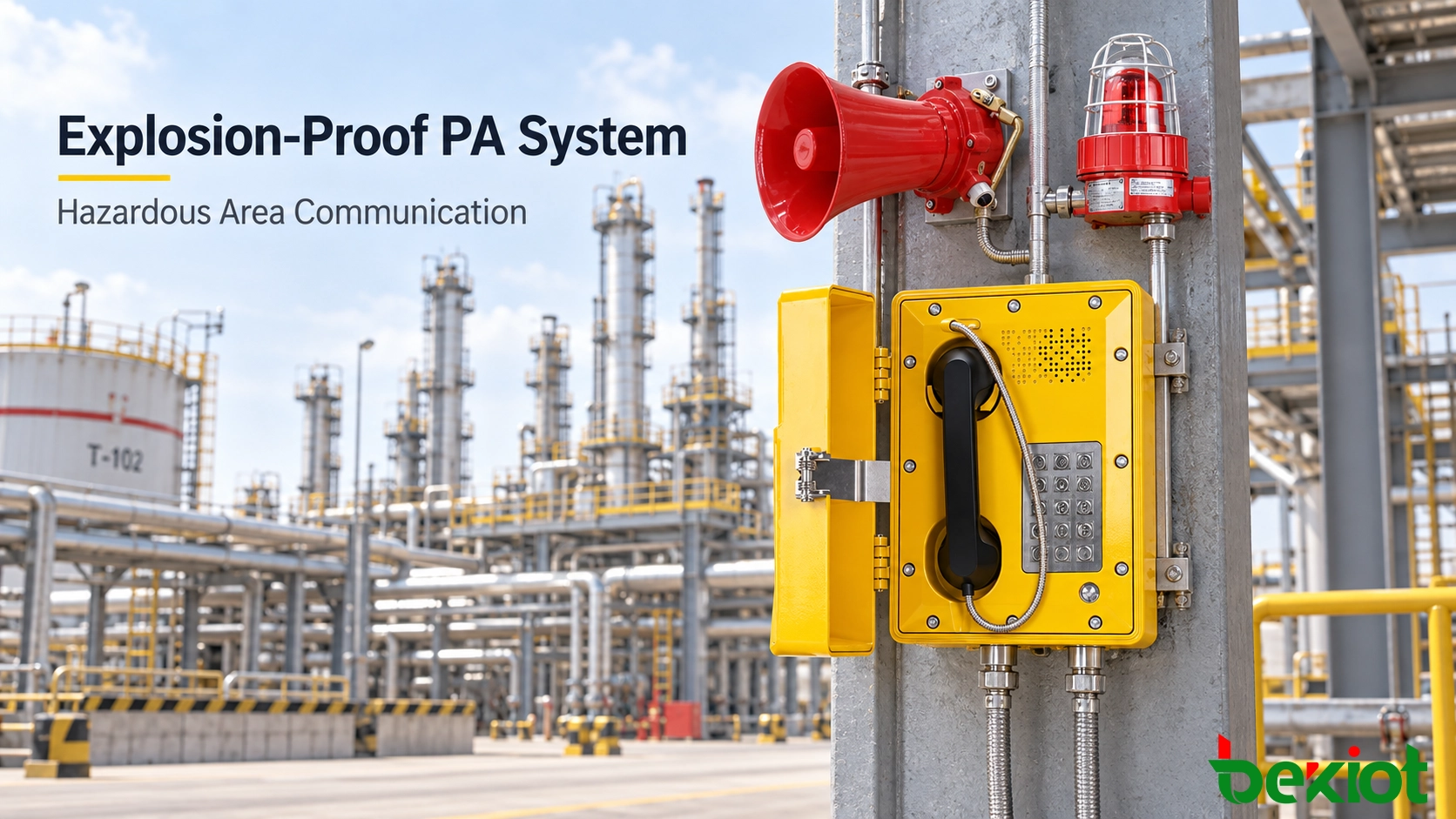
Petrochemical plants, oil and gas facilities, mines, energy sites and hazardous-material storage areas often combine explosive gases or dust with high noise, moisture, corrosion and outdoor exposure. When a gas leak, fire alarm, equipment failure or personnel emergency occurs, the control room needs more than a loudspeaker that can simply play an announcement.
Operators need to determine which area should receive the message, whether personnel can understand it under actual operating noise, whether field equipment is suitable for the classified location, and how workers can report conditions back to the control room.
An explosion-proof PA system should therefore be treated as an engineered communication system rather than a collection of hazardous-area speakers. The design needs to coordinate hazardous-area equipment, acoustic coverage, field communication, broadcast priority, alarm interfaces and control-room operation.
A useful design principle is straightforward: explosion protection addresses the safety suitability of field equipment, while paging, intercom and emergency notification are system-level communication functions.
Explosion-Proof PA vs. Standard PA
A conventional PA system mainly addresses audio distribution, paging zones and coverage. A PA system used in a hazardous industrial facility has an additional requirement: electrical equipment installed within a classified area must be suitable for that specific environment.
This requirement applies primarily to field devices such as explosion-proof telephones, intercom stations, loudspeakers, audible and visual warning devices, emergency buttons and associated electrical interfaces. Different installation points may have different hazardous-area classifications, gas or dust groups, temperature requirements and environmental conditions.
The words “explosion-proof” alone are therefore not sufficient for equipment selection. Engineers need to verify whether the exact product model and certification scope match the actual installation location.
At the same time, the communication system still needs to manage emergency-message priority, ambient noise, paging coverage and feedback from personnel in the field.
An effective design must answer two different questions: Can this device be safely installed here? and Will the required message reach the right people clearly when an incident occurs?
Hazardous and Safe Areas
An explosion-proof PA system does not mean that every server, dispatch console, network switch and control-room device must use an explosion-proof enclosure. Most industrial projects separate equipment according to where it is installed.
IP PBX servers, SIP servers, recording systems, dispatch platforms and operator consoles are normally installed in a control room or equipment room located in a safe area. These devices handle call routing, paging control, recording, operator workflows and system integration.
The classified field area is where hazardous-location requirements become critical. Typical field devices may include explosion-proof telephones such as the EX-BH621 Explosion-Proof SIP Telephone, hazardous-area intercom stations, suitable loudspeakers, audible and visual warning devices, and emergency call points.
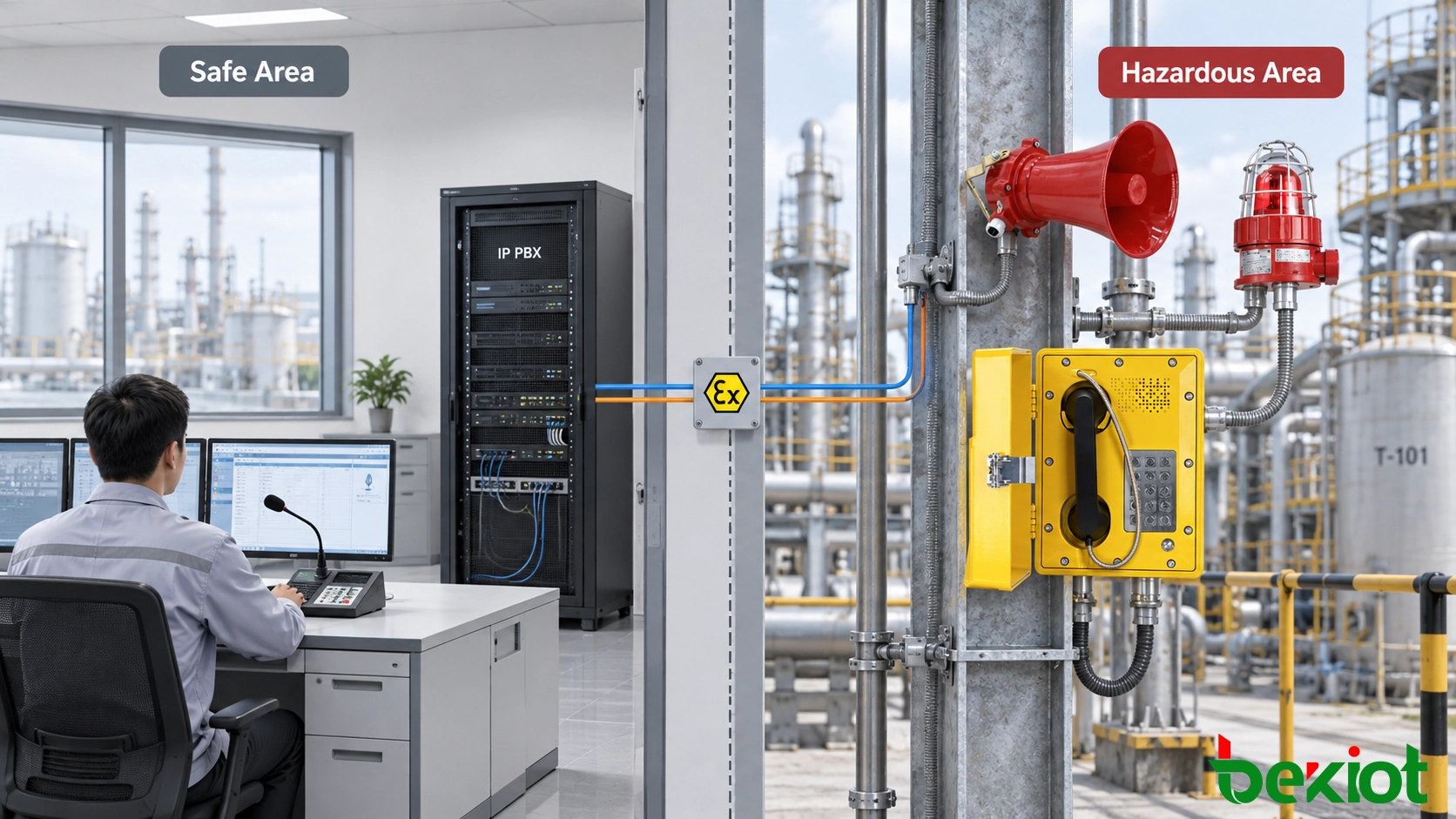
This architecture keeps servers, IP PBX equipment and operator stations in an accessible control environment while field devices are selected according to the safety requirements of their installation area.
Whether a device is suitable for Zone 1, Zone 2, a Class/Division location or another hazardous-area classification must be confirmed against the standards used by the project and the certification documents for the exact product model. Certification for one product should not be assumed to apply to another.
Environmental protection also needs separate verification. IP65, IP66 and similar ingress-protection ratings are product-specific characteristics. Outdoor exposure, humidity, dust, salt spray, temperature and corrosion may impose requirements beyond explosion protection alone.
Speaker Selection and Placement
Speaker selection should not begin with wattage alone. The practical objective is to make sure personnel can understand a message while the plant is operating under normal or emergency noise conditions.
Horn speakers are often used in outdoor areas, high-noise locations and installations that require directional coverage, such as tank farms, loading areas and process units. Other industrial loudspeaker formats may be more appropriate for corridors, platforms or areas where more uniform coverage is required.
Speaker placement should consider:
ambient noise levels;
where personnel normally work or move;
speaker mounting height;
direction of sound propagation;
obstructions created by equipment, vessels and pipework;
reflections from steel structures and building surfaces;
rain, corrosion, temperature and other environmental exposure.
Increasing amplifier or speaker power does not automatically improve intelligibility. Poor orientation, excessive overlap between sound sources or strong reverberation can make speech difficult to understand even when the measured sound level is high.
For high-noise areas, wideband audio, appropriate loudspeaker placement and suitable acoustic design can improve speech clarity, but actual performance should still be verified under realistic site conditions. A field paging test is usually more meaningful than relying only on the rated power printed on a datasheet.
Installation details are also part of hazardous-area engineering. Cable entries, glands, junction arrangements, mounting hardware and wiring methods must be reviewed together with the certified equipment. A compliant device does not make an arbitrary installation method acceptable.
Intercom and Paging
Public address is primarily a one-to-many communication method. Industrial incident response, however, often requires information to flow in both directions.
If a site relies only on loudspeakers, the control room can issue instructions but cannot immediately confirm whether personnel have received them, whether conditions are changing or whether additional assistance is required.
Explosion-proof telephones, hazardous-area SIP intercoms or emergency call stations can therefore be installed at locations where field personnel need a direct communication path to the control room.
A typical operational sequence may be:
Field Call → Control Room Answer → Location and Situation Confirmation → Response-Team Contact → Area Paging → Continued Field Feedback
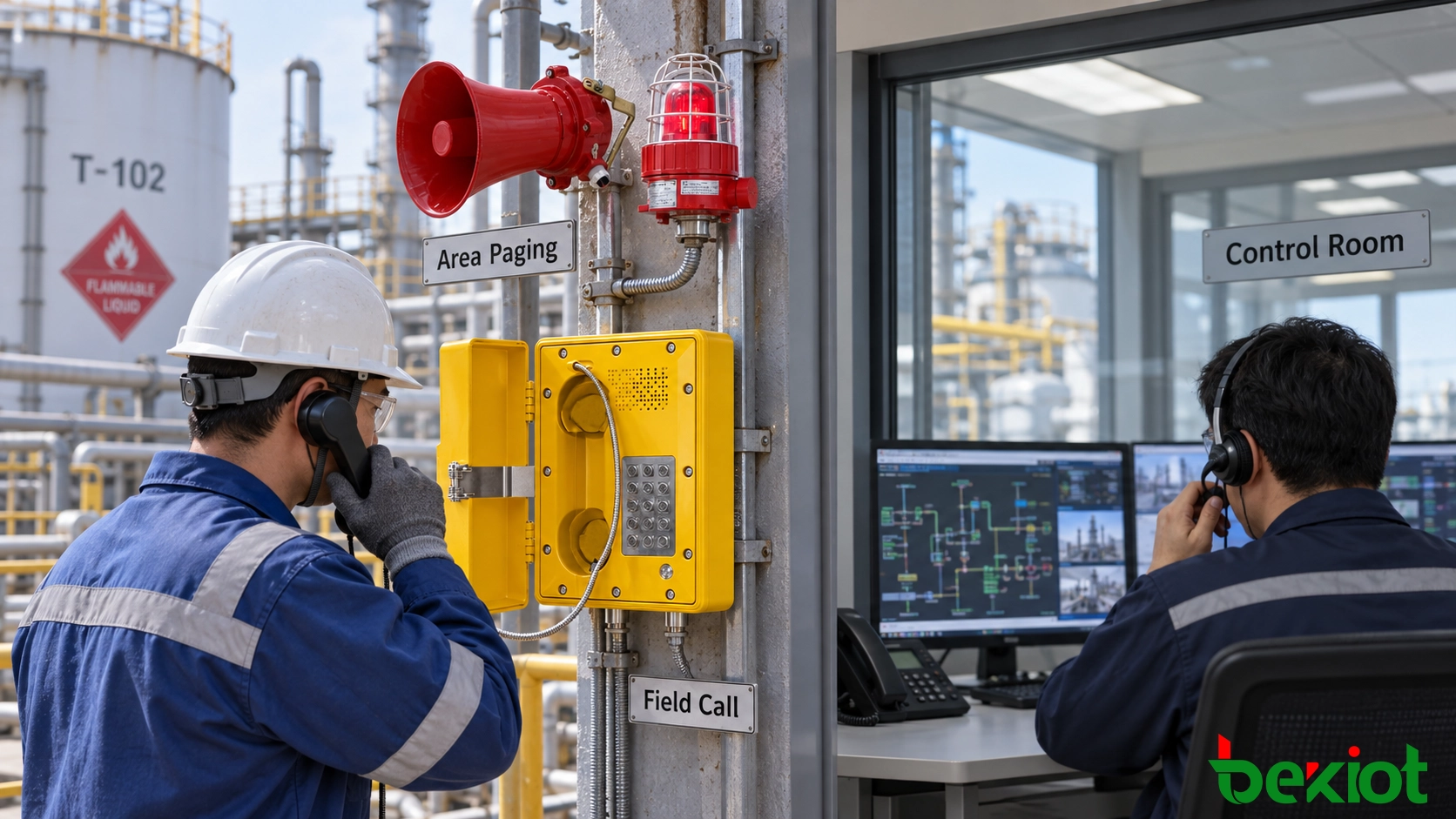
In a SIP/IP architecture, field communication terminals can register to an IP PBX or communication platform. In the control room, operators can use dispatch software or a dedicated terminal such as the DSC-BD156-IP Dispatch Console to answer field calls, contact response personnel and coordinate paging actions.
Group calling, conferencing, recording, failover destinations, call forwarding and priority rules depend on the actual IP PBX and dispatch configuration. SIP provides the communication foundation, but SIP support alone does not mean that every endpoint automatically provides emergency override, paging control or dispatch functionality.
For hazardous industrial sites, the combination of paging for wide-area notification and intercom for field feedback is often more useful than a one-way announcement system during an evolving incident.
Alarm-Triggered Paging
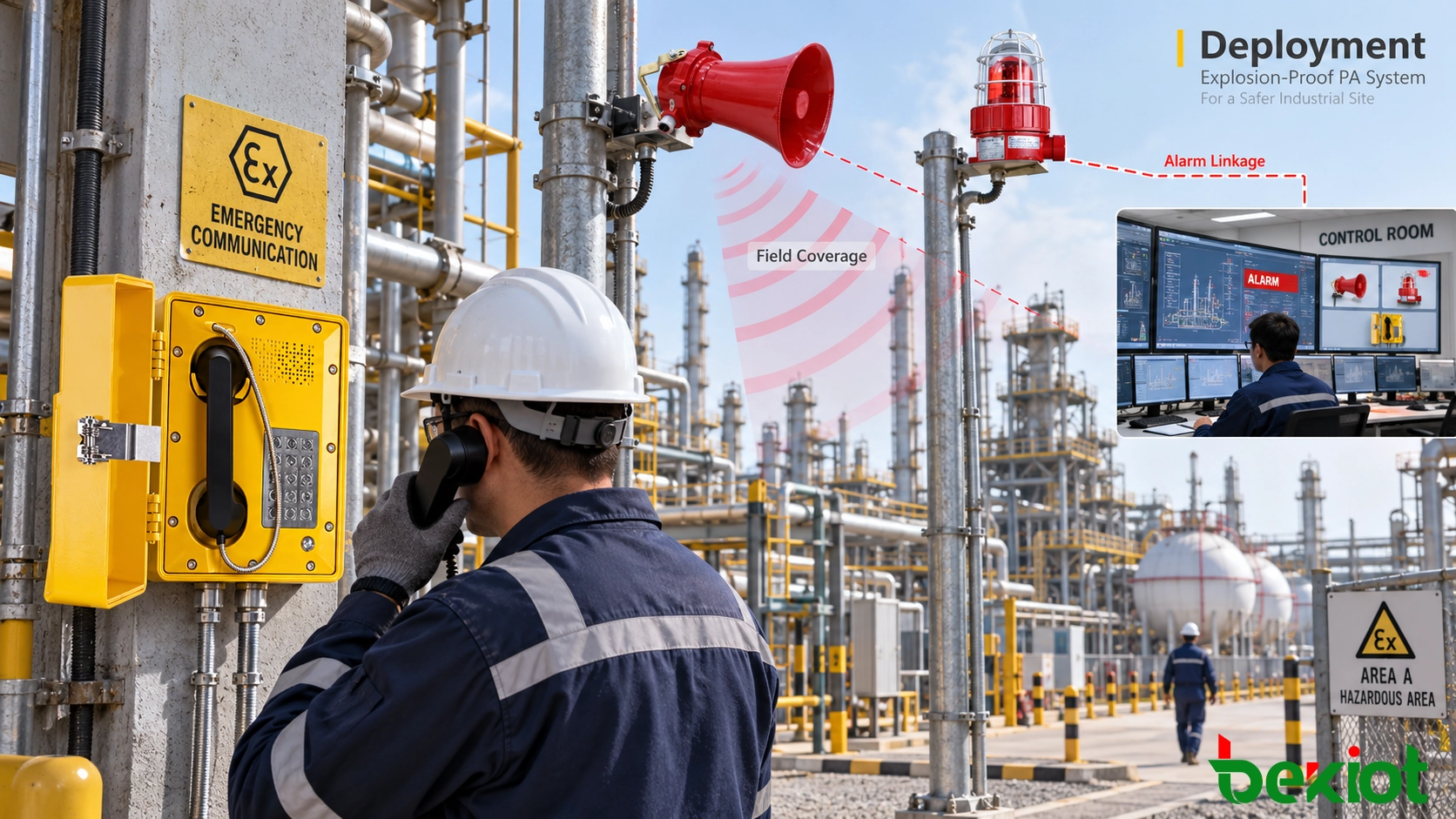
Petrochemical, oil and gas, energy and other large industrial sites often already operate Fire & Gas, fire detection, gas monitoring, CCTV or SCADA systems. An explosion-proof PA system can be associated with these events when the third-party system provides a compatible integration method.
For example, a gas-detection system may send an event to the dispatch or communication platform through an API, digital I/O, relay contact or another supported interface. The platform can then identify the affected area and retrieve the paging, field-communication and video resources associated with that location.
A typical response workflow may be:
Alarm Event → Area Identification → Field or Video Verification → Paging-Zone Selection → Emergency Message → Field Feedback → Event Record
Once the affected area has been identified, paging can be combined with local warning devices. Where both audible and visual indication are required, an Explosion-Proof Audible and Visual Alarm can be deployed in suitable hazardous locations according to its certification and installation requirements.
Each system still has a distinct role. SIP establishes voice communication, the alarm system generates the event, CCTV provides visual information, SCADA provides relevant process status, and the dispatch or application platform organizes these resources according to predefined operating rules.
Automation boundaries also need to be defined. Some notification actions can be triggered automatically, while decisions involving evacuation, process shutdown or other high-risk operations may require confirmation by an authorized operator.
Alarm linkage should therefore be understood as the coordinated result of configured interfaces and operating logic, not as a function performed independently by a single explosion-proof loudspeaker.
This type of architecture is also applicable to oil and petrochemical facilities where hazardous-area calling, paging and emergency notification need to operate together. A related deployment example is the explosion-proof public address and calling system for a petroleum facility.
SIP PA vs. PAGA
Explosion-proof PA systems and PAGA systems overlap in many industrial applications, but the two terms should not automatically be treated as interchangeable.
A SIP/IP-based explosion-proof PA system usually focuses on hazardous-area paging, field calling, zoned communication and communication with the control room. It may combine explosion-proof telephones, SIP intercoms, industrial loudspeakers, an IP PBX and dispatch functions.
PAGA stands for Public Address and General Alarm. In large oil and gas, offshore, petrochemical and critical industrial projects, a PAGA system may also place greater emphasis on:
priority between public address and general alarm;
predefined alarm tones and emergency voice messages;
large-area emergency coverage;
system fault monitoring;
redundancy of critical equipment and communication paths;
interfaces with Fire & Gas and other safety systems;
project-specific testing and acceptance requirements.
For a smaller industrial facility whose primary requirements are zoned paging and field communication, a SIP/IP-based hazardous-area PA system may provide an appropriate architecture. Larger facilities with General Alarm requirements may need a more structured PAGA system design covering alarm priorities, fault monitoring, redundancy and interfaces with Fire & Gas systems.
Where both wide-area notification and two-way field communication are required, a paging and intercom broadcasting system can provide a useful reference architecture for combining one-way paging with field communication.
Deployment Checklist
An explosion-proof PA project should not begin by asking how many speakers need to be purchased. The first step is to confirm the hazardous-area conditions, installation environment, ambient noise, required field communication and available alarm interfaces.
| Design Item | What to Confirm |
|---|---|
| Hazardous Area | Zone/Class classification and gas or dust environment |
| Explosion Protection | Whether the exact product certification covers the installation location |
| Environmental Protection | IP rating, temperature, corrosion, salt spray and mechanical exposure |
| Ambient Noise | Background noise during normal and peak equipment operation |
| PA Devices | Speaker type, output, direction, mounting height and location |
| Field Communication | Need for two-way feedback, emergency call points and terminal quantity |
| Paging Priority | Relationship between routine, alarm and emergency announcements |
| Alarm Interfaces | Fire & Gas, I/O, API, relay and other available interfaces |
| Power | Main power, UPS and any required backup supply |
| Field Installation | Cables, entries, wiring, mounting methods and certified accessories |
Retrofit projects also need an inventory of existing paging, telephone, alarm and video systems. Equipment that remains serviceable does not always need to be replaced. Depending on the available interfaces, it may be connected directly, through a gateway or at the platform level.
A practical engineering sequence is:
Hazardous-Area Review → Environmental and Noise Survey → PA Device Selection → Field Placement → Intercom Point Design → Alarm Interface Review → Platform Integration → Linkage Testing → Site Acceptance
The success of an explosion-proof PA system is not determined by the number of hazardous-area speakers installed. The system needs to answer four practical questions: Who must hear the message? Can they understand it under real operating conditions? How can personnel report back? Which communication resources should be activated when an alarm occurs?
Becke Telcom can assess hazardous-area classifications, ambient noise, paging locations, field-call requirements, third-party alarm interfaces and existing network conditions before defining the required explosion-proof communication terminals, SIP/IP platform and control method. The explosion-protection rating, environmental protection and certification scope of each device should always be verified against the actual installation area and the certificate for the exact product model.