In oil and gas, petrochemical, mining and other hazardous environments, an explosion-proof telephone is more than a communication device. It can also form part of the site's emergency coordination and operational communication system. Yet when a new unit arrives, attention often goes first to the model number and enclosure, while the small nameplate attached to the equipment receives far less attention.
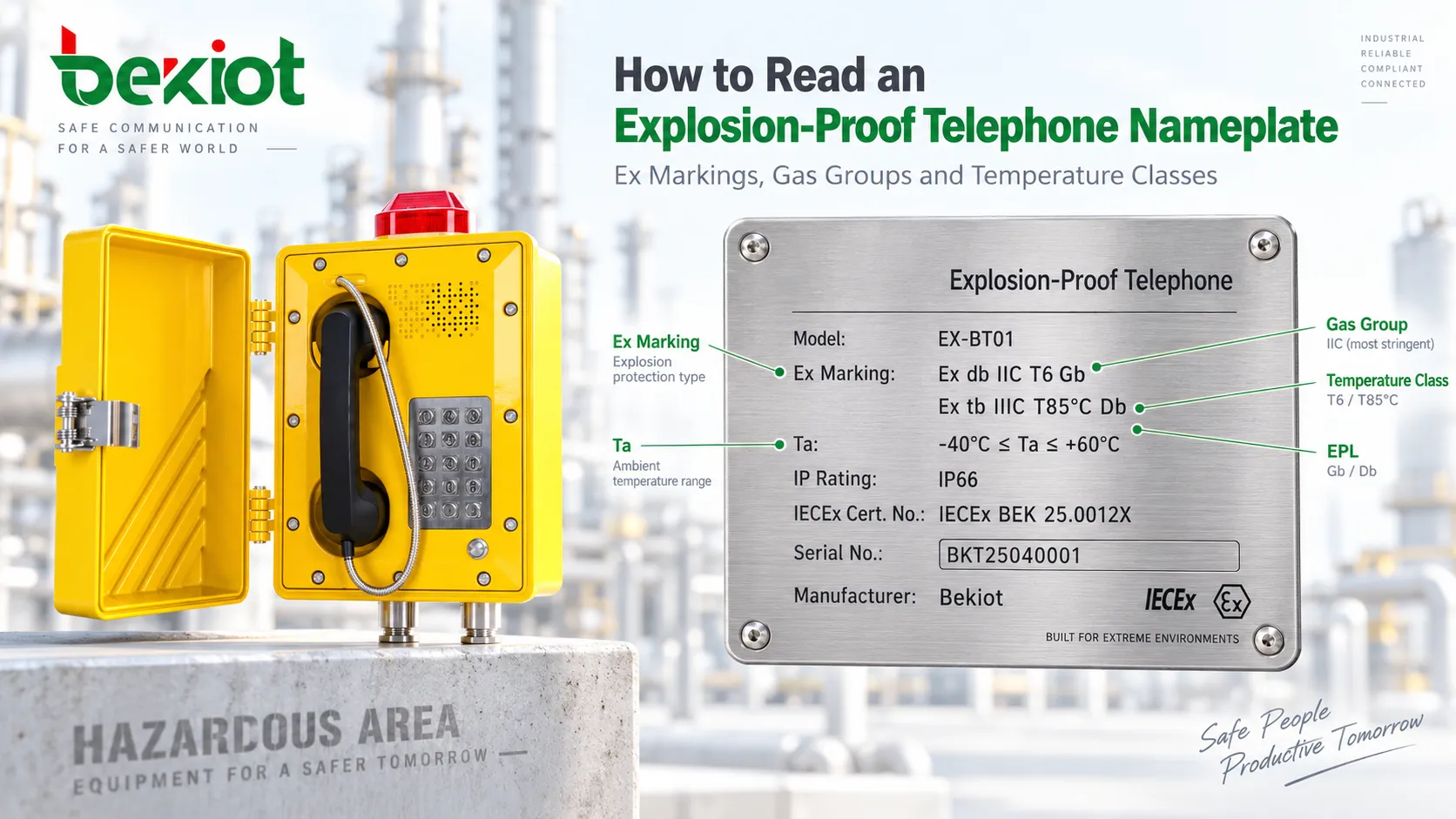
In practice, that nameplate acts as the equipment's technical identity and hazardous-area passport. It indicates whether the device carries the required Ex certification, which protection concepts are used, which explosive atmospheres it is intended for, the permitted surface-temperature class, the ingress-protection rating and the relevant certificate information. Ex markings, gas groups and temperature classes can directly determine whether the telephone is suitable for a particular installation point.
An explosion-proof telephone nameplate is not simply a string of characters proving that the device is "explosion-proof." It defines how the equipment is protected, which explosive atmosphere it is intended for, how hot its surface may become and what equipment protection level it provides. A mismatch between any of these parameters and the site's Hazardous Area Classification can make an otherwise capable telephone unsuitable for that location.
Breaking Down the Ex Nameplate
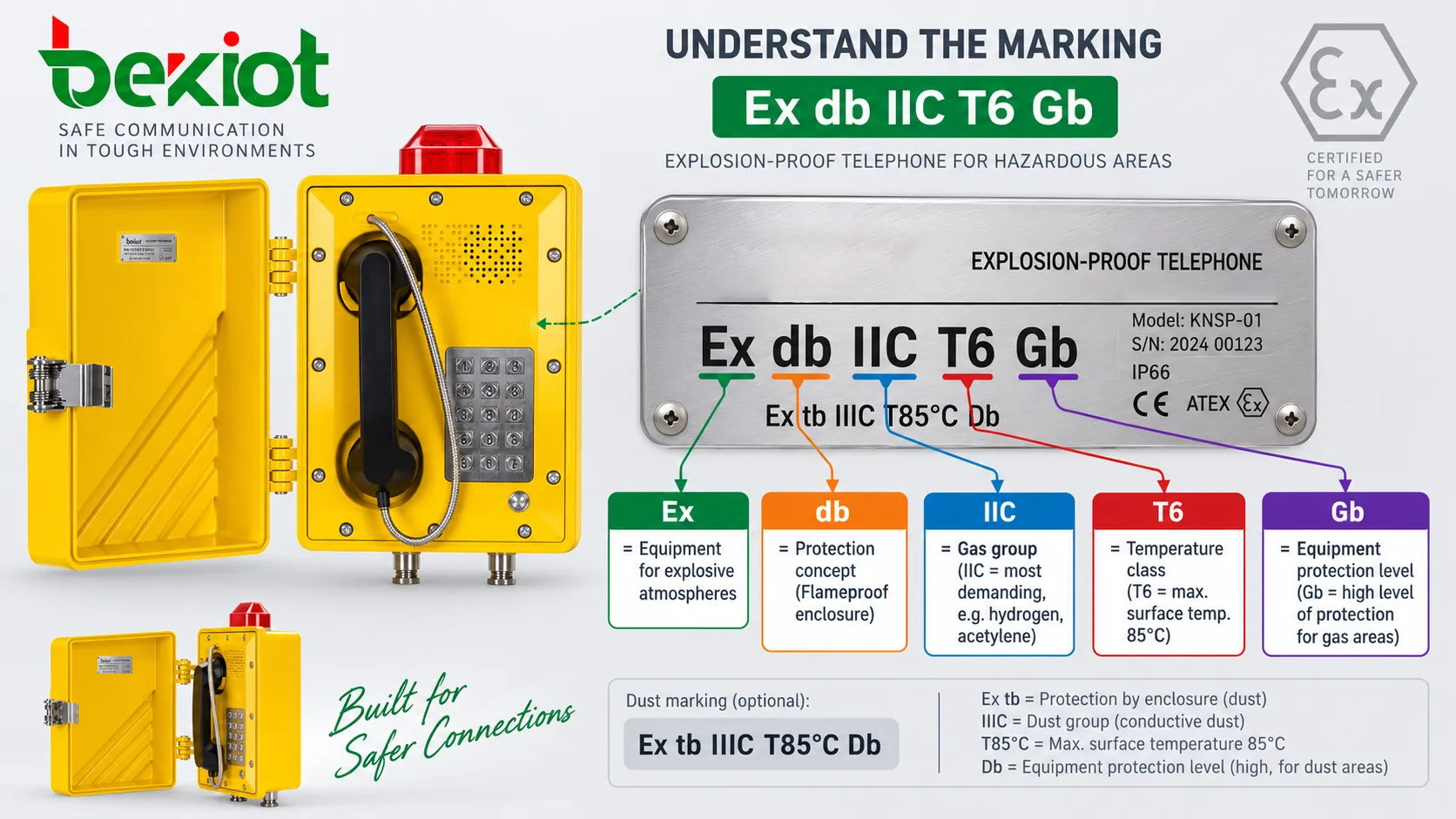
When engineers first see an Ex marking, it is easy to read the entire string as though it were a single product code. In reality, a typical gas-atmosphere marking is made up of several separate elements, each answering a different engineering question. For example:
Ex db IIC T6 Gb
Each part has a specific meaning.
Ex indicates that the equipment incorporates protection suitable for explosive atmospheres. db identifies the Protection Concept. IIC identifies the applicable gas group. T6 defines the maximum permitted surface-temperature class, while Gb indicates the Equipment Protection Level, or EPL, for gas atmospheres.
If the same telephone is also certified for combustible-dust environments, a separate dust marking may appear on the nameplate, for example:
Ex tb IIIC T85°C Db
The IIC and T6 markings used for gas atmospheres should not be used to interpret the dust classification. Dust environments use their own equipment groups, protection concepts and temperature markings. If both Gas and Dust markings appear on the same nameplate, each line needs to be checked separately against the hazardous-area classification of the installation site.
The first step when reading the nameplate is therefore not to ask whether the "Ex rating is high enough." Instead, separate the marking into its functions: which part describes the protection concept, which part identifies the hazardous medium, which part limits temperature, and which part defines the equipment protection level.
What db, eb and ia Mean After the Ex Marking
Many people stop reading once they see "Ex," but the letters that follow it describe how the equipment is actually designed to control ignition risk.
Ex d / db is generally associated with flameproof enclosures. The design does not assume that an ignition source can never occur inside the equipment. Instead, the enclosure, flame paths and related construction are designed and verified so that an internal explosion is contained and does not ignite the surrounding explosive atmosphere.
Ex e / eb refers to increased safety. The design reduces the likelihood of dangerous sparks or excessive temperatures during normal operation through measures involving construction, electrical clearances, terminal design and temperature control. Ex i / ia / ib refers to intrinsic safety, where the electrical energy available in the circuit is limited so that it cannot ignite the specified explosive atmosphere under defined conditions.
An explosion-proof telephone does not necessarily use only one protection method. The enclosure, keypad, terminals, internal circuits or other components may use different protection concepts, so a marking may look like this:
Ex db eb IIC T6 Gb
This should not be interpreted as "db is better than eb" or "more letters mean a safer product." It indicates that more than one protection concept is used, with different methods applied to different structural or electrical parts of the equipment.
Protection concept also has an important installation implication: field installation must not compromise the certified Ex design. Enclosures, fasteners, cable entries and other certified construction details should not be altered casually during installation or maintenance. A correct nameplate is only the starting point; the installed equipment must continue to preserve the certified construction.
IIA, IIB and IIC Are Gas Groups, Not Performance Tiers
IIA, IIB and IIC are among the most frequently misunderstood markings on an explosion-proof telephone.
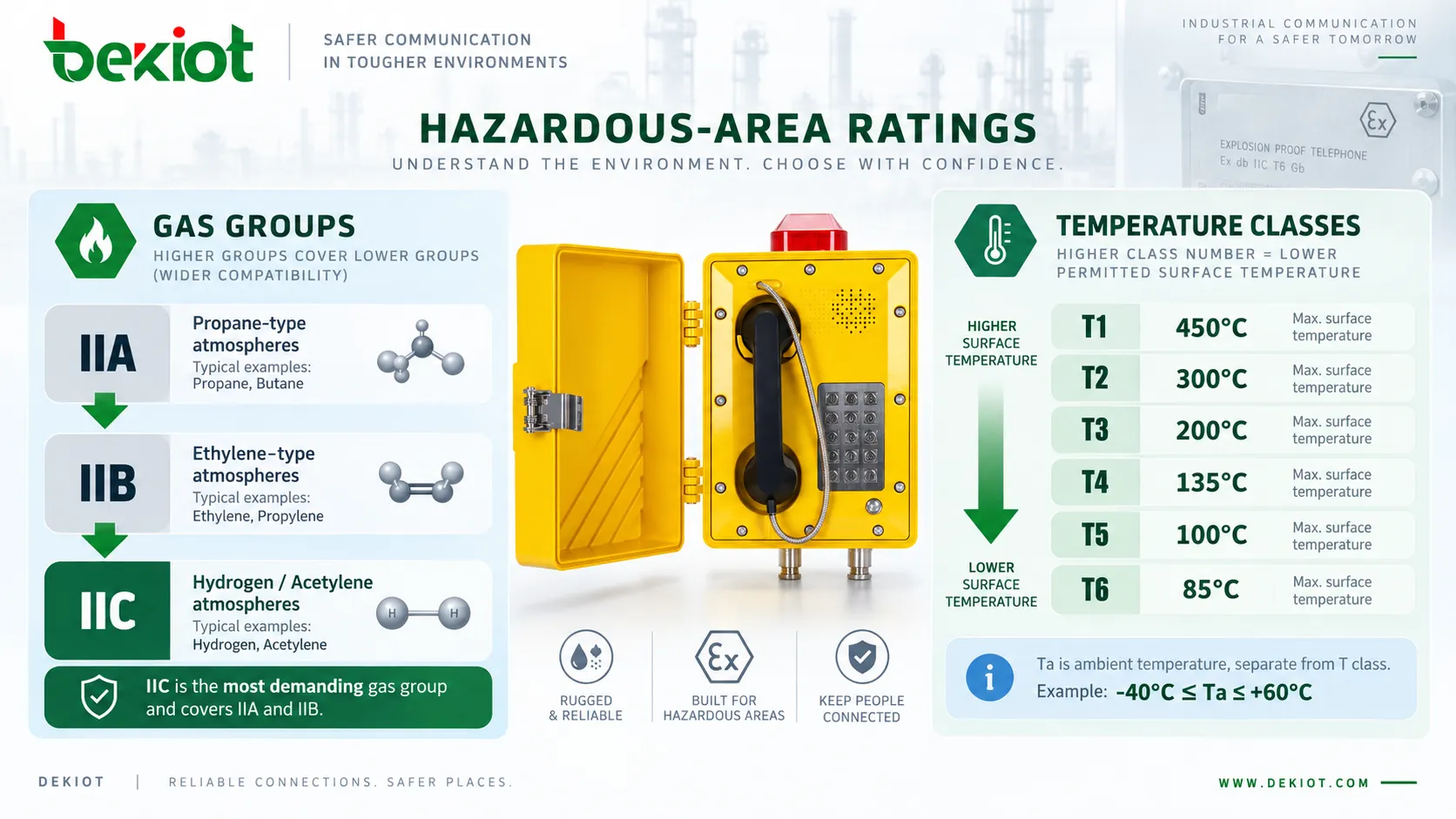
For non-mining explosive gas atmospheres, Group II is further divided into IIA, IIB and IIC according to the ignition characteristics of the gases. Propane is commonly used as a representative gas for IIA, ethylene for IIB, while hydrogen and acetylene are commonly associated with the more demanding IIC group.
| Gas Group | Typical Examples | Equipment Group Compatibility |
|---|---|---|
| IIA | Propane-type atmospheres | IIA, IIB or IIC equipment can satisfy the gas-group requirement |
| IIB | Ethylene-type atmospheres | IIB or IIC equipment can satisfy the gas-group requirement |
| IIC | Hydrogen, acetylene and similarly demanding gas atmospheres | IIC equipment is required |
If an installation area is classified as IIC, a telephone marked only IIB cannot be used simply because it is also an explosion-proof product. Conversely, IIC equipment can generally satisfy IIB and IIA gas-group requirements, but that does not automatically make the complete product suitable for the project.
Hazardous-area verification never depends on a single field. After checking IIC, engineers still need to verify the Zone/EPL requirement, Temperature Class, permitted ambient temperature, protection concept and actual certificate scope.
This is one of the most important lessons when reading an Ex nameplate: a more demanding rating in one category does not mean the entire nameplate automatically matches the installation conditions.
Understanding T1 to T6 Surface Temperature Classes
Temperature Class is another parameter that is often misunderstood because its numbering can appear counterintuitive.
T6 does not mean the equipment can operate at 600°C, nor does it indicate a higher allowable ambient temperature. For gas-atmosphere equipment, T1 through T6 define the maximum surface temperature that the equipment may reach under specified conditions.
| Temperature Class | Maximum Equipment Surface Temperature |
|---|---|
| T1 | 450°C |
| T2 | 300°C |
| T3 | 200°C |
| T4 | 135°C |
| T5 | 100°C |
| T6 | 85°C |
The direction is therefore opposite to what many people first assume. From T1 to T6, the number increases while the permitted maximum equipment surface temperature decreases.
If a hazardous medium requires equipment meeting T4, the relevant surface temperature must remain within the 135°C class limit. Equipment rated T6 can normally satisfy the temperature-class requirement of T4 because its permitted maximum surface temperature is lower, at 85°C.
This must still be distinguished from another important parameter: Ambient Temperature, normally shown as the Ta range on the nameplate or certificate.
T6 = 85°C does not mean the explosion-proof telephone is approved to operate in an ambient temperature of 85°C. The equipment may instead carry a marking such as:
-40°C ≤ Ta ≤ +60°C
That range defines the certified ambient-temperature limits for the equipment. If the actual site temperature can reach 65°C, a T6 marking alone does not make the telephone suitable. The Ta range still needs to cover the real installation conditions.
How to Read Gb, Zone, IP66 and Ta Together
Reaching IIC and T6 does not mean the nameplate review is finished.
Gb, for example, is an Equipment Protection Level for gas atmospheres. In engineering practice, Ga is associated with very high protection levels, Gb is commonly used for equipment suitable for Zone 1 applications, and Gc is commonly associated with Zone 2. Dust environments use Da, Db and Dc instead.
However, EPL-to-Zone relationships should not be applied in isolation from the certificate and site classification. Whether a telephone is acceptable for a particular project depends on the applicable standards, the complete equipment marking, the certificate scope and the site's Hazardous Area Classification.
Another common mistake is treating IP66 as though it were an explosion-protection rating.
IP ratings describe resistance to ingress of solid objects and water. IP66 is important for outdoor explosion-proof telephones exposed to dust, rain or washdown, but it does not describe Ex protection. An ordinary IP66 industrial telephone may be highly resistant to dust and water and still have no approval for use in an explosive gas atmosphere.
Engineers should also look for the ambient-temperature range, product model, manufacturer information and certificate number. For IECEx-certified equipment, the IECEx Certificate Number on the nameplate can be checked against the formal certificate. If the certificate number carries an X suffix, the equipment has Specific Conditions of Use that must be reviewed before installation, operation or maintenance.
These details may be less visually prominent than "IIC T6," but they often determine whether the equipment can actually be installed as planned.
Final Site Verification
A common mistake in engineering review is to start with the product. Engineers see "IIC T6," assume that the specification is strong, and then ask whether it can be installed in a particular area. A more reliable method starts from the site requirements and works back toward the nameplate.
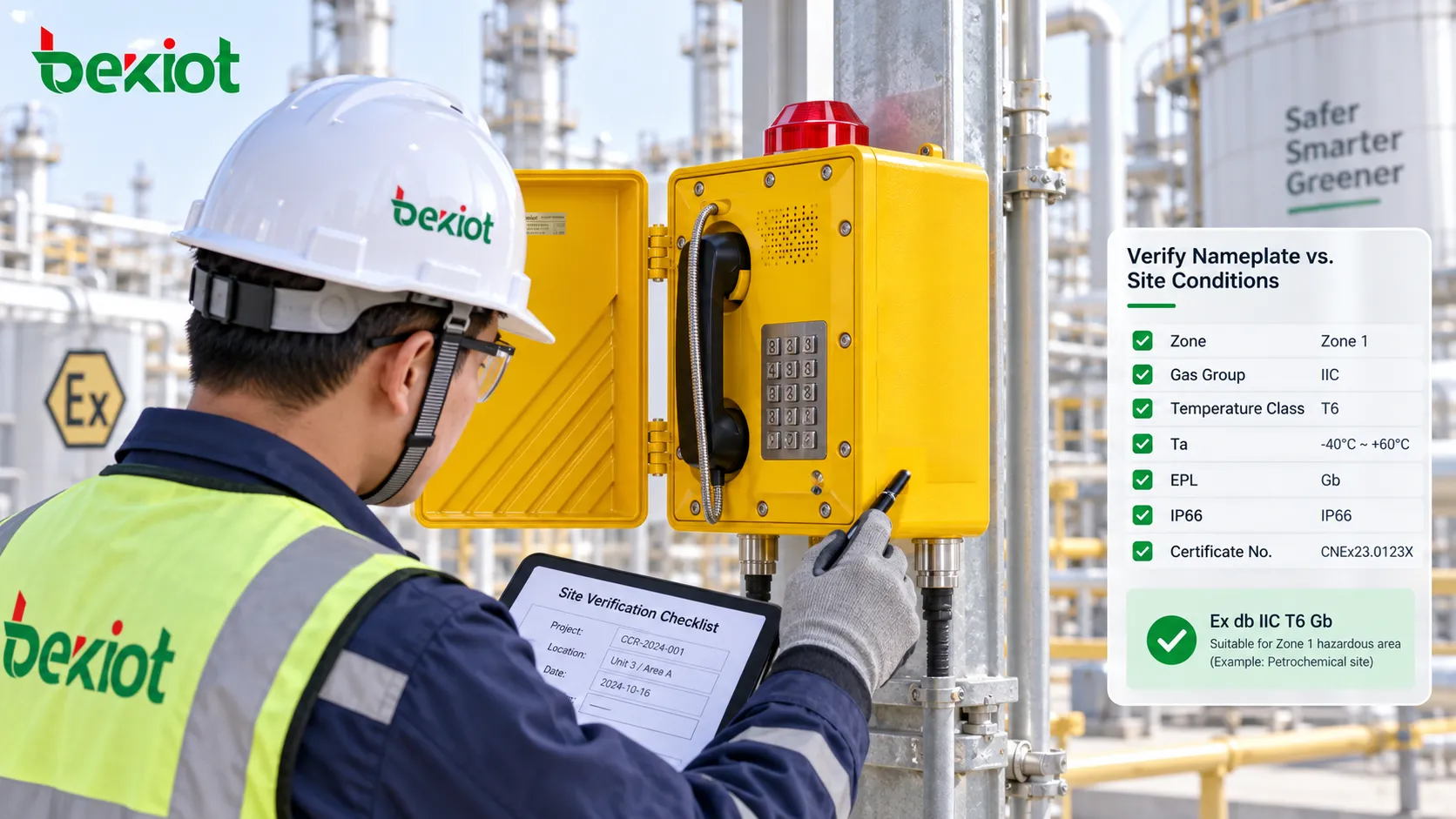
Suppose an installation point has already been classified as Zone 1, IIB gas atmosphere, with a T4 requirement and an ambient-temperature range of -20°C to +55°C. An explosion-proof telephone can then be reviewed against those site conditions step by step:
Confirm that the classification is for a Gas Hazard rather than matching the site against the dust marking;
Check whether the EPL and certification scope are suitable for Zone 1;
Confirm that the Gas Group meets at least IIB;
Verify that the Temperature Class satisfies the T4 requirement;
Confirm that the Ta range covers -20°C to +55°C;
Check the protection concept, certificate number and installation conditions.
If the telephone is marked Ex db IIC T6 Gb, then IIC and T6 both appear more demanding than the site's IIB and T4 requirements, and Gb is commonly associated with the protection level required for Zone 1 applications. Even then, the engineering review should not stop. The complete certificate, approved model scope, Ta range and the certification scheme accepted in the project country or region still need to be verified.
The nameplate should also be checked during incoming inspection. Does the actual model match the approved Submittal? Does the certificate number apply to that model? Is the nameplate complete and undamaged? Does the Ex Marking on the physical equipment match the procurement documentation? If the certificate carries an X condition, have the installation personnel received and understood the relevant Specific Conditions of Use?
These checks are much closer to real hazardous-area acceptance practice than simply confirming that the enclosure is yellow or that the telephone can place a call.
FAQ
Can an Explosion-Proof Telephone Marked IIC T6 Be Installed in Any Zone 1 Area?
No. IIC only addresses the Gas Group requirement, while T6 addresses the Temperature Class requirement. Suitability for a particular Zone 1 location also depends on EPL, protection concept, ambient-temperature range, complete certification scope, Specific Conditions of Use and the regulations and standards adopted by the project.
Does IP66 Mean an Explosion-Proof Telephone Is Certified for Hazardous Areas?
No. IP66 is an Ingress Protection rating describing resistance to dust and water. Ex Marking defines the equipment's protection design and certified suitability for explosive atmospheres. Hazardous-area telephones often require both appropriate IP protection and valid Ex certification, but the two ratings are not interchangeable.
Does T6 Mean the Telephone Can Operate in an Ambient Temperature of 85°C?
No. T6 means that the relevant gas-atmosphere temperature class limits the equipment's maximum surface temperature to 85°C. It does not define the permitted ambient temperature. The allowable operating environment must be checked separately using the Ta range shown on the nameplate, certificate or technical documentation.
If the Same Nameplate Shows Both IIC and IIIC, Which One Should Be Used?
That depends on whether the installation point is classified as a gas hazardous atmosphere or a combustible-dust hazardous atmosphere. IIC is a gas group, while IIIC is a dust group. They belong to different classification systems and must be checked separately against the corresponding Hazardous Area Classification. IIC and IIIC should not be interpreted as higher and lower values within the same rating scale.