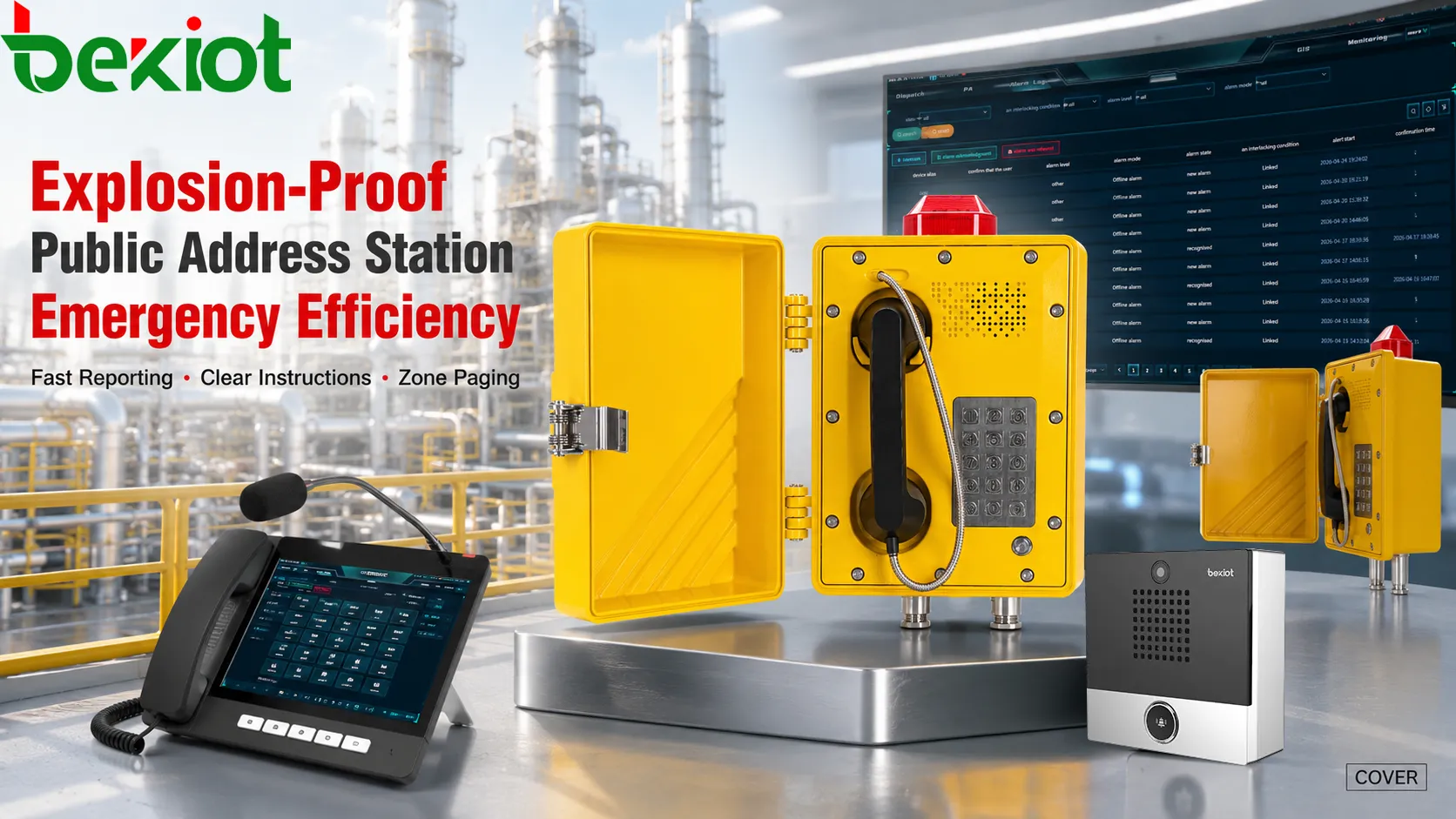
In hazardous industrial environments, emergency communication cannot depend only on ordinary phone calls or manual shouting across a noisy site. When a gas alarm, fire risk, chemical leakage, equipment failure, power incident, or evacuation demand occurs, field personnel need instructions that are fast, clear, and easy to confirm. An explosion-proof public address station is designed for this kind of situation. It can provide a safe voice access point in hazardous areas while also supporting amplified announcement, paging, alarm linkage, and communication with the control room.
The emergency efficiency of this equipment comes from two directions. First, it shortens the time between incident discovery and message delivery. Second, it improves the chance that the message is actually understood by people in the field. In industrial communication, a system is not efficient simply because it sends audio quickly. It becomes efficient when the right people hear the right instruction, in the right area, with enough clarity to act immediately.
Why Fast Voice Matters
Emergency efficiency begins with speed. In a hazardous location, one or two minutes can change the outcome of an incident. If a worker discovers abnormal pressure, smoke, odor, gas concentration, equipment overheating, or a blocked evacuation route, the control room must receive the information quickly. At the same time, nearby workers may need to hear warning instructions before the incident develops further.
An explosion-proof public address station supports this by placing a communication point directly in or near the risk area. Workers do not need to return to an office phone, search for a mobile signal, or depend on a colleague to relay the message. They can use the installed station to report the event, and the control room can use the connected system to broadcast instructions to the affected zone.
This fixed-location advantage is important in oil and gas plants, chemical workshops, tank farms, loading areas, mines, tunnels, power stations, offshore platforms, and other industrial sites. These are not environments where ordinary consumer devices are always allowed or reliable. A purpose-built station gives the site a known, visible, and protected communication point.
Fast voice access also reduces uncertainty. When workers hear a clear announcement from the control room, they do not have to guess whether an alarm is a drill, a local fault, or a real evacuation event. A direct voice message can explain what happened, where to avoid, where to gather, and whether additional confirmation is needed.
How the Station Works
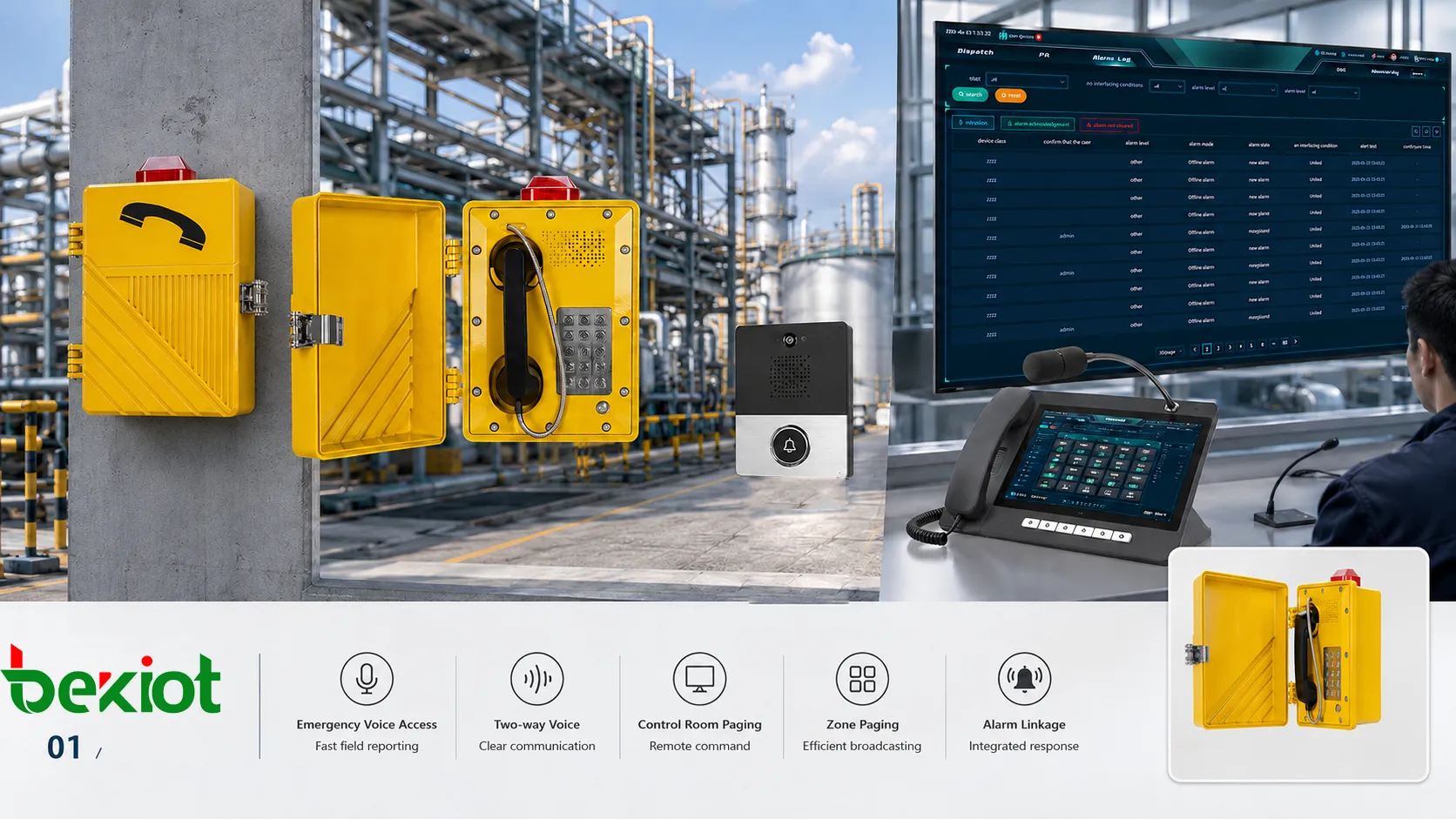
An explosion-proof public address station usually works as part of a wider communication and safety system. It may include a call interface, microphone, speaker or amplified output, push button, handset, status indicator, network or analog connection, relay input, and linkage with a dispatch or paging platform. The exact structure depends on the project, but the workflow is generally similar.
When a field user needs help, the station can initiate a call to the control room, safety desk, dispatch console, or emergency response center. The operator can answer, listen to the field situation, ask questions, and decide whether to trigger a local or area-wide broadcast. In some designs, the station itself can also receive live announcements or play emergency messages from the platform.
Alarm linkage can further improve response speed. A gas detector, fire alarm, emergency button, access control event, or process alarm may trigger the communication system. The platform can then send a preconfigured announcement, alert the operator, or open a voice channel. This reduces the manual steps required between alarm detection and field notification.
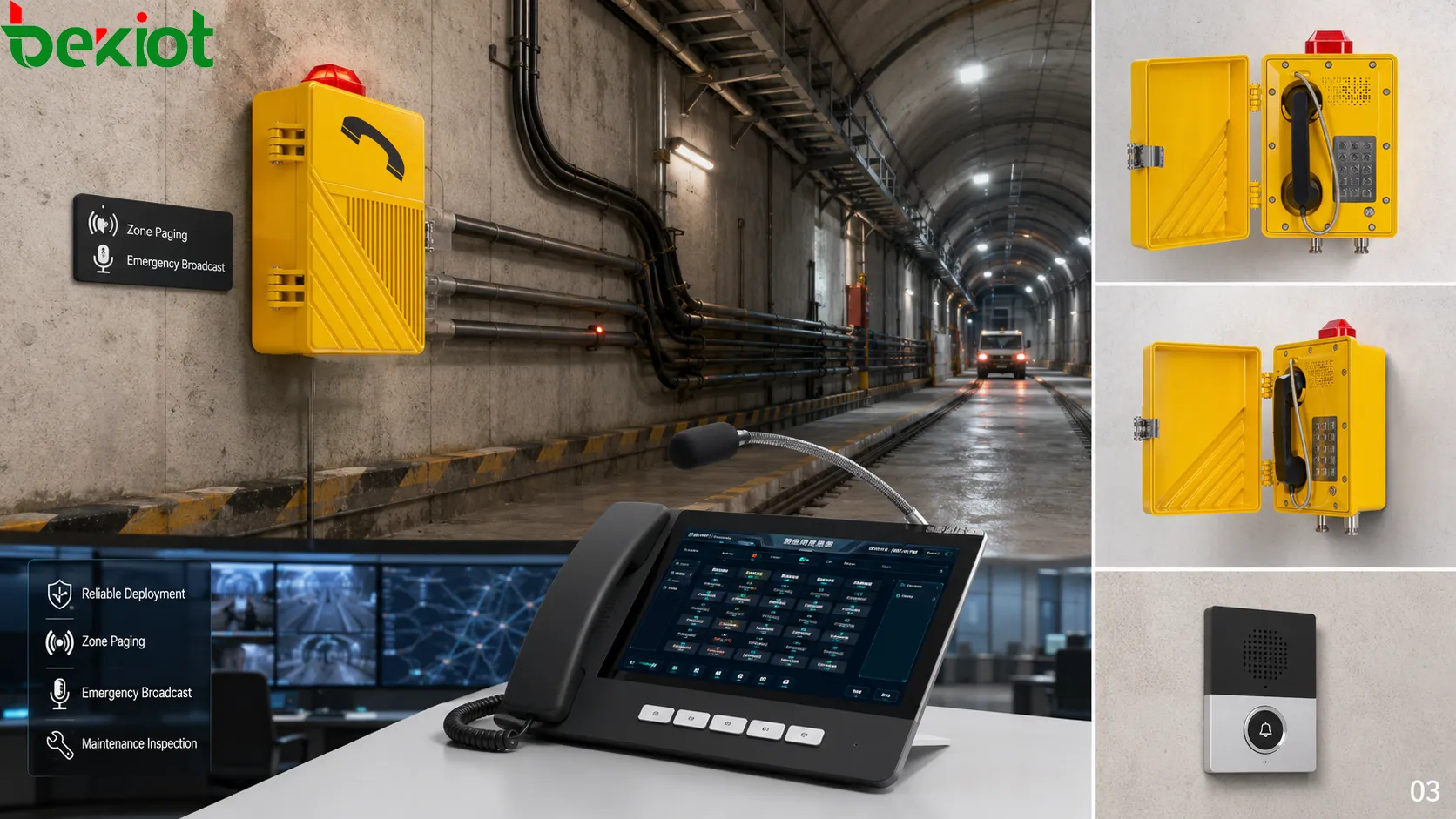
Zone control is another key part of the system. A message may need to reach only one workshop, one tank area, one tunnel section, one loading bay, or one floor. In a more serious event, it may need to reach the whole site. A well-designed public address architecture lets operators choose the correct area instead of relying only on all-call broadcasting.
What Makes Audio Clear
Emergency efficiency depends heavily on voice clarity. A broadcast that is loud but unclear may create confusion rather than action. Industrial sites often include machine noise, ventilation, vehicle movement, wind, rain, alarms, echo, and protective equipment. These conditions make speech harder to understand, especially when people are under stress.
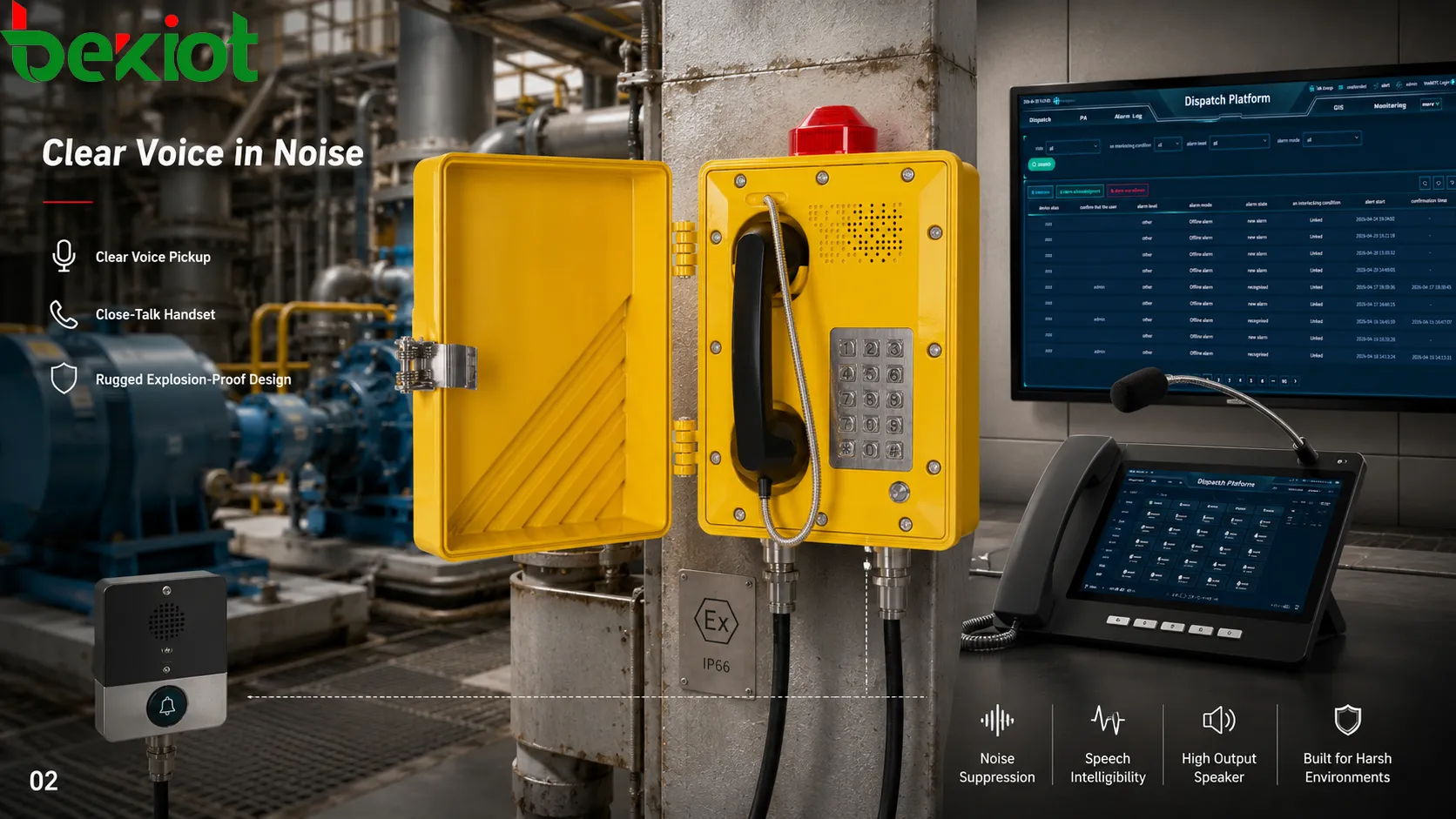
Explosion-proof public address stations and industrial telephones improve clarity through acoustic and structural design. The microphone should capture the user’s voice while reducing unnecessary background noise. If a handset is used, the close-talk position improves the signal-to-noise ratio because the microphone is close to the mouth. If a hands-free interface is used, the microphone direction, acoustic opening, and echo control become more important.
The output side is just as important. The speaker or receiver must provide enough volume for the environment without excessive distortion. Speech intelligibility should be the standard, not only sound pressure. Human instructions rely on consonants, rhythm, and clear word endings. If the system over-amplifies low-frequency noise or creates harsh distortion, workers may still miss important details.
Hardware stability also protects audio quality. Industrial communication equipment may face dust, moisture, corrosion, vibration, impact, temperature variation, and frequent use. A damaged handset cord, blocked microphone opening, loose terminal, corroded cable entry, weak speaker, or unstable power supply can reduce clarity over time. For this reason, rugged structure and regular maintenance are part of the audio design.
Becke Telcom EX-BH621 can be considered in hazardous-area communication projects where a field telephone must support clear voice access under demanding site conditions. In such projects, the device should be evaluated together with installation position, background noise, platform connection, and emergency workflow rather than judged only by its enclosure.
Where It Saves Time
The efficiency of an explosion-proof public address station becomes obvious in several practical scenarios. In petrochemical plants, field workers may need to report gas smell, pressure abnormality, pump failure, valve leakage, or fire risk. A local station lets them contact the control room quickly, while the operator can broadcast instructions to nearby zones.
In mines and tunnels, distance and acoustic conditions make emergency communication difficult. Fixed stations placed along key routes can help workers report incidents, receive evacuation instructions, and confirm whether an area has been cleared. Because tunnels and underground spaces may have echo and limited visibility, clear voice broadcasting is especially valuable.
In offshore platforms and port loading areas, weather, machinery, and restricted movement can slow down manual coordination. An explosion-proof station provides a known communication point for deck operations, loading supervision, emergency announcements, and command confirmation.
In power plants, chemical storage areas, and heavy manufacturing workshops, the station can support daily operational communication as well as emergency response. Workers can use it for maintenance contact, equipment confirmation, and safety reporting. During emergencies, the same infrastructure can shift into a higher-priority role for evacuation or incident command.
This dual value is important. Equipment that is only used during rare emergencies may be neglected. A station that also supports routine field communication is more likely to be noticed, tested, maintained, and trusted by workers.
How Design Affects Results
Good emergency efficiency requires careful deployment. The station should be installed where users can reach it safely, where the microphone can capture speech clearly, and where the speaker or connected public address system can cover the intended area. Mounting it directly beside the loudest machine may reduce communication quality. Mounting it too far from workers may reduce usability.
Zone planning should follow the real site layout. Operators should be able to select meaningful areas such as “tank farm north side,” “loading platform,” “compressor room,” “tunnel section three,” or “chemical storage entrance.” Clear zone naming reduces mistakes during pressure. Technical extension numbers alone are not enough for emergency work.
Power and network reliability also affect emergency performance. If the station uses SIP networking, the system should consider PoE reliability, switch backup, VLAN planning, QoS, SIP registration, and platform failover. If it uses analog lines, cable distance, grounding, surge protection, and line quality should be checked. The communication path must remain available when the site needs it most.
Testing should be done in real operating conditions. A station may sound clear during commissioning when machines are off, but become difficult to hear during normal production. Testing should include live voice calls, paging announcements, alarm-triggered messages, zone selection, audio clarity, and operator response. Maintenance teams should also inspect cable glands, enclosure condition, buttons, handset, microphone openings, speaker output, and visible labels.
Final Notes
The emergency efficiency of an explosion-proof public address station comes from faster reporting, clearer instruction delivery, safer hazardous-area access, zone-based broadcasting, alarm linkage, and reliable two-way confirmation. It helps industrial sites turn an alarm or field observation into coordinated action more quickly.
Voice clarity is a major part of that efficiency. In hazardous industrial environments, a message is useful only when workers can understand it. Acoustic design, close-talk voice pickup, speaker tuning, rugged hardware, stable circuits, proper installation, and full-system testing all contribute to clearer communication.
For projects that need hazardous-area field communication, emergency voice access, or explosion-proof telephone integration, Becke Telcom offers options such as the EX-BH621 for demanding industrial environments. The right solution should be selected according to site risk, noise level, coverage area, system platform, installation conditions, and emergency response procedure.
FAQ
What is an explosion-proof public address station?
It is a hazardous-area communication device used for field calling, local voice access, amplified announcements, alarm linkage, or emergency broadcasting in environments where ordinary equipment may not be suitable.
How does it improve emergency efficiency?
It shortens the path between field reporting and control room response. It can also deliver instructions to selected areas through paging or public address linkage, reducing manual relay time.
Why is voice clarity important during emergencies?
Workers must understand instructions quickly. If the message is distorted, too weak, or masked by machinery noise, people may hesitate, repeat calls, or take the wrong action.
Can one station cover a whole industrial site?
Usually not by itself. A station may serve as a local communication point, but large sites often need multiple stations, speakers, paging zones, dispatch control, and alarm integration.
What should be checked after installation?
Testing should include call function, microphone pickup, speaker output, paging zones, alarm linkage, power recovery, network or line stability, enclosure condition, and real-site audio clarity.