


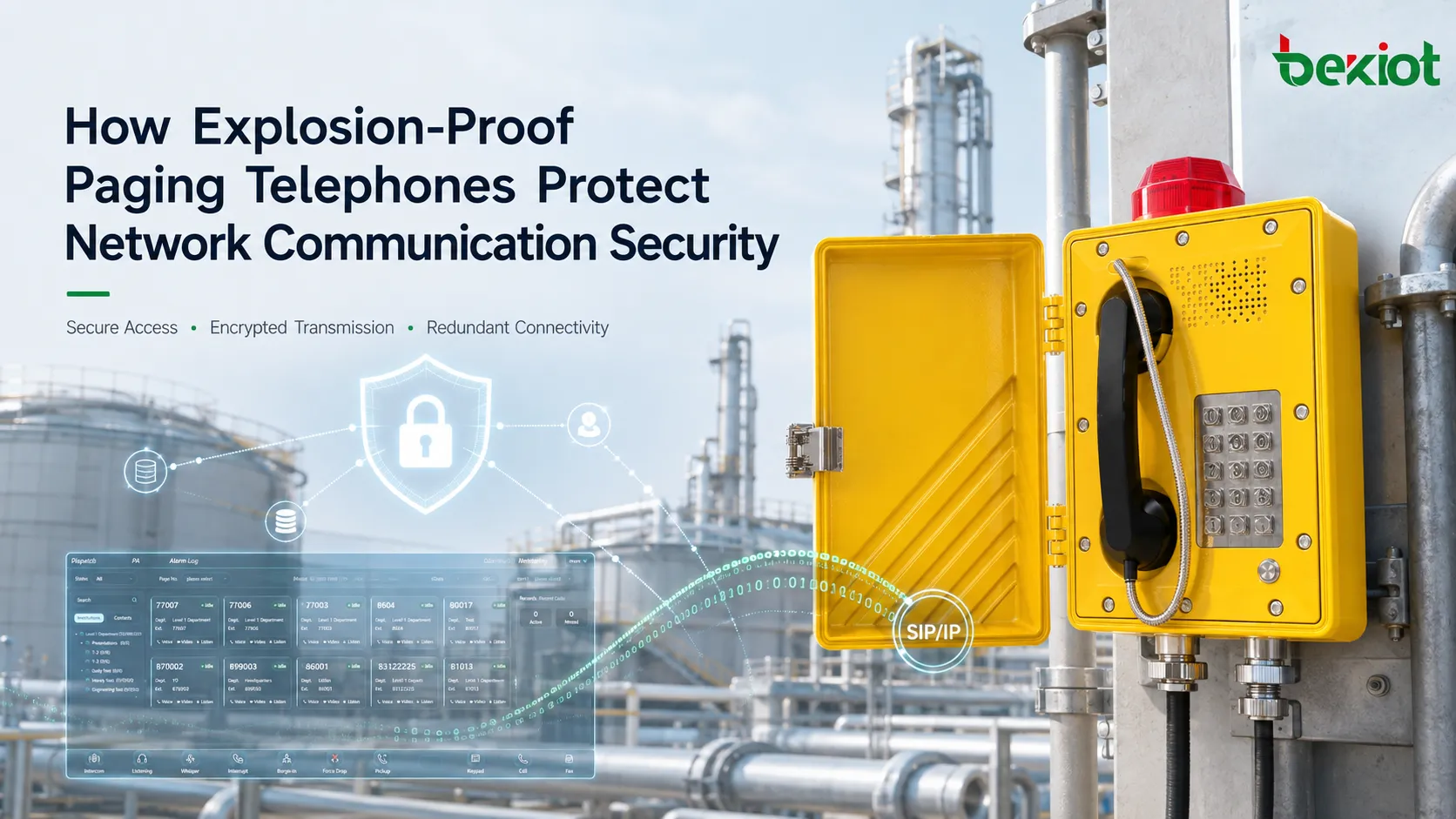
In petrochemical plants, underground mines, oil and gas facilities, power stations and other hazardous industrial environments, explosion-proof paging telephones are more than voice terminals. They are critical edge devices used for production coordination, emergency reporting, paging and operational communication.
As more industrial communication systems move to IP-based architectures, these field terminals are becoming directly connected to Ethernet networks, SIP platforms and dispatch systems. Their cybersecurity capabilities therefore affect not only the terminal itself, but also the reliability and security of the wider communication network.
Unauthorized access, tampered signaling, intercepted voice traffic or a failed network connection can interrupt critical communications at exactly the wrong time. For this reason, industrial communication security must extend from the physical terminal to network access, transmission, system permissions and platform management.
A properly designed explosion-proof paging telephone helps protect this edge of the network by combining physical protection, controlled network access, secure communication protocols and resilient system architecture.
Why Network Security Matters for Explosion-Proof Communication Terminals
Cybersecurity risks in industrial environments do not come only from external attacks. Device access, network configuration, maintenance practices and terminal availability are equally important.
Explosion-proof telephones are usually installed across production areas, tank farms, loading zones, underground tunnels, compressor stations and other locations that may be difficult to access. Because these devices are widely distributed, they can easily become overlooked endpoints in an otherwise well-protected industrial network.
In a refinery or underground mine, for example, a field telephone may be responsible for emergency calls, operational instructions, incident reporting or paging. If the terminal is compromised, disconnected or incorrectly configured, dispatch instructions may not reach the intended area and emergency response can be delayed.
Traditional analog explosion-proof telephones mainly focused on electrical and physical safety. Once the terminal becomes an IP device, additional risks must be considered, including unauthorized registration, improper network access, signaling interception, credential misuse and configuration changes.
For organizations operating in China, cybersecurity requirements may also need to be considered alongside MLPS 2.0 requirements and industry-specific safety regulations. The exact compliance requirements depend on the project, network classification and applicable industry standards.
Physical Protection Is the Foundation of Communication Availability
Network security is not only about encryption and authentication. Availability is equally important. If a field terminal cannot continue operating in a hazardous environment, the communication network loses one of its critical edge nodes.
Industrial Protection Helps Keep Field Terminals Online
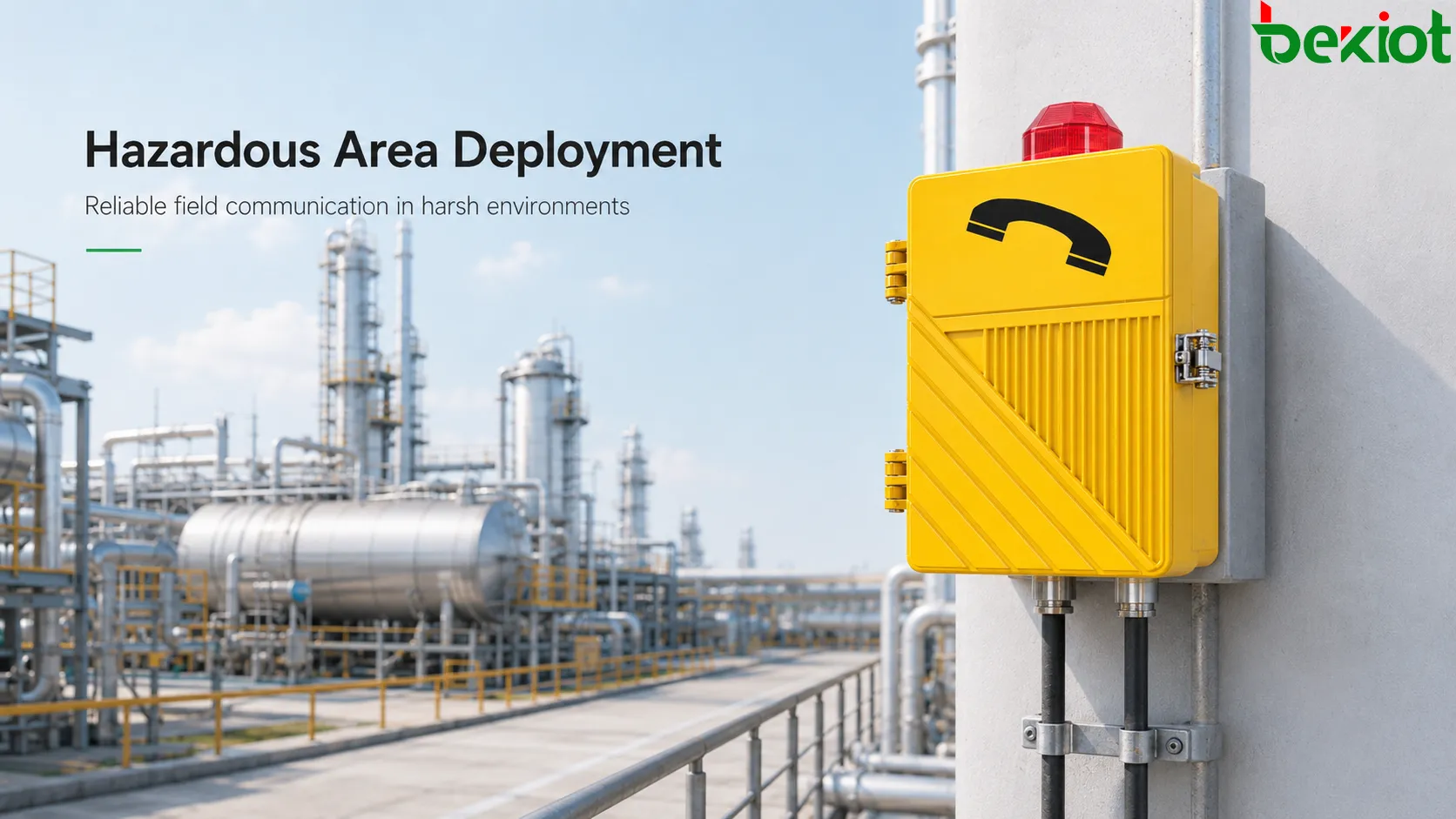
Explosion-proof paging telephones may use flameproof, intrinsically safe or other certified protection methods depending on the application. Enclosures are commonly manufactured from cast aluminum alloy, stainless steel or other industrial materials selected for impact resistance and corrosion protection.
Depending on the model, terminals may also provide IP66 or IP67 environmental protection and operate across a wide industrial temperature range. These features help protect the equipment against dust, moisture, rain, vibration, corrosion and temperature variation.
Reliable environmental protection reduces the likelihood of terminal failure caused by harsh site conditions and helps maintain the availability of the communication network.
Intrinsically Safe Circuit Design Reduces Electrical Risk
In intrinsically safe equipment, circuit energy is limited so that electrical sparks or thermal effects remain below levels capable of igniting the specified explosive atmosphere under defined normal and fault conditions.
This protection method reduces the possibility of the communication terminal itself becoming an ignition source. Maintenance procedures, live servicing and replacement requirements must still follow the equipment certification, installation instructions and site safety procedures.
How IP Architecture Improves Communication Network Resilience
Moving explosion-proof telephones from traditional analog wiring to IP-based communication changes more than the transmission medium. When properly designed, an IP architecture can improve scalability, fault isolation, centralized management and network redundancy.
SIP-based explosion-proof telephones can connect to an IP PBX, dispatch server or integrated communication platform over the industrial Ethernet network. Each field terminal operates as an independent network endpoint, which makes it easier to isolate individual failures compared with communication systems that rely heavily on shared analog circuits.
IP architecture also simplifies system expansion. New terminals can be added without rebuilding the entire communication backbone, provided that network capacity, addressing, VLAN planning and security policies have been properly designed.
Dual-Network and Ring Topologies Improve Link Availability
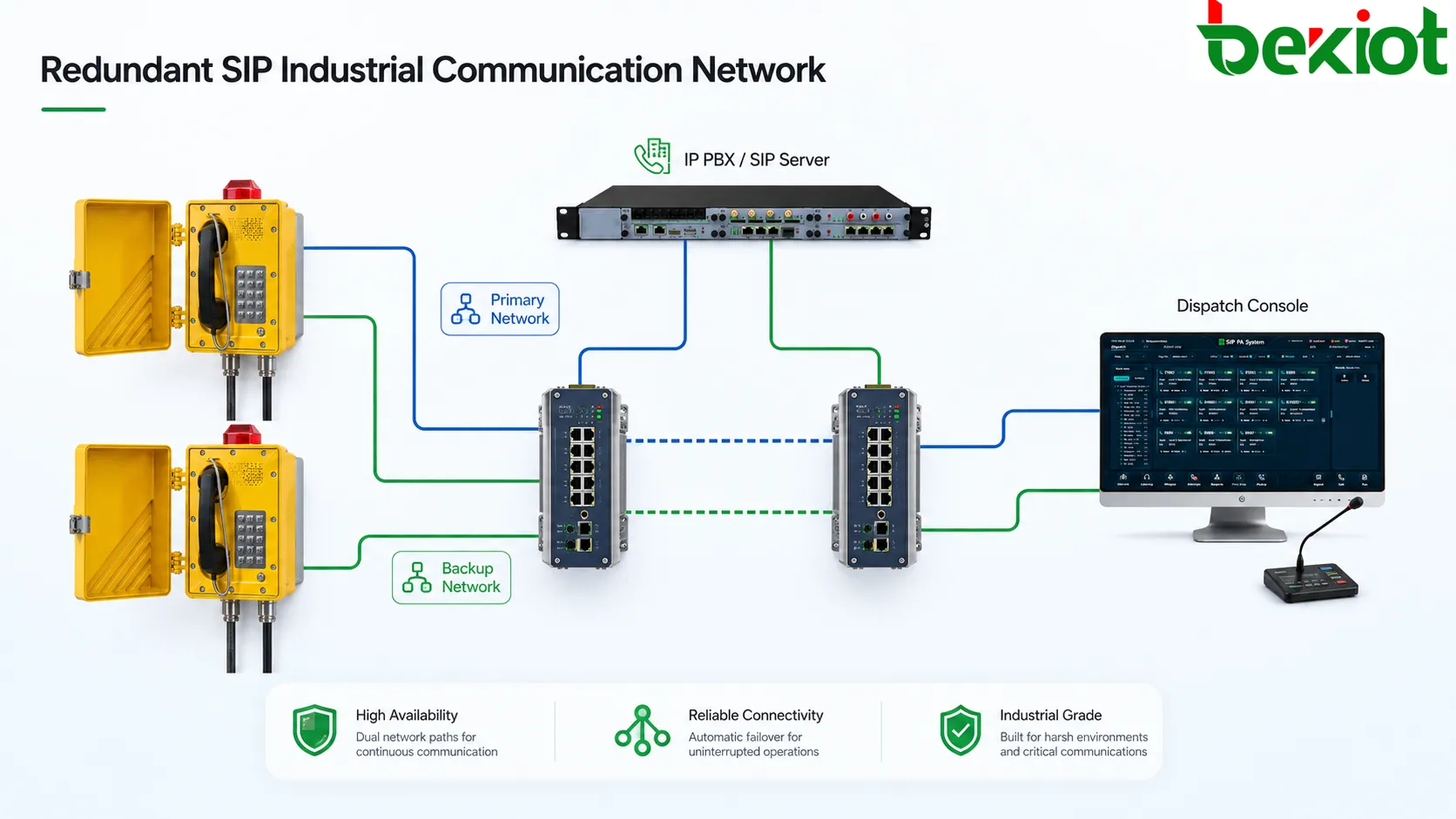
Some industrial paging telephones provide dual Ethernet interfaces or support deployment within redundant industrial network architectures. When used with managed industrial switches, redundant uplinks or ring protocols, the communication system can maintain service when an individual network segment fails.
Actual switchover performance depends on the terminal, switch configuration and redundancy protocol used in the project. Redundant power architecture may also be considered where continuous field communication is required.
By designing redundancy at both the network and power levels, system integrators can reduce the likelihood that a single cable, switch or power failure will take a critical communication terminal offline.
Standard Protocols Simplify Secure System Integration
SIP 2.0 provides a standardized method for connecting industrial telephones with IP PBXs, dispatch platforms and unified communication systems. Using widely supported protocols can simplify interoperability, troubleshooting and security policy implementation.
Standard protocols alone do not guarantee security. Authentication policies, network segmentation, secure configuration and software maintenance remain essential when integrating equipment from different vendors.
Key Cybersecurity Features of Explosion-Proof IP Telephones
Once an explosion-proof paging telephone becomes an IP endpoint, security should be addressed across the access, transport and management layers. Different products provide different capabilities, so security features should always be verified against the specific model and project requirements.
Access Authentication Helps Prevent Unauthorized Devices
Industrial communication networks may use mechanisms such as 802.1X authentication, switch port control, MAC address policies and SIP registration credentials to restrict network access.
These measures help ensure that only approved devices are allowed to connect to the communication network or register with the SIP platform.
VLAN segmentation is also widely used to place voice communication devices in a dedicated network segment. Separating the communication network from office IT systems and industrial control networks can reduce unnecessary exposure between different security zones.
Encrypted Signaling and Media Protect Communication Traffic
Where supported by the terminal and communication platform, SIP signaling can be protected using TLS, while voice media can be encrypted using SRTP.
These technologies can reduce the risk of signaling interception, credential exposure and unauthorized monitoring of voice traffic while data is being transmitted across the IP network.
Specific TLS versions, cipher suites and cryptographic requirements should be confirmed during project design. In environments requiring Chinese commercial cryptography algorithms or other specialized encryption standards, compatible terminals, servers and security infrastructure must be selected accordingly.
Role-Based Permissions Reduce Operational Risk
Security is also affected by how communication systems are managed. When explosion-proof telephones are integrated with a dispatch platform, different users can be assigned different operational permissions.
Field personnel may only need emergency calling or predefined speed-dial functions, while dispatch operators may require group calling, paging and call control. System configuration and maintenance permissions can be restricted to authorized administrators.
Configuration logs, call records and administrative audit logs can provide additional traceability and help identify unauthorized or accidental changes.
Controlling Security Boundaries in Integrated Communication Systems
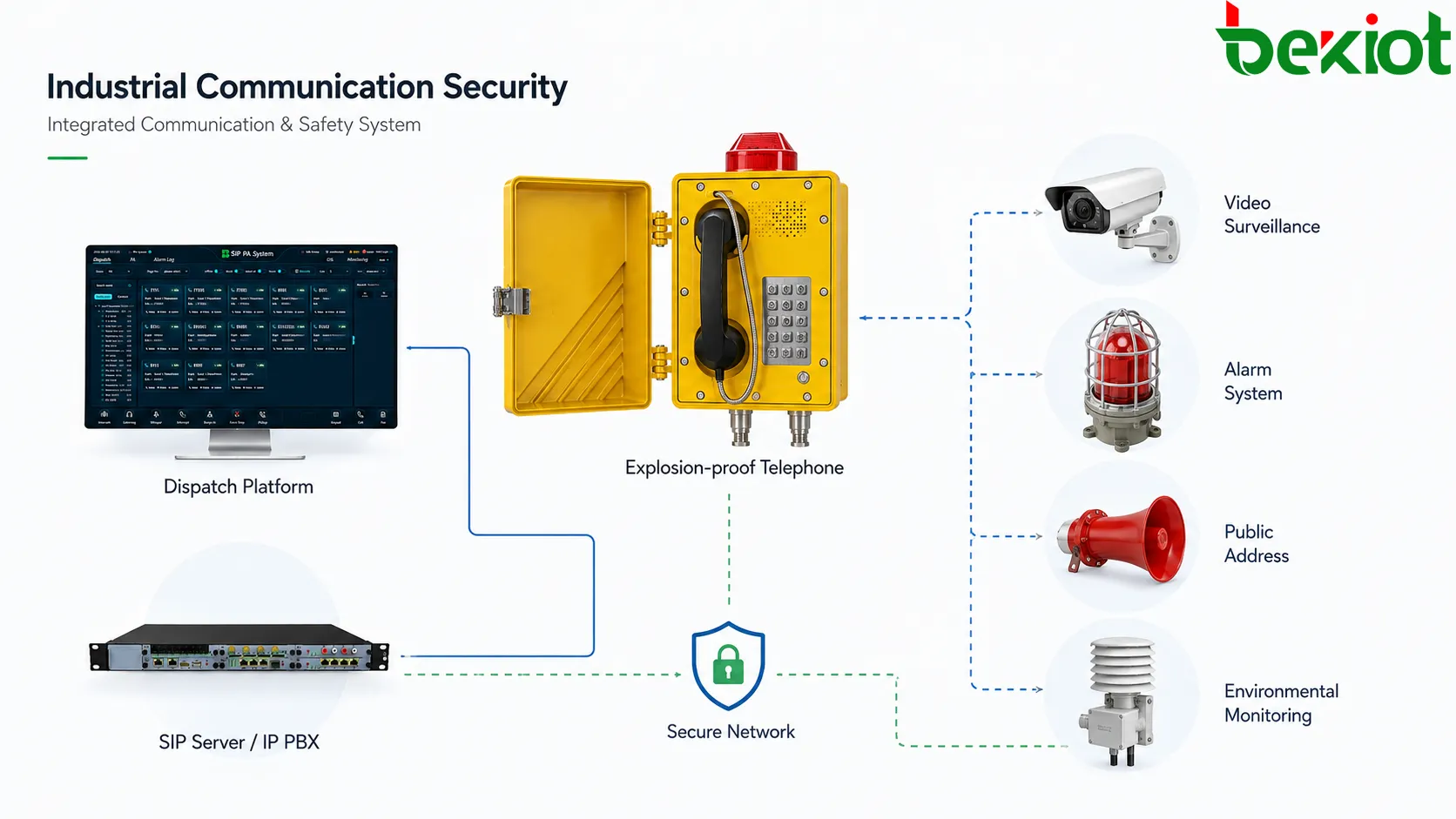
Explosion-proof paging telephones are often deployed as part of a larger emergency communication system. The dispatch platform may integrate with fire alarms, process alarms, video surveillance, environmental monitoring and public address systems.
These integrations improve operational response, but they also create additional interfaces between systems. Each interface should therefore be designed with a clearly defined security boundary.
| Integration | Recommended Security Approach |
|---|---|
| Alarm System | Limit integration to required alarm events and interfaces, and restrict unnecessary reverse-control permissions |
| Video Surveillance | Define controlled API or event interfaces and avoid exposing device configuration interfaces to unrelated systems |
| Dispatch Platform | Apply authenticated communication, encrypted transmission and role-based access to dispatch functions |
| Environmental Monitoring | Use read-only event or threshold data where possible and prevent communication applications from modifying monitoring parameters |
Protocol whitelisting, least-privilege access, network segmentation and controlled API permissions can reduce unnecessary exposure between systems.
The objective is to allow alarms, voice communication, video and dispatch functions to work together without turning one subsystem into an unrestricted path into another.
Security Requirements Vary by Industry
Petrochemical and Oil & Gas Facilities
Petrochemical facilities commonly deploy explosion-proof communication equipment in process areas, tank farms, pumping stations and loading terminals.
Network segmentation, secure signaling, reliable communication paths and controlled access are particularly important because communication systems may span multiple production units and hazardous zones.
Communication network design should also consider plant topology, hazardous area classification, environmental conditions and the consequences of losing communications in each operating area.
Mining and Underground Infrastructure
Underground mines and tunnel environments often involve long communication distances, difficult cable routes and limited access for maintenance.
In these environments, network resilience may be more important than adding large numbers of advanced features. Redundant fiber routes, industrial Ethernet rings, backup power and distributed communication nodes can help maintain communications if part of the network is damaged.
Power, Energy and Large Industrial Sites
Power stations, substations and large industrial campuses may contain hundreds of communication endpoints across multiple operational departments.
Centralized device management, network authentication, VLAN segmentation and role-based administration can help control which devices and personnel are permitted to access different communication services.
Network Security Features to Check When Selecting an Explosion-Proof Telephone
Explosion-proof certification and audio performance remain important selection criteria, but IP-based industrial communication projects should also evaluate network security and system reliability.
Access and transmission security:Confirm whether the required model supports features such as SIP authentication, 802.1X, VLAN, TLS, SRTP or other network security mechanisms required by the project.
Network resilience:Check Ethernet interface design, redundant network support, compatibility with industrial ring architectures and backup power options where continuous communication is required.
Device management:Evaluate password policies, configuration permissions, remote monitoring, firmware upgrade mechanisms, configuration backup and operational logging.
Certification: Verify that the product carries the required explosion-proof certification for the intended hazardous area. Network features do not replace hazardous-area compliance.
System compatibility:Confirm interoperability with the existing IP PBX, SIP server, dispatch platform, industrial switches and cybersecurity architecture before deployment.
Security capabilities should be evaluated as part of the complete communication architecture rather than as isolated specifications on a terminal datasheet.
The Role of Explosion-Proof Telephones in Industrial Communication Security
An explosion-proof paging telephone is no longer simply a rugged voice device. In an IP-based industrial environment, it becomes part of the communication network's edge architecture.
Physical protection keeps the terminal available in hazardous locations. Network segmentation limits unnecessary exposure. Authentication controls device access. Encryption protects signaling and voice traffic. Redundant network design improves communication availability when individual components fail.
Together, these measures help create a more resilient communication environment for routine operations and emergency response.
For hazardous industries, communication availability and information integrity are closely connected with operational safety. The objective is not simply to make a telephone more secure, but to ensure that emergency calls, dispatch instructions and paging functions remain available when they are needed most.
Becke Telecom provides explosion-proof telephones and industrial communication terminals for petrochemical, mining, energy, power and other industrial applications. Depending on the product model and project configuration, the system can support SIP-based communication, network segmentation, secure transmission and redundant network deployment.
FAQ
How is the network security of an explosion-proof telephone different from that of a standard IP phone?
The main difference is the operating environment and system requirements. An explosion-proof telephone must first meet the required hazardous-area certification and environmental protection requirements.
IP models may also provide industrial network functions such as VLAN segmentation, secure SIP signaling, encrypted media, access authentication and redundant network options. The exact features vary by manufacturer and model.
Does connecting an explosion-proof telephone to an industrial network create cybersecurity risks?
Any IP-connected device introduces an additional network endpoint that must be managed. The risk can be controlled through network segmentation, device authentication, secure configuration, encrypted communication and appropriate firewall or switch policies.
The important point is to treat the telephone as part of the industrial network security architecture rather than as an isolated voice device.
Why should an explosion-proof telephone support encrypted communication?
Dispatch instructions, emergency calls and operational communications may contain sensitive information. TLS and SRTP can help protect signaling and voice traffic against interception or unauthorized modification while the information travels across an IP network.
Can an explosion-proof telephone continue operating if the network fails?
This depends on the system architecture and terminal capabilities. In a redundant network, failure of one network path may be handled by a secondary path or industrial ring architecture.
Some systems may also provide local communication, fallback routing or other limited operation during a wider network or server outage. These functions should be verified during system design and acceptance testing rather than assumed from the SIP protocol alone.







