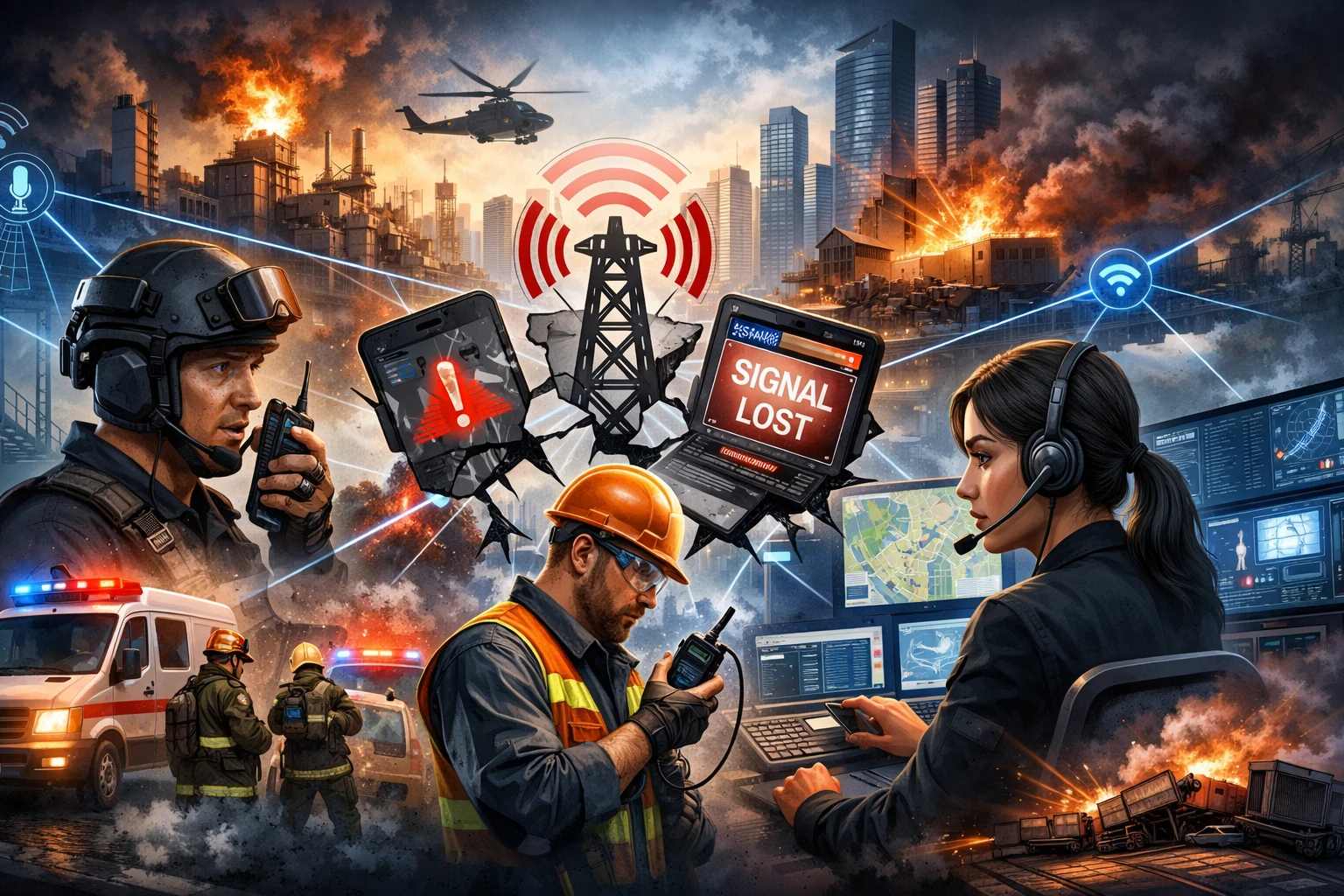
In oil and gas field operations, communication difficulty is rarely as simple as “whether there is a telephone.” Wellheads, metering rooms, gathering pipelines, booster stations, compressor areas, tank farms, loading points, and remote inspection points are all distributed across different locations. Field personnel face more than noise; they may also deal with flammable gas, sandstorms, rain, snow, night operations, equipment vibration, and long walking distances. Once abnormal pressure, a suspected leakage odor, a fire and gas alarm, or a pipeline fault occurs, the situation must be reported immediately, and the control room must deliver handling instructions accurately to the corresponding area.
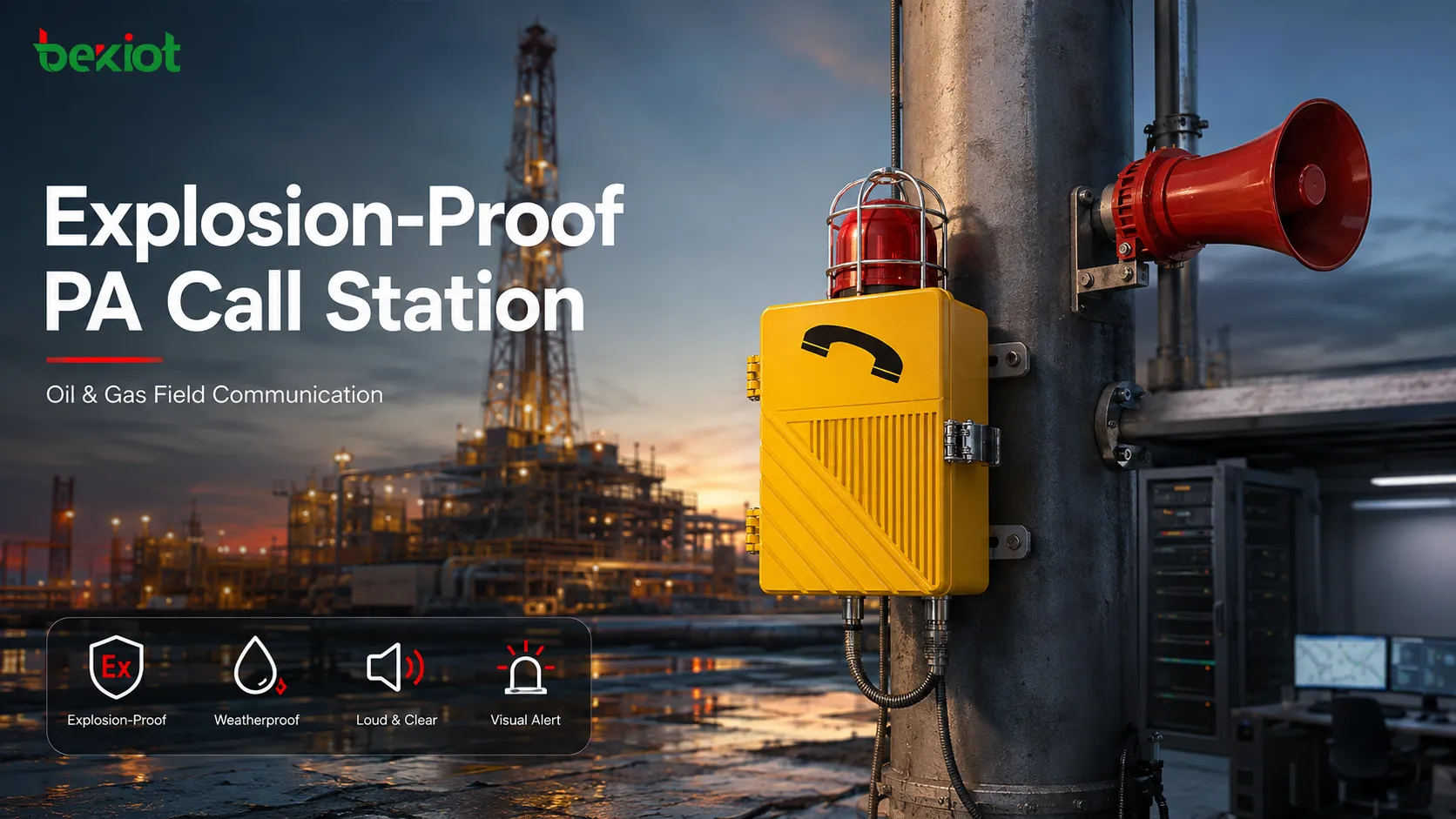
Explosion-proof public address call stations are necessary because they integrate “field calling” and “area broadcasting” into one emergency communication process. Field personnel can quickly contact the control room from near hazardous areas, while the control room can send instructions back through public address or zone-based announcements. This is not simply adding another telephone; it is establishing a fixed, recognizable, linkable, and traceable communication node within the oil and gas field operation chain.
Field Voice Must Get a Response
Oil and gas field operation areas are usually widely dispersed. A single well site may be far from the duty room, while multiple wellheads, valve groups, separators, heaters, metering devices, pipeline nodes, and electrical control cabinets may be distributed across different positions. When field personnel discover an abnormal condition, relying only on mobile phones, radios, or walking back to the duty room will lengthen the response chain.
The first problem solved by an explosion-proof public address call station is giving hazardous areas or remote points a fixed communication entrance. It is installed at a planned location. Field workers know where to place a call, and the control room can immediately identify the related area based on the calling point. This location certainty is critical in oil and gas field operations because many incident judgments depend not only on verbal descriptions but also on “where the call is coming from.”
“Getting a response” also means that control room instructions can be delivered directly back to the field. Oil and gas sites often include equipment noise, wind, vehicle movement, pumps, and compressor noise, making human relay unreliable. With public address capability, the control room can issue notices, warnings, or evacuation instructions to selected areas without relying on repeated manual transmission.
Unlike ordinary telephones, explosion-proof public address call stations are better suited to becoming the “first contact point” in oil and gas field operations. They can support abnormal condition reporting, equipment confirmation, inspection communication, loading coordination, temporary notification, emergency calling, and area broadcasting. The more frequently they are used in routine work, the easier it is to discover and maintain their operating condition, and the more trusted they become during emergencies.
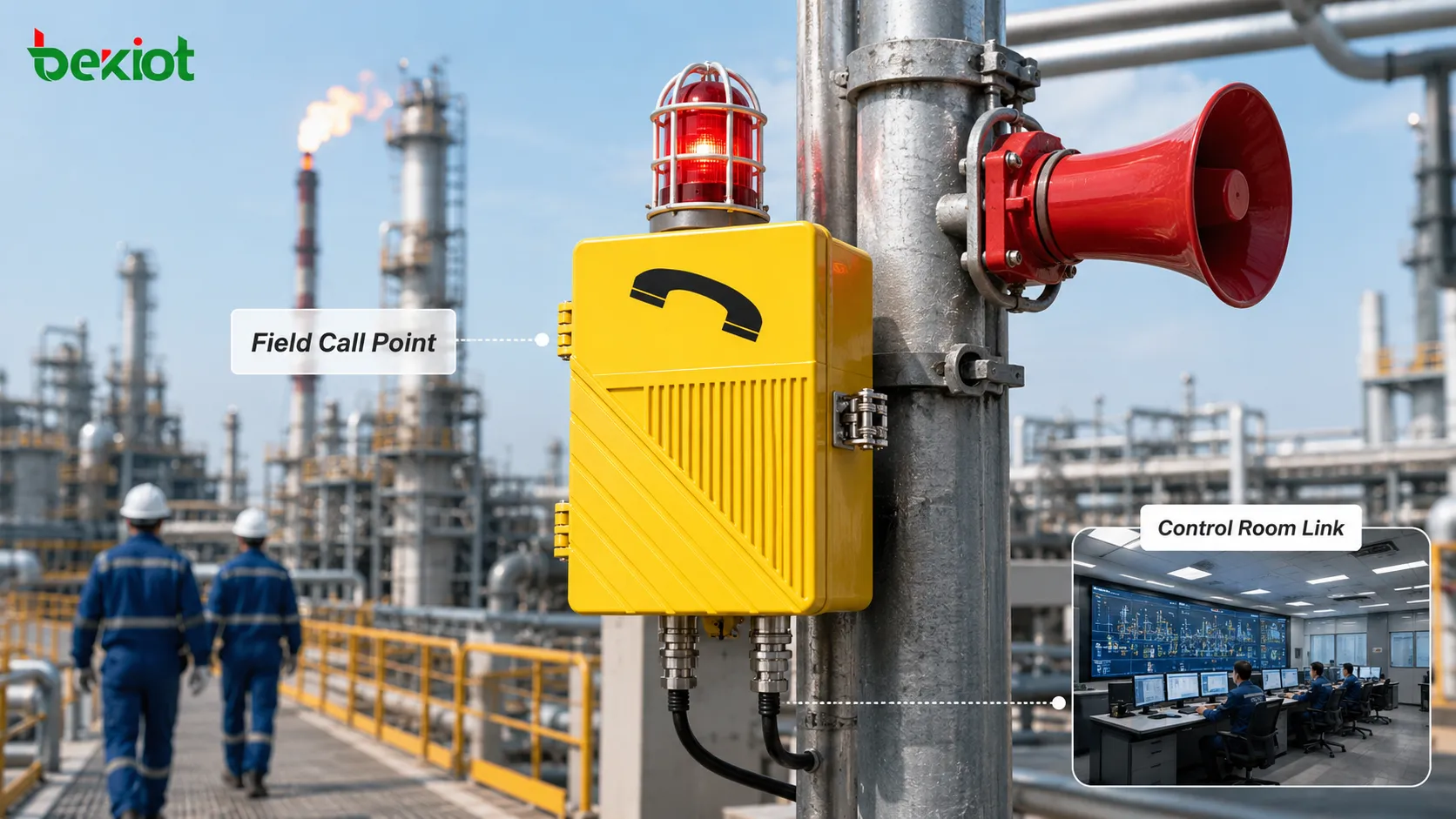
Hazardous Areas Need Protected Terminals
Oil and gas field operations may involve flammable gas, hydrocarbon vapor, mist-like media, and explosive atmospheres. Wellheads, separator areas, valve rooms, metering stations, compressor zones, tank farms, and loading points may form hazardous atmospheres under certain operating conditions. If communication equipment is not suitable for these locations, the equipment itself may become a safety risk.
Ordinary communication terminals are mainly designed for offices or general indoor environments. Their enclosure, buttons, line interfaces, electrical structure, wiring method, and protection level are not designed around explosive atmosphere requirements. Even if an ordinary telephone can make calls normally, that does not mean it can be safely installed in hazardous oil and gas field areas.
An explosion-proof public address call station takes hazardous-area safety requirements as a design premise from the beginning. The equipment must consider enclosure protection, cable entry, grounding, sealing, materials, circuit energy control, mechanical strength, and field installation methods. For oil and gas field projects, communication terminals must match area risks, installation locations, and site management requirements.
This is one of the core reasons why such stations are necessary. Oil and gas fields are not short of communication tools, but certain key locations require a fixed terminal that can both meet hazardous-area use requirements and support field voice calling and public address notification. Explosion-proof public address call stations meet exactly this gap.
Calling and Broadcasting Need a Closed Loop
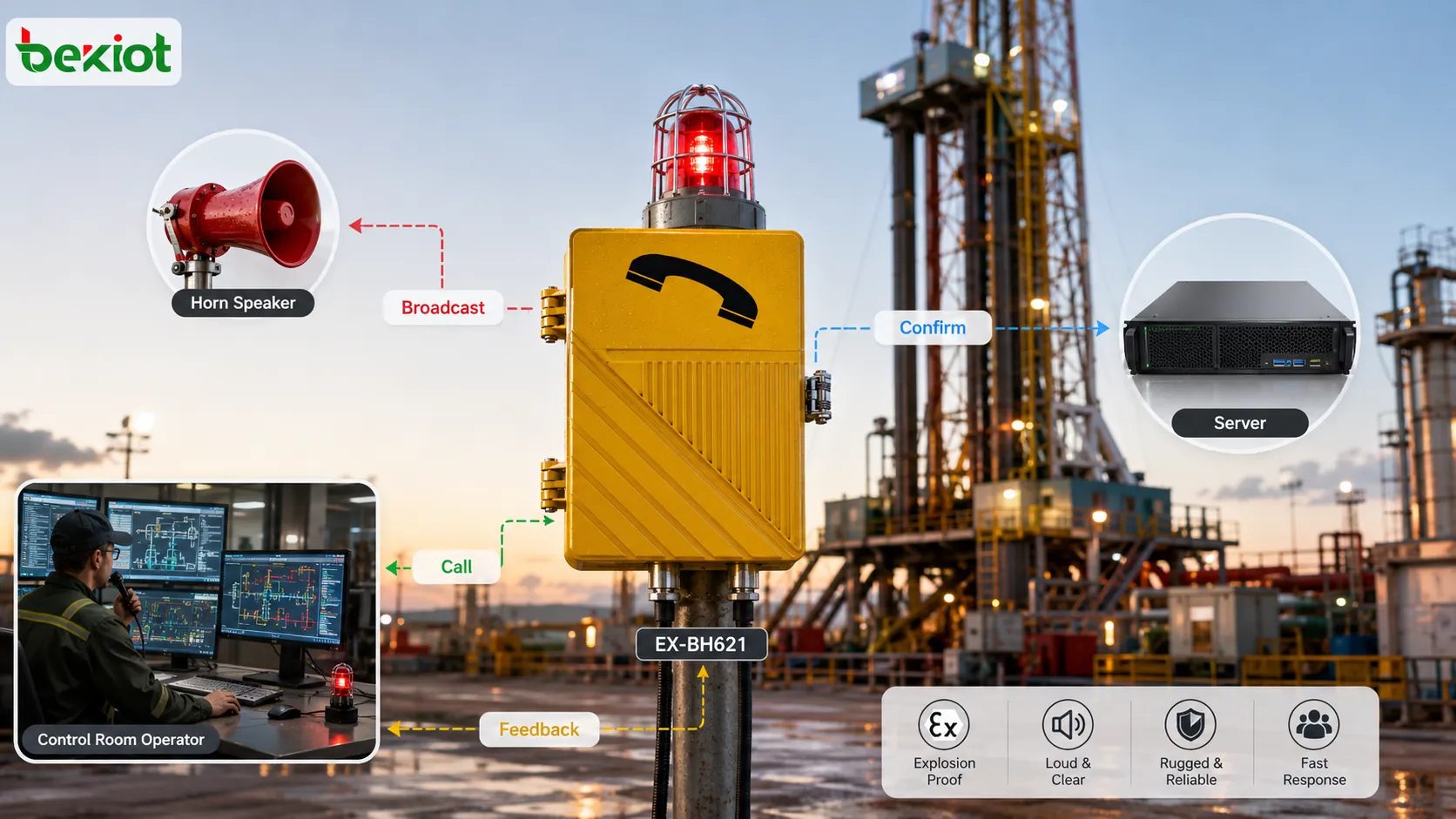
Emergency communication in oil and gas fields cannot rely only on one-way notification or only on point-to-point calling. One-way broadcasting can alert people, but it cannot confirm the field situation. A single telephone call can report a problem, but it cannot simultaneously notify nearby areas. The significance of an explosion-proof public address call station is that it connects “field-initiated calling” and “control room broadcast instructions” into a closed loop.
For example, an inspector at a well site smells an abnormal odor and immediately contacts the control room through the call station. After confirmation, the control room can broadcast a warning to that well site or adjacent areas, asking personnel to stay away from a specific pipeline section, stop a certain operation, wait for detection, or evacuate according to the emergency plan. If further confirmation is required, the control room can continue two-way communication with the field.
This closed loop is more suitable for oil and gas fields than simple radio communication or simple broadcasting alone. Field incidents usually require confirmation first, then notification, then feedback. Abnormal condition reporting, control room judgment, area notification, field confirmation, follow-up handling, and record keeping together form a complete emergency communication process.
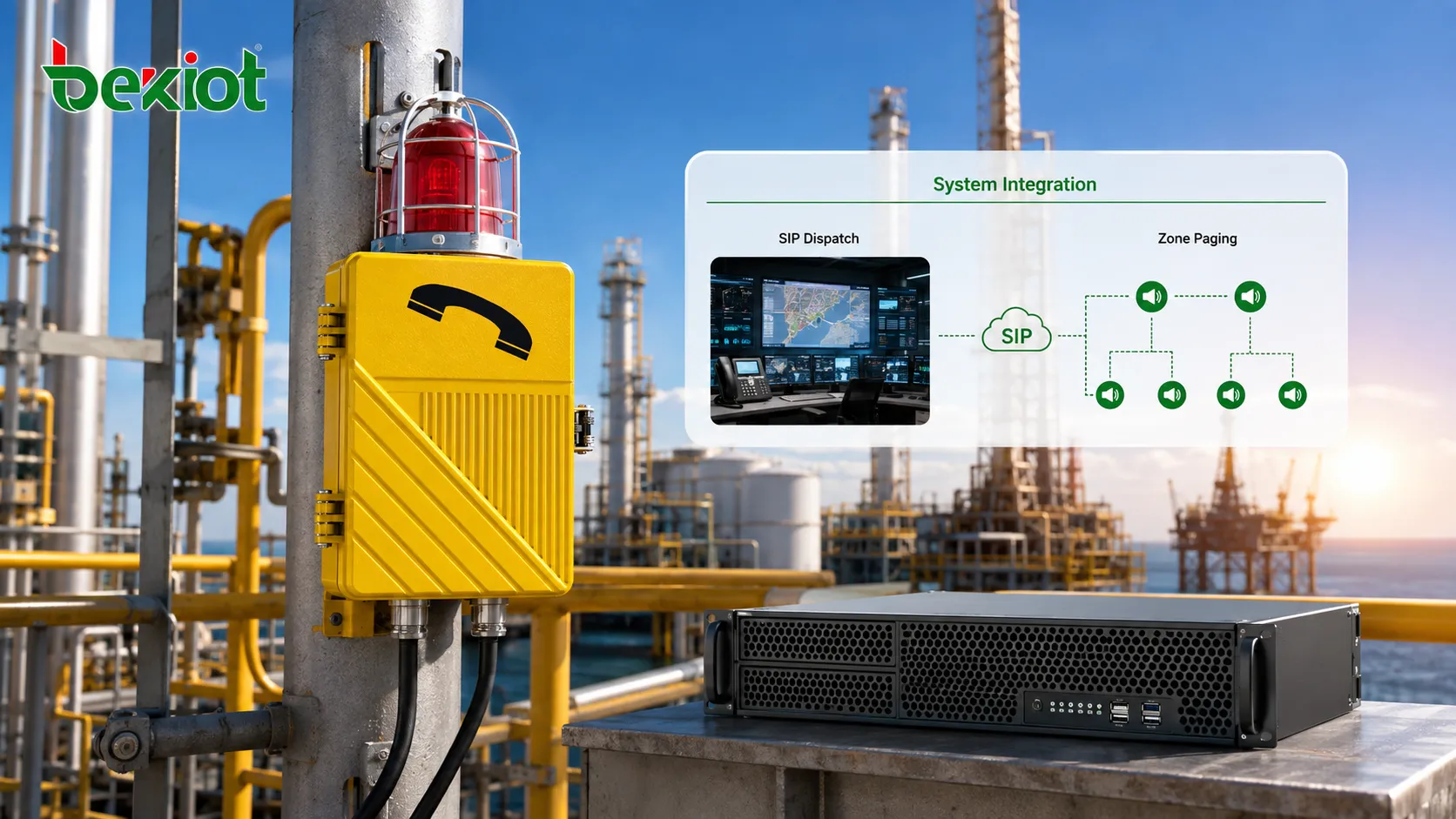
At the system level, explosion-proof public address call stations can connect to dispatch platforms, SIP systems, public address systems, recording systems, or alarm linkage systems. In this way, a field call is no longer an isolated event, and a broadcast is no longer temporary shouting. Both can enter a unified dispatch and safety management process.
High-Noise Areas Require Intelligible Voice
Oil and gas sites are not quiet. Compressors, pumps, heaters, generators, vehicles, ventilation equipment, and loading machinery can all generate continuous noise. Sandstorms, rain, snow, and large metal structures can further interfere with voice transmission. Even if personnel have access to a telephone, they may still struggle to hear or speak clearly because of excessive noise.
Explosion-proof public address call stations must support two types of voice quality. First, when field personnel call the control room, the microphone or handset must transmit speech clearly. Second, when the control room broadcasts to the field, personnel must be able to understand the message. Emergency communication is not only about volume; it is about whether instructions are intelligible.
In oil and gas field environments, “clearly understood” is far more important than “very loud.” A broadcast that is over-amplified but severely distorted may be heard, but field personnel may not understand the actual content. Broadcast messages should be short, clear, and focused, such as “Stop loading,” “Stay away from the north pipe rack,” or “Move to the assembly point.”
Equipment selection and installation position directly affect voice performance. The call station should not be installed beside the strongest noise source, nor should it be placed where personnel cannot approach it easily. Broadcast coverage should be tested according to unit layout, noise direction, personnel routes, and building reflection. Voice calling and public address tests under real operating conditions are far more valuable than paper specifications alone.
Remote Well Sites Need Unified Dispatch
Oil and gas fields are different from ordinary factories. One station may manage several well sites, multiple pipeline nodes, and remote operation points. Inspection, maintenance, temporary work, and vehicle dispatch are distributed across different areas. If remote points lack a fixed communication entrance, abnormal events may first be manually relayed before reaching the control room, increasing both delay and information distortion.
Explosion-proof public address call stations can bring remote points into unified dispatch management. Each call station corresponds to a clearly defined location. Once connected to the platform, it can be displayed by station name, area name, or number. When the control room receives a call, operators do not need to repeatedly ask, “Where are you now?” They can identify the incident area directly from the calling point.
This fixed terminal is especially important for unattended or lightly staffed well sites. Field inspectors may only stay briefly at the site. Once they discover a problem, they need to contact the duty center immediately. The call station can be configured to call the control room, dispatch seat, or duty position directly, avoiding time spent searching for numbers.
Remote well sites also need broadcasting capability. The control room may need to instruct field personnel to stop approaching a device, wait for remote confirmation, cooperate with valve operation, or move to a safe area. Contacting people one by one by phone is inefficient. Zone broadcasting allows the control room to cover the target area quickly.
Alarm Linkage Shortens Response Time
Oil and gas field alarms come from many sources: gas detection, fire alarm, pressure abnormality, liquid level abnormality, equipment shutdown, access control events, emergency buttons, or video inspection. After an alarm occurs, the key issue is converting the alarm information into field action, not merely displaying it on a control room screen.
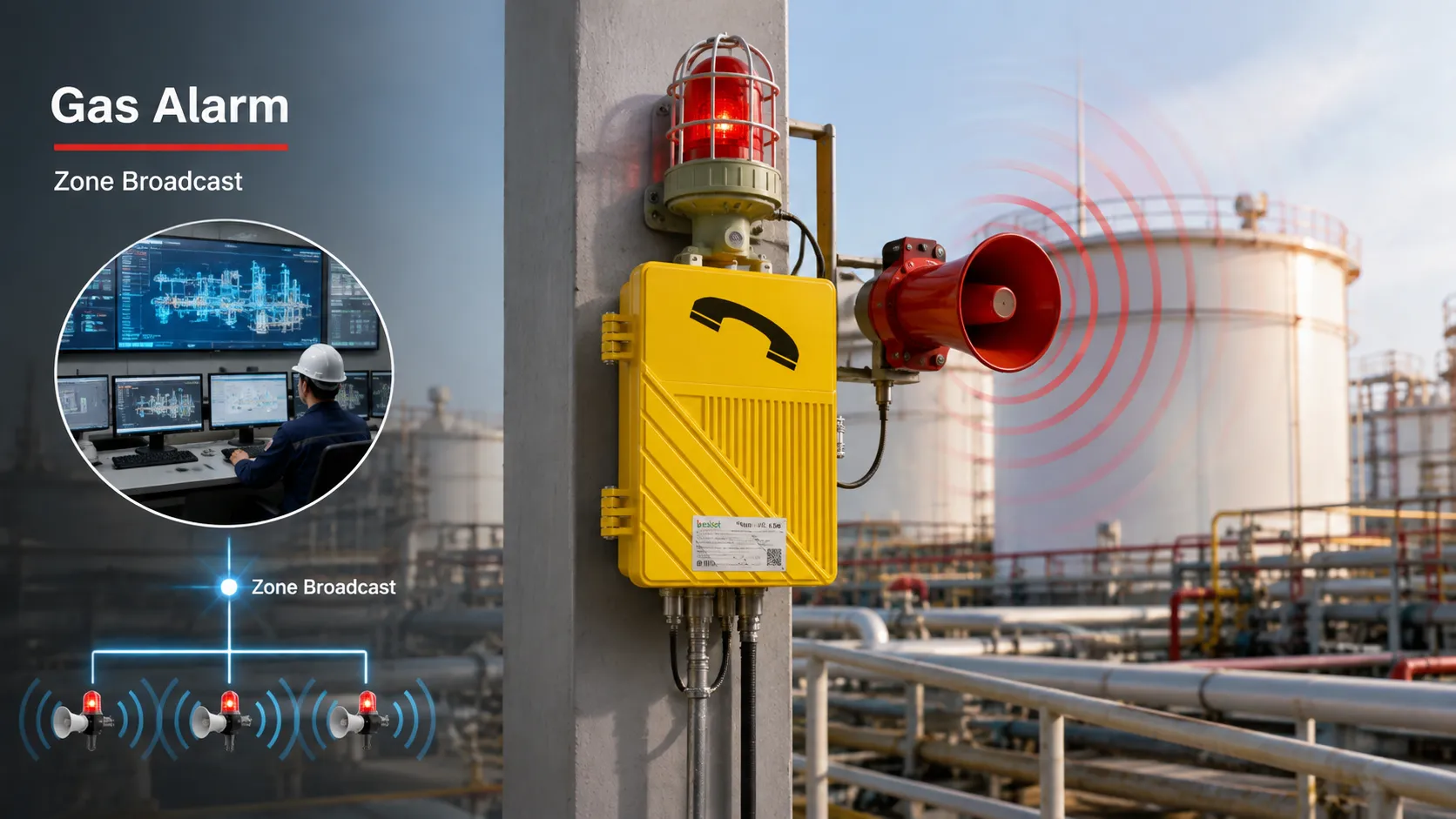
Explosion-proof public address call stations can be linked with alarm systems. When an alarm is triggered in a specific area, the platform can notify duty personnel and send a broadcast reminder to the related zone. Depending on the project design, the system can also play pre-recorded voice messages, trigger audible and visual alerts, establish a voice channel, or associate call records with the alarm event.
This linkage shortens the time between “risk detection” and “field notification.” Oil and gas incidents often develop progressively. Notifying personnel one minute earlier to stop work, leave a hazardous area, or shut down related processes may help prevent risk escalation.
Alarm linkage also needs grading. Not every alarm should trigger a site-wide broadcast. A low-level equipment reminder may only notify a maintenance point. A gas alarm may first cover the local area and adjacent zones. A major fire or leakage risk may require wider notification. The zone capability of explosion-proof public address call stations fits this graded notification logic.
Extreme Weather Tests Reliability
Oil and gas field operations are often outdoors or semi-outdoors. Equipment may face high temperature, low temperature, strong wind, dust, rain, snow, salt mist, ultraviolet exposure, day-night temperature differences, and long periods without direct supervision. For communication terminals, whether they can remain usable under these conditions is a major measure of value.
Explosion-proof public address call stations must not only meet hazardous-area safety requirements but also provide industrial-grade structural protection. Enclosures, covers, seals, hinges, locks, cable entries, handset cords, buttons, speaker openings, and mounting brackets all need to withstand long-term field exposure. Any weak point may become a future fault source.
Oil and gas field equipment has another feature: maintenance may not be convenient. Remote well sites, pipeline nodes, and distant valve rooms may require vehicle access, work permits, and personnel scheduling. Frequent failures increase maintenance cost and reduce confidence in emergency communication. The more stable the equipment, the easier it is for field personnel to rely on the system.
Therefore, oil and gas projects should not focus only on initial purchase cost. A cheaper device that is prone to water ingress, audio failure, loose wiring, or button malfunction may create more hidden cost over its lifecycle. Reliability, maintenance convenience, and spare-part support should all be included in the selection comparison.
Traceability Supports Safety Management
Oil and gas safety management emphasizes process records. After an abnormal event, managers usually want to know when the alarm occurred, who confirmed it, whether the field initiated a call, whether the control room broadcasted instructions, which areas received the notification, what the handling instruction was, and whether feedback was received. Once connected to the system, explosion-proof public address call stations can help form these communication records.
Call records, recordings, broadcast logs, alarm linkage records, and operation logs can support incident review and management improvement. They are not only for accountability; more importantly, they help reveal weak points in the process. For example, if personnel in one area did not hear a broadcast, the coverage may be insufficient. If a telephone point has not been tested for a long time, the maintenance process may be incomplete.
Traceability also improves daily management efficiency. Duty personnel can check which points are online, which points have abnormal call performance, which areas receive frequent broadcasts, and which devices need maintenance. For oil and gas fields with many points and scattered areas, this kind of visualization and traceability is highly practical.
If the communication system is connected with a dispatch platform or emergency management system, the call station becomes more than field hardware. It becomes part of safety management data. It links “someone found a problem” with “the system recorded the response.”
Selection Should Go Beyond the Enclosure
When configuring explosion-proof public address call stations for oil and gas fields, selection should not focus only on whether the enclosure is thick or whether there is an explosion-proof marking. Proper selection requires a combined evaluation of area risk, field noise, communication method, installation condition, system architecture, broadcast coverage, and maintenance planning.
First, confirm whether the equipment meets the hazardous-area requirements of the site. Second, review the communication interface: will the project use a SIP/IP platform, analog line, dispatch system, or public address system? Then clarify functional requirements: one-touch calling, numeric dialing, hotline calling, zone broadcasting, pre-recorded voice, alarm linkage, recording, and status monitoring may all be relevant.
Installation position is also critical. The call station should be placed where personnel can approach it easily, where the location is relatively safe, where labeling is clear, and where maintenance is practical. It should also avoid equipment blockage, long-term water accumulation, severe corrosion, or direct exposure to the strongest noise source. Broadcast coverage should be field-tested to confirm that instructions remain understandable under normal production noise.
The Becke Telcom EX-BH621 explosion-proof telephone can be considered as a reference option for hazardous-area voice access in oil and gas field projects. For scenarios that must consider explosion-proof safety, field calling, voice clarity, and system integration at the same time, it should be evaluated as part of a complete communication solution rather than as an isolated device.
Summary
Equipping oil and gas field operations with explosion-proof public address call stations is necessary not because the site lacks a single ordinary communication tool, but because oil and gas sites face combined requirements: hazardous-area safety, long-distance coordination, high-noise operation, rapid alarm response, zone notification, two-way confirmation, and process traceability. A single telephone, a single radio, or a single public address system is often not enough to cover all of these needs.
The core function of an explosion-proof public address call station is to connect field calling, control room dispatch, zone broadcasting, and alarm linkage. It allows field personnel to report quickly, helps the control room notify quickly, ensures emergency instructions reach the correct area, and provides records for later review.
For oil and gas field scenarios such as well sites, gathering stations, compressor zones, tank farms, loading platforms, valve rooms, and remote inspection points, Becke Telcom provides industrial explosion-proof communication products including the EX-BH621 explosion-proof telephone for field calling, emergency communication, and dispatch system access. Project selection should be determined by hazardous-area requirements, noise conditions, communication platform, broadcast zoning, installation conditions, and long-term maintenance planning.
FAQ
Why can’t oil and gas fields rely only on mobile phones or radios?
Mobile phones may be affected by safety restrictions, signal coverage, and battery status. Radios may face channel congestion, coverage blind spots, and poor traceability. Fixed explosion-proof public address call stations provide clear locations, stable access, and direct connection to the control room.
How is an explosion-proof public address call station different from an ordinary explosion-proof telephone?
An ordinary explosion-proof telephone focuses more on point-to-point calling. An explosion-proof public address call station also considers field calling, area broadcasting, alarm linkage, and unified control room dispatch, making it more suitable for zone notification and emergency response in oil and gas fields.
Which oil and gas field areas are suitable for installation?
Common areas include wellhead zones, metering stations, gathering stations, compressor rooms, tank farms, loading platforms, valve rooms, pump areas, remote inspection points, and locations near emergency assembly routes.
Does every area need broadcasting capability?
Not necessarily. It should be decided according to personnel density, noise level, risk level, distance from the control room, and the emergency plan. Some areas only need calling, some need both calling and broadcasting, and some need alarm linkage.
What tests are needed after installation?
Testing should include call routing, voice clarity, broadcast coverage, alarm linkage, zone selection, recording logs, power recovery, network or line stability, and the actual listening effect under normal production noise.