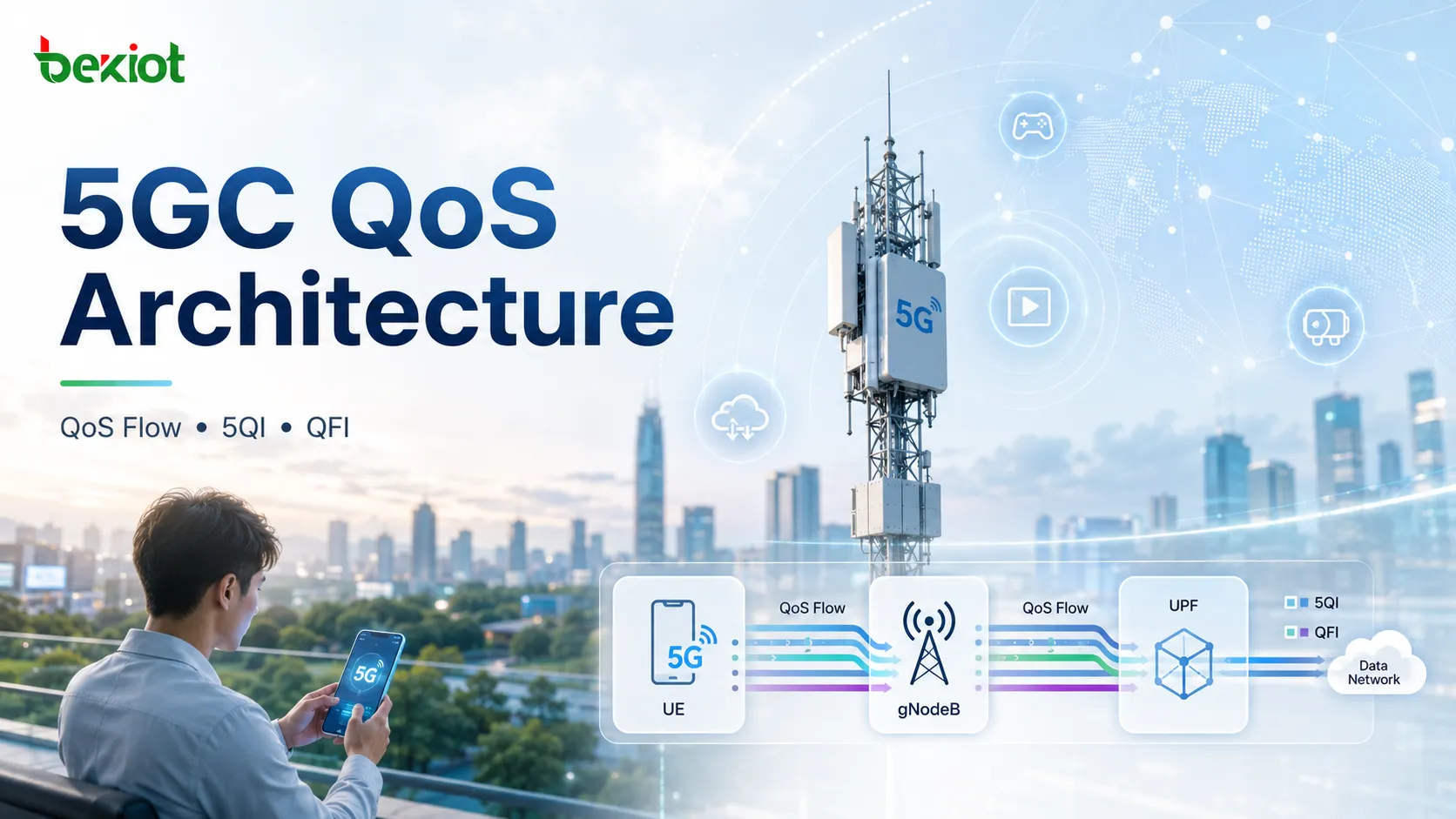
In a 5G network, QoS is not just a technical label attached to packets. It is the mechanism that decides which traffic receives ordinary best-effort treatment, which service deserves guaranteed resources, and how the network should react when radio conditions or congestion begin to affect user experience. For operators, QoS is closely tied to bandwidth cost and network resource allocation. For users and service partners, it often appears as service quality, subscription level, business priority, or guaranteed experience.
A mobile phone may generate many types of traffic at the same time: messaging, short video, cloud classroom, gaming, IMS signaling, VoNR audio, live video, AR/VR interaction, and background application updates. These flows do not have the same requirements. A buffered video can tolerate more delay than voice. IMS signaling needs reliable treatment but does not need the same bandwidth as video. A delay-critical industrial service may require far tighter latency and packet-loss control than an ordinary social app.
The role of 5GC QoS is to classify these service data flows, map them into suitable QoS Flows, assign forwarding treatment, and coordinate the UE, gNB, UPF, SMF and policy rules so that the user plane behaves according to service intent.
Service Value And Resource Cost
QoS begins with a simple reality: not every service receives the same network guarantee. Most public internet applications, such as social messaging, short video, ordinary browsing, music apps or online learning traffic, usually fall into best-effort treatment. They are commonly handled as Non-GBR services, meaning the network does not promise a guaranteed bit rate for each flow.
Some services may receive stronger QoS protection because a user, enterprise customer or service partner pays for differentiated treatment. Online gaming cooperation, premium enterprise applications, AR/VR services or industry-specific low-latency services can be handled with more controlled QoS. These services may use GBR, or Guaranteed Bit Rate, when the network must reserve or protect a minimum rate.
There are also operator-owned services that may receive QoS protection even without a separate user payment. Voice services are a typical example. In 4G this was often discussed through VoLTE, while in 5G the same logic can appear in VoNR-related traffic. Voice must remain stable, low-delay and understandable, so it cannot always be treated like an ordinary best-effort application.
From Bearer To Flow
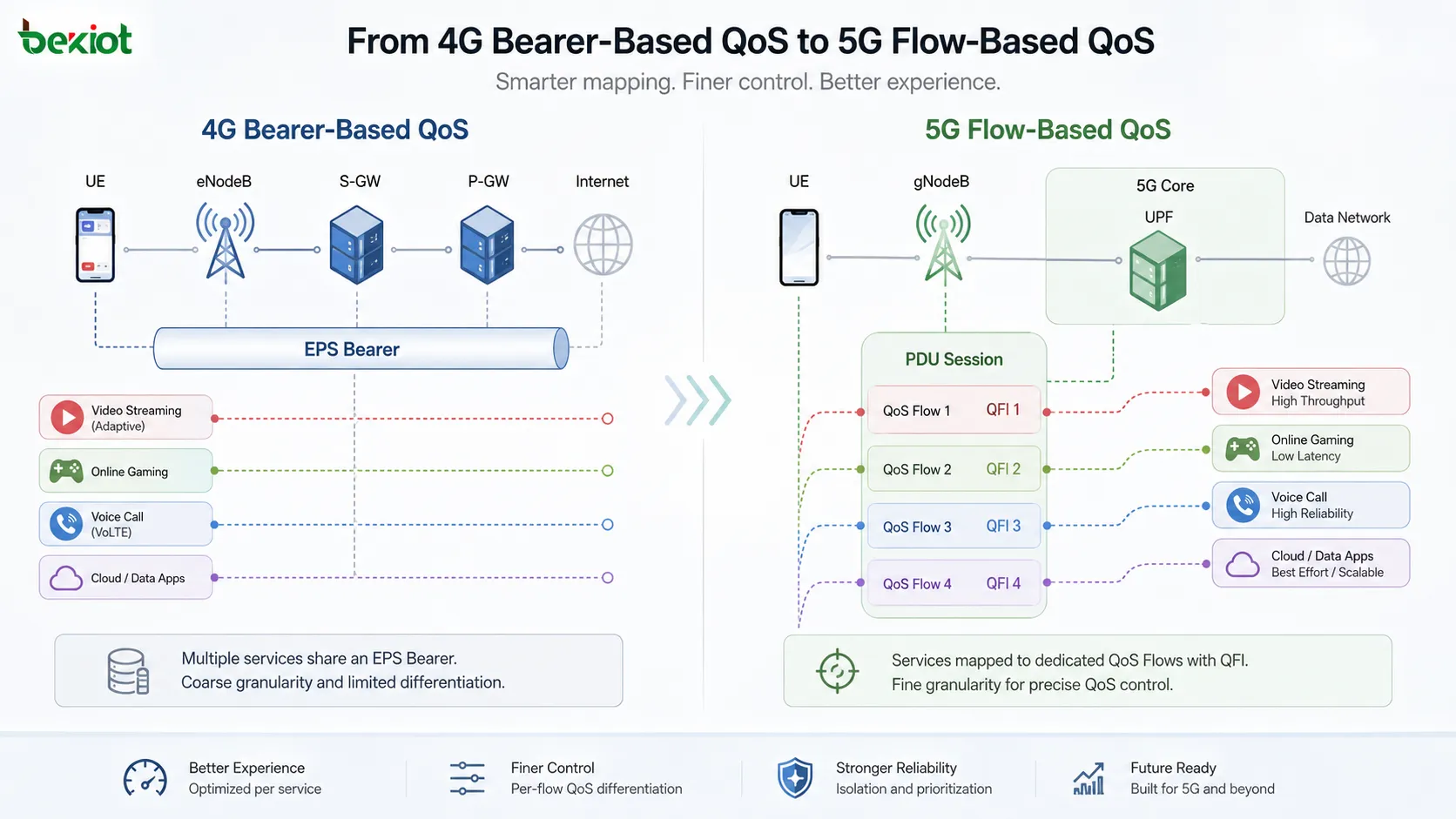
One of the most important differences between 4G and 5G QoS is the change from bearer-centered thinking to flow-centered thinking. In 4G, QoS was built around the EPS Bearer. A bearer relationship was associated with radio bearer, S1-U tunnel and S5/S8 tunnel resources. More bearers usually meant more corresponding tunnel and radio bearer structures.
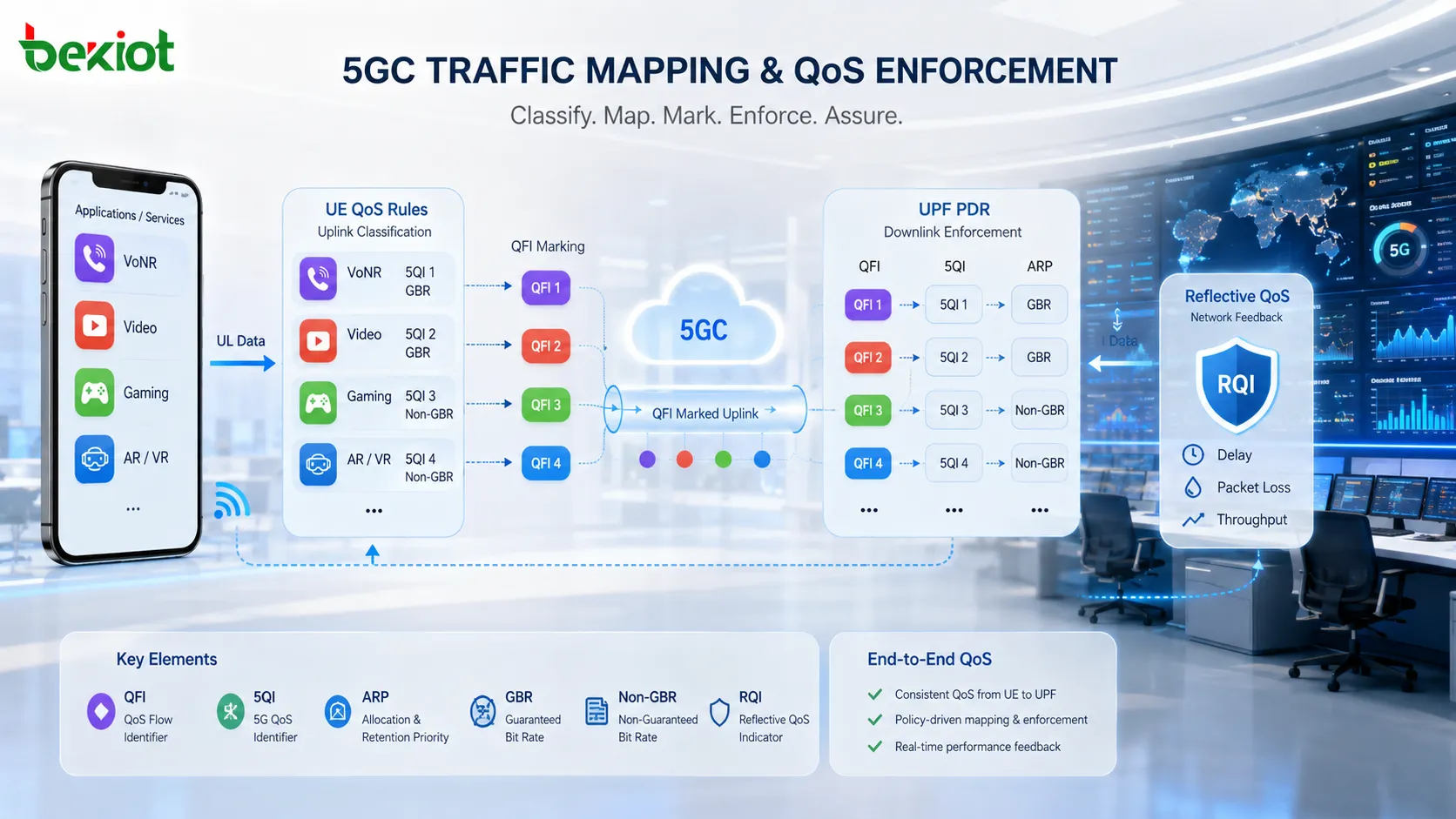
In 5G, the key QoS unit is the QoS Flow. A PDU session can carry one or more QoS Flows. A QoS Flow is identified by QFI, or QoS Flow Identifier, with values in the range of 0 to 63. Packets with the same QFI receive the same forwarding treatment. This gives 5G a finer and more flexible service classification model than the older EPS Bearer approach.
A single PDU session can carry multiple QoS Flows, while the N3 tunnel for that PDU session remains one tunnel. A DRB can carry one or more QoS Flows, and the actual mapping between QoS Flows and DRBs is controlled by the gNB. This means the number of DRBs does not have to equal the number of QFIs. For example, a Non-GBR app flow and a GBR gaming flow might share one DRB in one design, or they may be mapped separately according to radio strategy.
Key Parameters Shape Treatment
5GC QoS parameters describe how each flow should be handled. At the QoS Flow level, common parameters include 5QI and ARP. 5QI is the 5G QoS Identifier and evolved from the 4G QCI concept. It represents service characteristics such as priority level, packet delay budget, packet error rate, averaging window and maximum data burst volume for delay-critical GBR services.
ARP means Allocation and Retention Priority. It helps decide whether a QoS Flow can be established or retained when resources are limited. In congestion conditions, ARP can influence which flows are admitted and which flows are more likely to be released or rejected.
GBR flows have rate-related parameters. GFBR defines the guaranteed flow bit rate, which is the minimum rate the network aims to protect. MFBR defines the maximum flow bit rate; traffic above this value may be discarded. Notification control can be used when the RAN side cannot satisfy GFBR, such as during poor radio conditions. Maximum Packet Loss Rate defines the tolerable loss level for uplink or downlink traffic.
Non-GBR traffic is controlled differently. UE-AMBR limits the aggregate bit rate of all Non-GBR QoS Flows for the UE, while Session-AMBR limits all Non-GBR QoS Flows inside one PDU session. RQA, or Reflective QoS Attribute, indicates whether Reflective QoS can be applied to a flow.
How Traffic Is Mapped
QoS is useful only when packets can be classified and mapped correctly. In 5G, uplink and downlink classification are handled differently. For uplink traffic, the UE performs classification and mapping according to QoS Rules provided by the network or derived by the UE itself. For downlink traffic, the UPF performs classification according to PDR, or Packet Detection Rule, delivered by the SMF.
A QoS Rule or PDR includes packet filter information. This may include source or destination IP address, IPv6 prefix, source or destination port, IP protocol number, IPv6 Next Header type, IPv4 ToS, IPv6 Traffic Class, IPv6 Flow Label, IPsec SPI and traffic direction. These filters tell the UE or UPF which packets belong to which QoS Flow.
If the UPF cannot match a downlink packet to a valid PDR, the packet may be discarded. This is important because downlink QoS treatment depends on the SMF-installed rules at the UPF. In the uplink direction, the UE marks packets according to the applicable QoS Rule so that they can be placed into the correct QoS Flow and then handled by the radio access network.
Reflective QoS reduces signaling overhead in certain cases. When the network activates Reflective QoS, the UPF can send downlink data with an RQI indication. Through the N3 tunnel and air interface, the UE receives the downlink packet and derives an uplink QoS Rule from it. This UE Derived QoS Rule contains an uplink packet filter, QFI and priority. The UE can then classify future uplink packets without waiting for a separately delivered network-side rule.
FAQ
Why does 5G use QoS Flow instead of only DRB?
QoS Flow belongs to the core-network service treatment model, while DRB belongs to radio bearer handling. Separating them gives the network more flexibility when mapping service rules to radio resources.
Can two applications with similar traffic needs use different QoS Flows?
Yes. The operator may also consider service ownership, commercial agreements, subscription policy and charging model, not only bandwidth or delay requirements.
What happens when traffic exceeds MFBR?
Traffic above the maximum flow bit rate can be discarded, because MFBR defines the upper allowed rate for that GBR QoS Flow.
Why is 5QI important for service planning?
5QI provides a standardized way to associate service categories with priority, delay, packet error and resource-type expectations, making QoS behavior easier to design and compare.
Does Reflective QoS work on every terminal?
No. It requires UE support and proper network activation. Without terminal support, the UE cannot derive the uplink QoS Rule from downlink user-plane data.