AI is moving rapidly into business applications, and enterprise telephony is beginning to reflect the same shift. A few years ago, most discussion focused on whether speech recognition was accurate enough or whether an AI system could hold a natural conversation. In 2026, another question is becoming just as important: can these capabilities be configured, delivered, billed and managed by communications providers in the same way as SIP Trunks, IP PBX services or UC subscriptions?
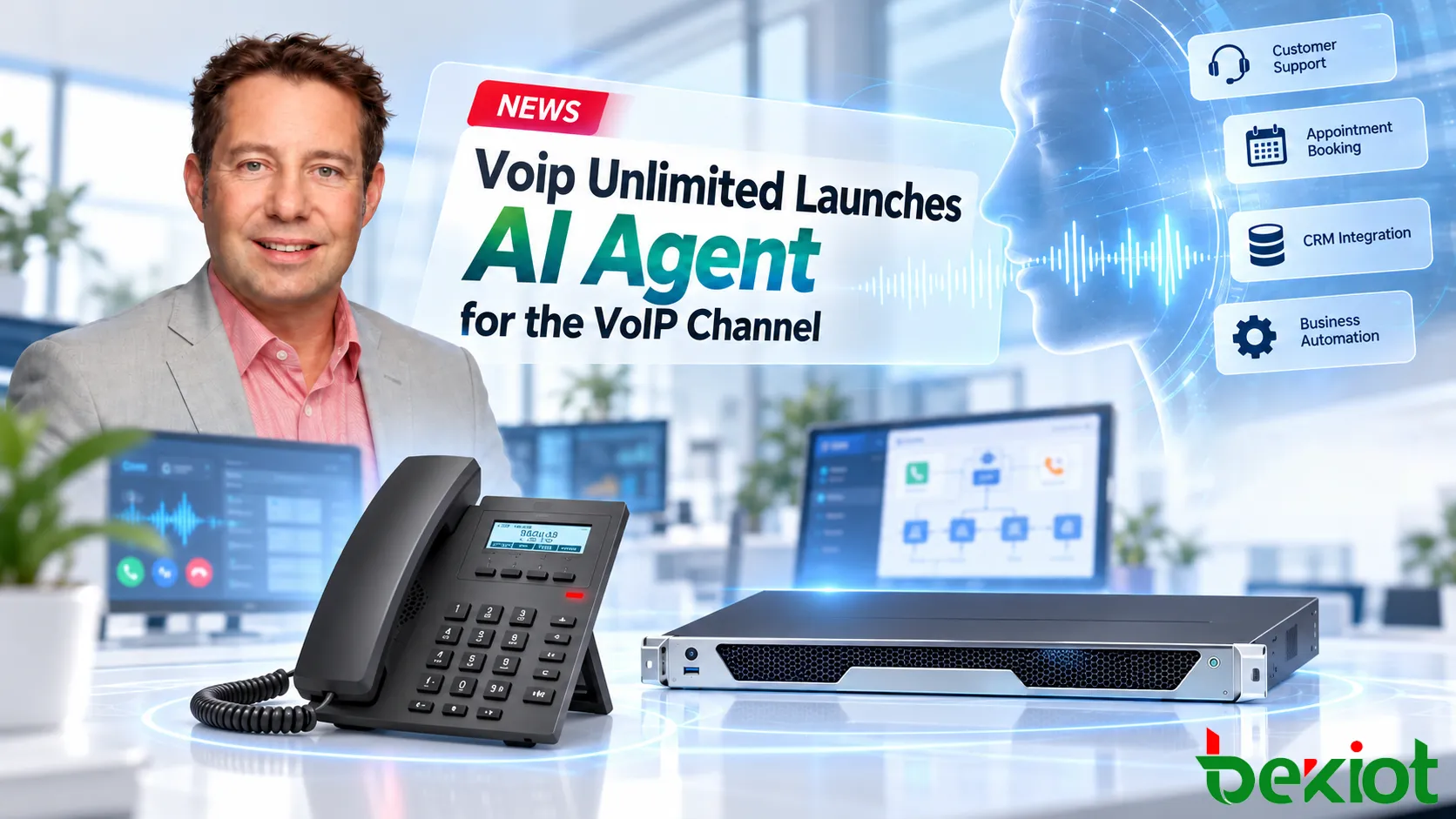
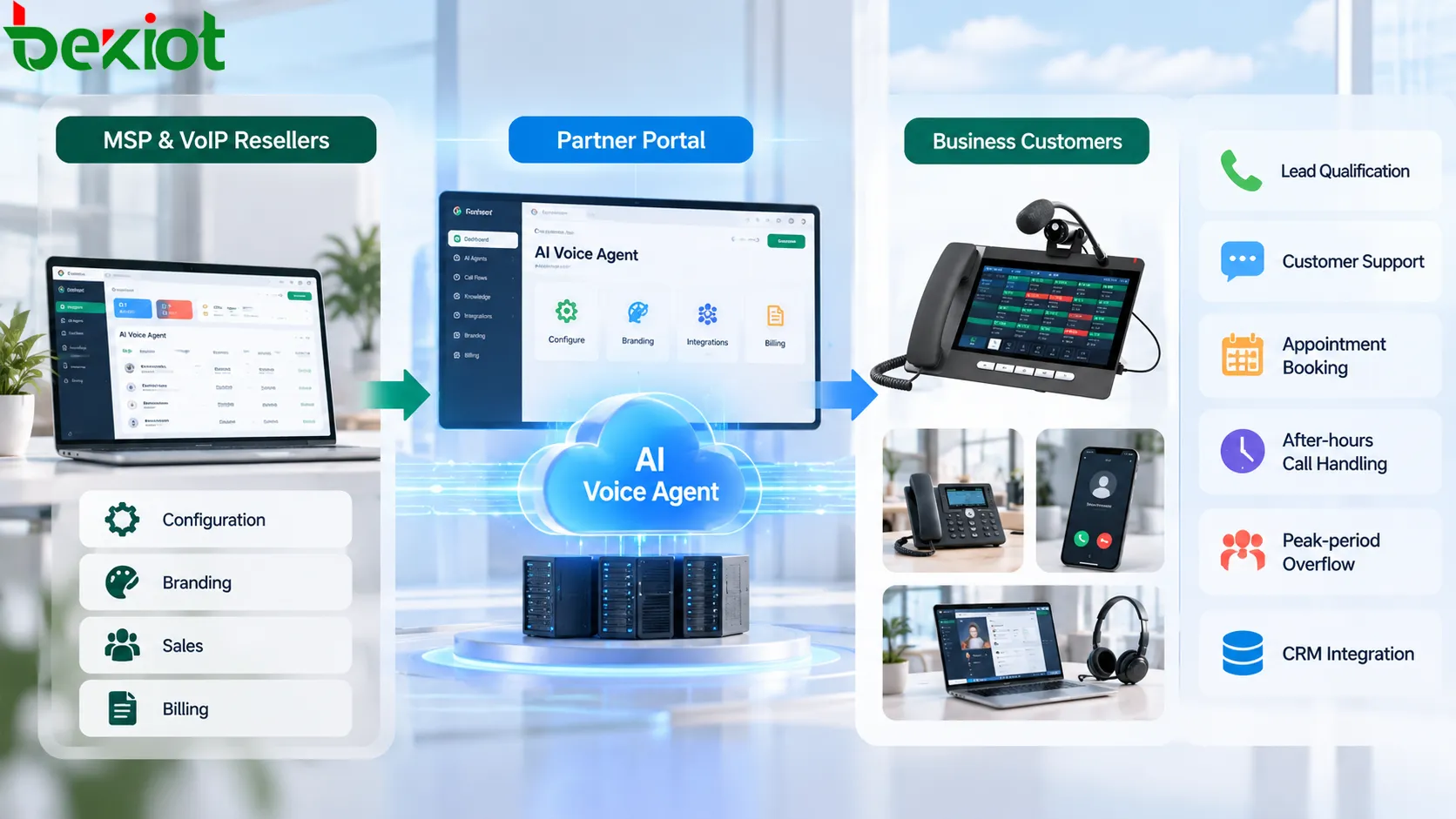
On October 16, Voip Unlimited launched AI Agent as the latest addition to its AI portfolio for channel partners. Rather than simply adding another AI feature, the launch gives partners the ability to create and configure AI Agents through the Partner Portal, then brand and bill the service within their own customer offering.
This puts the AI voice agent into a commercial model that is already familiar to the traditional VoIP channel. It is no longer only a vendor demonstration or standalone chatbot, but a service that MSPs, resellers and communications providers can deliver to end customers. At the same time, an AI Agent needs to connect with telephony, CRM platforms, business data and human staff, bringing VoIP, AI Voice Agents and business workflows into the same operational environment.
AI Voice Agents Are Becoming Channel-Ready Services
The commercial model behind the VoIP channel is already well established. Providers source SIP Trunks, numbers, PBX services, UC accounts or connectivity, then configure, deploy, support and bill them according to each customer’s requirements.
AI Voice Agents have traditionally been more difficult to fit into that model. An AI voice project may require vendor involvement in model configuration, conversation design, API integration and access to business data. The channel partner may own the customer relationship without fully controlling the delivery process.
Voip Unlimited’s emphasis on “Partner Autonomy” is designed to reduce that friction. Partners can provision AI Agents themselves instead of opening a support ticket every time a new customer is added or a workflow needs to be changed. Once partners can independently handle configuration, branding, sales and billing, an AI Voice Agent becomes much closer to a repeatable communications service.
Partners can then build Agents around specific customer requirements, including:
Pre-sales enquiries and Lead Qualification;
Customer support and frequently asked questions;
Appointment booking, registration and information capture;
After-hours and holiday call handling;
Peak-period Overflow Call handling;
Automated service workflows connected to CRM or ticketing platforms.
Voip Unlimited has already deployed an AI Agent on its own Accounts line to handle repetitive enquiries such as where customers can find an invoice. It is a relatively simple example, but it illustrates where AI Voice Agents often deliver the clearest early value: high-volume calls with predictable intent, repeatable answers and a recurring manual workload.
AI Voice Agents Are Taking on the Full Call Workflow
The business value of an AI voice agent cannot be judged only by how human it sounds in a demonstration. For an enterprise, the useful outcome of a phone call often depends on what happens after the conversation.
Consider a customer calling a service number after normal business hours. No human agent is available. The AI Agent needs to identify the reason for the call, ask for the required details, confirm a name, account number or appointment time, and then decide what should happen next.
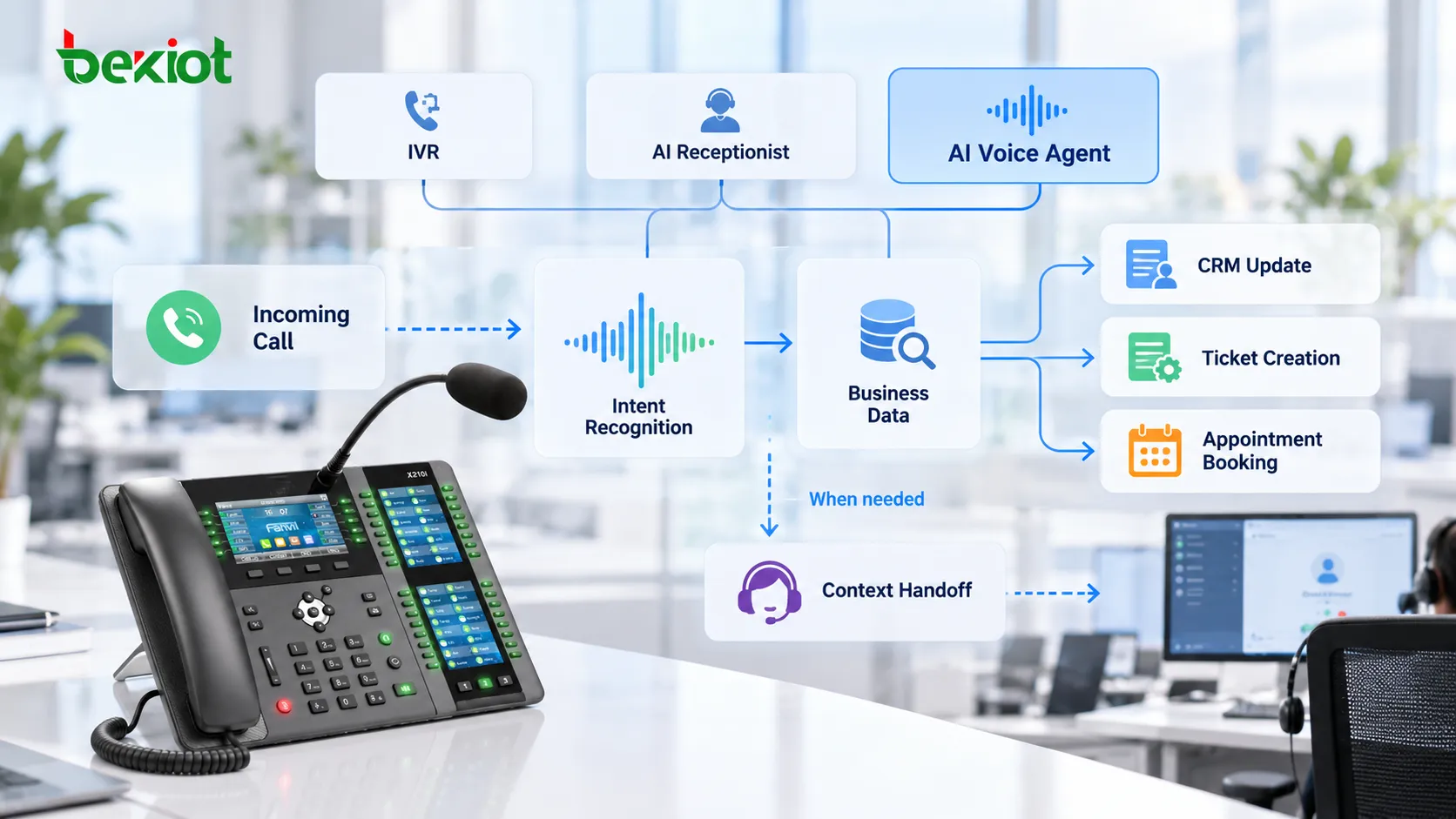
A relatively complete AI call workflow normally includes several stages:
Answer the call: the AI Agent receives a call from the business number or VoIP platform;
Identify intent: determine whether the caller needs information, an appointment, an order update or technical support;
Collect information: capture names, account details, dates or other fields required by the business process;
Access business systems: query CRM, ticketing, booking or other enterprise applications;
Complete or hand off the task: resolve straightforward requests directly or transfer more complex cases to a human;
Create a record: generate a structured summary for CRM records, email notifications or follow-up activity.
Voip Unlimited has positioned AI Agent around this kind of operational workflow. It can handle calls that a business would otherwise miss outside normal hours, during peak periods or while reception staff are busy. The Agent collects caller information and passes a structured summary to the appropriate person. Depending on the workflow, it can also provide follow-up confirmation by message, email or Outbound Call.
That goes beyond the role of a traditional automated attendant. A conventional system often finishes its task once it has routed the call to the correct destination. An AI Agent is expected to understand the conversation, retain context and help move the underlying business process forward.
Call completion rate is therefore only one measure of performance. Organizations should also evaluate:
Whether the required information was captured completely;
Whether intent classification was accurate;
Whether CRM or Ticket records were created correctly;
Whether conversational context survives a Human Handoff;
Whether the call produces a usable business outcome.
AI voice technology is therefore moving from automated call answering toward Voice Workflow Automation.
AI Agent vs Traditional IVR and AI Virtual Receptionist
AI Agents, AI Virtual Receptionists and traditional IVR systems are often discussed together, but their responsibilities are not identical.
Traditional IVR normally follows predefined menus. A caller might press 1 for Sales, 2 for Technical Support or 3 for Accounts. The model is deterministic, inexpensive and easy to control, but the caller must navigate the menu structure designed by the business.
An AI Virtual Receptionist can use natural language to identify the caller’s intent. A customer might simply say, “I need a copy of last month’s invoice,” and the system can classify the request as an Accounts enquiry before answering or transferring the call.
An AI Agent goes further by focusing on task completion. In addition to understanding why someone is calling, it may need to retrieve business data, create records, update a CRM, schedule an appointment, trigger follow-up communication or pass the task to another automated service or human employee.
| Approach | Primary Input | Main Objective |
|---|---|---|
| Traditional IVR | DTMF / Fixed Menus | Route calls according to predefined rules |
| AI Virtual Receptionist | Natural Language | Understand intent, answer enquiries and route calls intelligently |
| AI Voice Agent | Natural Language + Business Data | Complete conversations and drive specific business tasks |
These technologies do not have to replace one another. An organization can still use deterministic IVR rules for urgent or tightly controlled calls, send general front-desk traffic to an AI Receptionist, and use an AI Agent for tasks such as appointment booking, ticket creation or account enquiries that require integration with business systems.
That broader automation role is one reason Voip Unlimited’s AI Agent launch is notable. The product is positioned beyond a smarter Auto Attendant and closer to a service that can participate directly in business processes.
AI Trunking Can Add AI Without Replacing the Existing VoIP Platform
Another notable part of Voip Unlimited’s AI strategy is that the portfolio extends beyond its own AI Agent. The company is also developing AI Trunking capabilities that can connect with third-party voice platforms including Twilio and ElevenLabs.
This reflects a broader deployment model emerging in enterprise voice AI: the PBX, telephone numbers, SIP Trunks, endpoints and AI processing layer do not necessarily have to come from the same vendor.
Many organizations already operate a mature IP PBX, SIP numbers, call queues and desk phones. Replacing the entire telephony environment simply to introduce AI is often unnecessary. A more practical approach is to keep the existing Telephony Layer and route selected types of calls to an AI Service.
This architecture can be divided into four relatively independent layers:
| System Layer | Primary Role |
|---|---|
| Telephony Access | Provides business numbers, PSTN connectivity and SIP Trunks |
| Call Control | Uses an IP PBX or Voice Platform to manage routing, queues and transfers |
| AI Processing | Handles natural-language conversations, intent recognition and business logic |
| Business Applications | Connects CRM, ticketing, booking, ordering and other enterprise systems |
The exact interfaces and media-processing methods vary between platforms, and AI Trunking is not a standardized product term implemented identically by every vendor. The architectural principle, however, is clear: separate the traditional voice infrastructure from the AI processing layer.
This gives channel partners more flexibility when designing customer solutions. A business may retain its existing PBX and send only after-hours calls to AI. Another organization may keep its current Contact Center but divert a specific class of repetitive enquiries to an AI Agent.
For businesses that already have SIP infrastructure, this is often more practical than replacing the entire phone environment with a new AI-first telephony platform.
Becke Telcom’s IP PBX and VoIP Communication Systems are also based on standard SIP architecture and can provide a voice foundation for SIP phones, gateways, dispatch systems, intercoms and other business communication applications.
Data Governance Is Becoming a Requirement for AI Telephony
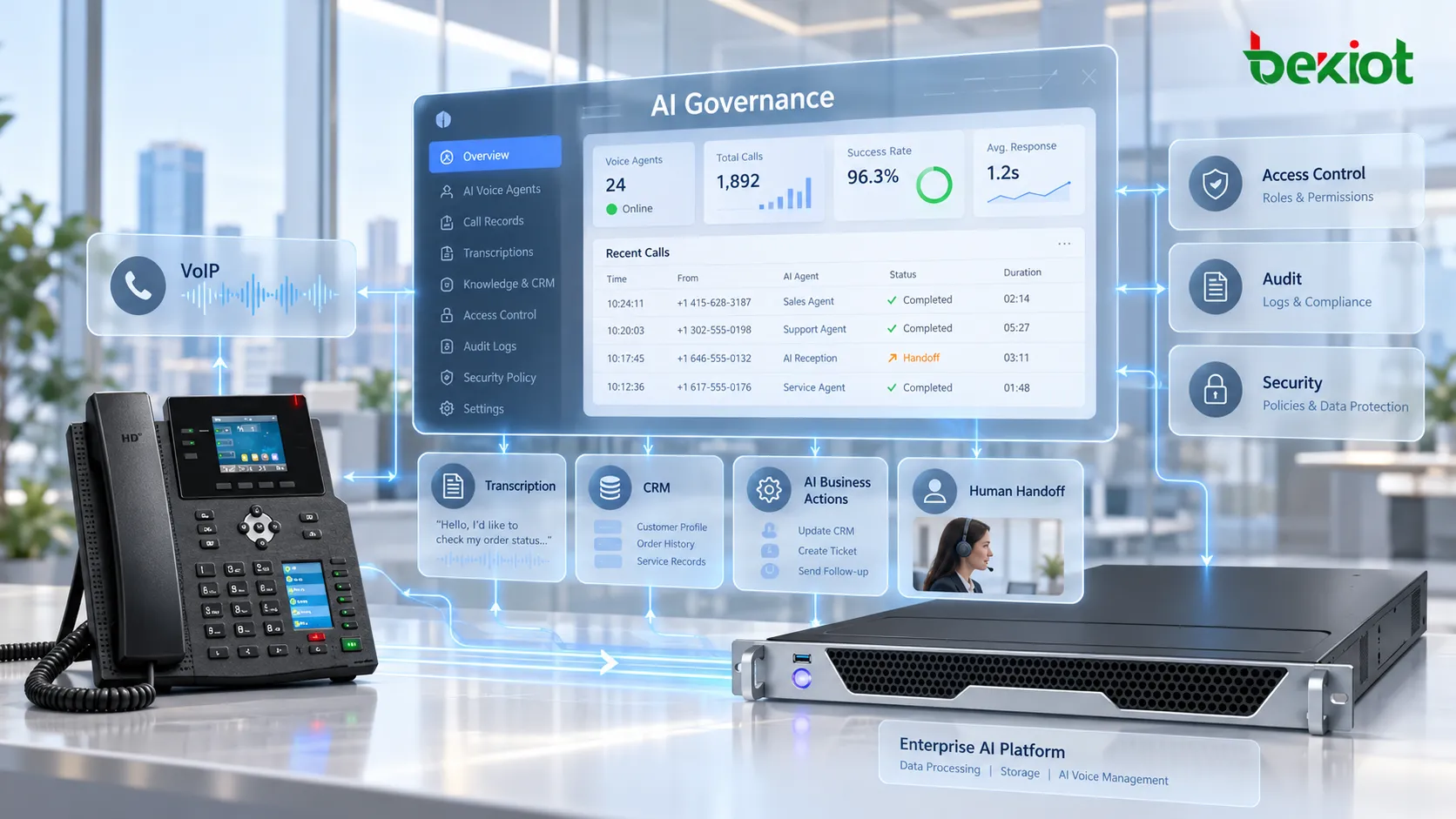
As AI voice agents move deeper into business systems, data governance becomes difficult to postpone until the end of a project. In connection with the launch, Voip Unlimited’s management highlighted a practical order of questions: before asking what an AI product costs, organizations should first understand where the data is stored and who can access it.
This is one of the most important differences between an AI Voice Agent and a conventional SIP phone.
A traditional phone system mainly handles numbers, SIP Signaling, RTP media and Call Detail Records. An AI Agent may additionally process:
Call recordings and live speech;
Transcripts and Call Summaries;
Customer names, phone numbers and account information;
CRM, order and service records;
AI-generated classifications, decisions and follow-up tasks.
Before production deployment, organizations should therefore define Data Location, Retention, Access Control, Audit requirements, recording notices and the data-processing boundaries of third-party models or platforms.
If the AI can perform real business actions, permissions also need to be defined more carefully. “Check an appointment time” and “cancel an order” should not automatically carry the same authorization level. Processes involving payments, account modifications or sensitive data may require additional identity verification.
Human Handoff is equally important. If the AI cannot determine the caller’s intent, the customer explicitly asks for a person, the interaction enters a high-risk process or a backend system returns an error, there should be a clear exit path rather than allowing the AI to continue guessing.
This is why large-scale AI telephony increasingly resembles a formal enterprise communications service. It requires more than a language model; it also needs permissions, data boundaries, business-system interfaces and a dependable human escalation mechanism.
Service Delivery Is Becoming the Next Competitive Advantage for the VoIP Channel
The most important part of Voip Unlimited’s AI Agent launch is not simply the arrival of another voice bot. The broader change is that AI Voice Agents are beginning to enter the same delivery framework that the communications channel already understands.
A typical customer project can now move through several stages:
Upstream service capability: the Wholesale Provider supplies the voice network, AI platform and core service capabilities;
Channel configuration: the MSP or Reseller configures the Agent, numbers and workflows around the customer’s business;
Customer-facing branding: the partner includes the AI capability within its own product and service portfolio;
Business deployment: the service connects to the customer’s existing telephony, CRM and human teams;
Ongoing operation: the partner bills the service and continues to optimize prompts, workflows and transfer rules based on call data.
At this point, differentiation between channel partners is no longer simply about whether they have access to an AI product. The same AI Voice Agent can produce very different results depending on who implements it.
One provider may connect a telephone number to an Agent and stop there. Another may first analyze the customer’s call types, opening hours, human teams, CRM fields, Escalation Rules and Data Policy before designing a complete Voice Workflow. The second approach is much closer to a Managed Service that a business may be willing to pay for over the long term.
This also explains why Voip Unlimited places so much emphasis on partner autonomy. Channel partners are closest to the end customer. They are more likely to know when calls are being missed, which questions reception staff answer repeatedly, which calls must reach a human and which business data can safely be accessed by an automated system.
Competition in AI voice services is therefore unlikely to be decided only by which Demo sounds most human. It will increasingly depend on who can combine Telephony, AI, Business Data and Human Handoff into a stable, manageable and billable business workflow.
For the VoIP industry, AI is beginning to move from the Feature List into Service Delivery.
FAQ
What Is an AI Voice Agent?
An AI Voice Agent is an AI system that can hold natural-language conversations over telephone or other voice channels and use the conversation to perform tasks such as information lookup, data capture, routing, appointment booking, ticket creation or other business processes. It normally works together with a telephony platform and enterprise applications.
What Is the Difference Between an AI Voice Agent and Traditional IVR?
Traditional IVR mainly follows fixed menus and DTMF input, while an AI Voice Agent can understand natural language and conversational context and, when integrated with business systems, can perform more complex tasks. IVR still has an important role where deterministic and tightly controlled call flows are required.
Can an AI Agent Integrate With an Existing IP PBX?
Yes, although the exact integration method depends on the AI service and PBX capabilities. A common architecture keeps the existing numbers, SIP Trunks and IP PBX while routing selected call paths to the AI service, so the organization does not necessarily need to replace its entire phone system.
Which Calls Are Best Suited to an AI Voice Agent?
Good starting points are high-volume, relatively predictable and lower-risk calls, such as after-hours answering, appointment booking, FAQs, order-status enquiries, simple service-desk requests and peak-period Overflow Calls. Complex complaints, sensitive account changes and high-risk decisions are usually better handled with a clear Human Handoff path.
Can an AI Agent Completely Replace Human Agents?
Not in every scenario. AI is well suited to repetitive tasks, information gathering and standardized workflows, while exceptions, complex negotiations, highly emotional customers and processes requiring human authorization still need a defined Human Handoff mechanism.
What Should a Business Check Before Deploying an AI Voice Agent?
In addition to recognition accuracy and conversational quality, organizations should review telephony integration, business-system access, data location, permissions, retention policies, human escalation paths and which actions the AI is allowed to perform. These boundaries should be defined before the service moves into production.
Becke Telcom provides VoIP communication products and solutions for enterprise and industrial environments, including IP PBX, SIP servers, SIP phones, VoIP gateways, SBCs and unified communication devices. These systems can provide a standards-based SIP foundation and integration environment for AI voice reception, intelligent IVR, CRM voice integration and multi-site business communications.