AI virtual receptionist technology is becoming an important development direction for UC platforms, IP PBX systems, SIP communication networks, and enterprise phone systems. As business communication moves from traditional voice calling to intelligent interaction, the receptionist function is no longer limited to answering calls and transferring extensions. It is evolving into an intelligent voice entry point that can understand caller intent, route calls accurately, support multiple languages, connect with business systems, and improve service efficiency.
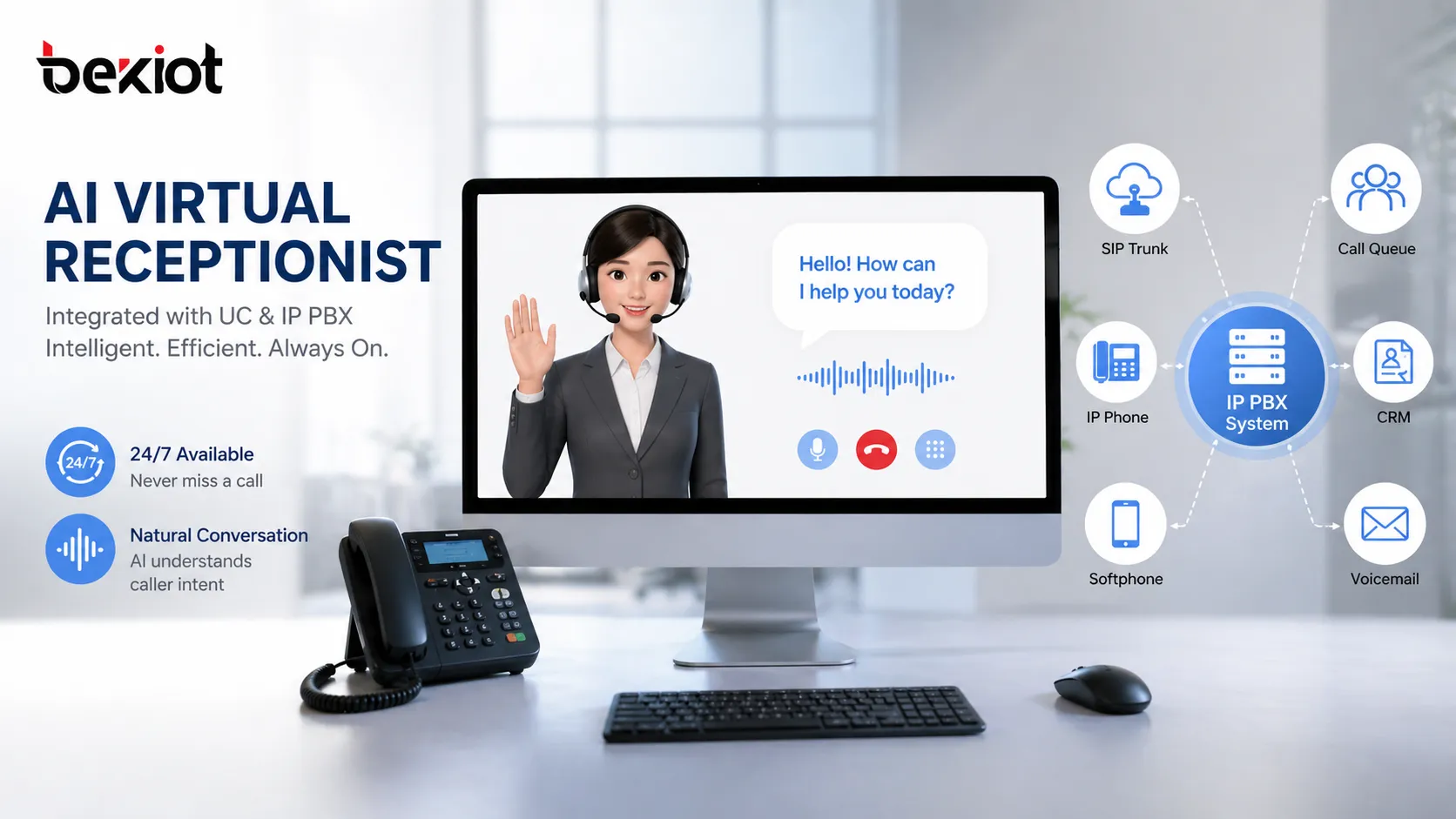
Compared with traditional IVR systems, an AI virtual receptionist provides a more natural communication experience. Instead of asking callers to follow fixed keypad menus, it allows users to speak in everyday language. The system can identify what the caller wants, determine the correct destination, and complete the call handling process with less manual intervention.
What Is an AI Virtual Receptionist?
An AI virtual receptionist is a software-based voice assistant designed to answer incoming calls, communicate with callers, understand their needs, and direct them to the appropriate person, department, service, or workflow. It usually combines speech recognition, natural language understanding, voice synthesis, call routing logic, and integration with telephony platforms.
In UC and IP PBX environments, an AI virtual receptionist may work together with SIP trunks, IP phones, softphones, call queues, contact centers, CRM platforms, directories, voicemail systems, and operator consoles. Its value comes not only from automation, but also from its ability to connect voice communication with enterprise workflows.
Core Technologies Behind AI Virtual Receptionist Systems
Speech Recognition
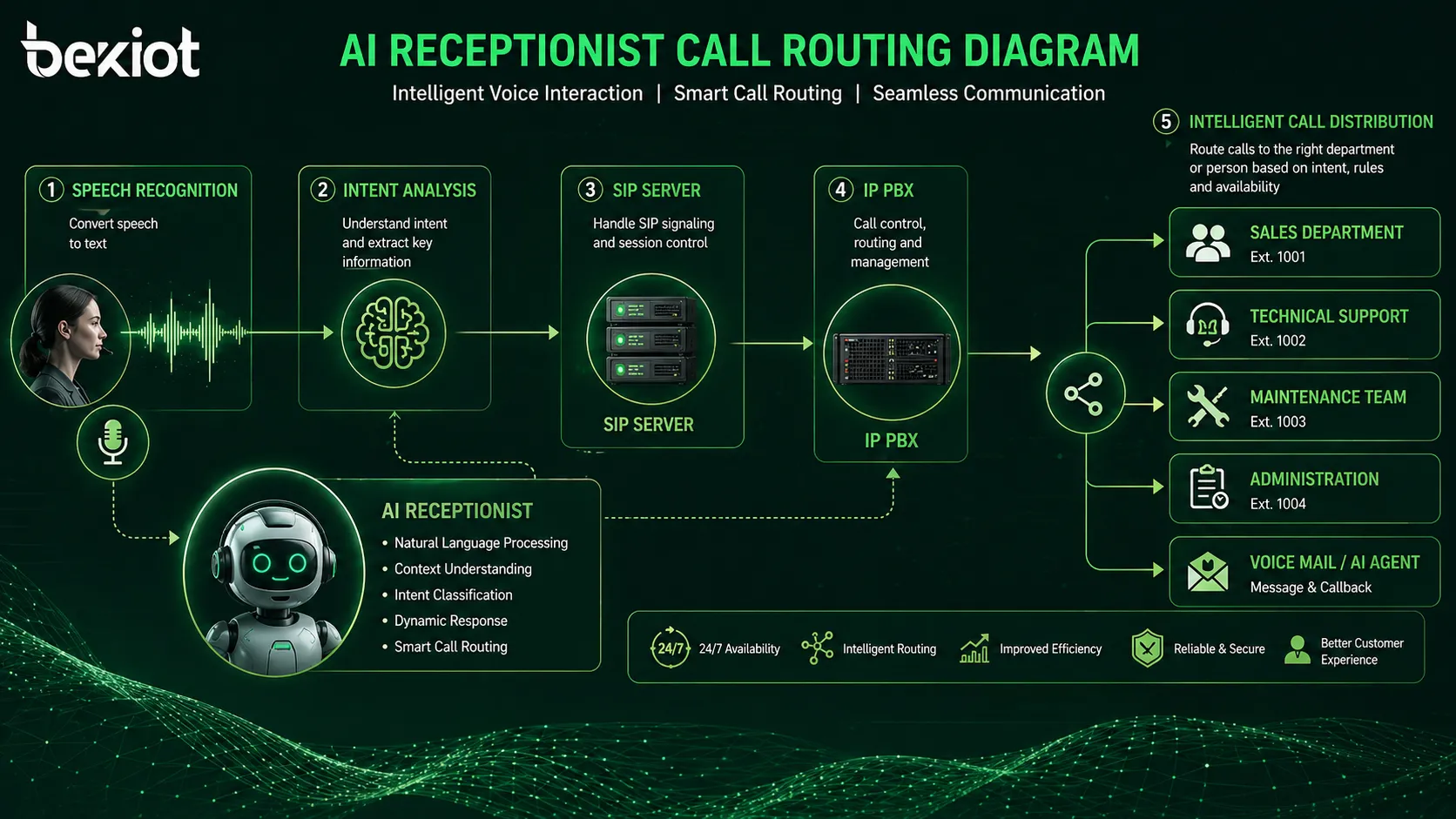
Speech recognition converts the caller’s spoken words into text so the system can process the meaning of the conversation. A reliable AI receptionist should be able to recognize different accents, speaking speeds, names, departments, extension numbers, and industry-specific terms.
Natural Language Understanding
Natural language understanding helps the system identify caller intent. For example, a caller may want to reach sales, request technical support, report a fault, check an order, schedule a visit, or speak with a specific employee. The system must understand the purpose of the call rather than simply match a few keywords.
Voice Synthesis
Voice synthesis allows the AI receptionist to respond in a natural and professional voice. A clear and pleasant voice experience is important because it directly affects the caller’s first impression of the organization.
Call Routing and PBX Integration
The AI receptionist must be connected to the phone system to transfer calls, place callers into queues, forward calls to extensions, trigger voicemail, or route calls to different branches. For SIP-based environments, stable integration with SIP servers and IP PBX platforms is essential.
Main Functions of an AI Virtual Receptionist
Automatic Call Answering
The system can answer incoming calls automatically and greet callers with a consistent professional message. This reduces missed calls and helps businesses provide service during busy hours, lunch breaks, holidays, or after normal working hours.
Intelligent Call Routing
Instead of relying only on keypad selection, the system can route calls according to spoken intent. For example, “I need help with an invoice” can be routed to the finance department, while “I want to report a device problem” can be routed to technical support.
Multilingual Communication
For international companies and cross-border service teams, multilingual reception is highly useful. It allows callers from different regions to communicate in a language they are comfortable with and helps reduce communication barriers.
Customer Information Recognition
When connected with business systems, the AI receptionist can identify callers through phone numbers, company names, account details, service records, or order information. This helps employees handle calls with better context.
Call Summary and Record Support
After the call, the system can generate a summary, classify the caller’s request, record key information, and support follow-up tasks. This is useful for customer service, sales, technical support, and operation teams.
Applications in UC and IP PBX Environments
Enterprise Front Desk Automation
Many companies use AI virtual receptionists to handle general inbound calls, provide company information, transfer calls, and reduce the workload of human receptionists. This allows front desk staff to focus on visitors, administrative work, and higher-value communication.
Customer Service and Support
AI receptionists can help classify customer issues before transferring calls to service agents. They can ask basic questions, collect required information, and direct the caller to the correct support queue.
Branch Office Communication
For organizations with multiple branches, AI call handling can help route calls between locations, departments, and regional teams. This is especially useful when the company has a centralized phone system or cloud PBX platform.
Industrial and Public Facility Communication
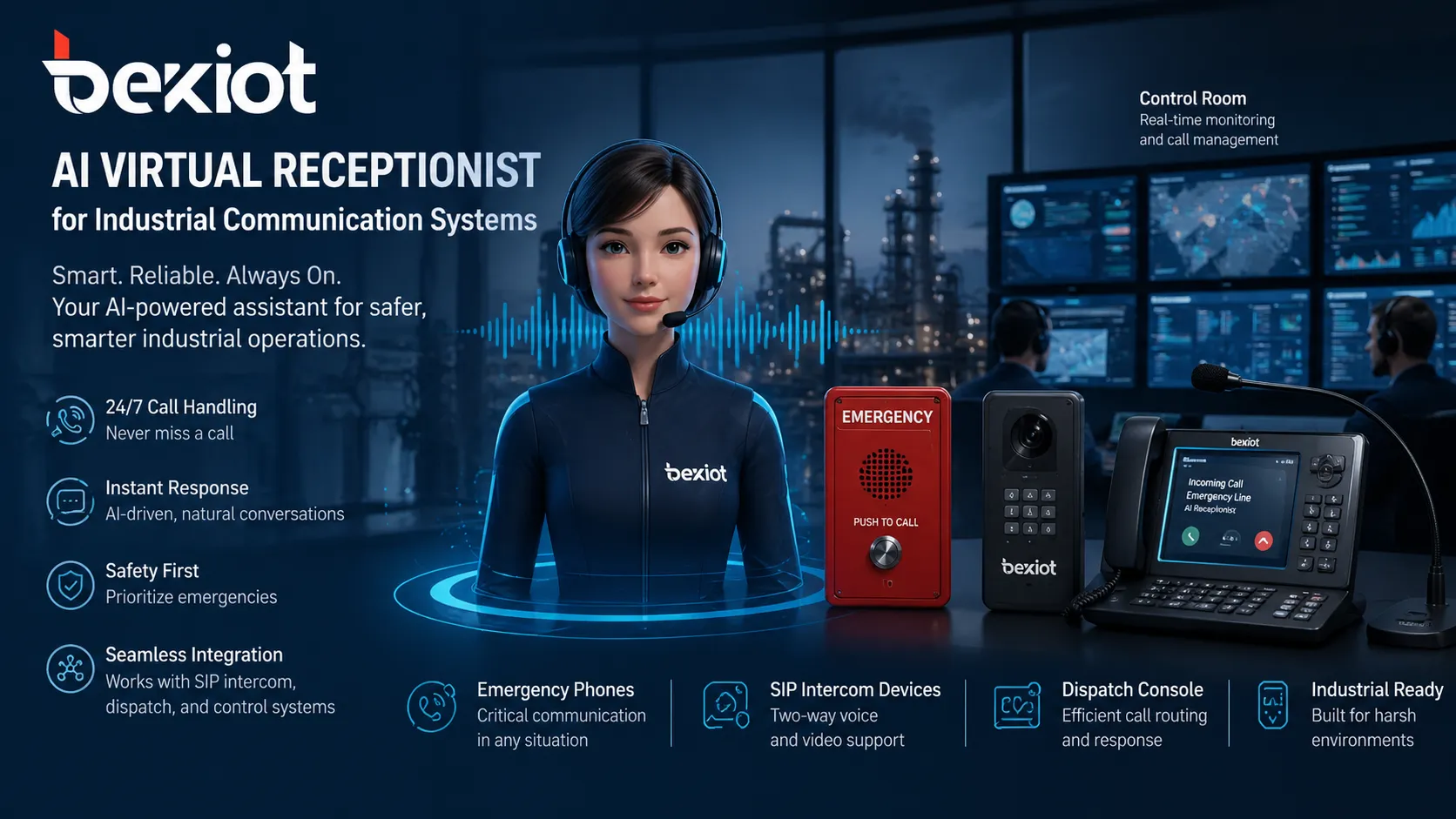
In industrial sites, campuses, transportation facilities, hospitals, energy plants, and public service environments, AI receptionists can support emergency call handling, department routing, maintenance requests, visitor assistance, and operator support.
Becke Telcom Perspective and Industry Analysis
Becke Telcom focuses on industrial communication systems, SIP communication platforms, IP PBX solutions, emergency phones, industrial intercoms, paging systems, gateways, and dispatch communication. From an industrial communication perspective, AI virtual receptionist technology should not be limited to office front desk scenarios. It can also become an intelligent access point for field communication, emergency reporting, operation support, and dispatch workflows.
Industrial communication systems often require more than simple call transfer. They need reliable voice connectivity, clear priority control, location awareness, alarm linkage, paging integration, and fast coordination between field users and control rooms. When AI receptionist technology is integrated with SIP servers, IP PBX systems, industrial telephones, emergency call stations, intercom terminals, and dispatch platforms, it can help improve the efficiency of call classification and response.
In mission-critical communication, AI should improve decision support and call handling efficiency while keeping the communication system stable, secure, and easy to control.
Future Outlook
The future of UC and IP PBX systems will likely combine telephony, AI voice assistants, workflow automation, speech analytics, real-time transcription, and business system integration. AI virtual receptionist technology will become a practical tool for improving service efficiency, reducing repetitive work, and making communication systems more intelligent.
Conclusion
AI virtual receptionist technology is changing how organizations handle inbound communication. It improves call answering, routing, multilingual service, information collection, and workflow automation. In UC and IP PBX systems, it helps connect voice communication with business processes and operational response.
For industrial communication providers such as Becke Telcom, this technology creates new opportunities to enhance SIP-based communication systems, emergency phones, intercom networks, paging platforms, dispatch systems, and multisite communication solutions. The key is to use AI as a practical assistant for communication efficiency, not as a replacement for reliable communication infrastructure.
FAQ
What is an AI virtual receptionist?
An AI virtual receptionist is an intelligent voice assistant that answers calls, understands caller needs, and routes calls to the right person, department, or workflow.
How is it different from a traditional IVR system?
A traditional IVR system usually uses fixed keypad menus. An AI virtual receptionist allows callers to speak naturally and uses language understanding to identify their intent.
Can an AI virtual receptionist work with an IP PBX?
Yes. When integrated with SIP and PBX platforms, it can work with IP PBX systems, SIP trunks, IP phones, call queues, voicemail, and enterprise directories.
Where can this technology be used?
It can be used in office front desks, customer service centers, branch offices, campuses, hospitals, industrial facilities, transportation sites, and emergency communication systems.