Throughput is a performance concept that describes how much useful data, traffic, processing output, or completed work a system can successfully handle within a given period of time. In simple terms, it answers a very practical question: how much can actually get through? This makes throughput one of the most important real-world measurements in networking, software platforms, storage systems, communication environments, and industrial control processes.
In technical discussions, throughput is often associated with networks and data transmission, but the concept is broader than that. A network link may have high theoretical capacity, yet lower real throughput because of congestion, protocol overhead, retransmissions, latency, weak endpoints, or processing limitations. The same logic applies to servers, applications, media platforms, and transaction systems. What matters is not only what the system is designed to support in theory, but what it can actually deliver in practice.
For businesses, throughput is not just an engineering metric. It is closely connected to service efficiency, user experience, workflow speed, system value, and long-term scalability. A platform with poor throughput may create delays, bottlenecks, instability, or wasted infrastructure investment. A platform with strong throughput can support heavier workloads more reliably and more predictably. That is why throughput is frequently used as both a technical benchmark and a business performance indicator.
What Throughput Means in Practical Terms
Definition and Core Meaning
Throughput refers to the amount of successful work or data transfer completed within a measured time interval. In networking, it often describes how much data is actually transmitted from one point to another over a link or through a service path. In computing and platforms, it may describe how many requests, transactions, sessions, messages, or operations are completed over time.
The important word is successful. Throughput is not merely about raw capacity or theoretical maximum bandwidth. It reflects the usable output that the system is genuinely delivering. If a network is rated at a certain speed but large amounts of traffic are delayed, dropped, retried, or blocked by processing limits, the practical throughput may be significantly lower than the nominal capacity figure suggests.
This is why throughput is often treated as a more realistic performance measure than simple specification numbers alone. It helps show what the user, application, or business process can actually receive from the system.
Throughput is the performance people experience, not just the capacity engineers write on a datasheet.
Why Throughput Matters
Throughput matters because most operational value depends on successful delivery, not merely on theoretical design capability. A network may advertise high bandwidth, but if real traffic flow is weak under active conditions, the business still experiences slow file transfers, delayed calls, lagging dashboards, or unstable application access. In the same way, a server may be powerful on paper but still produce disappointing user outcomes if its completed work rate remains low.
In enterprise and communication environments, this can affect many areas at once. Voice traffic, video streams, industrial telemetry, remote user access, cloud applications, monitoring platforms, and internal business systems all depend on practical throughput. If the system cannot move enough traffic or process enough transactions reliably, service quality and productivity both suffer.
That is why throughput is often used to assess the real operational strength of a platform rather than relying only on theoretical maximums.
How Throughput Works
Input, Processing, and Successful Output
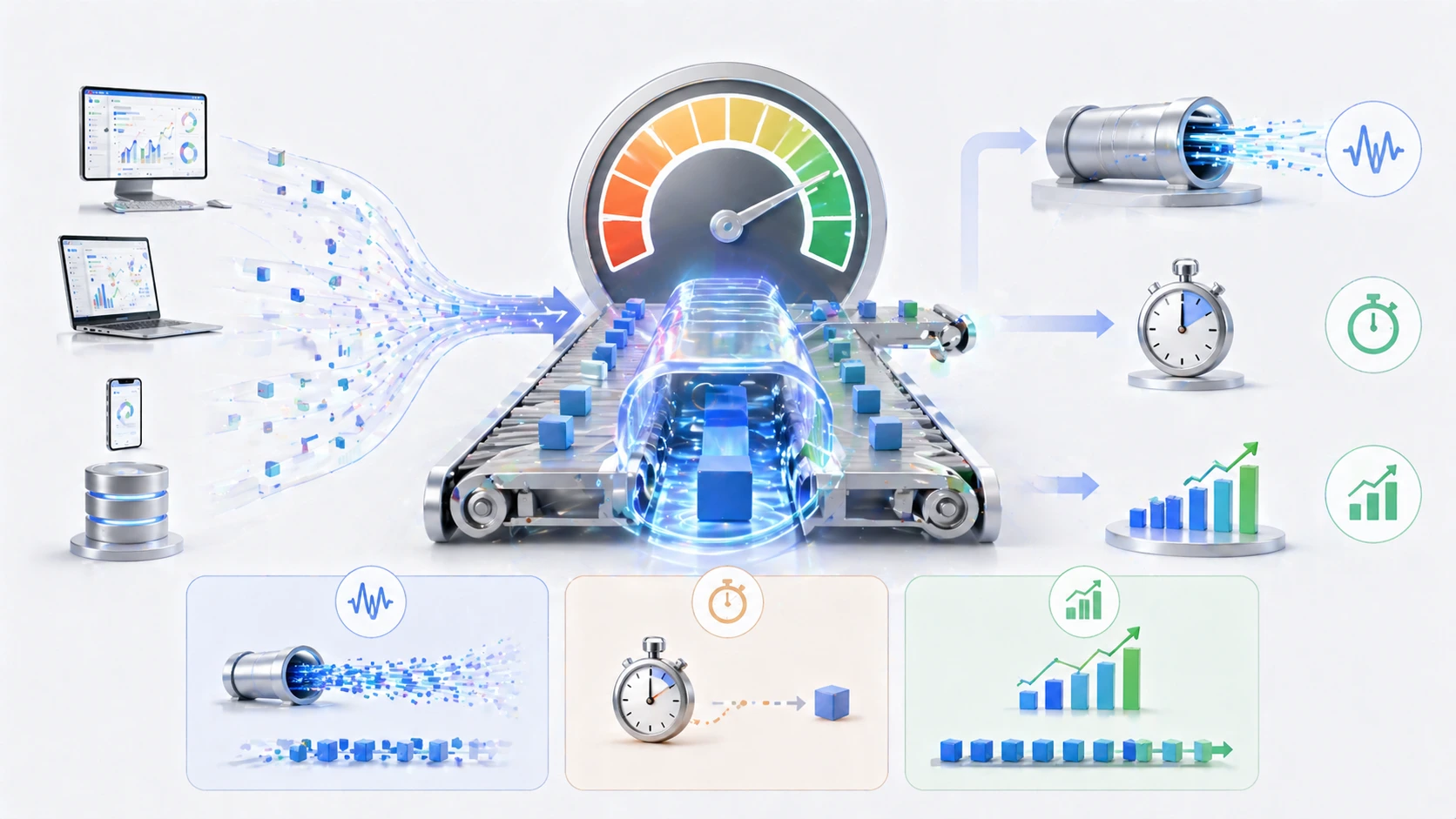
Throughput works as the result of a complete flow: input enters the system, the system processes or transports it, and usable output emerges at the other end. This seems simple, but each stage introduces possible limits. Data may arrive too quickly, the processing layer may become overloaded, queues may build up, packet loss may trigger retransmissions, or storage may fail to keep pace with the workload.
As a result, throughput depends on more than one component. A fast network interface alone does not guarantee high throughput if the CPU, memory, storage, protocol stack, or software logic cannot keep up. In the same way, a powerful application server may still show weak throughput if the network path, database layer, or upstream integration becomes the true bottleneck.
Real throughput therefore emerges from coordination across the full service path. The system can only deliver as much successful output as its weakest operational constraint allows.
Time, Loss, and Efficiency
Time is central to throughput because the concept is always measured over an interval. The question is not simply how much data exists, but how much data or work is completed per second, per minute, or another defined period. This is why throughput is often expressed in units such as bits per second, packets per second, transactions per second, or processed jobs per hour depending on the environment.
Loss and inefficiency also affect the result. If a system retransmits data, waits on slow acknowledgments, spends too many resources on overhead, or holds work in long queues, the amount of useful completed output falls. In other words, throughput is shaped not only by capacity, but by how efficiently the system converts available resources into successful delivery.
This is why throughput analysis often reveals problems that are invisible in simple capacity planning. It shows where inefficiency is limiting real performance.
Strong throughput is created not only by speed, but by the system’s ability to turn available capacity into successful, repeatable output.
Throughput Versus Related Performance Concepts
Throughput Versus Bandwidth
Throughput is often confused with bandwidth, but they are not the same. Bandwidth generally refers to the theoretical maximum amount of data that a link or channel can carry. Throughput refers to the amount of data that is actually delivered successfully in practice. A system may have high bandwidth yet still show disappointing throughput if real conditions introduce inefficiency.
This distinction matters in business decisions. If teams focus only on bandwidth, they may overestimate the real user experience. A high-capacity link can still underperform if packet loss, congestion, processing overhead, poor endpoint performance, or protocol behavior reduces the actual output. Throughput is therefore often the more realistic measure of operational performance.
In simple terms, bandwidth describes what the road could theoretically carry, while throughput describes how much traffic actually reaches the destination.
Throughput Versus Latency
Throughput is also different from latency. Latency measures delay, or how long it takes for data or a request to travel from one point to another. Throughput measures quantity of successful output over time. A system can have low latency but modest throughput, or strong throughput but noticeable latency, depending on its design and workload.
These two factors often influence each other in real environments, especially in applications involving acknowledgments, streaming, cloud access, or session-based communication. However, they remain distinct measurements. A service might respond quickly to small requests yet still struggle to move large amounts of data efficiently, which would mean good latency but limited throughput.
That is why performance analysis should not rely on one metric alone. Throughput and latency describe different aspects of user experience and system behavior.
Main Factors That Influence Throughput
Network Conditions and Protocol Behavior
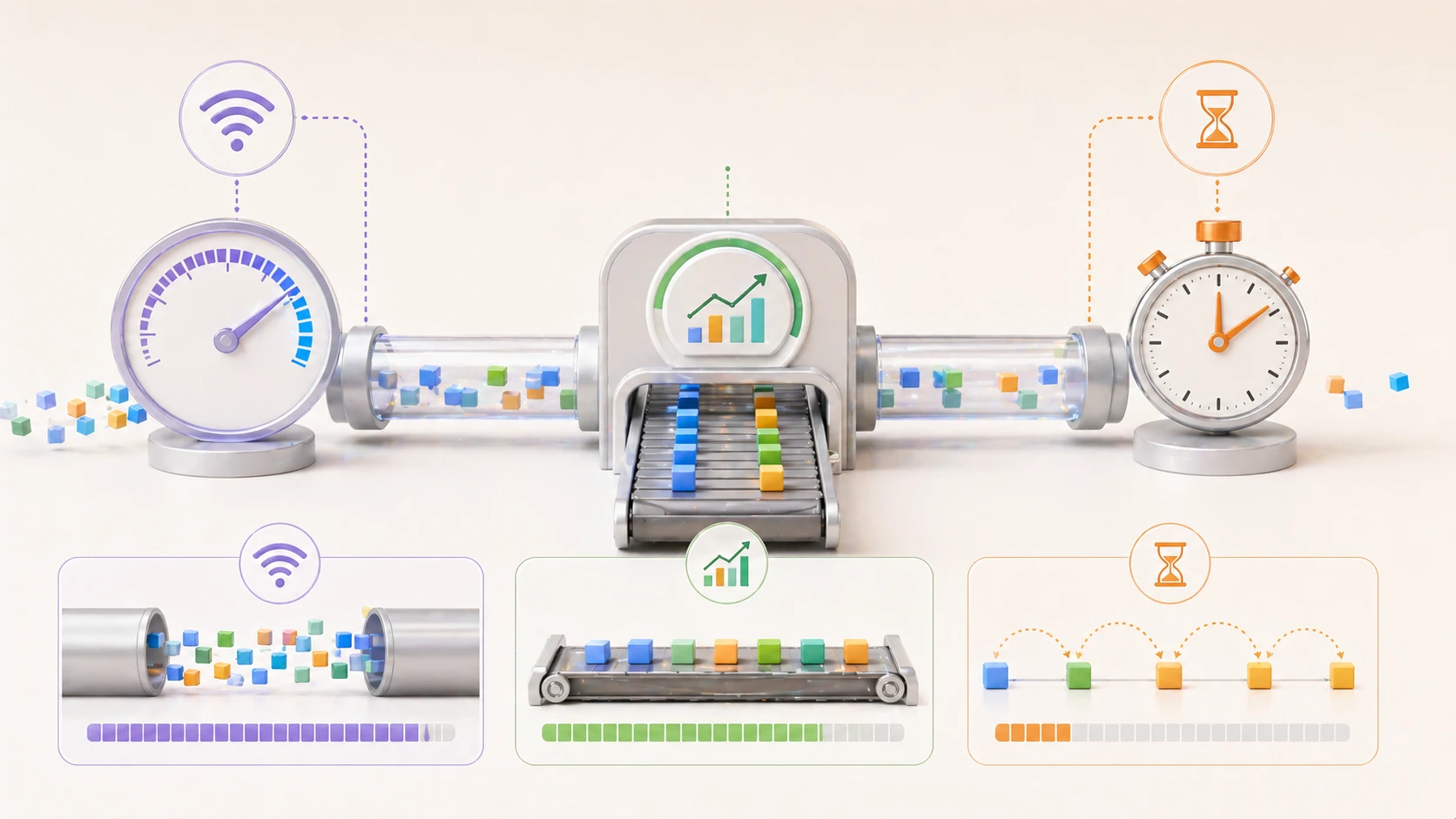
In networking environments, throughput is strongly affected by link quality, congestion, packet loss, retransmission behavior, protocol efficiency, and path stability. Even if the nominal link speed is high, real throughput can fall when the network experiences errors, inconsistent quality, poor routing, or excessive contention between applications.
Protocol behavior matters as well. Different protocols handle acknowledgments, retransmissions, session control, and overhead differently. Some application types are more tolerant of variation, while others lose effective throughput quickly when latency or packet loss rises. This is especially important in wide-area networks, internet-connected services, and distributed communications environments.
As a result, throughput should always be evaluated under realistic network conditions rather than by link speed alone.
Endpoints, Processing, and Storage Limits
Throughput is also shaped by the endpoints doing the work. A network path may be capable of carrying large volumes of traffic, but if the sending or receiving system lacks CPU, memory, disk performance, session handling power, or application efficiency, real throughput will still be limited. In many environments, the bottleneck is not the link itself but the equipment or platform using it.
Storage systems can have the same effect. If applications generate data faster than storage can read or write it efficiently, throughput falls. Database performance, queue handling, thread design, and resource contention also influence how much useful work the system can complete over time.
This is why throughput analysis often becomes a whole-system exercise rather than a narrow network test.
Advantages of Strong Throughput
Better Performance Under Real Load
One of the clearest advantages of strong throughput is better performance under real operating conditions. A platform with healthy throughput can move more data, support more users, or complete more work without becoming unstable too quickly. This improves the practical usability of the service and makes performance more consistent as traffic rises.
In business environments, this means applications feel more responsive under active use, file transfers complete faster, monitoring data flows more smoothly, voice and media systems perform more predictably, and back-end platforms can process demand with less visible strain. The value is especially clear during peak hours or operational spikes, when weak throughput often becomes most obvious.
In simple terms, strong throughput helps systems stay useful when demand becomes real rather than remaining comfortable only during light testing.
More Efficient Use of Infrastructure
Another important advantage is better infrastructure efficiency. If a system achieves stronger throughput from the resources already deployed, the organization gets more usable performance from its investment. Poor throughput often means capacity is being wasted through inefficiency, bottlenecks, or poor design alignment.
This matters for both cost and planning. Businesses do not want to keep buying more bandwidth, more servers, or more hardware if the real problem is that current resources are not being converted effectively into completed work. Throughput analysis helps reveal whether the environment is using its capacity well or simply consuming budget without proportional results.
Strong throughput therefore supports better value from existing systems as well as stronger justification for future expansion.
High throughput is not just about more output. It is about making the existing platform perform closer to the value it was supposed to deliver.
Business and Operational Benefits
Improved User Experience and Workflow Speed
Throughput has direct consequences for user experience. If data moves slowly, application responses queue up, or large workloads take too long to complete, users feel the problem immediately even if they never use the word throughput. They experience it as lag, waiting, interrupted tasks, or unreliable service. Strong throughput helps reduce those frustrations.
This also improves workflow speed. Teams can move files, access tools, conduct transactions, support customers, or communicate across systems more efficiently when the platform sustains stronger real output. In operations-heavy environments, this can create meaningful productivity gains even without changing the business process itself.
In this way, throughput is not only a technical metric. It is a practical contributor to daily efficiency and service quality.
Better Scalability Potential
Strong throughput also supports scalability. A platform that already uses resources efficiently is generally better positioned to absorb growth than one that struggles under current load. This does not mean throughput alone guarantees scalability, but it often provides a strong foundation for it.
If the system can deliver more completed work per unit of time, organizations gain more room to add users, sites, devices, traffic, or services before major redesign becomes urgent. This is especially important in enterprise, cloud, and communication environments where adoption and workload rarely stay fixed.
Throughput therefore helps the organization not only perform better now, but also expand more confidently later.
Applications of Throughput Analysis
Networks, Data Services, and Cloud Platforms
Throughput analysis is widely used in network design, WAN planning, cloud service evaluation, data center operations, storage assessment, and application performance testing. These environments depend on the movement and processing of large amounts of data, so understanding real output over time is essential for reliable planning.
In these applications, throughput helps teams identify whether services are performing in line with expectations or whether hidden bottlenecks are reducing value. It can also help compare architectures, validate upgrades, and assess whether real-world behavior matches design assumptions.
This makes throughput analysis a practical tool for both troubleshooting and strategic planning.
Communication Systems and Media Traffic
Throughput is also highly relevant in communication environments, especially where signaling, media streams, paging traffic, monitoring data, and user sessions share the same infrastructure. Voice, video, messaging, intercom traffic, and operational data all depend on real throughput, not only on theoretical bandwidth.
If a communication platform lacks throughput under active conditions, users may experience unstable sessions, poor media quality, delayed recordings, slower dashboard updates, or reduced service capacity during busy periods. That is why throughput analysis is important in communication servers, IP networks, unified communication platforms, remote access services, and media-oriented infrastructure.
In these settings, throughput helps show whether the environment can handle practical communication demand rather than only nominal link specifications.
Maintenance Tips for Throughput Performance
Monitor Real Conditions, Not Just Theoretical Capacity
One of the most important maintenance practices is to monitor real operating behavior instead of relying only on theoretical design values. A link rating, hardware specification, or platform datasheet does not automatically reveal whether the environment is performing well in practice. Teams should observe real data movement, transaction completion, session behavior, and peak-period performance under live conditions.
This helps identify where actual throughput begins to fall below expected levels. Monitoring can reveal congestion, overloaded devices, inefficient software behavior, protocol overhead, or application bottlenecks before they become more serious service problems. In many cases, real throughput issues appear gradually rather than as one obvious failure.
Strong maintenance therefore depends on visibility into practical performance, not only configuration assumptions.
Review Bottlenecks Across the Full Path
Another key practice is to review the entire service path when troubleshooting throughput. Many teams first blame the network, but weak throughput may originate in the server, database, storage, endpoint device, encryption layer, or application logic instead. Treating throughput as a whole-system property leads to more accurate diagnosis.
This is especially important in multi-layer environments where cloud platforms, WAN links, application servers, authentication systems, and user devices all contribute to the final result. One weak component can reduce throughput for the entire chain even if the rest of the infrastructure remains healthy.
In practical terms, throughput problems are solved more effectively when teams investigate the full delivery path instead of only the most visible component.
Throughput maintenance is most effective when it follows the complete path from source to destination rather than assuming one layer is always responsible.
Limitations and Design Trade-Offs
Higher Throughput Alone Does Not Solve Everything
Strong throughput is valuable, but it is not the only performance concern. A system can show high throughput while still having poor latency, unstable control behavior, weak security design, or limited resilience. For this reason, throughput should be understood as one major performance dimension rather than the only one that matters.
This is particularly important in communication and business systems where user experience depends on a combination of responsiveness, continuity, reliability, and manageable load behavior. If teams chase throughput alone without considering these related factors, optimization may become unbalanced.
The best performance strategy usually treats throughput as essential, but not isolated from the wider system experience.
Optimization May Require Trade-Offs
Improving throughput can also require design trade-offs. More aggressive buffering, batching, resource allocation, or protocol tuning may increase output but also change behavior in other ways. In some cases, stronger throughput may come with higher hardware cost, greater configuration complexity, or more specialized scaling requirements.
This does not reduce the value of throughput optimization, but it does mean decisions should be made carefully. The goal is not maximum output under artificial conditions. The goal is practical, sustainable throughput that fits the business and technical needs of the real environment.
In that sense, good throughput design is not about pushing numbers alone. It is about building balanced performance that remains useful under actual operating conditions.
Conclusion
Throughput is a practical measure of how much useful data, traffic, or completed work a system can deliver over time. It matters because real performance is defined not by theoretical capacity alone, but by how much successful output the platform actually produces under live conditions.
Its importance spans networks, applications, cloud services, communication platforms, and business systems. Strong throughput improves real-load performance, supports better user experience, increases infrastructure efficiency, and provides a stronger foundation for growth. Weak throughput, by contrast, often exposes hidden bottlenecks that reduce the value of otherwise capable systems.
For organizations evaluating system performance, throughput is one of the most practical and revealing metrics available. It shows what the environment can really deliver when work must actually get done.
FAQ
What is throughput in simple terms?
In simple terms, throughput means how much useful data or completed work a system can successfully deliver in a certain amount of time. It shows what the system really gets done, not just what it could theoretically support.
This makes it a very practical performance measure.
What is the difference between throughput and bandwidth?
Bandwidth is the theoretical maximum capacity of a link or channel, while throughput is the amount of data or work that is actually delivered successfully in practice. Throughput is usually lower than raw bandwidth because real conditions add overhead and inefficiency.
That is why throughput often gives a more realistic view of performance.
Why is throughput important for business systems?
Throughput is important because it affects how quickly and reliably systems can move data, handle requests, support users, and complete transactions. Weak throughput can create delays, bottlenecks, and poor user experience even when the infrastructure looks strong on paper.
Strong throughput helps platforms remain efficient, scalable, and useful under real operating demand.