Tunnel Emergency Communication System: Intercom, Paging, and Safety Communication Explained
A tunnel emergency communication system is a dedicated voice and alerting network used inside road tunnels, railway tunnels, metro tunnels, utility tunnels, mining tunnels, and other underground passages. Its main purpose is to help people communicate quickly during accidents, equipment failures, fires, maintenance work, traffic incidents, or evacuation situations.
Relevant Solution Overview:Tunnel PA and Intercom Solution
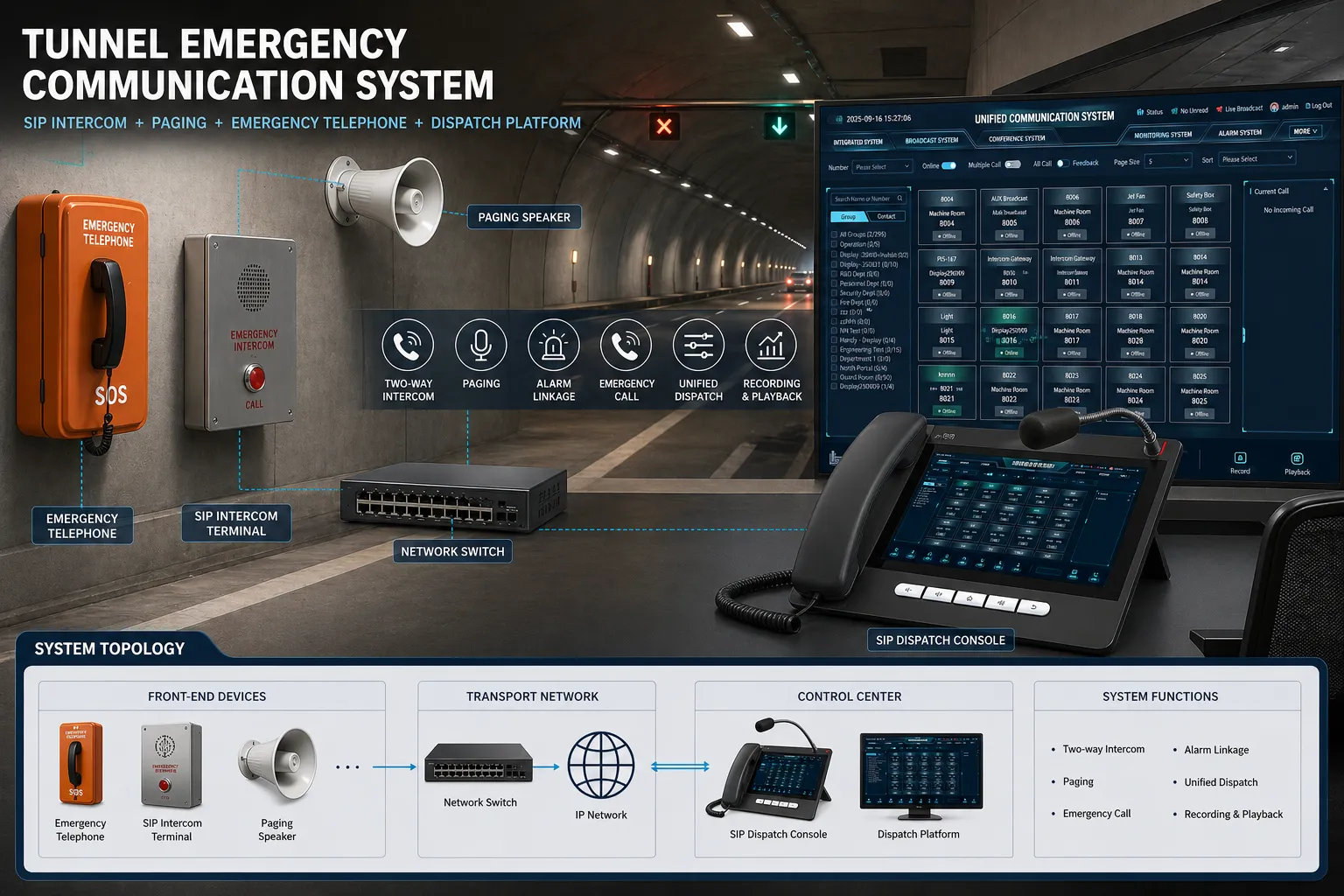
Unlike a normal office phone system or a simple public address system, a tunnel communication system must work in a long, enclosed, noisy, and sometimes harsh environment. It usually combines emergency intercom, industrial telephones, SIP paging, horn speakers, alarm linkage, video monitoring, dispatch software, and control room management into one coordinated platform.
Why Tunnel Communication Requires a Dedicated System
Tunnels Are Difficult Communication Environments
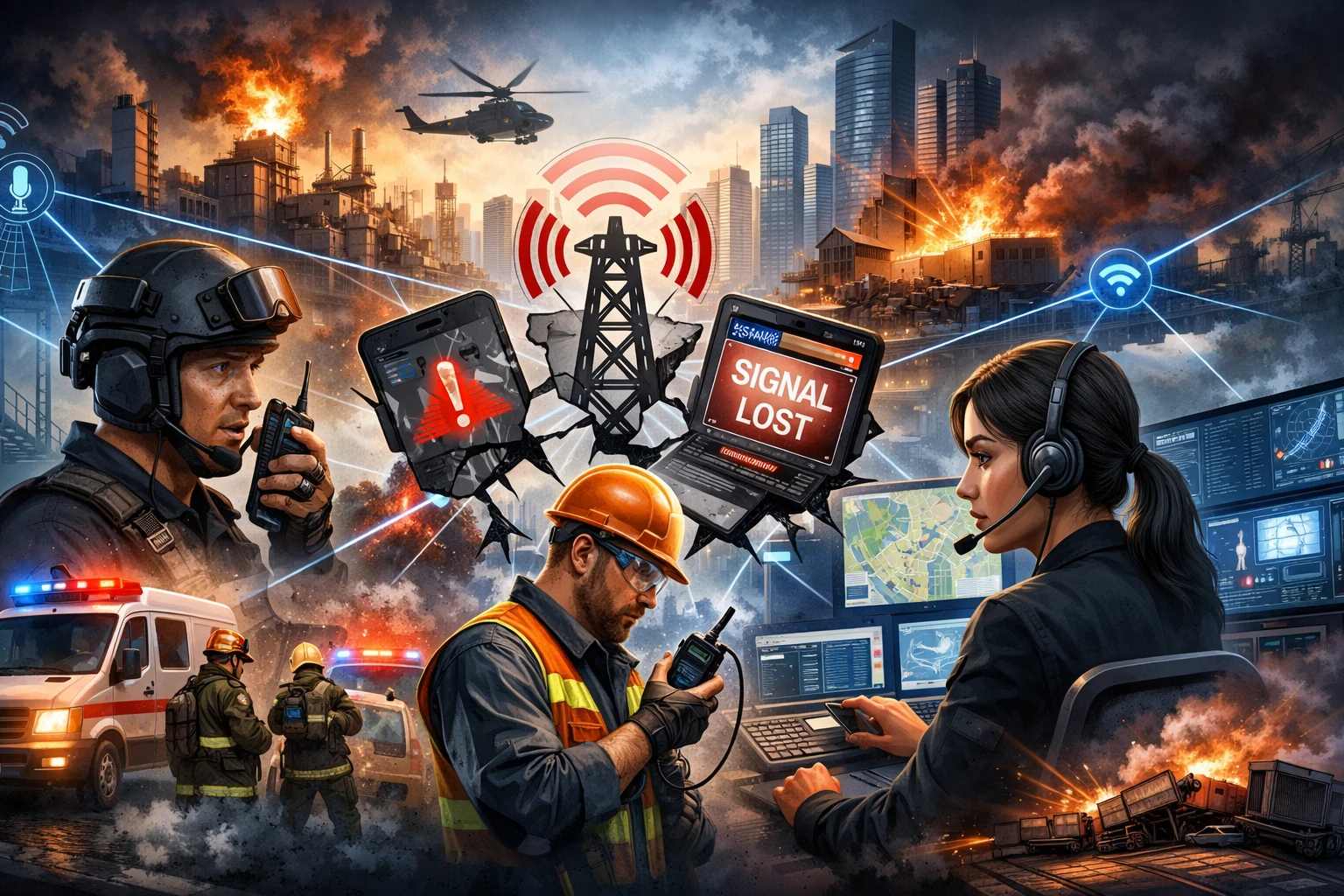
Tunnels are not easy places for communication. They are usually long and narrow, with concrete walls, vehicle noise, ventilation fans, echo, weak mobile signals, and limited visibility. In a normal environment, a phone call or speaker announcement may be enough. In a tunnel, however, voice clarity, device location, emergency priority, and system reliability become much more important.
When an accident happens inside a tunnel, operators need to know where the problem is, communicate with people on site, broadcast instructions to a specific area, and coordinate rescue or maintenance teams. This is why a tunnel emergency communication system is often designed as a combined intercom and paging system rather than a single device.
Independent Systems Can Slow Down Response
Many tunnels already have CCTV, fire alarm systems, ventilation control, traffic monitoring, telephones, radio systems, and public address systems. If these systems are built separately, the operator may need to use different screens, different controls, and different procedures during an emergency.
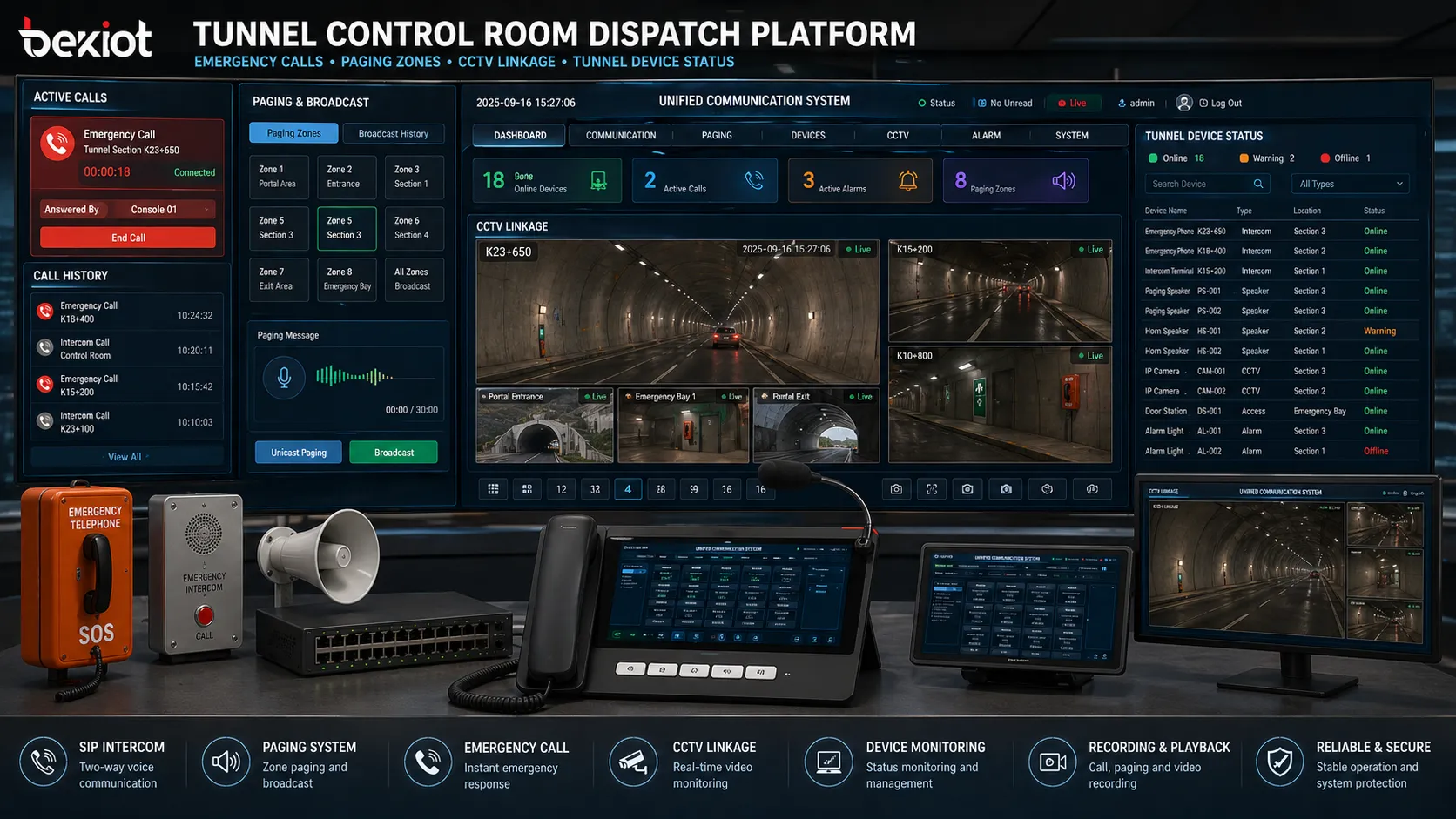
A better approach is to connect communication, paging, alarm, video, and dispatch functions together. When a person presses an emergency call button, the control room can answer the call, see the device location, view nearby camera footage, start a paging announcement, and notify response teams from one platform.
A tunnel emergency communication system is not only about making calls. It is about helping operators hear, speak, locate, broadcast, and respond faster.
What Is Included in a Tunnel Emergency Communication System?
Emergency Intercom and Industrial Telephones
Emergency intercom stations and industrial telephones are installed at tunnel portals, emergency bays, evacuation passages, equipment rooms, cross passages, service areas, and maintenance zones. These devices allow drivers, passengers, workers, or maintenance staff to contact the control room directly.
In many projects, SIP emergency phones or IP industrial telephones are used because they can connect through the tunnel IP network. For harsher sites, the devices may need waterproof, dustproof, corrosion-resistant, vandal-resistant, or explosion-proof protection depending on the project environment.
IP Paging and Public Address Devices
Paging devices are used to broadcast live announcements, evacuation instructions, warning messages, maintenance notices, and safety reminders. These devices may include SIP horn speakers, IP column speakers, IP paging amplifiers, ceiling speakers, or high-power outdoor speakers.
In tunnel environments, horn speakers are common because they provide strong directional sound projection. For long tunnels, speakers are usually divided into zones so the control room can broadcast to a specific section instead of sending every message to the whole tunnel.
Control Room Dispatch Platform
The control room is the command point of the tunnel communication system. Operators can answer calls, start announcements, monitor device status, transfer calls, create group calls, review recordings, and handle alarms through a dispatch console or management platform.
A visual dispatch platform can also display tunnel sections, device positions, call status, alarm information, and video links. This makes it easier for operators to understand what is happening and decide what action should be taken.
Video and Alarm Linkage
A modern tunnel emergency communication system often connects with CCTV and alarm systems. When an emergency call or alarm is triggered, the system can automatically display nearby camera footage, show the location, record the event, and guide the operator to respond.
Alarm linkage can include fire alarms, smoke detectors, gas sensors, water level alarms, manual alarm buttons, door contacts, intrusion sensors, or other tunnel safety systems. The communication platform can then trigger paging, call response teams, or activate warning devices according to the emergency plan.
How Tunnel Intercom and Paging Work Together
Emergency Call Workflow
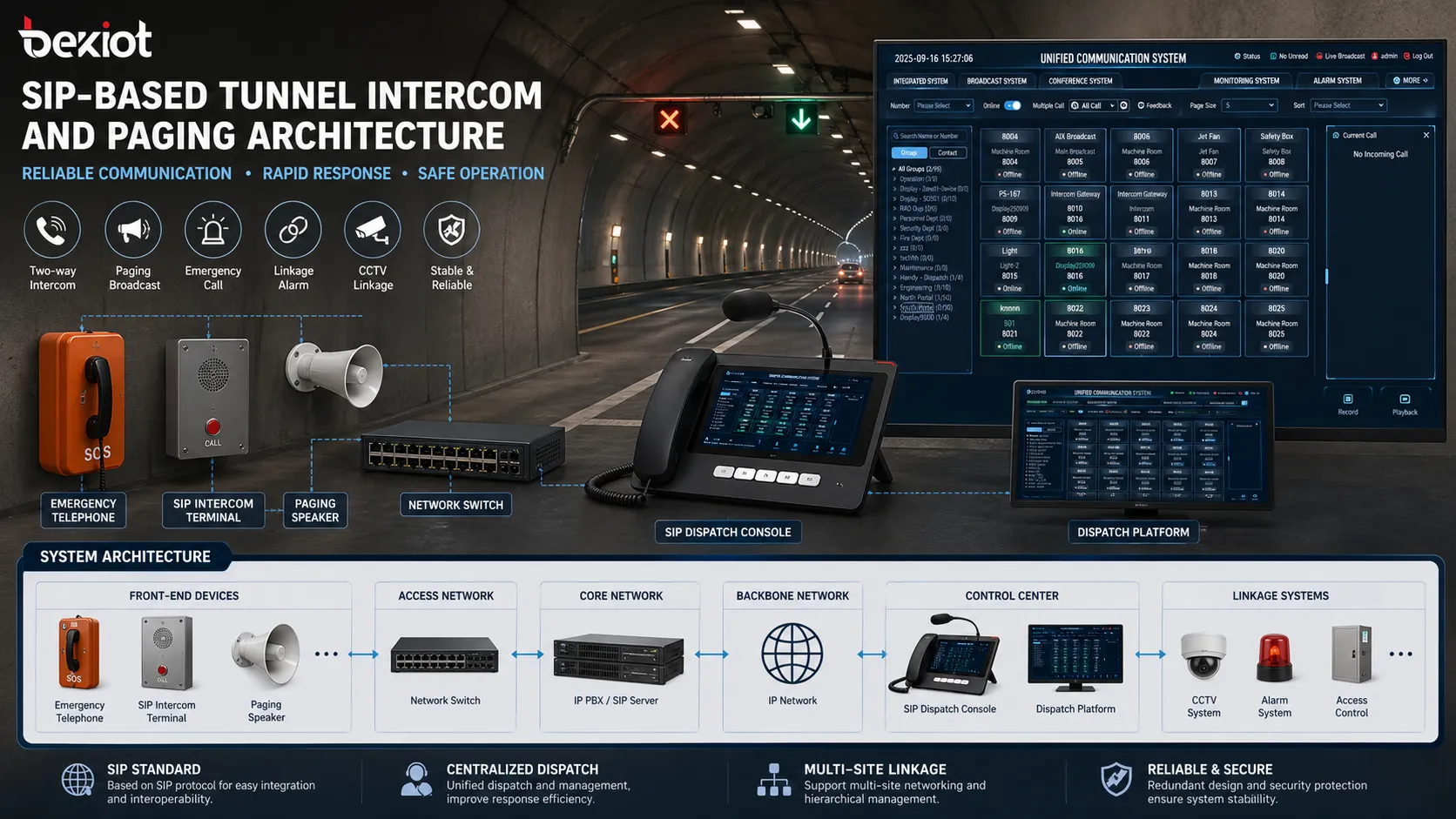
In a typical emergency call process, a person inside the tunnel presses an emergency button or picks up an industrial phone. The call is sent to the tunnel control room through the SIP server or IP PBX. The operator answers the call, checks the device location, confirms the situation, and starts the correct response procedure.
If the main control room is busy, the system can forward the call to another operator, a duty phone, a mobile phone, or an upper-level command center. This helps prevent missed emergency calls and improves response reliability.
Paging and Evacuation Workflow
Paging is used when the control room needs to send instructions to people in the tunnel. For example, operators may need to tell drivers to stop, guide people to an evacuation passage, warn workers about maintenance activities, or ask personnel to leave a dangerous section.
Emergency paging should have a higher priority than routine announcements. When urgent information needs to be broadcast, the system should be able to interrupt lower-priority audio and play emergency messages immediately.
Video Verification Workflow
Video linkage helps the operator confirm the real situation before taking further action. When a call or alarm is triggered, the related camera can pop up automatically on the control room screen. This is useful for checking smoke, vehicle accidents, blocked exits, equipment damage, or abnormal personnel activity.
With video verification, the control room can avoid relying only on voice descriptions. It also helps teams coordinate better because operators can describe the actual site condition to rescue or maintenance personnel.
Common Application Scenarios
Highway and Road Tunnels
Highway tunnels require emergency communication for traffic accidents, vehicle breakdowns, fires, smoke events, congestion, and evacuation. Emergency telephones and paging speakers can be installed along the tunnel, at portals, near emergency parking bays, and inside equipment rooms.
The system allows operators to talk with drivers, broadcast traffic instructions, notify maintenance teams, and coordinate with police, fire rescue, or road management departments.
Metro and Railway Tunnels
Metro and railway tunnels require communication between operation centers, station control rooms, platform staff, maintenance teams, and tunnel personnel. Intercom and paging systems can support emergency evacuation, train incident response, tunnel maintenance, and daily operational coordination.
In rail environments, the communication system is often connected with CCTV, PA systems, access control, emergency alarms, and operation control platforms.
Utility Tunnels and Underground Corridors
Utility tunnels contain important infrastructure such as power cables, communication lines, water pipes, gas pipelines, and control equipment. Workers inside these tunnels need reliable communication for inspection, maintenance, alarm reporting, and emergency evacuation.
In this type of environment, industrial telephones, IP intercoms, paging speakers, gas alarm linkage, video monitoring, and access control integration are especially important.
Industrial and Mining Tunnels
Industrial tunnels and mining-related passages may have dust, moisture, vibration, chemical exposure, or explosion risks. Communication equipment used in these areas should be selected according to the site conditions and safety requirements.
For demanding environments, rugged industrial telephones, explosion-proof phones, weatherproof intercoms, high-power paging speakers, and dispatch platforms can help maintain communication during both routine work and emergency events.
Key Features to Consider When Choosing a Tunnel Communication System
Clear Voice Quality
Voice clarity is one of the most important requirements. The system should support reliable audio transmission, suitable speaker power, echo control, and enough sound coverage for noisy tunnel environments.
Zone-Based Paging
Long tunnels should not be treated as one single broadcast area. Zone-based paging allows operators to send messages to a specific section, portal, equipment room, evacuation passage, or emergency area.
Emergency Priority
Emergency calls and evacuation broadcasts should have higher priority than routine calls, music, or scheduled announcements. Priority control helps ensure that critical messages are delivered first.
Video and Alarm Integration
Integration with CCTV and alarm systems can greatly improve response efficiency. When communication, alarm, and video are connected, operators can see the situation, speak to people on site, and start emergency procedures faster.
Rugged Device Protection
Tunnel field devices may face dust, water, vibration, temperature changes, exhaust gas, and mechanical impact. Industrial-grade protection, reliable housing, and stable power design are important for long-term operation.
Recording and Event Logs
Call recording, paging logs, alarm records, and operation history are useful for incident review, training, maintenance, and safety audits. A good system should keep traceable records of important communication events.
Deployment Tips for Tunnel Projects
Plan Communication Points Based on Real Use
Emergency phones and intercoms should be installed where people are most likely to need help, such as tunnel portals, emergency exits, equipment rooms, cross passages, maintenance points, and accident-prone areas. The layout should support both public emergency use and maintenance team communication.
Design Paging Zones Carefully
Paging zones should follow the tunnel structure and emergency response plan. A clear zone design allows operators to broadcast only to affected areas, reducing confusion and improving evacuation guidance.
Consider Network and Power Redundancy
Since emergency communication must remain available during critical situations, network redundancy and backup power should be considered. Fiber ring networks, UPS power, industrial switches, and local fallback operation can improve system reliability.
Use Open Protocols Where Possible
Open protocols such as SIP, RTP, ONVIF, RTSP, GB/T 28181, dry contact I/O, and API integration can make the system easier to connect with existing tunnel platforms. This reduces the risk of isolated systems and supports long-term expansion.
A well-designed tunnel emergency communication system should support daily operation, emergency response, maintenance coordination, and future system expansion.
How Becke Telcom Supports Tunnel Emergency Communication
Becke Telcom provides industrial communication products and integrated solutions for emergency calling, SIP intercom, IP paging, industrial telephony, dispatch communication, and harsh-environment communication systems. For tunnel projects, Becke Telcom can support system design with SIP emergency phones, industrial telephones, paging amplifiers, horn speakers, dispatch platforms, gateways, and integration interfaces.
The solution can be adapted for road tunnels, railway tunnels, metro tunnels, utility tunnels, underground industrial corridors, and public safety infrastructure. By combining intercom, paging, video linkage, alarm response, and dispatch management, Becke Telcom helps operators build a safer and more manageable tunnel communication network.
For tunnel projects that require emergency intercom, paging, industrial telephones, and dispatch integration, Becke Telcom can provide flexible communication system support for different site conditions.
FAQ
What is a tunnel emergency communication system?
A tunnel emergency communication system is a dedicated system that allows people inside a tunnel to call the control room and allows operators to broadcast emergency messages, safety instructions, and evacuation guidance.
What is the difference between tunnel intercom and tunnel paging?
Tunnel intercom is mainly used for two-way voice communication between field users and the control room. Tunnel paging is used for one-way or group announcements through speakers. In most tunnel projects, both functions are needed.
Why are SIP devices used in tunnel communication systems?
SIP devices can work through IP networks and integrate with SIP servers, IP PBX systems, dispatch platforms, paging systems, and gateways. This makes the system easier to expand and connect with other communication platforms.
Can a tunnel communication system connect with CCTV?
Yes. Many systems can connect with CCTV platforms so that when an emergency call or alarm occurs, nearby camera footage can appear on the operator screen for visual verification.
What devices are commonly used in tunnel emergency communication?
Common devices include SIP emergency phones, industrial telephones, emergency call stations, SIP intercoms, horn speakers, IP paging amplifiers, paging microphones, dispatch consoles, gateways, and alarm linkage modules.
Where should emergency communication devices be installed in tunnels?
Devices are usually installed at tunnel portals, emergency parking bays, cross passages, evacuation passages, equipment rooms, pump rooms, electrical rooms, maintenance zones, and other key safety points.