


Explosion-proof sound and light telephones are designed for hazardous industrial environments where emergency communication must be fast, clear, visible, and reliable. In oil and gas plants, chemical facilities, mines, tunnels, power stations, offshore platforms, and heavy industrial sites, workers may face explosive gas, combustible dust, strong noise, low visibility, moisture, vibration, and other harsh conditions. In these environments, a normal telephone is not enough to support safe and efficient emergency response.
An explosion-proof sound and light telephone combines voice communication, emergency calling, audible alarm, visual alarm indication, and dispatch system linkage into one rugged industrial terminal. When an abnormal event occurs, field personnel can quickly contact the control room, while the sound and light alarm helps nearby workers notice the emergency status. When integrated with an IP PBX, SIP server, dispatch console, PA system, or alarm platform, the device becomes an important part of a complete hazardous area emergency communication system.
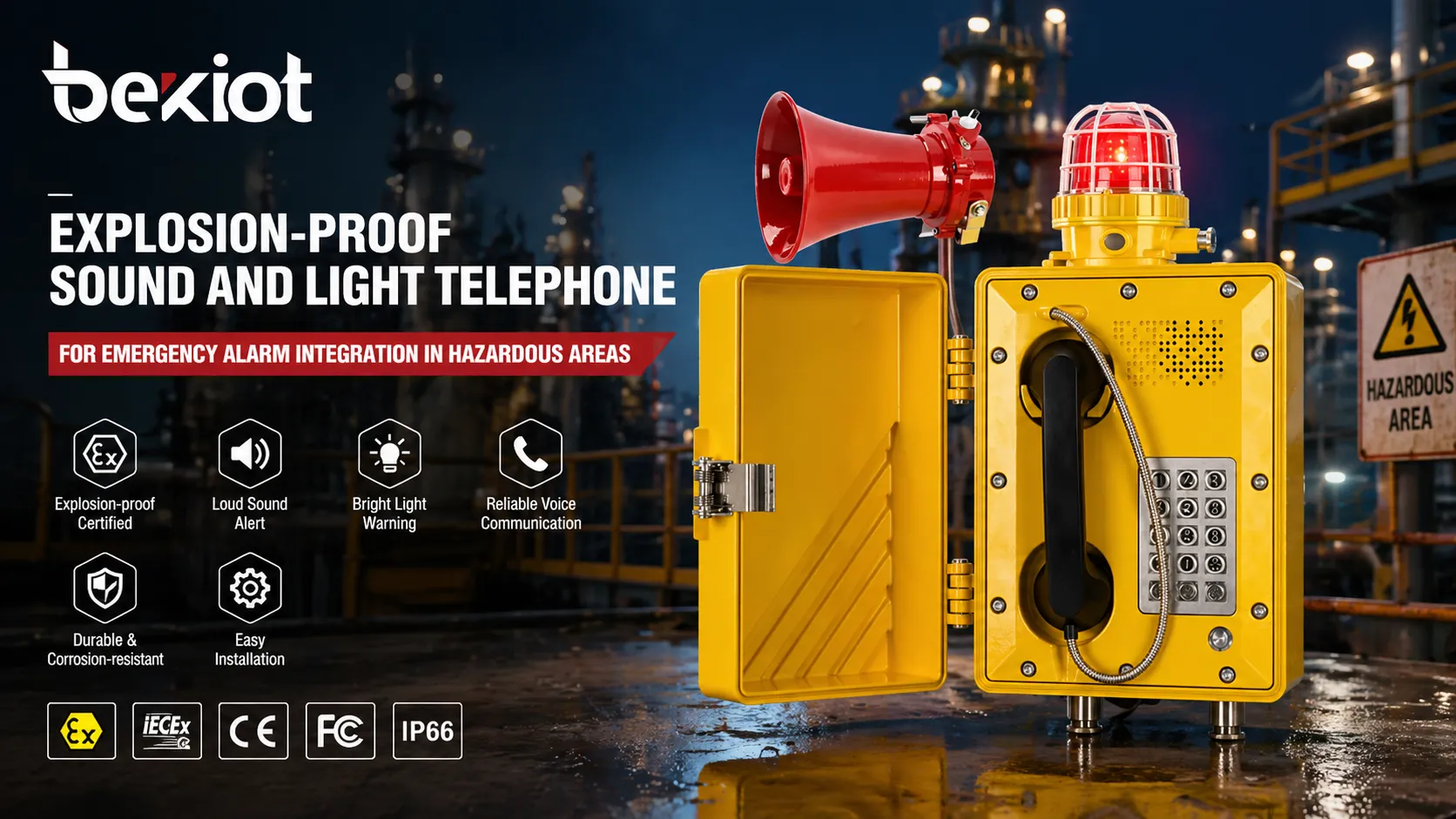
What Is an Explosion-Proof Sound and Light Telephone?
An explosion-proof sound and light telephone is an industrial emergency communication terminal designed for hazardous areas and harsh working environments. It usually includes a rugged explosion-proof enclosure, a telephone handset or hands-free calling function, an emergency call button or hotline calling function, a visual warning light, and an audible alarm unit. The purpose is to make emergency communication easier to start, easier to notice, and easier to manage.
Compared with a standard industrial telephone, a sound and light telephone provides stronger event awareness. The visual alarm can indicate incoming calls, emergency activation, alarm linkage, or system status. The audible alarm can attract attention in noisy workshops, tunnels, pump rooms, loading areas, and outdoor industrial zones. This combination helps improve response efficiency when every second matters.
For hazardous area communication, the value of a telephone is not only in making a call. It must also help the emergency signal be seen, heard, answered, and handled.
Why Emergency Alarm Integration Matters
Faster Emergency Response
In industrial safety management, emergency response speed is critical. When a worker discovers gas leakage, equipment failure, fire risk, abnormal pressure, pipeline damage, or personnel injury, the communication device must allow immediate contact with the control room or dispatch center. An explosion-proof sound and light telephone can be configured for hotline dialing, one-button emergency calling, SIP calling, or analog line communication, depending on the project requirements.
Once the call reaches the control room, operators can identify the call point, communicate with the field worker, confirm the incident type, and start the response procedure. This makes the telephone a fixed emergency contact point for areas where mobile phones, radios, or normal office phones may not be suitable.
Visible and Audible Alarm Notification
Many hazardous industrial sites are noisy, dusty, or visually complex. A simple ringtone may be missed, and a voice call alone may not be enough to alert nearby personnel. The sound and light alarm function helps make the emergency status more noticeable. A flashing beacon, warning lamp, or strobe light can provide visual indication, while the audible alarm can draw attention from workers nearby.
This is especially useful in petrochemical plants, underground tunnels, mines, power stations, compressor rooms, tank farms, and industrial production areas. When the telephone is activated or linked with an alarm system, the local sound and light signal can help workers quickly recognize that an emergency communication event is taking place.
Control Room and Dispatch Linkage
Emergency alarm integration becomes more powerful when the sound and light telephone is connected with a dispatch platform. Through SIP, IP PBX, industrial gateways, emergency PA systems, or alarm management software, field calls can be linked with control room workflows. Operators can answer the call, check the location, communicate with the caller, make a broadcast announcement, notify maintenance teams, or escalate the event to emergency command personnel.
For large industrial sites, this type of dispatch linkage helps turn individual field telephones into a coordinated emergency communication network. Instead of relying on isolated devices, the entire system can support calling, alarm indication, event reporting, zone broadcasting, and response coordination.
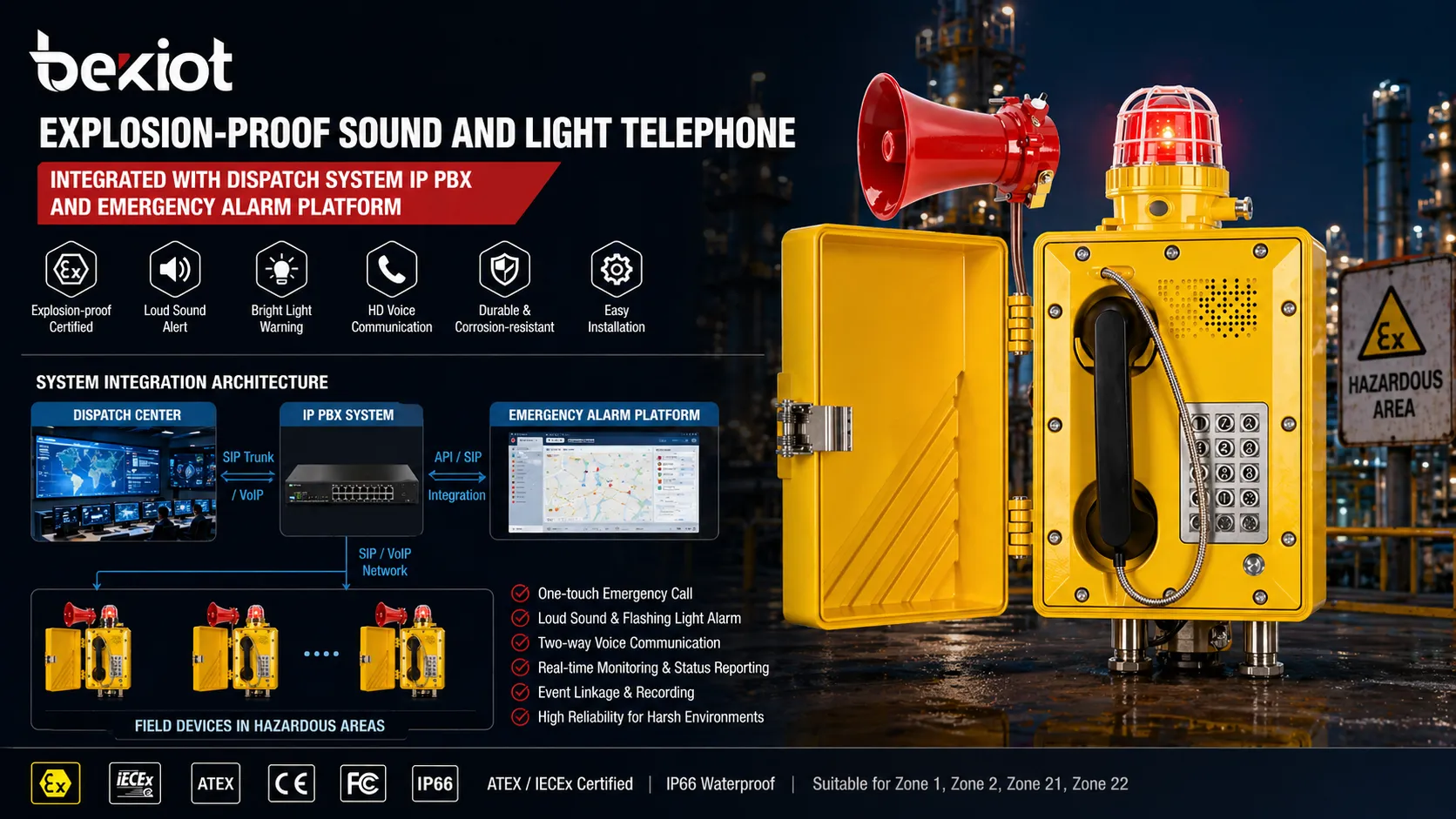
Core Features of Explosion-Proof Sound and Light Telephones
Explosion-Proof and Rugged Enclosure
The enclosure of an explosion-proof telephone must be suitable for the safety and environmental requirements of hazardous areas. A rugged housing helps protect internal components from impact, corrosion, dust, moisture, and harsh outdoor conditions. Depending on the project, the telephone may require special cable entry, wall mounting, column mounting, weatherproof sealing, or corrosion-resistant surface treatment.
Before selecting a model, industrial users should confirm the hazardous area classification, gas or dust environment, temperature range, installation location, power supply condition, and certification requirements. Proper product selection helps ensure that the communication terminal matches the actual site environment.
Emergency Call and Hotline Function
Emergency call function is one of the most important requirements for hazardous area communication. The telephone can be configured to call the control room, dispatch center, security office, maintenance team, or emergency response center. In some applications, the device may support one-button emergency calling, auto-dialing, speed dialing, or hotline calling after lifting the handset.
This function is valuable for workers who need quick access to help during abnormal events. A clear and simple operation process reduces communication delay and helps field personnel report incidents without searching for contact numbers.
Sound and Light Alarm Indication
The integrated audible and visual alarm function provides local indication for call status or emergency events. The warning light can help identify the device location or show alarm activation. The sound alarm can support attention in loud or complex environments. This makes the device suitable for locations where communication events need to be clearly noticed by both the caller and surrounding workers.
In some projects, the sound and light alarm can be linked with external alarm inputs, emergency buttons, dispatch signals, or public address notifications. This allows the device to become part of a wider safety communication and alarm response system.
SIP, IP PBX, and System Integration
Modern industrial communication systems often use SIP-based architecture. A SIP explosion-proof sound and light telephone can connect with an IP PBX, SIP server, dispatch console, recording platform, gateway, or emergency PA system. This allows field terminals to join the same communication network as office phones, control room consoles, industrial intercoms, SIP speakers, and paging devices.
For existing sites with analog systems, analog telephone models or gateway integration can be used. This flexibility is important for renovation projects, brownfield industrial facilities, and multi-site systems where new SIP devices must work together with existing telephone lines or legacy communication equipment.
Typical Application Scenarios
Oil, Gas, and Petrochemical Facilities
Oil refineries, gas plants, chemical production workshops, LNG stations, tank farms, loading areas, and compressor rooms require emergency communication equipment that can operate in hazardous environments. Explosion-proof sound and light telephones can be installed at key operation points to support emergency reporting, production coordination, and control room communication.
When connected to a dispatch platform, the telephone can help operators identify the incident location and coordinate a response. The sound and light alarm also helps nearby workers recognize emergency status in noisy or complex operating areas.
Mines, Tunnels, and Underground Utility Corridors
Mines, highway tunnels, metro tunnels, railway tunnels, and underground utility corridors often require fixed emergency communication points along long-distance routes. Mobile signals may be unstable, and environmental noise or poor visibility may affect communication. Explosion-proof or rugged sound and light telephones provide a reliable contact point for workers, maintenance teams, and emergency personnel.
By linking telephones with dispatch systems and PA broadcasting, operators can respond to calls, locate events, and broadcast instructions to specific zones. This improves communication efficiency in long, enclosed, or remote industrial spaces.
Power Plants, Substations, and Heavy Industry
Power generation plants, substations, steel plants, cement factories, ports, shipyards, and large manufacturing sites need reliable communication between field areas and central control rooms. Sound and light emergency telephones can support daily communication, emergency calls, equipment fault reporting, and alarm linkage in critical production zones.
For high-noise environments, the visual alarm and audible signal help improve event recognition. For control room operators, dispatch integration helps manage incoming emergency calls and coordinate field response more effectively.
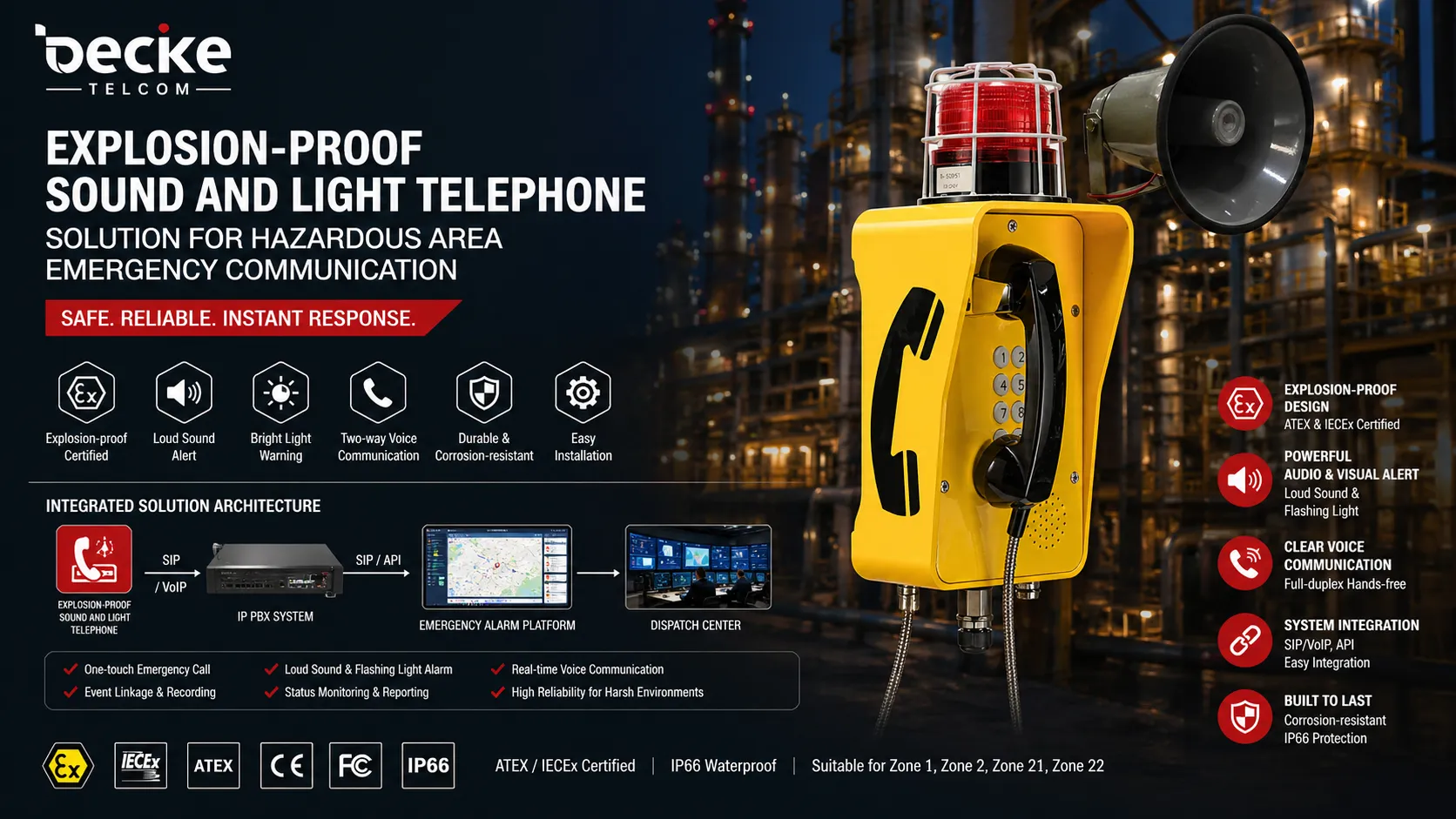
Key Benefits for Industrial Emergency Communication
| Benefit | Description | Industrial Value |
|---|---|---|
| Emergency Call Access | Provides a fixed communication point for workers in hazardous or harsh areas. | Helps field personnel contact the control room quickly during abnormal events. |
| Sound and Light Alarm | Uses audible and visual indication to highlight call status or emergency activation. | Improves awareness in noisy, dusty, outdoor, or low-visibility environments. |
| Explosion-Proof Design | Designed for hazardous areas where explosion protection and rugged reliability are required. | Supports safer communication in oil, gas, chemical, mining, and energy facilities. |
| Dispatch Integration | Can connect with SIP servers, IP PBX systems, dispatch consoles, PA systems, and gateways. | Creates a coordinated emergency communication and response workflow. |
| System Expansion | Supports single-site or multi-site industrial communication network deployment. | Helps factories, industrial parks, and infrastructure projects build scalable communication systems. |
How to Select the Right Explosion-Proof Sound and Light Telephone
Check the Hazardous Area Requirements
The first step is to confirm the actual installation environment. Project teams should check whether the area involves flammable gas, vapor, combustible dust, corrosive substances, outdoor exposure, high humidity, or heavy vibration. The required explosion-proof rating, protection level, operating temperature, and cable entry method should be reviewed before product selection.
Confirm the Communication Architecture
Different sites may use different communication systems. New projects may prefer SIP-based communication with IP PBX and dispatch software. Existing facilities may still use analog telephone lines or mixed communication networks. The selected telephone should match the existing infrastructure and future upgrade plan.
Plan Alarm and Dispatch Linkage
A sound and light telephone should not be considered as an isolated device. For better emergency management, the system design should include how the device connects with the control room, dispatch platform, alarm system, PA broadcasting system, video surveillance system, or emergency command center. This planning helps create a complete emergency communication chain.
A reliable emergency alarm integration solution should connect the field device, the alarm signal, the communication network, the control room, and the response team.
Becke Telcom Explosion-Proof Sound and Light Telephone Solutions
Becke Telcom provides industrial telephone, explosion-proof telephone, sound and light emergency telephone, SIP call station, weatherproof telephone, dispatch communication, and PA system integration solutions for hazardous and harsh industrial environments. The solution can be used in oil and gas, chemical plants, mines, tunnels, power facilities, ports, heavy industry, and other critical infrastructure applications.
For engineering contractors, system integrators, and industrial end users, Becke Telcom can support product selection, communication architecture planning, emergency call design, dispatch linkage, and integration with existing SIP or analog systems. By combining field terminals with IP PBX, SIP servers, gateways, dispatch consoles, and emergency broadcasting devices, Becke Telcom helps build reliable hazardous area communication systems.
Conclusion
An explosion-proof sound and light telephone is an important emergency communication terminal for hazardous industrial environments. It combines explosion-proof protection, emergency voice calling, audible alarm, visual alarm indication, and dispatch linkage into one practical field device. For sites where noise, dust, moisture, low visibility, and explosion risk may affect communication, this type of telephone helps make emergency events easier to report, notice, and manage.
With proper product selection and system integration, explosion-proof sound and light telephones can become a key part of a complete emergency alarm integration solution. Becke Telcom supports industrial users and system integrators with rugged communication terminals and system-level solutions for safer, faster, and more reliable hazardous area communication.
FAQ
What is an explosion-proof sound and light telephone?
An explosion-proof sound and light telephone is an industrial communication device designed for hazardous areas. It provides emergency voice calling and uses audible and visual alarm indication to show call status, alarm activation, or emergency events.
Where can explosion-proof sound and light telephones be used?
They can be used in oil and gas facilities, chemical plants, mines, tunnels, power plants, offshore platforms, tank farms, heavy industrial workshops, and other hazardous or harsh environments that require reliable emergency communication.
Can the telephone be integrated with an emergency alarm system?
Yes. Depending on the system design, the telephone can be integrated with alarm inputs, dispatch platforms, IP PBX systems, SIP servers, gateways, PA systems, and emergency command platforms to support coordinated emergency response.
Why is sound and light indication important?
Sound and light indication helps make emergency events more noticeable in noisy, dusty, outdoor, or low-visibility environments. It allows workers and operators to recognize call or alarm activity more quickly than voice communication alone.
Can a SIP explosion-proof telephone connect with an IP PBX?
Yes. A SIP explosion-proof sound and light telephone can connect with IP PBX systems, SIP servers, dispatch consoles, recording systems, and PA platforms. This allows field emergency calls to become part of a unified industrial communication network.
How do I choose the right explosion-proof emergency telephone?
You should check the hazardous area classification, environmental protection requirements, communication protocol, power supply, installation method, alarm linkage needs, and dispatch integration requirements. A professional industrial communication supplier can help match the product to the actual project environment.







