Introduction to Private Radio over IP (ROIP)
For decades, Land Mobile Radio (LMR) systems have formed the core of mission-critical voice communications for public safety, transportation, utilities, and industrial operations. As organizations grow and digital transformation accelerates, traditional radio networks often struggle with coverage gaps, system incompatibility, and limited integration with modern IP-based applications. Radio over IP (ROIP) software solves these challenges by transmitting voice, PTT signaling, and control data over standard IP networks.
While many ROIP solutions are offered as cloud services, a growing number of security-focused enterprises and government agencies choose private ROIP software—a self-hosted, fully governed platform that delivers radio dispatch and IP communication without depending on third‑party infrastructure. This approach ensures data sovereignty, low latency, and complete operational control.
What Is Private ROIP Software?
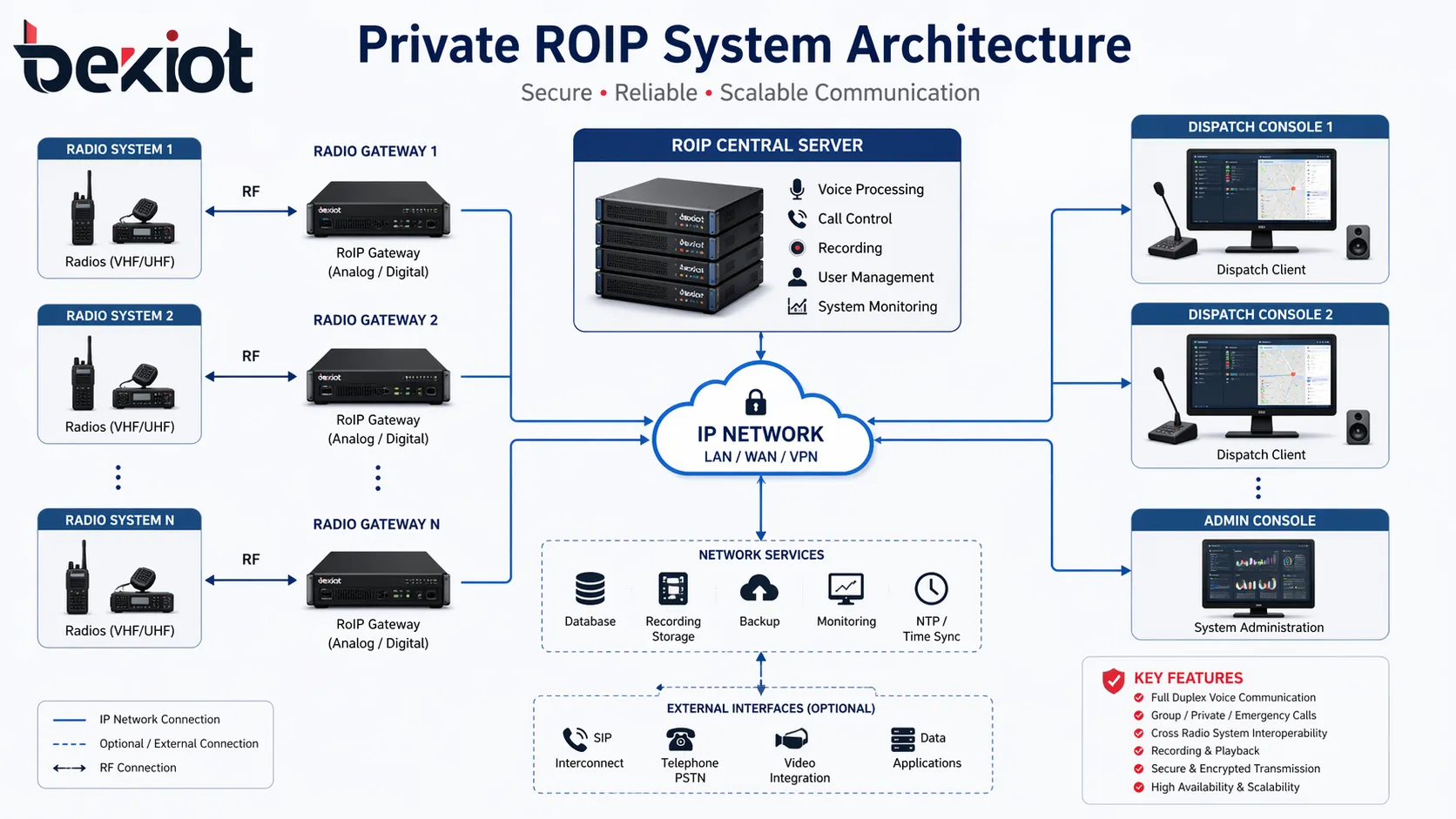
Private ROIP software is an on‑premises or privately hosted communication platform that interconnects radio base stations, repeaters, dispatch consoles, and other voice endpoints over a controlled IP network. The software digitizes analog or digital radio audio, encapsulates push-to-talk (PTT) signalling and control data into IP packets, and allows dispatchers and authorized users to communicate with field radios from any location with network access.
Because it runs on the organization’s own servers or virtual machines, a private ROIP solution keeps all voice traffic and system management strictly within the local security perimeter. This makes it the preferred architecture for sectors where privacy, uptime, and regulatory compliance are non‑negotiable.
How Private ROIP Systems Work
A typical private ROIP deployment includes these core components:
-
ROIP Gateways: Hardware or software interfaces that connect directly to radios (base stations, repeaters, consoles). They convert RF audio and radio control signals into IP streams and can be deployed on embedded Linux devices, virtual machines, or dedicated appliances.
-
Dispatch Console Software: The operator interface for managing communications. It supports multi‑channel monitoring, instant recording playback, patching, paging, and emergency alarm handling. Modern consoles run on Windows, Linux, or as a web‑based application.
-
Central Control Server: Handles user authentication, talk group routing, cross‑patching between channels, and logging. In a private deployment, this server is hosted inside the organization’s own data center or trusted private cloud.
-
Protocol Adapters: Support standard protocols like SIP, RTP, and proprietary ROIP protocols to ensure seamless interoperability with existing PBX, VoIP phones, and legacy radio systems.
Key Features of On‑Premises ROIP Solutions
Advanced private ROIP software packages deliver a comprehensive feature set tailored for dispatch and unified critical communications:
-
Multi‑Vendor & Cross‑Band Interoperability: Unite radios from different manufacturers (Motorola, Kenwood, Hytera, etc.) and various frequency bands into one dispatch interface, eliminating silos.
-
End‑to‑End Encryption: All voice and control data remain within the organization’s encrypted network. AES‑256 encryption can be applied to ROIP links without exposing keys to external parties.
-
Unlimited Dispatch Positions: Scale from a single operator to a multi‑agency command center with customizable layouts, active channel monitoring, and priority override capabilities.
-
Built‑in Voice Recording: Capture all radio traffic and store it on local or NAS storage for compliance, incident review, and training. Instant replay and search functions speed up investigations.
-
Real‑Time GPS Tracking & AVL: Ingestion of GPS data from field radios enables real‑time display of personnel and vehicle locations on integrated maps, enhancing situational awareness.
-
Granular User & Role Management: Define precise permissions that control who can listen, transmit, or reconfigure the system—critical for multi‑agency task forces and secure environments.
-
API & Workflow Automation: RESTful APIs integrate with computer‑aided dispatch (CAD), alarm panels, and IoT sensors to automate responses, such as dynamic channel patching during emergencies.
Private ROIP vs. Cloud‑Based ROIP: A Detailed Comparison
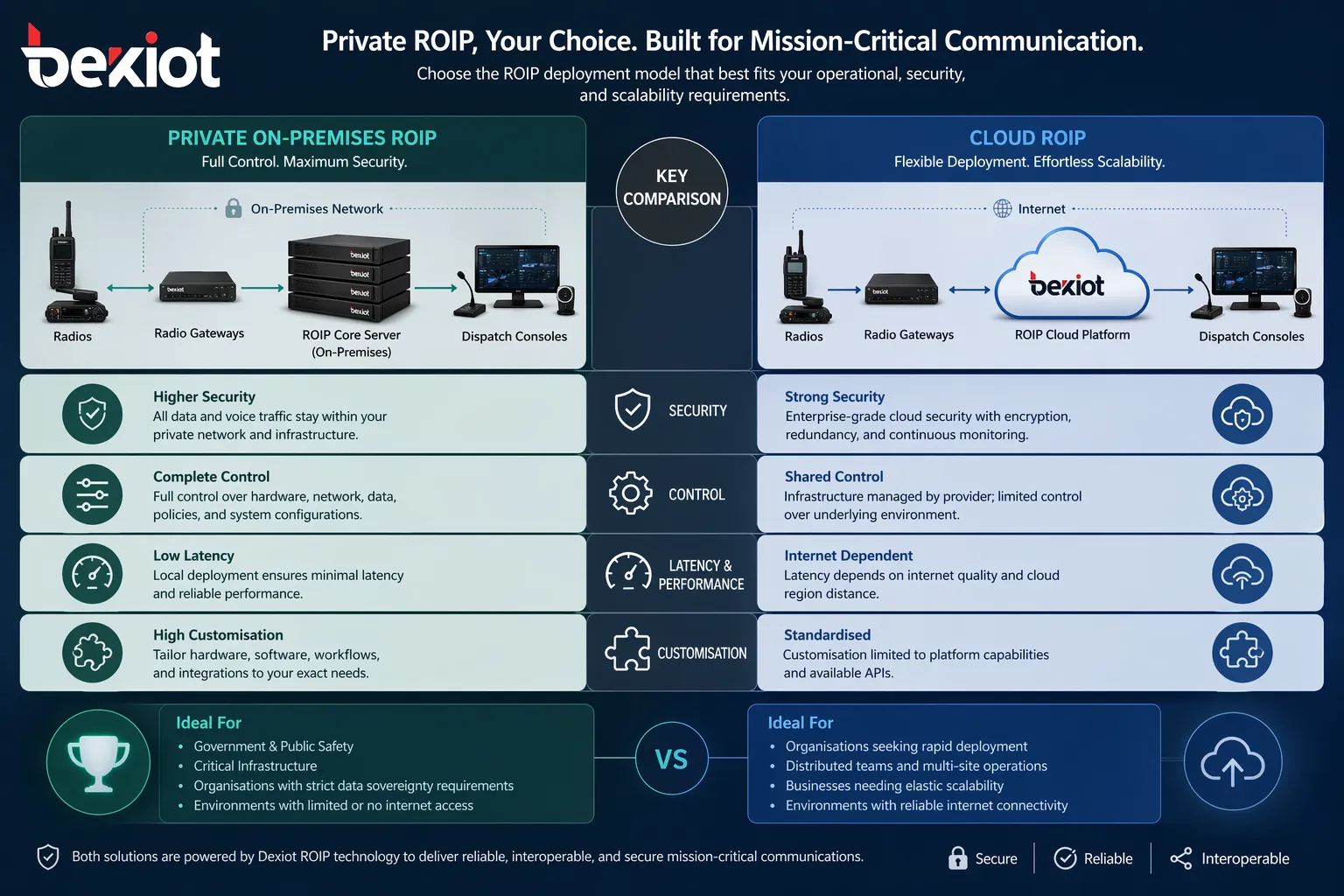
Choosing between a private, on‑premises ROIP solution and a cloud‑hosted service depends on several operational and security priorities. The table below highlights the differences:
| Comparison Factor | Private ROIP Software | Cloud‑Based ROIP |
|---|---|---|
| Data Sovereignty | Complete control; data never leaves the local infrastructure. | Voice and control data stored and processed on third‑party servers. |
| Network Latency | Sub‑50 ms on a properly designed LAN/WAN; stable and predictable. | Variable latency depending on internet path and cloud provider performance. |
| Security Posture | Operates inside existing security perimeter; minimal external attack surface. | Shared responsibility model; requires robust cloud security configuration. |
| System Reliability | Continues to function during internet outages if internal network is intact. | Fully dependent on internet connectivity and cloud service uptime. |
| Customisation | Deep integration with radio‑specific signalling, legacy infrastructure, and bespoke workflows. | Limited to features and APIs provided by the cloud vendor. |
| Total Cost of Ownership | Higher initial CAPEX; lower and more predictable OPEX for large‑scale systems. | Subscription‑based OPEX that escalates with channel and user count. |
For public safety, defence, energy, and critical infrastructure operators, the guarantees of always‑available communications and uncompromised data privacy make private ROIP software the clearly superior choice.
Real‑World Deployment Scenarios

1. Public Safety & Emergency Operations Centres
A county‑wide dispatch centre connects VHF, UHF, and 700/800 MHz trunked systems via a private ROIP backbone. Primary and backup dispatch consoles at separate sites operate without dependency on the public internet, using fibre and microwave links.
2. Railways & Transportation Networks
A national railway operator links dispatchers at headquarters to remote repeater sites spread over thousands of kilometres of track. Integration with signalling and automatic train location (ATL) improves both safety and operational efficiency.
3. Mining & Tunnel Operations
Underground mines deploy leaky‑feeder radio systems connected via private ROIP to surface control rooms. Voice, real‑time telemetry, and atmospheric sensor data travel across the same secure IP backbone, enabling centralised monitoring and emergency response.
4. Maritime & Port Facilities
A port authority interconnects VHF marine radios from multiple remote towers. Radio traffic is routed over a private microwave ring to the vessel traffic service (VTS) centre, ensuring secure and real‑time coordination even in congested harbour environments.
5. Multi‑Agency Joint Operations
During planned events or emergencies, multiple agencies use a jointly managed private ROIP server to interconnect their normally separate radio channels. Strict permission controls prevent unauthorised cross‑channel access while maintaining full interoperability.
Deployment Best Practices for Private ROIP
Successful implementation of a private ROIP system demands careful network planning and security design:
-
Network QoS & VLAN Segmentation: Prioritise ROIP voice packets with Quality of Service rules and isolate radio control data on dedicated VLANs to protect against congestion and interference.
-
VPN‑Secured Connectivity: Use IPsec or WireGuard tunnels to securely link geographically distributed ROIP gateways, and restrict firewall rules to only necessary SIP and RTP ports.
-
Radio Interface Compatibility: Verify that the ROIP platform supports the precise audio, COR, and PTT interfaces of existing radio equipment, including analogue 4‑wire E&M, tone remote, and digital serial protocols.
-
High‑Availability Architecture: Design with redundancy in mind—failover servers, dual power supplies, and diverse network paths. Many private ROIP platforms also offer automatic fallback to backup dispatch positions or direct RF links.
-
Vendor & Standards Evaluation: Choose solutions that support open standards (SIP, RTP) to avoid vendor lock‑in, ensure a clear migration path, and provide reliable local technical support.
The Future of Private ROIP Technology
Private ROIP platforms are rapidly adopting innovations from the broader IT and telecom industries:
-
WebRTC‑Based Dispatch Consoles: Moving dispatch from installed applications to secure web browsers simplifies deployment, supports bring‑your‑own‑device (BYOD), and eliminates the need for VPN clients.
-
AI‑Driven Audio Processing: Locally hosted machine learning models perform real‑time noise suppression, automatic speech‑to‑text transcription, and keyword‑based incident detection—enhancing operator efficiency without sending data to the cloud.
-
Unified Critical Communications: Seamless integration of ROIP with LTE Push‑to‑Talk (MCX/MCPTT) and enterprise VoIP telephony creates a single‑pane‑of‑glass interface for all voice paths.
-
Standards‑Based Interoperability: Adoption of ETSI FRMCS and 3GPP MCX standards will position private ROIP as the interoperability bridge between legacy LMR systems and next‑generation broadband networks.
Despite the ongoing evolution towards 5G and cloud services, many organisations will retain their LMR investments for years. Private ROIP software ensures these assets remain secure, relevant, and increasingly intelligent.
Conclusion
Private ROIP software delivers a strategic advantage for any organisation that depends on reliable radio dispatch and IP communications. By hosting the solution on‑premises, you regain full control over critical voice paths, achieving the low latency, military‑grade security, and deep customisation that cloud services cannot match. From emergency command centres to remote industrial sites, private ROIP bridges traditional radio with the digital age, providing dependable, interoperable, and future‑ready communications.
When planning your next dispatch upgrade, look beyond the feature list and evaluate the underlying architecture. A private ROIP platform is more than software—it is the foundation of a resilient, integrated communication ecosystem under your complete command.