At 3:00 a.m., a 5G industrial gateway sends a Registration Request to the AMF. Its TAI is unchanged from the previous registration, the 5G-GUTI is the same, the serving AMF has not changed, and the device may not have transmitted any uplink data for several hours. From a purely mobility-management perspective, the request carries no new location information and might appear to be a duplicate registration. However, the Registration type field clearly identifies it as a Periodic Registration Update. What the AMF needs to confirm is not where the UE has moved, but something more fundamental: whether the UE is still present, whether it should still be considered reachable for paging, and whether its registration context should continue to be retained.
In 5GC registration management, Mobility Registration Update and Periodic Registration Update address two different problems. The former is triggered by mobility and focuses on location and routing updates, while the latter is triggered by T3512 expiry and focuses on periodically confirming registration status and UE reachability. A UE that remains in CM-IDLE for a long period may still need to contact the network when T3512 expires even if it remains within the same Registration Area, stays under the same serving AMF and has not changed location. Through this interaction, the network refreshes its view of UE reachability and can eventually release stale registration context through implicit deregistration if the UE remains absent. The key to understanding the periodic registration update procedure is therefore not whether the Registration Request carries a new location, but how T3512 is managed, how the UE triggers the procedure in CM-IDLE, how the AMF interprets the Registration type and UE context, and how the network handles a UE that fails to update on time.
Why Is Periodic Registration Needed When the UE Has Not Moved?
After completing Initial Registration, the UE enters the 5GS Registered state. However, "Registered" does not mean that the UE continuously maintains a NAS signaling connection with the AMF. Many smartphones, IoT devices and low-traffic terminals enter CM-IDLE when there is no active data or signaling activity in order to reduce radio and core-network resource consumption.
From the UE perspective, remaining inactive for long periods saves resources. From the 5GC perspective, however, it creates an important question: the last time the AMF knew the UE was available may have been tens of minutes or even hours earlier. Since then, the UE may have powered off, lost coverage or exhausted its battery, or it may simply still be camped normally without generating any traffic.
If the core network retained the UE registration indefinitely, it could continue holding stale context for a device that is no longer reachable. If it removed the context too aggressively, a UE that was still normally registered might be forced to establish a new registration unnecessarily.
Periodic Registration Update coordinates these two requirements. The network uses T3512 to tell the UE how long it may remain without another relevant 5GMM interaction before initiating a periodic registration update.
The procedure can therefore be viewed as a periodic status check-in between the UE and the 5GC:
UE is already registered
→ UE remains in CM-IDLE for an extended period
→ T3512 continues running
→ T3512 expires
→ UE re-establishes NAS signaling connectivity
→ UE initiates a Periodic Registration Update
→ AMF confirms and refreshes the registration state
Its primary purpose is not to report a new cross-area movement, but to prevent the UE and the network from remaining indefinitely out of sync about whether the existing registration context is still valid.
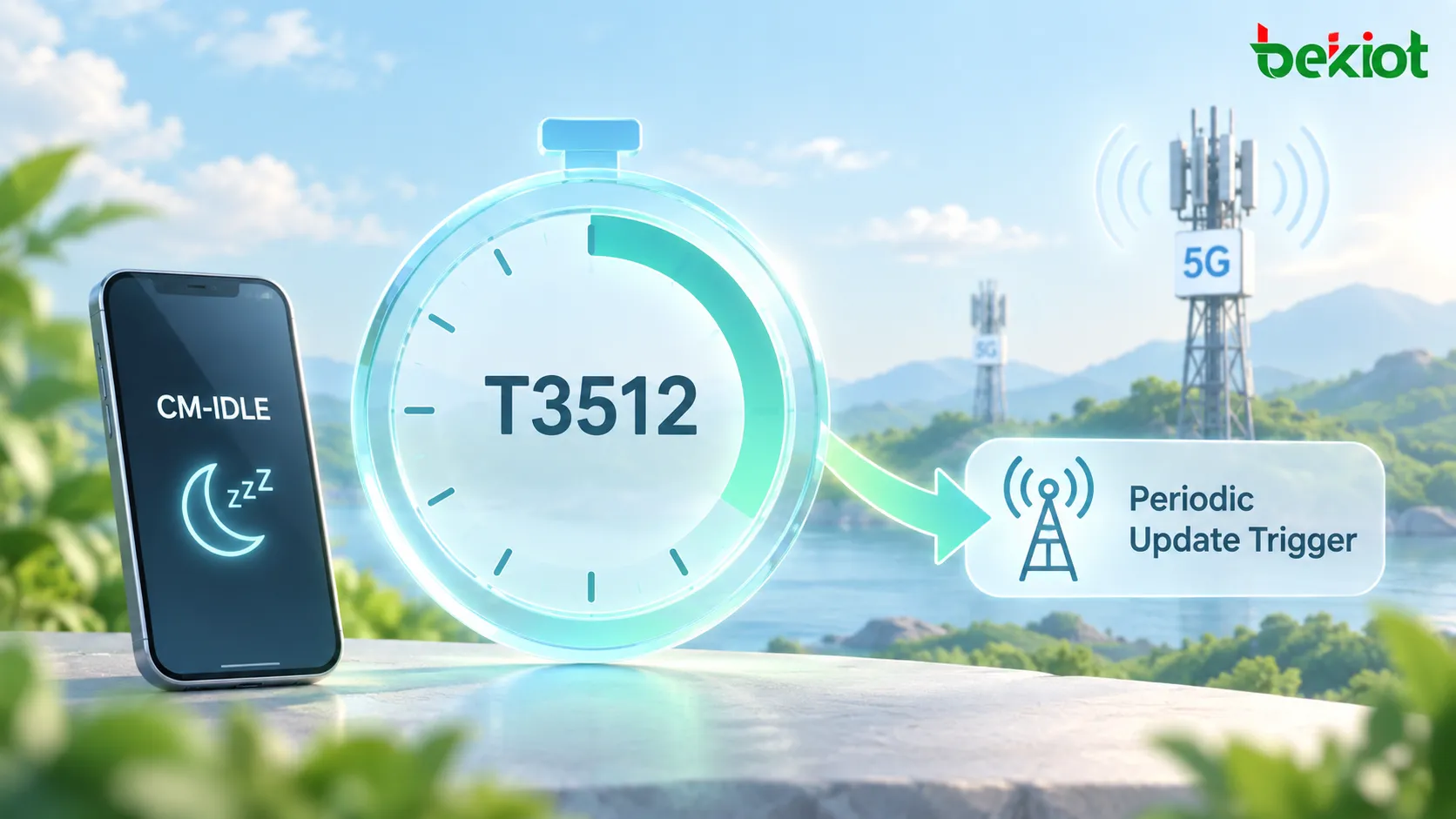
When Does T3512 Actually Start Running?
T3512 is not simply a local timer chosen by the UE. Its value is controlled by the network, and the AMF can provide the periodic registration timer value to the UE in the Registration Accept message. Unless the UE later receives a new value, it continues using the stored T3512 configuration.
The 3GPP-defined default value of T3512 is 54 minutes, but this does not mean every commercial 5G network causes every UE to perform an update every 54 minutes. The AMF can assign a different value according to network configuration, UE behavior, subscription information and policy. If the network deactivates T3512 or sets it to zero, the corresponding Periodic Registration Update is not performed.
In a common 3GPP access scenario, if the network is not using the strictly periodic registration timer capability, the UE starts or restarts T3512 when it moves from 5GMM-CONNECTED to 5GMM-IDLE. When the UE returns to 5GMM-CONNECTED, the timer normally stops. This is important because Periodic Registration Update is not simply generated according to an absolute clock regardless of UE activity.
Suppose a UE completes registration at 09:00, then releases the NAS signaling connection and enters CM-IDLE with T3512 configured to 54 minutes. If no other interaction occurs that stops, restarts or changes the timer, the UE is expected to enter the periodic registration update procedure when the timer expires.
Newer specification behavior can also support a strictly periodic registration timer. In this mode, T3512 may start after successful completion of registration and is not simply stopped because the UE enters 5GMM-CONNECTED. If the timer expires while the UE is in the connected state, the timer may be restarted, while the actual Periodic Registration Update is still handled according to the current 5GMM state.
Therefore, seeing "T3512 = 54 minutes" in a Registration Accept does not automatically mean that a Registration Request must appear exactly 54 minutes later. Trace analysis should also consider whether the UE entered CONNECTED state during that period, whether another registration occurred, whether strict periodic operation is enabled, and whether the timer was updated or disabled.
How Is a Periodic Registration Request Different from Initial Registration?
When T3512 expires, the UE needs to re-establish control-plane communication with the network. After the NAS signaling path is restored through the gNB, the gNB sends an NGAP Initial UE Message to the AMF carrying the UE's current location information and the NAS Registration Request.
The most important information element for signaling analysis is the 5GS registration type in the Registration Request. In this procedure, it is set to periodic registration updating, explicitly telling the AMF that the UE is not attaching to the 5GS for the first time and is not updating registration because it left its Registration Area. It is refreshing an existing registration periodically.
The UE normally also carries its existing 5G-GUTI so the AMF can quickly associate the request with an existing UE context. The message may also include information such as Last Visited Registered TAI, UE Security Capability and PDU Session Status to help the network reconcile the mobility and session state currently held by the UE.
Three Registration Request scenarios that are easily confused can therefore be distinguished directly from the beginning of a trace:
Initial Registration: the UE needs to establish a new 5GS registration relationship
Mobility Registration Update: the UE's mobility location or Registration Area conditions have changed
Periodic Registration Update: the existing registration relationship needs to be refreshed periodically
All three procedures use a Registration Request, but their triggers are fundamentally different. When analyzing 5GC registration signaling, seeing the message name "Registration Request" is not enough to identify the procedure. The 5GS registration type is the first element that should be checked.
Why Can the Update Be So Short When the Serving AMF Does Not Change?
One of the most important characteristics of Periodic Registration Update is not how many new signaling messages it introduces, but how much shorter it can be than Initial Registration when the existing context is still valid.
Assume the UE remains within the service area of the same AMF, there has been no AMF change, the previously established UE Context and security context are still usable, and there is no subscription or policy change requiring additional processing. When the AMF receives the Registration Request carrying the existing 5G-GUTI, it can use the GUAMI information associated with that identity to determine that the UE is still served locally and retrieve the corresponding UE Context.
Under these conditions, many procedures that commonly appear during a full Initial Registration do not necessarily need to be repeated.
If the identity and security state are still valid, a complete 5G-AKA procedure may not be required, so the AUSF may not appear in the trace. Because the Serving AMF has not changed, the AMF does not necessarily need to register itself again in the UDM or retrieve the complete subscription profile solely because a periodic update occurred. If the access area and policy have not changed, a new PCF AM Policy procedure may not be required either. If there is no need to select a new AUSF, UDM or PCF, the corresponding NRF discovery procedures may also be absent.
A typical simplified signaling path may therefore look like this:
UE
→ gNB: re-establish access
→ AMF: Initial UE Message + Periodic Registration Request
→ AMF: retrieve existing UE Context using the 5G-GUTI
→ gNB / UE: Registration Accept
→ UE: Registration Complete when required
The phrase "may not be required" is important. The 3GPP registration framework allows the network to perform whatever identity, security, subscription and policy processing is necessary for the current context. A simplified commercial trace should therefore not be interpreted as a fixed mandatory sequence for every Periodic Registration Update.
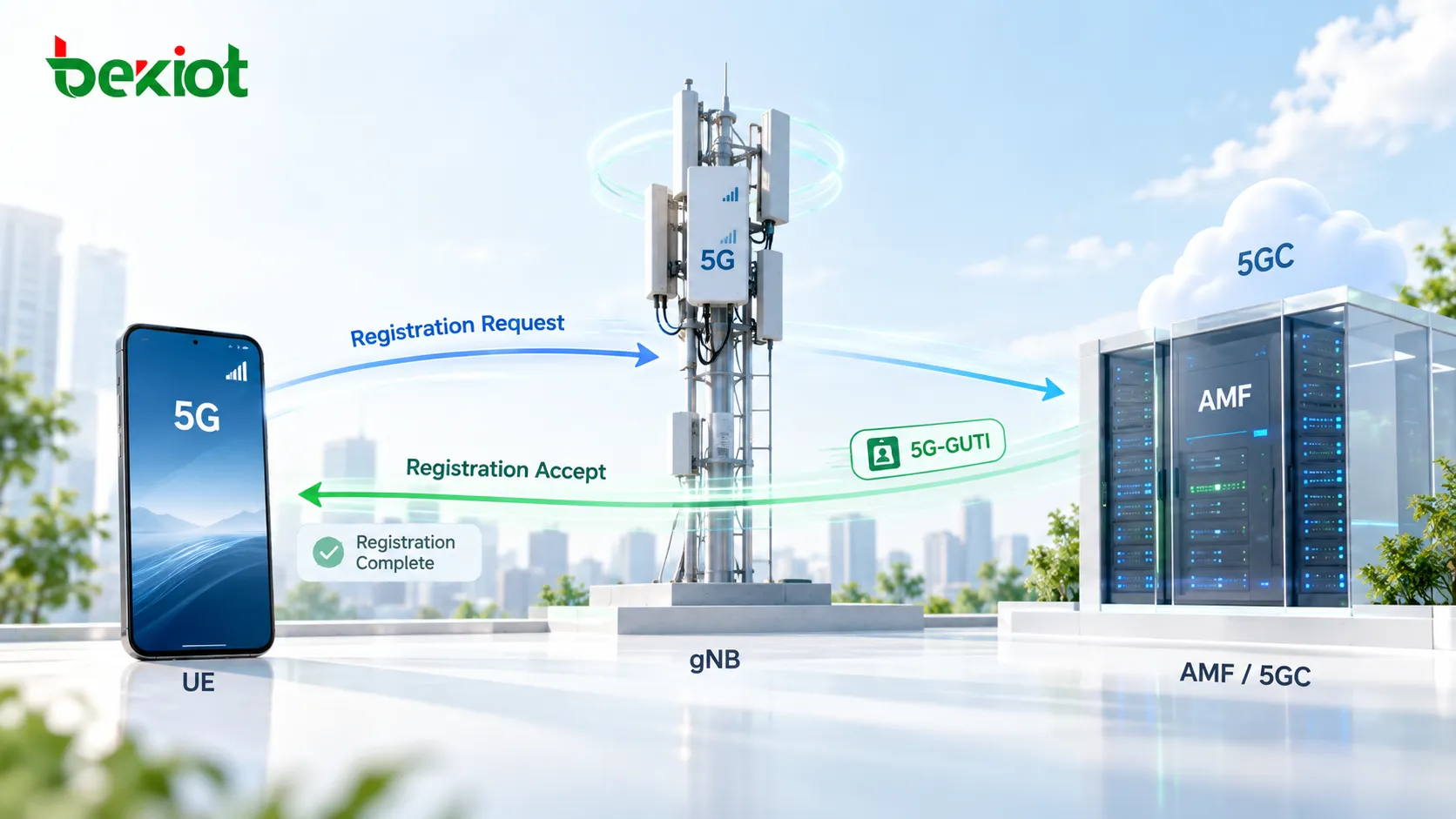
Which Registration States Can Registration Accept Refresh?
After the AMF confirms that the UE may remain registered, it returns the updated registration result to the UE through Registration Accept. Depending on the network outcome, the message can include parameters such as Allowed NSSAI, T3512, the TA List and, when required, a newly assigned 5G-GUTI.
T3512 is particularly important in a Periodic Registration Update. If the AMF provides a new value, the UE should use that value for the next periodic cycle. If no new value is provided, the UE may continue using the stored configuration. This allows the network to adjust periodic registration behavior over time instead of permanently fixing the interval inside the terminal.
The TA List in Registration Accept continues to define the UE's current Registration Area. Although the periodic update itself is not triggered by leaving that area, a successful registration interaction still allows the network to provide the UE with the latest mobility-management parameters.
If Registration Accept contains a newly assigned 5G-GUTI, the UE needs to confirm successful receipt of the temporary identity through Registration Complete. If the AMF does not assign a new 5G-GUTI, the absence of Registration Complete does not automatically indicate a failure. The trace should be interpreted according to which information elements in Registration Accept actually require confirmation.
This is also why Periodic Registration Update is more than a simple keepalive. It remains part of the 5GMM Registration framework, allowing the network to resynchronize registration-related mobility parameters rather than merely checking whether the UE can still respond.
How Can You Verify a Periodic Registration Update in a Signaling Trace?
When troubleshooting Periodic Registration Update, the most effective approach is not to start by looking for AUSF or UDM signaling. Instead, follow the chain T3512 → UE State → Registration Request → AMF Context → Registration Accept.
If the UE never initiates a periodic update after registration, first check whether the Registration Accept contained a valid T3512 value. If T3512 is deactivated or set to zero, no periodic update should be expected. If the value is valid, confirm whether the UE actually entered the applicable 5GMM-IDLE state and whether any NAS interaction occurred that could have stopped, restarted or updated the timer.
If the UE sends a Registration Request but the AMF treats it as Initial Registration, check the 5GS registration type and the 5G-GUTI. If the AMF cannot associate the 5G-GUTI with an existing UE Context, the procedure may enter a more complex identity-recovery or re-registration path.
If the Registration Request is correctly recognized but a complete authentication procedure appears afterward, this alone does not prove that anything is wrong. The existing NAS Security Context should be checked, along with whether the network has decided to perform Authentication again according to its security policy.
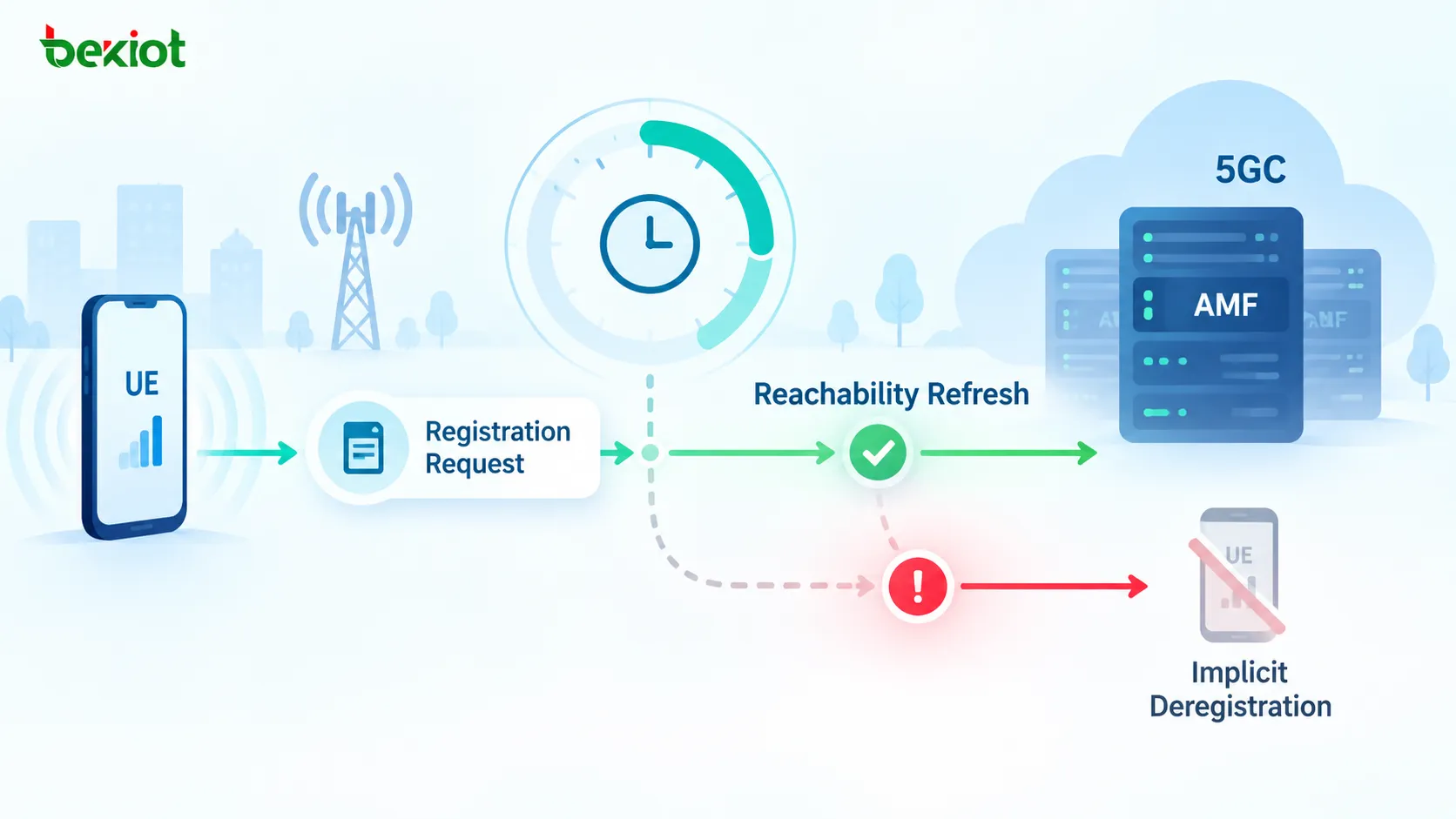
In addition to T3512 on the UE side, the AMF uses an important network-side reachability supervision mechanism: the Mobile Reachable Timer. For a normally registered UE, this network-side timer is longer than T3512, with the default relationship typically being T3512 plus four minutes. The AMF starts the Mobile Reachable Timer after releasing the NAS signaling connection and stops it when the UE re-establishes NAS connectivity.
The two mechanisms work together:
UE-side T3512: tells the UE when it should return to refresh registration
AMF-side Mobile Reachable Timer: supervises whether the UE reappears within the expected period
If the UE fails to contact the network for an extended period, the Mobile Reachable Timer and the subsequent implicit deregistration mechanism allow the core network to gradually handle a UE whose reachability can no longer be confirmed instead of retaining stale registration context indefinitely.
The real purpose of the 5GC Periodic Registration Update is therefore not to "register again every few dozen minutes." It allows a UE that remains idle for a long time and the AMF to periodically re-establish a shared view of the registration state: the UE is still present, the existing registration relationship is still valid, and the relevant mobility parameters can continue to be used for the next period.
FAQ
Is T3512 Fixed at 54 Minutes in Every 5G Network?
No. Fifty-four minutes is the 3GPP-defined default value, but the AMF can assign another value according to network configuration, UE behavior, subscription information and policy. Signaling analysis and troubleshooting should always use the T3512 value actually received by the UE rather than assuming it is always 54 minutes.
If the UE Has Normal Traffic During the 54-Minute Period, Will It Still Send a Periodic Registration Update at Exactly 54 Minutes?
Not necessarily. Under normal T3512 operation, entering 5GMM-CONNECTED affects the periodic timer, and the timer may restart when the UE later returns to IDLE. The next Registration Request therefore cannot be predicted simply by adding 54 minutes to the completion time of Initial Registration. The timing behavior is also different when a strictly periodic registration timer is enabled.
Does Every Periodic Registration Update Require AUSF, UDM and PCF?
No. If the Serving AMF remains unchanged, the existing UE Context and security context are valid, and no subscription or policy information needs to be refreshed, the procedure can remain very short. Whether AUSF, UDM, PCF or NRF are invoked depends on the UE Context and network implementation at that time. They should not be treated as mandatory participants in every Periodic Registration Update.
Does Periodic Registration Update Apply to Non-3GPP Access Such as Wi-Fi?
The T3512-based periodic registration update mechanism applies to a UE registered with the 5GS through 3GPP access. For non-3GPP access, the 5GS uses other relevant registration and deregistration management mechanisms, so the T3512 Periodic Registration Update behavior used for NR access should not be applied directly to Wi-Fi or other non-3GPP access scenarios.