
A call button at a building entrance, factory floor, parking area or emergency help point does not have to terminate at a dedicated intercom master station. With SIP, that field device can become part of the same IP communication environment used by desk phones, IP PBX platforms, operator consoles, paging systems and software clients.
A SIP intercom is an IP-based intercom endpoint that uses Session Initiation Protocol for call signaling. Depending on the device, it may provide two-way audio, video, one-touch calling, relay control, alarm inputs, paging and integration with access control or other operational systems. SIP handles the establishment and management of the session, while the actual voice or video media is normally transported separately over the IP network.
SIP intercom systems extend intercom communication into standard IP voice environments. The field terminal no longer has to operate as an isolated talkback device; calls can be routed to different users, departments or sites according to the communication workflow.
What Is SIP Intercom?
SIP stands for Session Initiation Protocol. Defined for IP-based multimedia session signaling, SIP is widely used by IP phones, PBX systems, softphones, gateways and other communication endpoints. In an intercom system, it provides a common signaling method for identifying endpoints, starting calls, receiving calls and terminating sessions.
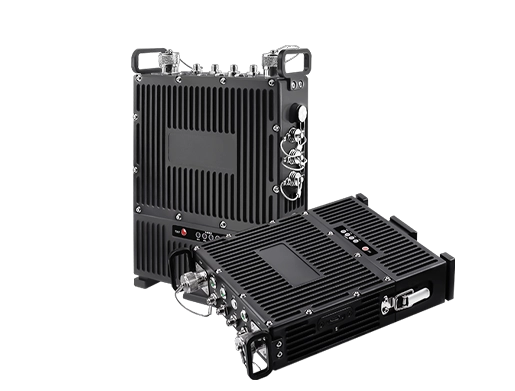
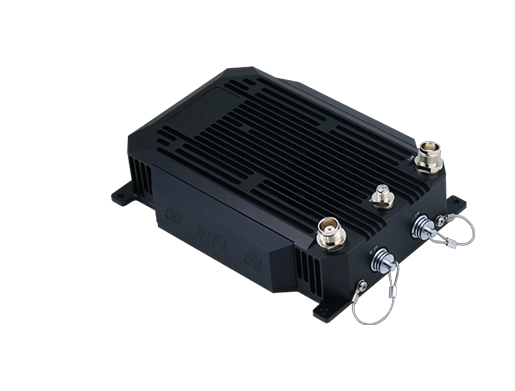
The physical device can take many forms. A door station may combine a call button, camera and door-release relay; an industrial station may use a rugged enclosure and high-output speaker; an emergency help point may have a large illuminated button; and an indoor intercom may use a display or handset. Their hardware and operating environments differ, but each can function as a SIP endpoint within the network.
Registration to an IP PBX or SIP server is common. After registration, the intercom can be assigned an extension and included in dial plans, ring groups, schedules or escalation rules. Registration is not mandatory in every architecture, however. Some devices also support direct SIP or peer-to-peer communication between endpoints.
The distinction between SIP and IP is worth noting. An intercom can use an IP network without necessarily using SIP. The term SIP intercom specifically describes an intercom that uses SIP as part of its communication and call-control method.
How SIP Intercom Works
A SIP intercom call normally involves three separate elements: signaling, real-time media and any control action associated with the call. Separating these functions makes the system easier to understand and also helps when diagnosing registration, one-way audio or integration problems.
Registration
When an IP PBX or SIP server is used, the intercom typically registers an extension or SIP account with the platform. The server then knows where the endpoint is located and can apply authentication, extension numbering, call routing and other communication policies.
Registration also allows the platform to route calls toward the intercom. An operator can therefore call a field station directly, subject to the device configuration and system permissions, rather than communication working only from the intercom toward the control room.
Call Setup
Pressing a button or triggering a configured event starts the signaling process. The intercom can send a SIP INVITE toward a desk phone, operator console, indoor station, softphone, call group or another destination defined by the PBX. The answering device responds through the SIP session, and the call is established when both sides accept the required communication parameters.
Routing can be more sophisticated than a fixed one-button-to-one-phone relationship. During working hours, for example, an entrance station could ring reception. After hours, the same station could be routed to security. An emergency point may first call a local duty room and then use another destination if nobody answers.
Media Transport
SIP establishes the session but does not normally carry the conversation itself. Once the call is connected, audio is generally transported using RTP. Where supported and required, SRTP can encrypt the real-time media. Audio codecs may include G.711, G.722, Opus or other codecs supported by both endpoints.
Video-capable intercoms can negotiate a video stream in addition to voice. Whether that video can be displayed depends on the camera, codec, SIP platform and answering endpoint. A SIP video intercom connected to an audio-only desk phone may still provide voice communication even though the phone cannot display its video.

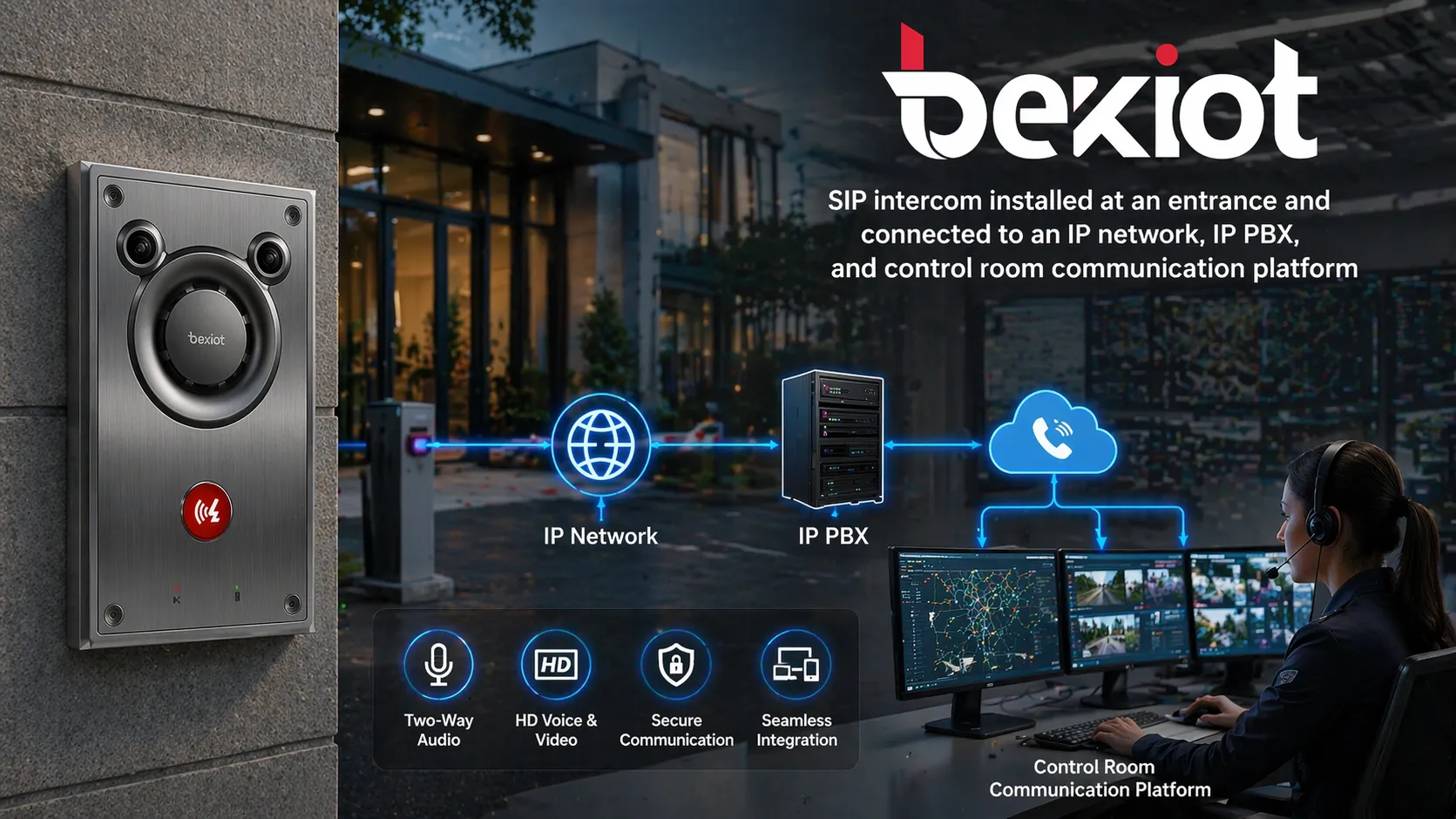
SIP intercoms register to a SIP platform and use standard call logic to establish two-way communication. A simplified path is:
SIP Intercom → IP Network → SIP Server / IP PBX → Phone / Console / Indoor Station / Software Client
Control Actions
Communication can be linked with physical control. At an entrance, the answering user may enter a DTMF command or use a software control to activate a relay connected to an electric lock. In another project, a digital input might initiate an emergency call when an external button or alarm contact changes state.
These actions are device- and platform-dependent. SIP compatibility alone does not guarantee identical relay, DTMF, API or access-control behavior, so interoperability should be verified when these functions are required.
Core Functions
SIP provides the communications framework, but the actual capabilities of an intercom depend on its hardware, firmware and intended environment. A simple help point and a multi-function video entrance station may both support SIP while serving very different operational requirements.
Two-Way Audio
Two-way voice remains the core function. Full-duplex communication allows both parties to speak naturally, while echo cancellation, automatic gain control and noise handling can improve intelligibility in difficult locations. Speaker power and microphone performance become especially important in factories, stations, tunnels, roadside areas and other noisy environments.
Video Intercom
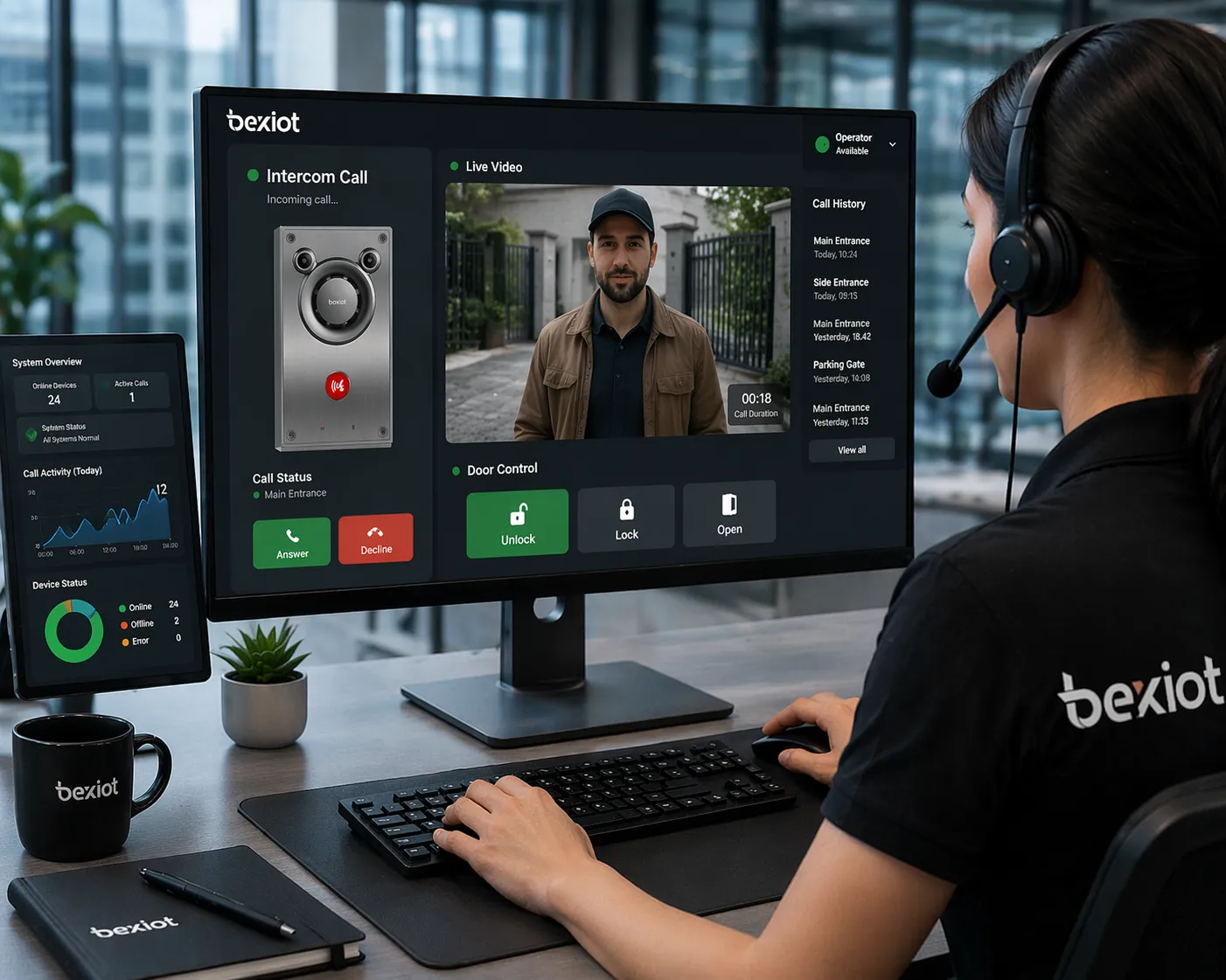
A built-in camera adds visual verification for entrances, gates, security checkpoints and public assistance points. Operators can identify a caller or assess the immediate situation before deciding what action to take. Camera resolution is only one consideration; field of view, low-light performance, video compatibility and the capabilities of the receiving endpoint also matter.
Call Routing
Once the intercom participates in a SIP call-control environment, calls can use PBX functions such as extension dialing, ring groups, hunt groups, forwarding, schedules and fallback destinations. This allows communication logic to change without rewiring the field endpoint.
Multi-site systems can use the same principle to route an intercom call from a remote facility to a centralized duty center. Local and remote destinations can also be combined when the network and PBX architecture support the required routing.
Access Control
Many SIP intercoms include relay outputs, digital inputs or interfaces for doors, gates and alarm contacts. Communication and access decisions can therefore be connected: the operator speaks with the caller, verifies the situation and then performs an authorized action from the answering device or management platform.
Paging Integration
In campus, industrial and public-service projects, intercom functions may coexist with SIP paging or emergency broadcasting. Compatible terminals can receive pages, participate in paging groups or work with SIP speakers and paging gateways. Some systems also use multicast for one-to-many audio distribution without creating an individual SIP call to every speaker.
Remote Management
Network-based intercoms commonly provide browser-based configuration for SIP accounts, network parameters, call destinations, audio settings and device maintenance. Large deployments benefit from centralized provisioning, configuration backup and firmware management because servicing hundreds of endpoints individually can otherwise become a major operational burden.
System Architecture
A SIP intercom system is more than the terminal mounted on a wall. Reliable operation depends on several layers working together, and separating those layers is useful both during system design and troubleshooting.
Field Layer
The field layer contains door stations, wall intercoms, emergency help points, industrial call stations and other devices used by visitors, employees or the public. Product selection at this layer should reflect the actual environment: indoor, outdoor, vandal-prone, high-noise, industrial or exposed to dust and water.
Network Layer
Ethernet switches and the IP network transport SIP signaling and media. PoE can simplify field installation where the intercom supports it by carrying power and data over one network cable. Larger deployments may also use VLANs to separate communication or security devices from ordinary data traffic, while QoS can help prioritize real-time audio where network congestion is a concern.
Control Layer
An IP PBX, SIP proxy or communication server manages endpoint registration and call routing. This layer can contain extension plans, authentication rules, call groups, time-based routing, failover logic and other policies that determine how each intercom call is handled.
Operator Layer
Calls do not have to terminate at a dedicated intercom master station. Depending on the system, an operator may answer on a SIP phone, indoor station, dispatch console, softphone or software platform. A control room can therefore incorporate intercom calls into a broader operational communication workflow.
Integration Layer
Access control, CCTV, recording, alarms, paging, dispatch software and building-management applications may sit around the communication system. Integration methods vary: some use physical I/O, some use SIP functions, and others rely on APIs or middleware. The required interfaces should be defined during system design rather than added as an assumption after equipment has already been selected.
A layered architecture also makes fault isolation more precise. If a call fails, engineers can check endpoint registration, IP connectivity and routing separately. If a call connects but audio is missing, attention can shift toward RTP paths, VLANs, NAT, firewall rules or codec negotiation instead of treating the entire intercom as a single black box.
SIP vs Traditional Intercom
Traditional analog or proprietary intercom systems can still provide reliable local communication, particularly where the installation is small and unlikely to change. The difference becomes more significant when a project requires integration with PBX services, flexible answering points, software management or communication across multiple locations.
| Item | SIP Intercom | Traditional Intercom |
|---|---|---|
| Network | Ethernet and IP networks | Dedicated or proprietary cabling is common |
| Call Control | IP PBX, SIP server or direct SIP | Dedicated controller or master station |
| Answering Devices | SIP phones, consoles, indoor stations and software clients | Usually dedicated system stations |
| Routing | Groups, schedules, forwarding and multi-site routing | Usually based on fixed device relationships |
| Integration | PBX, paging, access control, recording and software platforms | Often depends on vendor-specific interfaces |
| Expansion | Additional endpoints can use the IP infrastructure | Expansion may require additional dedicated hardware or wiring |
SIP should not be interpreted as universal plug-and-play compatibility. Two devices can both support SIP and still differ in authentication, codecs, DTMF handling, video implementation, provisioning, TLS support or manufacturer-specific functions. For projects that depend on advanced features, actual interoperability testing remains important.
Applications and Selection
The same SIP architecture can support very different applications. What changes from one project to another is the required terminal design, response workflow and integration depth.
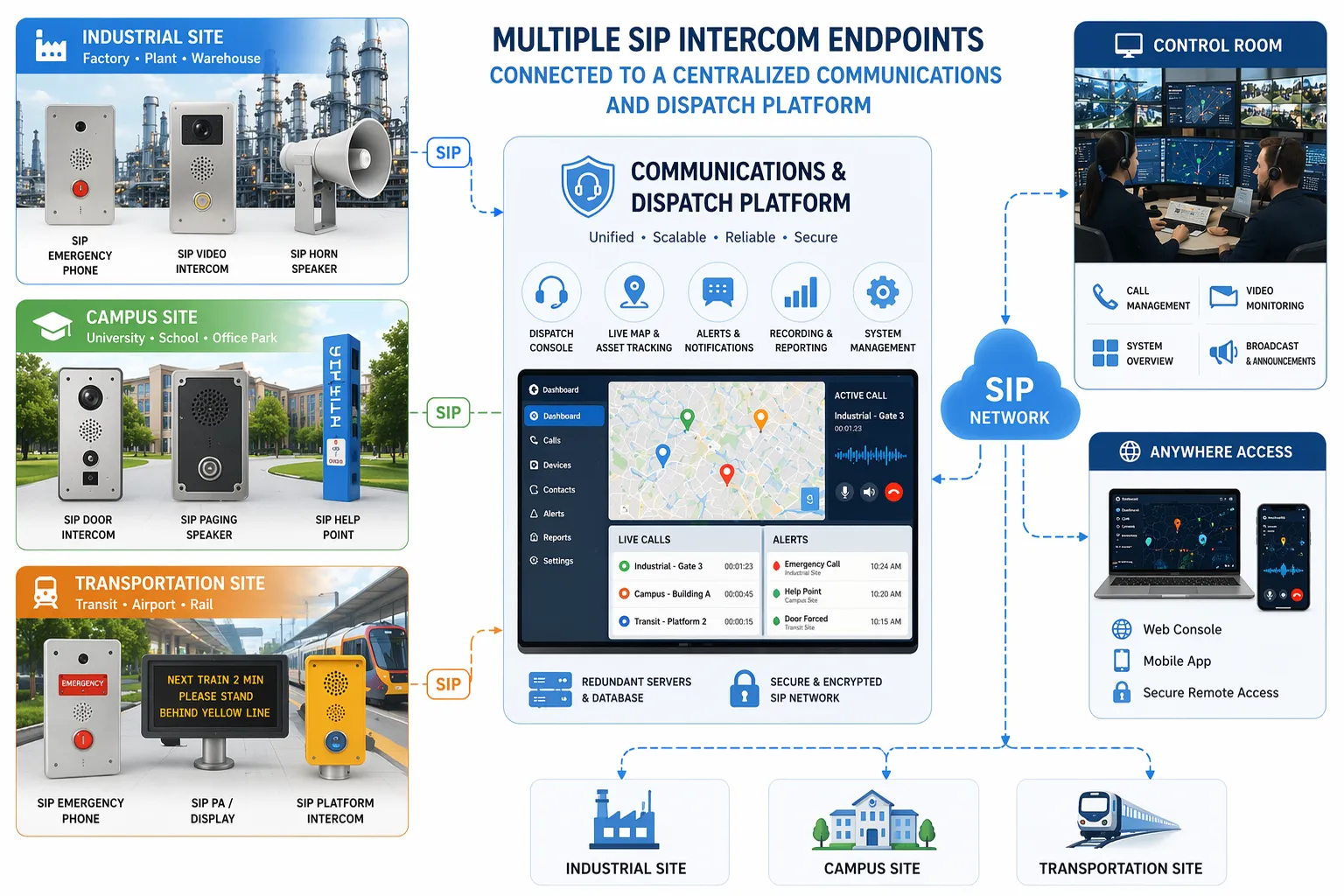
Building Entrances
At offices, residential entrances, gates and reception areas, a visitor can press a call button and reach reception, security or another authorized user. Video models support visual verification, while relay integration can provide remote door or gate release after communication.
Industrial Sites
Factories, warehouses, utility facilities, tunnels and other operational locations often need field communication with a central control room. SIP allows the intercom to use the site's IP communications infrastructure while specialized hardware addresses environmental requirements such as dust, moisture, impact or high ambient noise.
Help Points
Passenger terminals, campuses, parking facilities and public spaces can use SIP intercoms as emergency or assistance points. Each endpoint can have its own extension or identity so the receiving system knows which location initiated the call. Routing rules can then direct the request to the appropriate service or security team.
Healthcare
Hospitals and care facilities may use intercom endpoints at entrances, restricted rooms, assistance points and service locations. Here the design may prioritize hands-free operation, simple user interaction and reliable routing to the appropriate staff rather than conventional visitor-door functionality.
Public Safety
Emergency call stations and fixed help points can link field users with duty desks or dispatch environments. Where required, calls can be combined with location identification, recording, video or alarm workflows so that operators receive more context than an ordinary telephone call provides.
Product selection should begin with this workflow. The question is not simply whether a device supports SIP, but what must happen before, during and after a call.
Compatibility
Confirm the intended SIP server or IP PBX, registration method, supported transport, audio codecs, DTMF method and required call features. For video applications, verify video codec and receiving-end compatibility as well.
Environment
Indoor offices, outdoor gates and industrial areas require different hardware. Relevant factors may include IP protection rating, impact resistance, operating temperature, enclosure construction, mounting method and corrosion resistance. Publicly accessible devices may also require vandal-resistant construction.
Audio Design
Speaker output, microphone pickup, echo cancellation and noise performance should match the installation environment. In a quiet lobby, modest acoustic performance may be sufficient; a factory floor or transport platform can require substantially stronger audio design.
Network Design
Review Ethernet connectivity, PoE requirements, IP addressing, VLANs, QoS and remote-management methods. Where endpoints communicate across WAN links or the public internet, firewall, NAT and routing behavior must also be considered because a successful SIP registration does not automatically guarantee a correct RTP media path.
Security
A SIP intercom should be managed as a network endpoint rather than treated as an isolated appliance. Strong credentials, controlled administrative access, HTTPS, network segmentation and firmware maintenance are basic considerations. Where supported and required by the system design, SIP over TLS can protect signaling and SRTP can protect media.
System Integration
Define door relays, digital inputs, access-control links, paging, CCTV, recording, API requirements and alarm interaction before final product selection. This avoids discovering during commissioning that a device supports SIP calling but lacks one interface that is essential to the actual workflow.
FAQ
Does a SIP intercom need an IP PBX?
Not necessarily. An IP PBX or SIP server is useful for centralized registration, routing, groups, schedules and multi-site management, but some SIP intercoms can also communicate directly with another compatible SIP endpoint in peer-to-peer deployments.
Does SIP carry the voice?
SIP primarily handles signaling and session control. After a call is established, real-time audio is normally transported using RTP, while SRTP may be used where encrypted media is supported and configured.
Can it call phones?
Yes. A SIP intercom can generally call compatible SIP desk phones, indoor stations, operator consoles and software clients through the configured SIP environment. The exact features available during the call depend on both endpoints and the call-control platform.
Can it open doors?
Many entrance-oriented SIP intercoms provide relay outputs or access-control integration for remote door and gate release. Control may use DTMF, a software interface, API commands or another mechanism supported by the selected system.
Does every SIP intercom support video?
No. SIP intercoms may be audio-only or audio-video. Industrial and emergency applications often use audio-only devices where clear, reliable voice is more important, while entrances and security checkpoints may benefit from integrated cameras.
Can it support paging?
Some models can receive SIP paging calls, participate in paging groups or use multicast audio. Paging should be checked as a separate product capability because SIP support by itself does not guarantee multicast or paging functionality.
What should be tested before deployment?
Commissioning should cover registration, incoming and outgoing calls, two-way audio, video where applicable, DTMF or relay control, routing and failover, network recovery and any required integration with access control, paging, recording, CCTV or dispatch systems. Testing the complete workflow is more useful than confirming SIP registration alone.