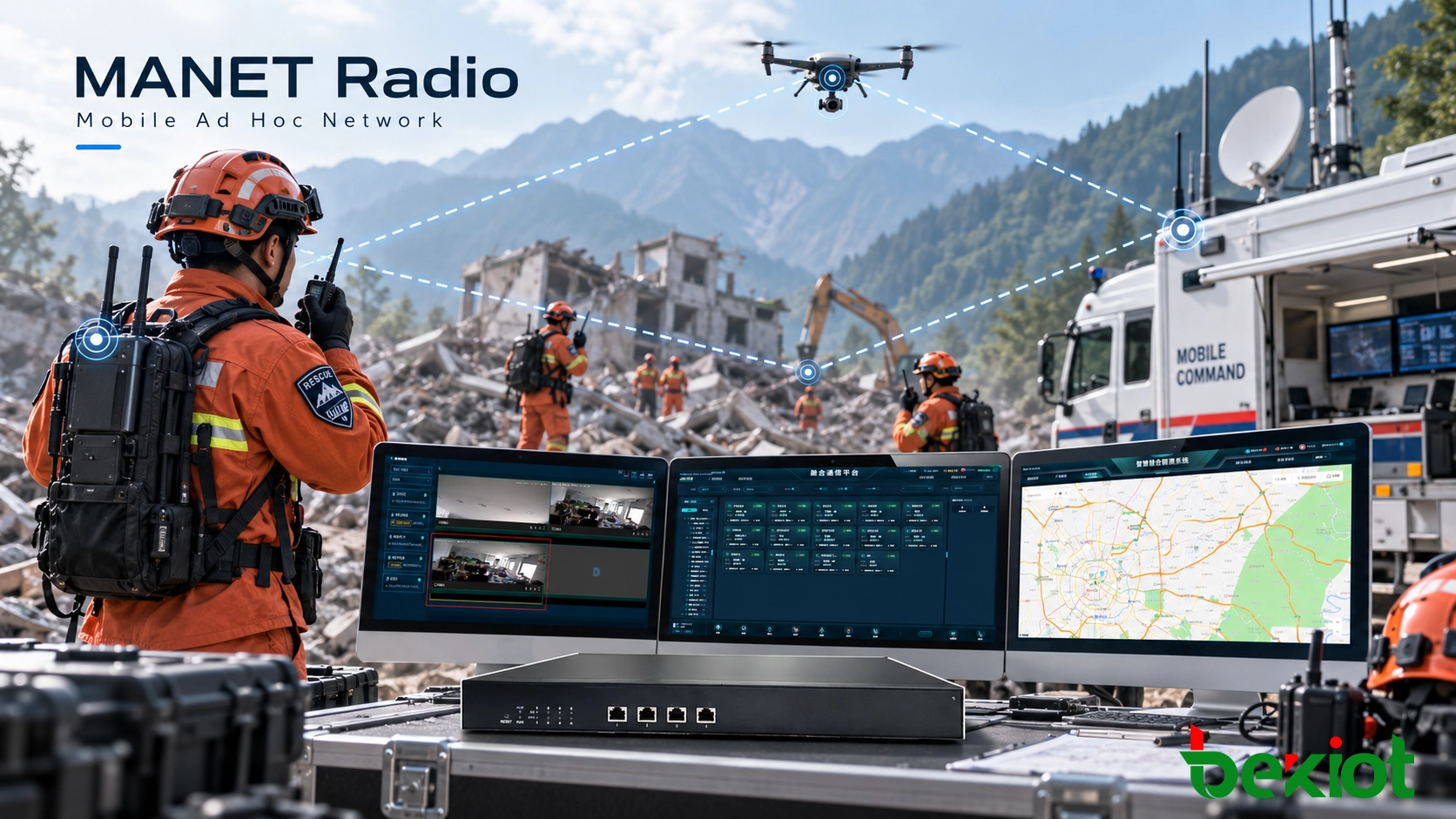
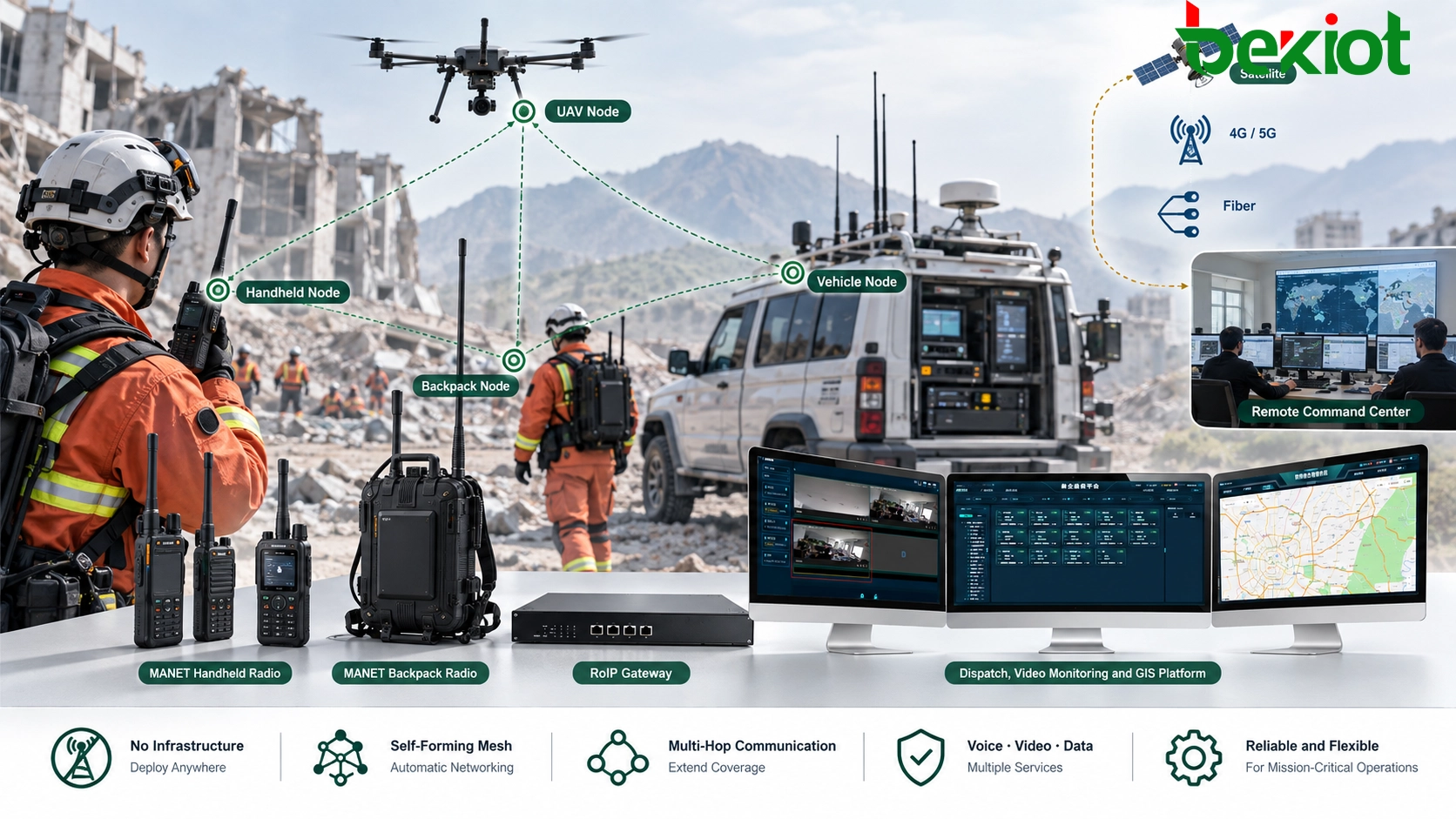
A rescue team moves into an area with no cellular coverage. Several responders carry handheld radios, a vehicle remains near the temporary command post, and an unmanned aircraft circles above the site transmitting live video. There is no cellular base station or fixed wireless controller between them, yet voice, location information and video can still move across the team as their positions change.
Related Products & Solutions: MANET Radio Systems
This is the type of problem a MANET radio is designed to solve.
MANET stands for Mobile Ad Hoc Network. Instead of requiring every device to communicate through a fixed base station, MANET radios can discover nearby nodes, establish wireless links and forward traffic for one another. A radio therefore serves two roles at the same time: it is an endpoint used by its own operator, and, when needed, it can also become part of the network path carrying traffic for other users.
That second role is what separates MANET from ordinary point-to-point radio communication. If Radio A cannot directly reach Radio D, the network may still deliver the traffic through Radio B and Radio C. As personnel, vehicles or airborne nodes move, those paths can be recalculated according to the links that remain available.
MANET Radio Network Architecture
Traditional radio, infrastructure-based wireless networks and MANET all use radio frequency links, but their network structures are fundamentally different.
In a conventional direct radio system, two users communicate when their radios are within usable RF range:
Radio A → Radio B
If terrain, distance or obstruction prevents the two radios from hearing each other, the direct path is lost unless a repeater or other infrastructure has been installed.
An infrastructure network works differently. Cellular and many conventional wireless systems are built around fixed network elements:
Device → Base Station → Network Infrastructure → Device
The terminal does not normally forward traffic for another terminal. Communication depends on access to the infrastructure.
A MANET distributes more of that network function among the radios themselves:
Node A → Node B → Node C → Node D
Node B and Node C are not necessarily dedicated repeaters. They may be handheld, vehicle-mounted, backpack or airborne radios being used for their own communications while simultaneously relaying packets for other nodes.
| Network Type | Traffic Path | Infrastructure Dependency |
|---|---|---|
| Direct Radio | Radio-to-radio | Low, but normally limited to direct RF reach |
| Infrastructure Network | Terminal through base station or access point | Depends on fixed infrastructure |
| MANET | Direct or multi-hop through other nodes | Can form without a fixed central base station |
The phrase "infrastructure-independent" does not mean that a MANET can never use fixed nodes, command vehicles or gateways. A high-site relay, vehicle radio or fixed gateway may still improve coverage and connect the field network to other systems. The difference is that these devices do not have to be the single central point through which every local node communicates.
Self-Forming Mesh and Neighbor Discovery
A MANET becomes useful before any multi-hop route is created. The radios first need to determine which other nodes can actually be reached over the air.
When nodes become active, they exchange information that allows the network to build an awareness of nearby radios and available wireless links. The exact signaling depends on the MANET implementation, but the process commonly includes several functions.
Neighbor Discovery
Each node identifies radios that are currently reachable. A handheld radio moving with a responder may detect another handheld radio, a vehicle-mounted node and an airborne relay at the same time.
These relationships do not remain fixed. A radio that is a neighbor now may disappear from usable range several minutes later as people or vehicles move.
Link Evaluation
Discovering another radio does not automatically make it the best path. The MANET may evaluate characteristics such as signal quality, link availability, channel conditions and other routing metrics supported by the system.
A strong direct path may be preferred at one moment, while a different multi-hop path may become more suitable after one of the nodes moves behind a building or terrain obstruction.
Route Formation
Once enough topology information is available, traffic can be forwarded across one or more nodes.
Suppose Node A cannot hear Node D directly, while the following links remain usable:
A → B → C → D
A packet generated by Node A can first be transmitted to B. Node B forwards it to C, and C forwards it to D. From the application perspective, A and D are connected even though no direct RF link exists between them.
This leads to one of the most useful ways to describe a MANET radio:
A MANET radio is both a communications endpoint and, when required, part of the network infrastructure used to forward traffic for other nodes.
The ability to create these paths automatically is commonly described as self-forming. It reduces the need for personnel to manually configure a new repeater path every time the field topology changes.
Multi-Hop Routing and Dynamic Topology
The word "Mobile" in Mobile Ad Hoc Network matters because the topology is expected to change.
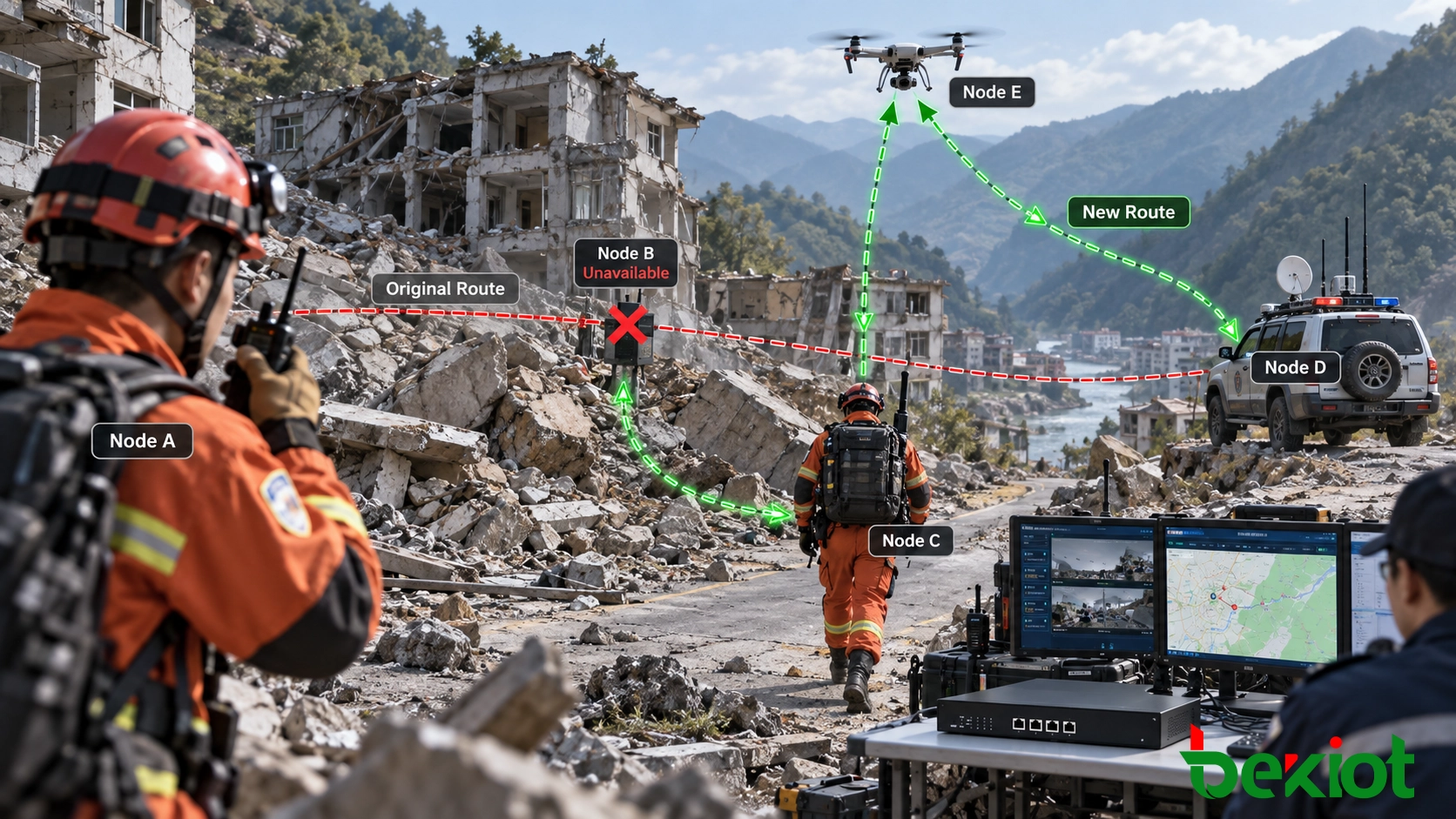
Consider an operating route that initially looks like this:
Node A → Node B → Node C → Node D
If Node B moves away and its links disappear, the original path can no longer carry traffic. If another node provides a usable alternative, the network may reorganize:
Node A → Node E → Node C → Node D
Depending on the MANET implementation, route handling may involve proactive, reactive, hybrid or proprietary routing methods. Some systems maintain topology information continuously, while others discover or update routes when communication is required. The specific algorithm varies, but the engineering objective is similar: traffic should follow a currently usable path as the wireless environment changes.
This behavior is often called self-healing, but the term needs to be interpreted carefully. Self-healing does not mean that a failed radio repairs itself, nor does it guarantee uninterrupted communications in every topology.
It means that when a node or link becomes unavailable, the network can select another route if an alternate RF path exists.
For example, if Node B fails but Nodes A and C can both reach Node E, routing can move through E. If Node B was the only node physically bridging two separated groups and no alternative path exists, the network may split into two disconnected segments. This condition is usually described as a network partition.
Node placement therefore still matters. MANET reduces dependence on fixed infrastructure, but it cannot bypass basic RF propagation. Terrain, buildings, distance and interference still determine whether enough links exist for routing to work.
Voice, Video and Data over a MANET
Modern MANET systems are not limited to carrying push-to-talk voice. Once the radios form an IP-capable mobile network, different types of applications can share the wireless transport.
A responder may transmit PTT voice and GPS position while another user sends images. A vehicle node may carry telemetry or connect a local IP camera. An airborne node may transmit real-time video toward a mobile command vehicle.
A video stream, for example, may follow a path such as:
Camera / MANET Radio → Field Node → Relay Node → Vehicle MANET Radio → Command Application
The challenge is that these applications do not have the same network requirements.
Voice usually consumes relatively little bandwidth but is highly sensitive to delay, jitter and packet loss. A conversation becomes difficult even when throughput looks sufficient if packets arrive too late or irregularly.
Live video requires considerably more bandwidth and may adapt its bitrate according to available network capacity. As the number of hops increases or RF conditions worsen, maintaining high-resolution video can become more difficult.
GPS position, messaging and telemetry usually consume much less bandwidth, but these services may need frequent and reliable updates so that a command application maintains an accurate operational picture.
MANET design therefore involves more than maximizing peak throughput. A practical network needs to consider:
Latency for real-time voice and command traffic;
Jitter and packet loss across changing RF links;
Available bandwidth for live video;
QoS treatment for different traffic classes;
Link stability as nodes move through the operating area.
A network that can demonstrate high throughput between two stationary radios in an open field may behave very differently when ten or twenty moving nodes begin forwarding voice, telemetry and several video streams at the same time.
MANET Range, Hop Count and Network Capacity
"What is the range of a MANET radio?" sounds like a simple question, but a single range figure rarely describes how a MANET actually performs.
There are two separate concepts: single-hop RF range and end-to-end network reach.
Single-hop range describes how far two nodes can communicate directly under a particular set of conditions. It is influenced by frequency, transmit power, antenna gain, antenna height, terrain, buildings, vegetation, interference and receiver performance.
A direct link may look like:
Node A → Node B
A MANET can extend communication beyond that individual link by introducing intermediate nodes:
Node A → Node B → Node C → Node D
Node A may therefore exchange traffic with Node D even when the two are far outside direct radio range of each other.
This does not mean that every additional hop provides free network coverage. Multi-hop forwarding has a cost.
Intermediate nodes need airtime to receive and retransmit traffic. Depending on radio architecture, channel plan and network implementation, increasing the number of hops can increase end-to-end latency and reduce the capacity available to individual data flows. A busy relay near the center of the topology may also carry traffic for many users at once.
More hops can therefore introduce:
Additional latency;
Greater shared-airtime consumption;
Reduced effective throughput on some routes;
More route changes as intermediate nodes move;
Greater exposure to interference and weak RF links.
The advantage of MANET is therefore not "unlimited radio range." Its value is the ability to use distributed nodes to extend network reach into areas where a single direct RF link would not be possible.
Node density matters for the same reason. Too few nodes spread across a large operating area may leave gaps with no alternate path. Adding useful relay positions can improve connectivity, but simply adding radios without considering RF conditions and traffic load does not automatically improve network capacity.
Deployment Parameters and Backhaul Integration
MANET performance depends heavily on how the network is deployed. The routing algorithm cannot compensate for every poor RF or system-design decision.
Frequency and Channel Bandwidth
Frequency affects propagation, antenna characteristics and the way signals interact with buildings, terrain and vegetation. Channel bandwidth influences available data capacity and may also affect how the network performs in congested or interference-heavy spectrum.
A deployment optimized for long-range voice and position reporting may therefore use very different RF parameters from one designed to carry several high-bitrate video streams.
Node Density and Mobility
MANET needs enough usable wireless relationships to create alternative paths. If nodes are too widely separated, multi-hop routing has nothing to work with.
Mobility also affects route stability. A network of relatively slow-moving ground teams normally changes topology less aggressively than one combining fast vehicles, aircraft and handheld users moving through dense urban structures.
Antenna Placement
Antenna position can be as important as transmit power. A vehicle radio with a properly installed external antenna may provide a much stronger relay position than a handheld radio carried close to the body. An airborne node can sometimes create useful line-of-sight paths between ground teams separated by terrain or buildings.
For this reason, handheld, vehicle-mounted and airborne MANET radios are often complementary rather than interchangeable.
Field Network and Backhaul
MANET primarily addresses communications among nodes in the operating area. A command organization may also need to move information beyond that local network.
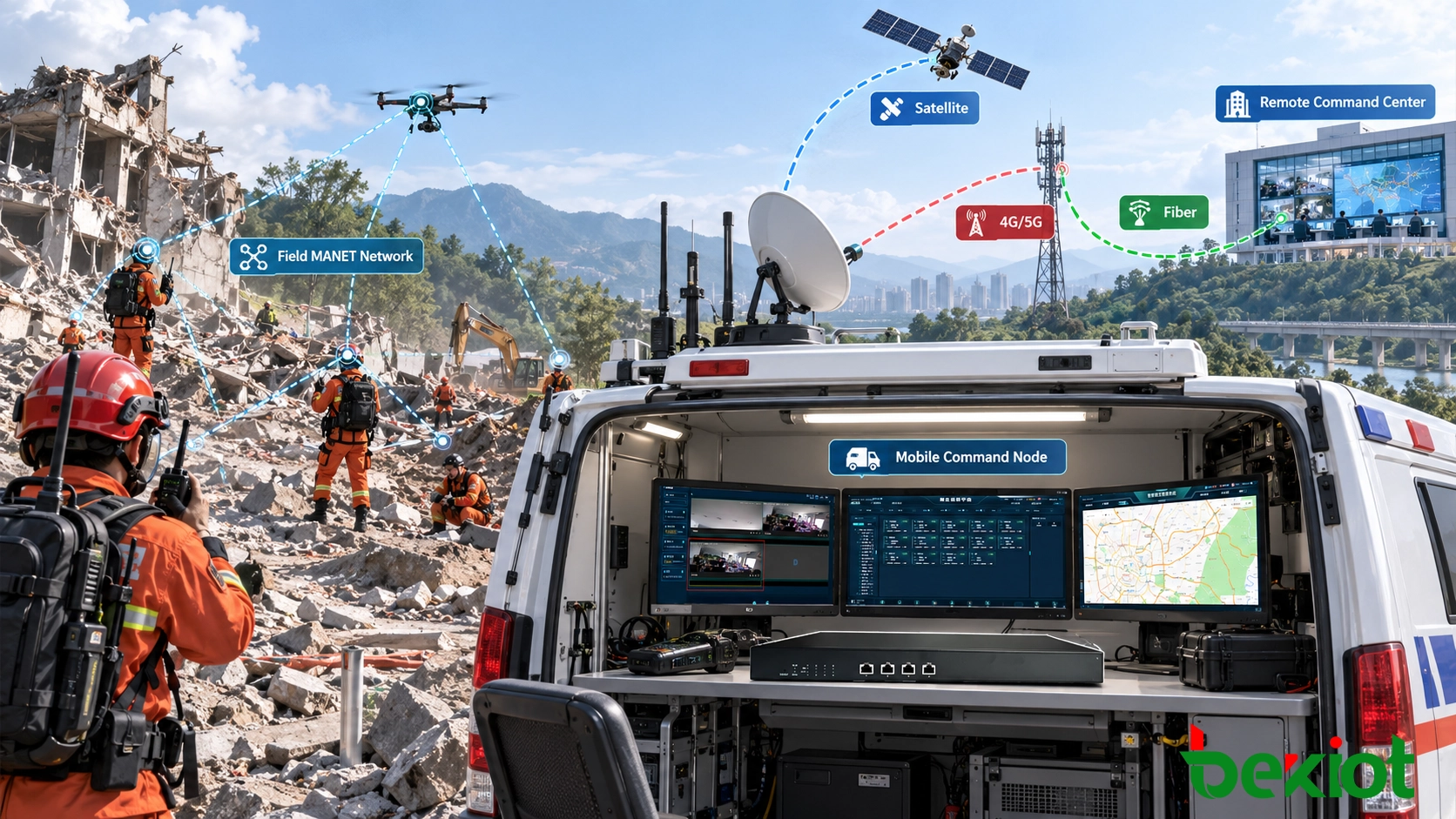
A typical architecture could be:
Handheld / Vehicle / UAV MANET Nodes → Mobile Command Node → 4G / 5G / Satellite / Fiber Backhaul → Remote Command Center
The MANET and the backhaul solve different problems. The MANET provides the local mobile mesh between field users. Cellular, satellite, microwave or fiber may provide the long-distance connection between that field network and a remote command center.
Keeping these two layers separate is important when evaluating resilience. A satellite backhaul failure does not necessarily mean local MANET users lose communication with one another. In the same way, a healthy satellite connection cannot compensate for a field MANET that has divided into isolated RF segments.
FAQ
Is a MANET Radio the Same as a Walkie-Talkie?
Not necessarily. A conventional walkie-talkie typically communicates directly with another radio or through fixed repeater infrastructure. A MANET radio can participate in an ad hoc data network in which nodes discover one another and may forward packets across multiple wireless hops. Depending on the system, that network can carry PTT voice as well as IP data, video, location and other services.
Does a MANET Radio Need a Base Station?
A MANET can form communications between participating nodes without requiring a conventional central base station. Fixed relays, vehicle nodes, high-site radios or gateways can still be added to improve coverage, capacity or connectivity to other networks, but they do not necessarily act as the single control point for every local communication path.
What Happens If One MANET Node Goes Offline?
If another usable path exists, the network can route traffic through different nodes. For example, a route that originally used A → B → C may change to A → D → C after Node B disappears. If the failed node was the only RF bridge between two parts of the network and no alternate path exists, the MANET can become partitioned until connectivity is restored.
Can MANET Radios Carry Live Video?
Yes, MANET systems with sufficient IP throughput can carry live video, but actual performance depends on RF conditions, channel bandwidth, modulation, interference, video bitrate, number of active users and the number of wireless hops in the route. Video traffic generally places much greater demand on network capacity than voice, messaging or position reporting.
What Is the Difference Between a Mesh Radio and a MANET Radio?
The terms are sometimes used together because both can involve multi-node wireless forwarding. MANET places particular emphasis on a mobile ad hoc topology in which network nodes can move and routes adapt as connectivity changes. "Mesh radio" is a broader description and may also refer to fixed or mostly static wireless mesh deployments.
What Is the Difference Between MANET and RoIP?
They solve different communication problems. MANET creates the wireless IP network between mobile nodes, while RoIP transports radio audio and control over an IP network. A RoIP Gateway can extend or integrate an existing radio channel through IP, but it does not by itself create the type of dynamic multi-hop mobile mesh associated with MANET.
Becke Telcom provides MANET radio, RoIP Gateway, radio dispatch, IP communication and unified communications solutions for mobile teams, command vehicles and field communication environments, with system integration options for voice, data, video and remote backhaul connectivity.