


A 5G device does not stay in constant active signaling with the core network forever. Most of the time, a UE moves between connected and idle behavior according to traffic demand, radio conditions, battery saving needs and network-side resource control. The challenge is simple but important: the network must know enough about the UE to reach it, but it should not waste radio resources, paging effort or AMF memory on a device that may no longer be reachable.
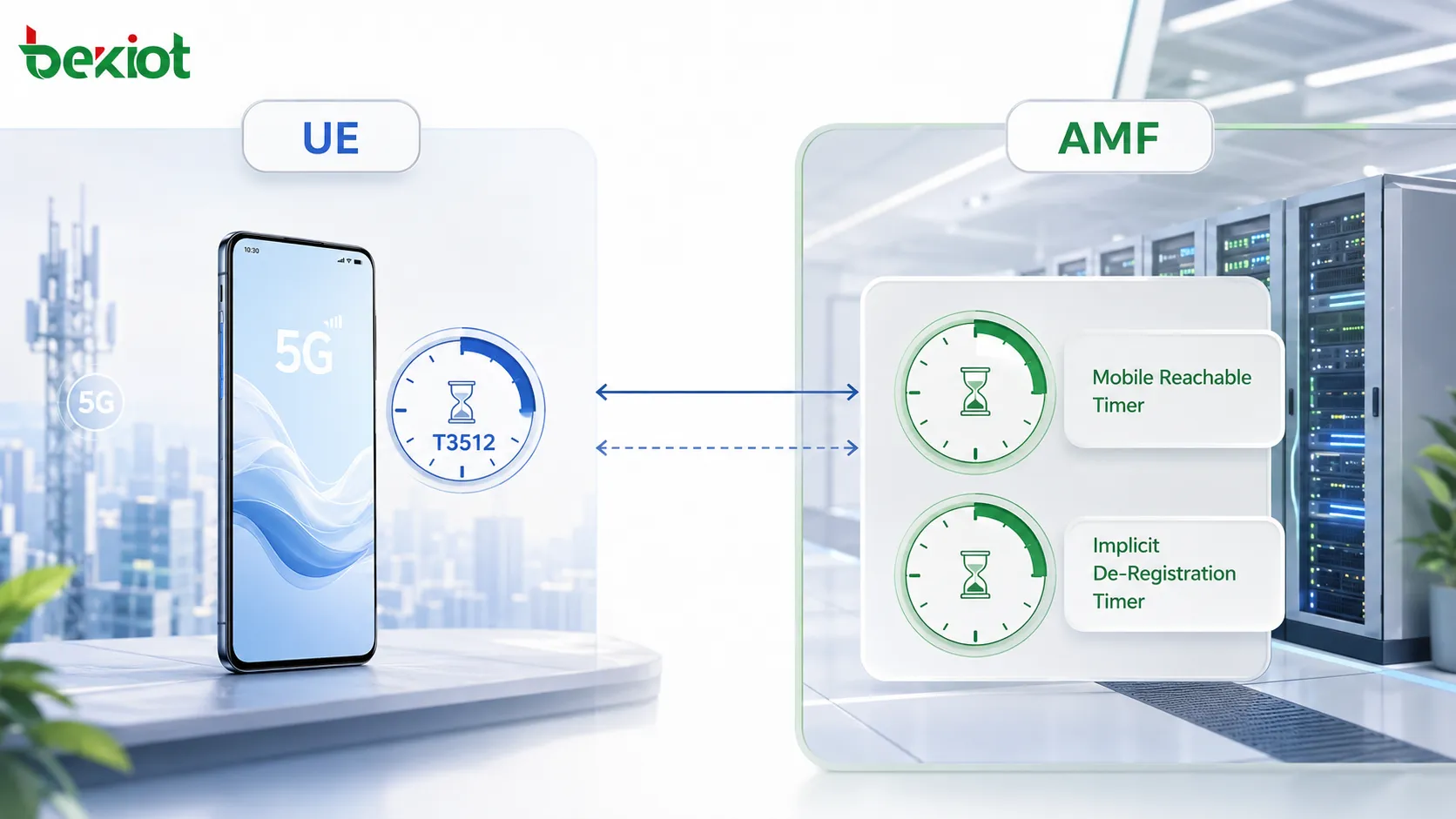
This is where mobility management timers become practical. In 5GC, several timers are used to control registration status, UE reachability and context retention. Three timers are especially important around the N1 interface: the Periodic Registration Update Timer (T3512), the Mobile Reachable Timer and the Implicit De-Registration Timer.
These timers do not perform the same job. T3512 mainly works from the UE side and drives periodic registration update behavior. The Mobile Reachable Timer and the Implicit De-Registration Timer are handled on the AMF side and influence how long the network continues paging a UE or keeping its context. Together, they create a staged process: first confirm whether the UE is still alive, then reduce paging when reachability becomes uncertain, and finally remove the context when the UE appears fully lost.
Why These Timers Matter
Mobility management in 5GC is not only about handover or cell movement. It also includes the way the network manages a UE after registration. Once a device is registered, the AMF holds context that helps identify the UE, control its mobility state and support later signaling. Keeping this information has value, but it also consumes resources.
If the network removes a UE context too early, the user experience may suffer. A UE returning from idle coverage would need to perform a full registration process again, even if it was only temporarily unreachable. If the network keeps context and paging behavior for too long, the AMF and radio access network may waste effort trying to reach a device that has disappeared, powered off unexpectedly or moved into poor coverage.
The three timers solve this by creating different levels of tolerance. T3512 gives the UE a regular check-in responsibility. The Mobile Reachable Timer gives the AMF a grace period after the UE becomes idle. The Implicit De-Registration Timer gives the network a final deadline before deleting UE context. This layered approach protects both network efficiency and user continuity.
T3512 Keeps UE Visible
T3512 is the Periodic Registration Update Timer on the UE side. Its commonly shown default value is 54 minutes. The timer is used while the UE is in the 5GMM-REGISTERED state. Its purpose is to prevent the network from losing track of the UE for too long when the device has no other signaling activity.
T3512 behavior depends on the connection management state. If the UE is in CM-IDLE when T3512 expires, the UE needs to initiate a periodic registration update procedure. This tells the network that the UE is still present and allows the AMF to refresh its understanding of the UE state.
If the UE is already in CM-CONNECTED when T3512 expires, the behavior is different. The UE does not need to start a new periodic registration update procedure simply because the timer expired. Instead, it restarts T3512. The logic is reasonable: when the UE is already connected, the network can already interact with it through an active signaling connection.
T3512 is assigned by the AMF. The UE receives it in the Registration Accept message during initial registration or mobility registration update. This makes T3512 visible in signaling, unlike AMF-local timers that are configured internally and not carried over the air in the same way.
| Timer | Main Side | Typical Trigger | Expiry Result |
|---|---|---|---|
| T3512 | UE | UE remains registered while time passes | Periodic registration update in CM-IDLE; restart in CM-CONNECTED |
| Mobile Reachable Timer | AMF | UE enters CM-IDLE | AMF stops paging the UE but keeps UE context |
| Implicit De-Registration Timer | AMF | Mobile Reachable Timer expires in idle mode | AMF starts implicit de-registration and deletes UE context |
AMF Timers Reduce Waste
The Mobile Reachable Timer is controlled by the AMF. A typical value is T3512 plus 4 minutes, although the actual value is an AMF-side configuration. It starts when the UE enters CM-IDLE. It normally stops when an N1 NAS signaling connection is established again, meaning the UE has returned to connected behavior.
This timer represents the period during which the network still considers the UE potentially reachable. While it is running, the AMF can still page the UE if downlink signaling or service activity requires it. When the timer expires, the AMF does not immediately delete the UE context. Instead, it stops paging the UE. This helps reduce air-interface overhead because repeated paging would be wasteful if the UE is probably unreachable.
The important detail is that context is still retained. By keeping the UE context after paging stops, the AMF allows the UE to return more quickly if it becomes reachable again. The UE does not necessarily need to perform a complete registration from zero just because paging was suspended.
The Implicit De-Registration Timer is also controlled by the AMF. It has no fixed default value in the same way T3512 does; a common reference value is around 60 minutes in practical comparison with earlier mobile-core behavior. It starts after the Mobile Reachable Timer expires while the network is in idle mode. It stops if an N1 NAS signaling connection is re-established.
When the Implicit De-Registration Timer expires, the AMF treats the UE as no longer worth retaining. It initiates implicit de-registration and removes the UE context. This releases AMF memory, license-related resources and other context storage. If the UE later returns to coverage, it must perform registration again because the network no longer has its previous UE context.
How The Timers Work Together
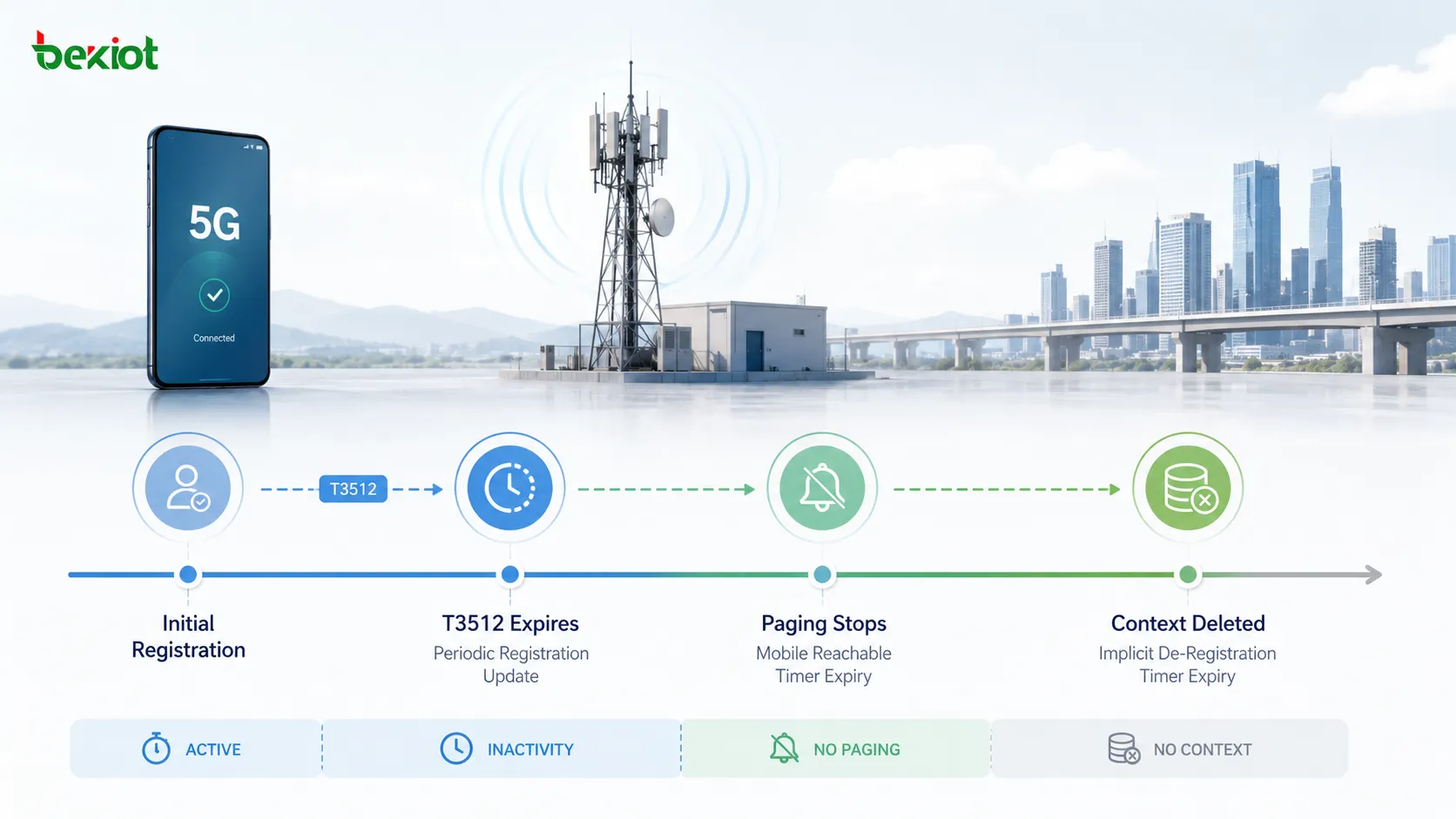
A realistic timeline makes the relationship easier to understand. Suppose a UE powers on at 7:00 AM and performs initial registration. The AMF accepts registration and provides T3512, for example 54 minutes. The UE enters registered and connected behavior. If the gNB later detects inactivity, the N2 connection can be released and the UE enters registered plus idle behavior. T3512 continues to run from the UE perspective.
When T3512 expires while the UE is idle, the UE should initiate a periodic registration update. If this succeeds, the UE returns to connected behavior for the procedure and the timer cycle can restart. After another inactivity period, the UE may go idle again.
Now consider a coverage problem. The UE goes deep into an underground area or another weak-signal environment. T3512 may expire again, but the UE cannot successfully perform periodic registration update because it cannot reach the network. From the AMF side, the Mobile Reachable Timer eventually expires. At that point, the AMF stops paging the UE but keeps the UE context.
If the UE still does not return before the Implicit De-Registration Timer expires, the AMF deletes the UE context through implicit de-registration. The staged behavior is important. The network does not immediately discard the UE after one missed update. It first reduces paging, then waits longer, then clears the context only when the UE appears completely unreachable.
For engineers, the key is to understand which timer is visible in signaling and which timer is not. T3512 is assigned to the UE through registration signaling. The Mobile Reachable Timer and the Implicit De-Registration Timer are AMF-local parameters, so they are not captured directly as transmitted values in the signaling flow. Their effects can be observed through network behavior, but the configuration itself belongs to the AMF.
FAQ
Why does the UE not always stay connected after registration?
Staying connected all the time would waste radio and core-network resources. Idle behavior allows the UE and network to reduce signaling while still maintaining registered status.
Can the Mobile Reachable Timer value be found in a packet capture?
No. It is an AMF-local configuration, so it is not carried as a normal network-transmitted timer value in the N1 signaling procedure.
What happens if the UE returns before implicit de-registration expires?
If the UE re-establishes N1 NAS signaling before the final timer expires, the AMF can stop the timer and continue using the retained UE context.
Why does the AMF stop paging before deleting context?
Stopping paging saves radio resources when the UE appears unreachable, while retaining context still allows faster recovery if the UE soon returns.
Does implicit de-registration mean the UE is permanently blocked?
No. It only means the old UE context has been removed. When the UE becomes reachable again, it can perform registration again and rebuild its network context.
The three mobility management timers form a practical control chain for 5GC registration behavior. T3512 keeps the UE responsible for periodic status updates. The Mobile Reachable Timer helps the AMF decide when paging is no longer efficient. The Implicit De-Registration Timer gives the network a final point to release the UE context. Together, they keep 5G mobility management balanced between reachability, signaling efficiency and resource protection.







