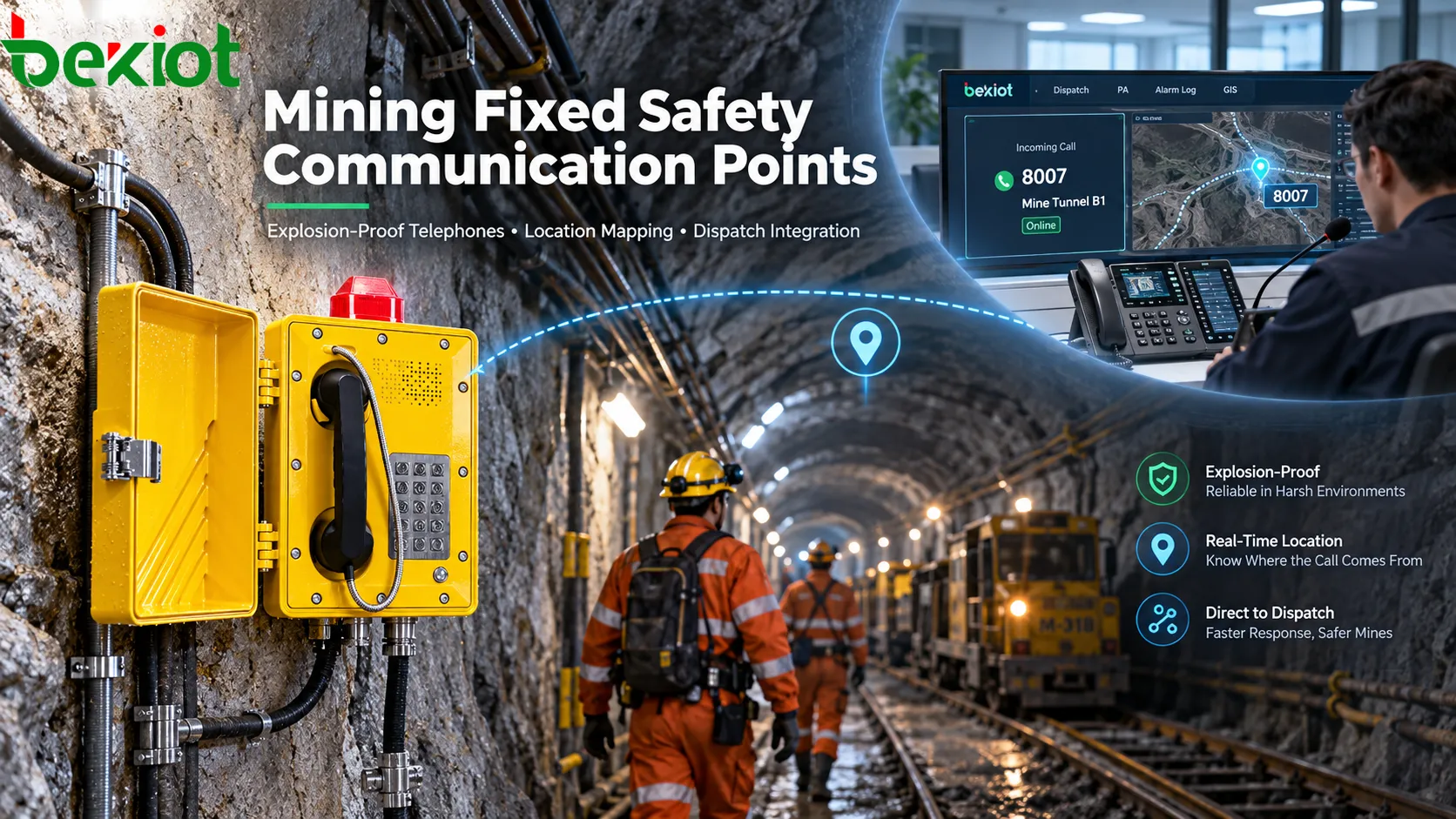
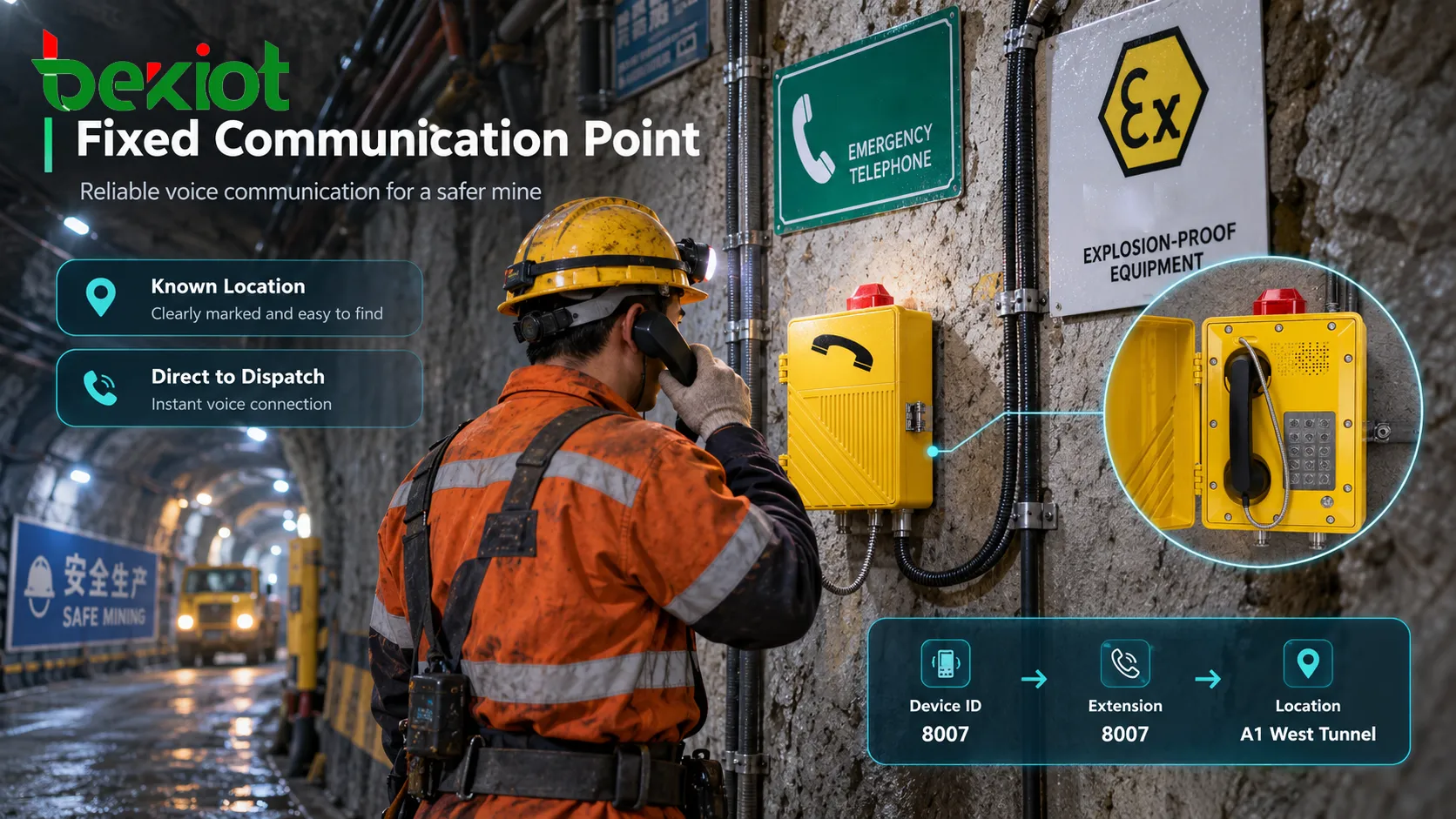
Mine communications face a fundamental challenge: when working faces advance, wireless coverage changes, local equipment fails, power is interrupted, or an accident occurs, can underground personnel still reach a clearly defined communication point and contact the surface dispatch center without delay? This is where a mining explosion-proof telephone serves a role beyond that of an ordinary fixed phone. It becomes a fixed safety communication point within the underground communications system: its location is known, the terminal remains permanently available at the site, its number can be tied to a specific area, and it can provide a voice path that complements mobile wireless communications.
For this reason, the safety value of a mining explosion-proof telephone should not be judged only by its explosion-protection rating, enclosure strength or ability to make a call. A more useful assessment is whether it can provide three forms of operational certainty: the communication point remains available as far as reasonably possible when abnormal conditions occur, the dispatch center can immediately identify where a call originates, and personnel can reach the correct control or emergency position without complicated dialing procedures.
What Communication Problems Must Underground Mines Actually Solve?
Underground mines present a very different communications environment from ordinary buildings. Tunnels are long and branching, working faces continually move, and rock formations, heavy machinery and metal structures can all affect communication conditions. Even where a mine has deployed a wireless communications network, coverage quality cannot be assumed to remain identical at every location and at all times. Wireless service also depends on base stations, antennas, transmission infrastructure, power and mobile terminals. A failure in any of these elements can reduce communications capability in part of the mine.
Another limitation is that wireless terminals move with personnel. A radio may not have been carried, its battery may be depleted, the device may be damaged, the channel may be busy, or an injured worker may be unable to operate it easily. These issues may not be obvious during normal production, but an emergency communications plan should not depend entirely on the assumption that every worker always has a fully functional wireless terminal.
Mine safety communications therefore need to answer a more basic question: when mobile communication becomes uncertain, are there still clearly identified fixed communication points underground that personnel know how to find and can use immediately? This is the main reason fixed mining telephones continue to have value.
Why Are Fixed Communication Points Still Needed Alongside Wireless Systems?
Fixed telephones and wireless communications should not be treated as competing technologies. Wireless systems are well suited to maintaining contact with personnel as they move through the mine, while fixed telephones provide something different: a known communication point that remains at a critical location. The two therefore serve different safety functions.
For example, a wireless terminal is more convenient for inspection teams moving through tunnels. At locations such as electrical chambers, pump rooms, haulage points, areas near working faces, refuge locations and permanently staffed posts, however, a fixed communication point offers a different advantage. It does not leave when one worker moves away, its location is not constantly changing, and users do not need to collect or carry a personal terminal before they can use it.
Fixed communications also provide something that mobile terminals cannot always offer with the same certainty: known location. When the surface dispatch center receives a call from a fixed telephone, the extension or terminal identity can be mapped to a specific underground location. The dispatcher should be able to see whether a call came from a particular level, tunnel, equipment chamber or operating area rather than first having to ask, "Where are you?"
The real value of a mining explosion-proof telephone is therefore the certainty it introduces: a known device location, a known number, a known destination and a consistent operating method. The more complex the emergency environment becomes, the more important that certainty can be.
How Can a Mining Telephone Become a Survivable, Location-Aware, Direct-to-Dispatch Communication Point?
Simply mounting an explosion-proof telephone on an underground wall does not automatically make it a safety communication point. To perform that role, the installation should provide three capabilities at the same time: communications survivability, location identification and direct access to dispatch.
Survivability: Do Not Put Every Communication Path Behind the Same Failure Point
Survivability does not mean that a telephone can never be damaged in an accident. It means the system should be designed so that one failure does not unnecessarily remove every communication option from an entire area. Fixed telephones can use an access method that is independent of mobile wireless terminals and, depending on the mine design, can be supported by backup power, protected transmission paths, redundant core switching equipment or other backup communication methods.
If dozens of underground telephones all depend on one core device, one uplink and one power source, with no alternative path, a single central failure can make all of those terminals unavailable at the same time. The safety value of a mining telephone system therefore depends not only on how many terminals are installed, but also on whether the complete communication path contains obvious single points of failure.
Location Awareness: Telephone Identity Must Be Tied to the Underground Location
One of the strongest advantages of a fixed telephone is that its installation location can remain clearly defined. The system should therefore maintain a consistent asset relationship such as:
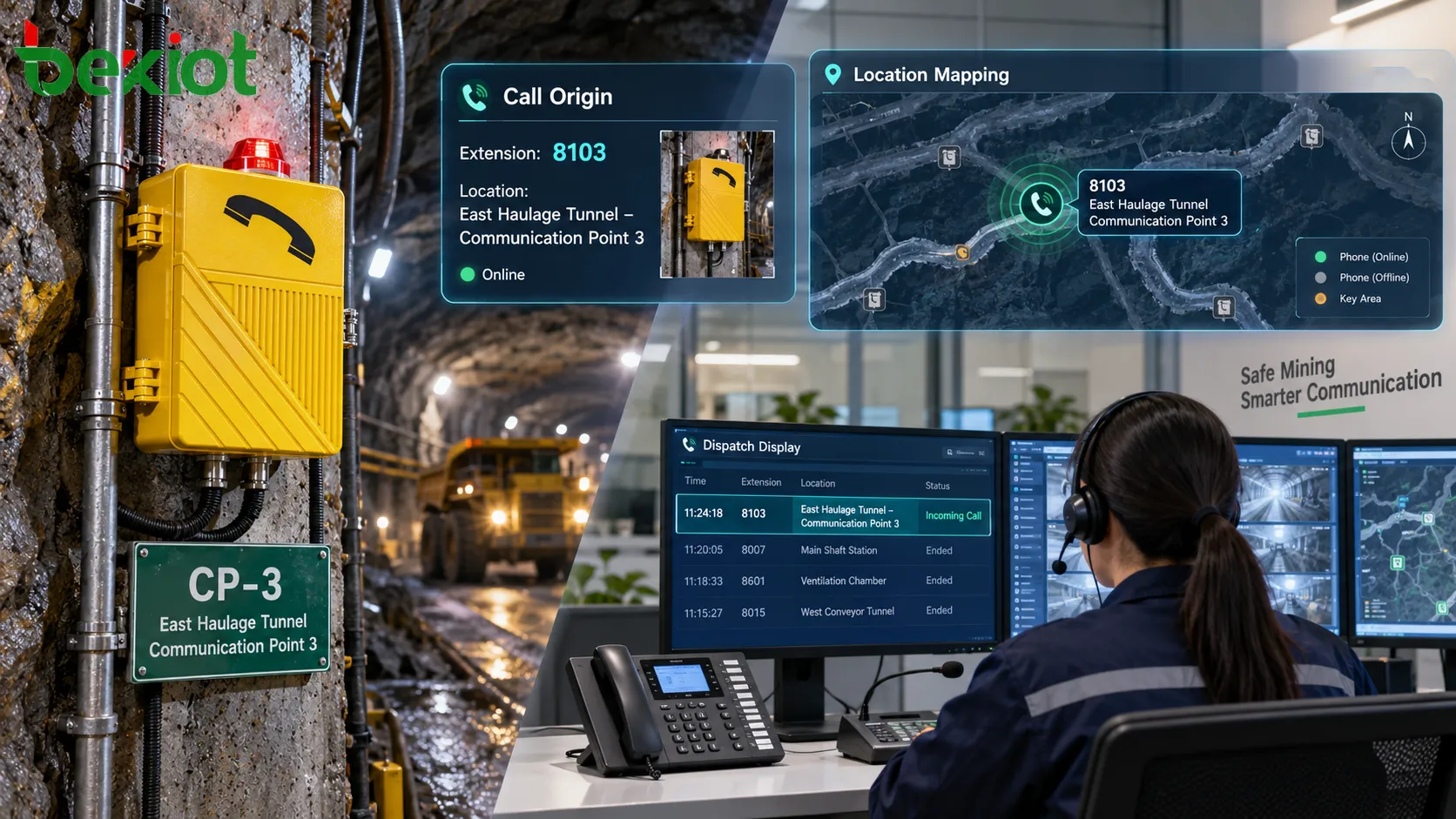
Device ID → Telephone Number → Installation Location → Line or Network Port → Dispatch Console Display Name
For example, when a call reaches the dispatch console, the screen should ideally show more than an extension such as "8103." It should map that number to a clear location such as "East Haulage Tunnel – Communication Point 3." Even if the caller cannot provide a complete verbal report, the dispatcher still has an immediate indication of where the call originated.
As working faces advance, tunnels are extended or equipment is relocated, these mappings must be updated. Otherwise, the telephone may still work electrically while losing one of its most important safety functions: reliable location identification.
Direct-to-Dispatch Calling: Emergency Communication Should Not Require Complex Dialing
Emergency communications in mines need to be fast and simple. At critical locations, the system can be designed with hotline calling, preset destinations, emergency keys or other rapid-call logic so that personnel do not need to remember complicated extension numbers before reaching the surface dispatch center or a designated control position.
The dispatch side should also define call priority, no-answer routing, recording and the required follow-up workflow. In this way, the fixed telephone becomes more than a device that can place a call; it becomes a direct entry point from the underground work area into the dispatch process.
How Should a Fixed Underground Communication Solution Be Implemented?
For fixed safety communication points to work as intended, telephone terminals, installation locations, transmission infrastructure and the surface dispatch system need to be designed as one system rather than purchased and deployed independently.
The first step is to determine where fixed communication points are actually required. The objective should not be to distribute telephones evenly for the sake of quantity. Priority should be given to locations where personnel regularly work or pass, where important equipment is concentrated, where operational risk is higher, where an incident may need to be reported quickly, and where wireless coverage may be less reliable. Areas near working faces, major electrical chambers, pump stations, power-distribution facilities, haulage and hoisting points, refuge areas and important staffed positions should all be evaluated according to the mine layout.
The second step is to select a suitable communications path. Traditional mine systems may use dedicated communication cabling connected to a surface exchange or dispatch platform. Modern mines may use appropriately designed industrial IP networks to carry IP/SIP voice. The protocol itself is not the most important issue. What matters is whether the complete path from the underground terminal to the dispatch position can be tested, supervised and maintained.
The third step is to integrate fixed telephones into the actual dispatch workflow. The purpose of the telephone is not simply to allow one extension to call another; it is to ensure that an abnormal situation underground can be received and acted on at the surface. A typical workflow may be:
Underground Fixed Telephone Initiates Call → Dispatch Console Displays Location → Dispatcher Confirms the Event → Relevant Teams and Rescue Personnel Are Contacted → Wireless Dispatch or Zone Paging Is Activated if Required → Calls and Operator Actions Are Recorded
Within this architecture, the fixed telephone carries information from the field to the control center, wireless communications support ongoing coordination among mobile personnel, and public address provides one-to-many instructions to the required area. These systems are not redundant copies of one another; they provide complementary communication functions under different operating and failure conditions.
What Should Determine Telephone Placement, Communication Paths and Redundancy?
Mining explosion-proof telephones should not be positioned according to a single fixed spacing rule without considering the site. The correct location of a communication point depends on the mine layout, worker movement, operational risks and the availability of other communication methods.
Two tunnels of similar length may have very different communication requirements. One may simply be a transit route, while the other may connect important electrical equipment, a high-occupancy work area or a primary escape route. The more useful design questions are therefore: "How far would a worker need to travel to reach a fixed communication point after an incident?" and "If wireless coverage is lost at this location, what other communication method remains available?" These questions are more meaningful than simply trying to distribute telephones at uniform intervals.
The design should normally consider:
Normal working, inspection and travel routes;
Current working faces and their expected movement;
Major electrical equipment, pump stations, substations and haulage points;
Refuge areas and emergency evacuation routes;
Locations where wireless coverage is weak or vulnerable;
Single points of failure in critical communication paths and core equipment;
The actual duration available from backup power systems;
Mine type, hazardous-area conditions and applicable mining safety and equipment certification requirements.
A mine is also a continuously changing production environment. As a working face advances, a tunnel is closed or equipment is moved, a telephone position that was once appropriate may become less useful. "Fixed" therefore means that the communication point has a clearly defined location during a given operating stage; it does not mean that the installation should never be reviewed or relocated.
An effective placement plan should be reviewed as the mine layout changes so that fixed communication points remain close to actual work areas, travel routes and critical risk locations.
How Can You Verify That These Fixed Communication Points Will Work During an Emergency?
A common problem with fixed mine telephones is not that they fail on the day of installation, but that they remain physically present for years while the actual communication path gradually deteriorates. System acceptance and routine maintenance should therefore verify end-to-end operation rather than checking only the enclosure or the status shown on a management platform.
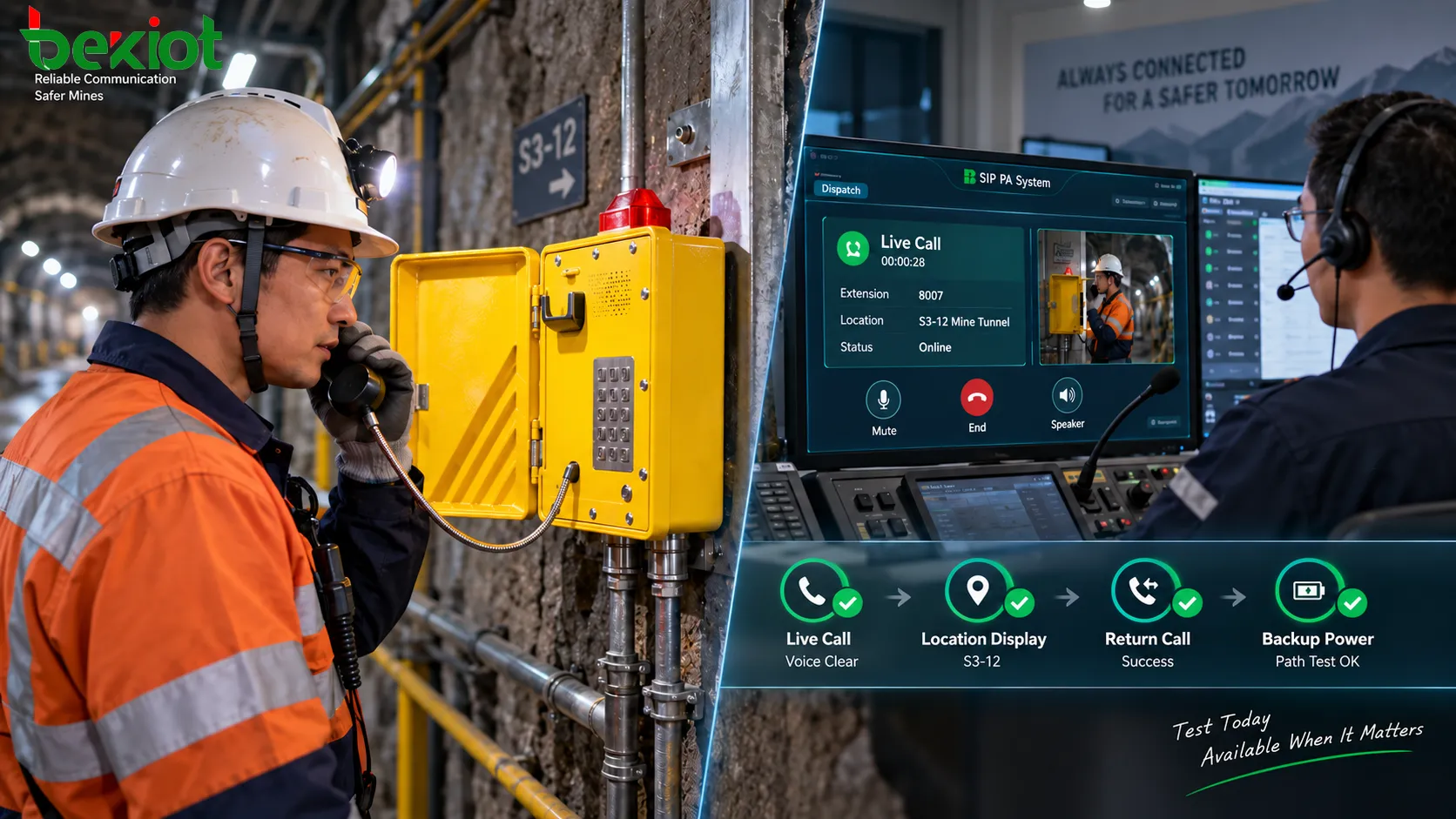
Field inspection should confirm mounting condition, enclosure integrity, cable entries, line connections, off-hook detection, keys or hotline functions, incoming ringing and two-way audio. Critical terminals should also be used to place an actual call to the surface dispatch position so that the correct number and location are displayed. The dispatch center should then call the underground telephone back to verify operation in both directions.
For SIP/IP terminals, a device shown as Online or SIP Registered should not automatically be treated as fully operational. Network reachability only confirms part of the network path, while SIP registration confirms signaling availability. Safe voice communications still depend on the microphone, receiver, audio path, number routing and the dispatch console itself. Critical communication points therefore still require periodic end-to-end call tests.
Backup conditions should also be tested. For example, can backup power take over when core equipment loses mains power? Is another communication path available if the primary link fails? Does the equipment automatically return to service after power is restored? Including these abnormal conditions in the maintenance program is what allows a mine to determine whether its communication system is genuinely usable during an emergency rather than merely available during normal operation.
Mining Explosion-Proof Telephones Ultimately Provide Communication Certainty, Not Just Voice Calling
From a mine safety perspective, the most important role of a mining explosion-proof telephone is not to prove that traditional fixed telephones are still needed underground. Its real purpose is to preserve a form of communication certainty in a complex underground environment. At a critical location, personnel know where the telephone is. Once a call is placed, the dispatch center knows where it came from. If wireless communications are locally disrupted, another communication path may still remain available. Once the dispatch center receives the report, it can continue the response through wireless communications, paging and other coordination systems.
An effective fixed mine telephone system should therefore provide four characteristics at the same time: communication points positioned close to actual work and risk areas, strict mapping between telephone identity and location, communication paths designed to avoid obvious single points of failure, and direct integration between underground terminals and the surface dispatch process. Only when these elements work together does the mining explosion-proof telephone become more than a device mounted on a tunnel wall; it becomes a fixed anchor point in the mine safety communications architecture.
Wireless systems, industrial networks and digital dispatch platforms will continue to develop, but fixed communication points still provide a distinct function. Wireless communication addresses the question, "Can personnel stay connected as they move?" A fixed telephone addresses another: "Is there always a known communication point at this location?" In safety-critical mine operations, these two capabilities complement each other more effectively than relying entirely on either one.
FAQ
Why Are Fixed Explosion-Proof Telephones Still Needed if the Mine Already Has a Wireless Communication System?
Wireless communications are ideal for maintaining contact with personnel as they move, while fixed telephones provide permanent, location-specific communication points. Their safety functions are different. If wireless coverage, a mobile terminal or part of the wireless network becomes unavailable, a fixed communication point may provide another way to reach the dispatch center. The two systems should therefore be treated as complementary rather than duplicate infrastructure.
Is Explosion Protection the Most Important Function of a Mining Explosion-Proof Telephone?
Explosion protection or the applicable mining safety certification is a basic requirement for using equipment in certain environments, but certification alone does not make a terminal an effective safety communication point. Placement, location mapping, direct access to dispatch and the reliability of the complete communication path are equally important to its operational value.
Why Should a Fixed Mining Telephone Be Mapped to Its Installation Location?
A fixed terminal has the advantage of a known location. If the dispatch center can identify the underground area from the telephone number or terminal identity as soon as a call arrives, less time is spent confirming the caller's location during an emergency. This also improves rescue coordination, call-record retrieval and incident traceability.
Does Installing More Mining Explosion-Proof Telephones Automatically Improve Safety?
Not necessarily. Quantity is only one factor. More important is whether personnel can quickly reach a telephone from critical work areas, equipment zones, escape routes and locations where wireless communication may be vulnerable. Placement should follow the actual mine layout and be reviewed as operational risks and working areas change.
Does SIP Registered Mean a Mining Telephone Is Fully Operational?
No. SIP registration only confirms that SIP signaling has successfully registered with the relevant platform. It does not prove that the microphone, handset receiver, RTP audio path, number routing and dispatch position are all functioning correctly. Safety-critical terminals should still be verified through periodic two-way call tests.
What Is the Most Important Failure Mode to Avoid in a Fixed Mine Communication System?
One of the most important risks is allowing multiple critical communication points to depend on the same unprotected failure point, such as a single power source, one core device or one transmission path. The safety value of fixed telephones comes from the design of the complete communications architecture, not from the reliability of one terminal alone.
Fixed communication points in mines should be planned together with underground work areas, transmission infrastructure and the surface dispatch system. Becke Telcom provides industrial telephones, explosion-proof telephones, SIP voice access, dispatch and related industrial communication products, with equipment selection and system support for different underground operating environments.