


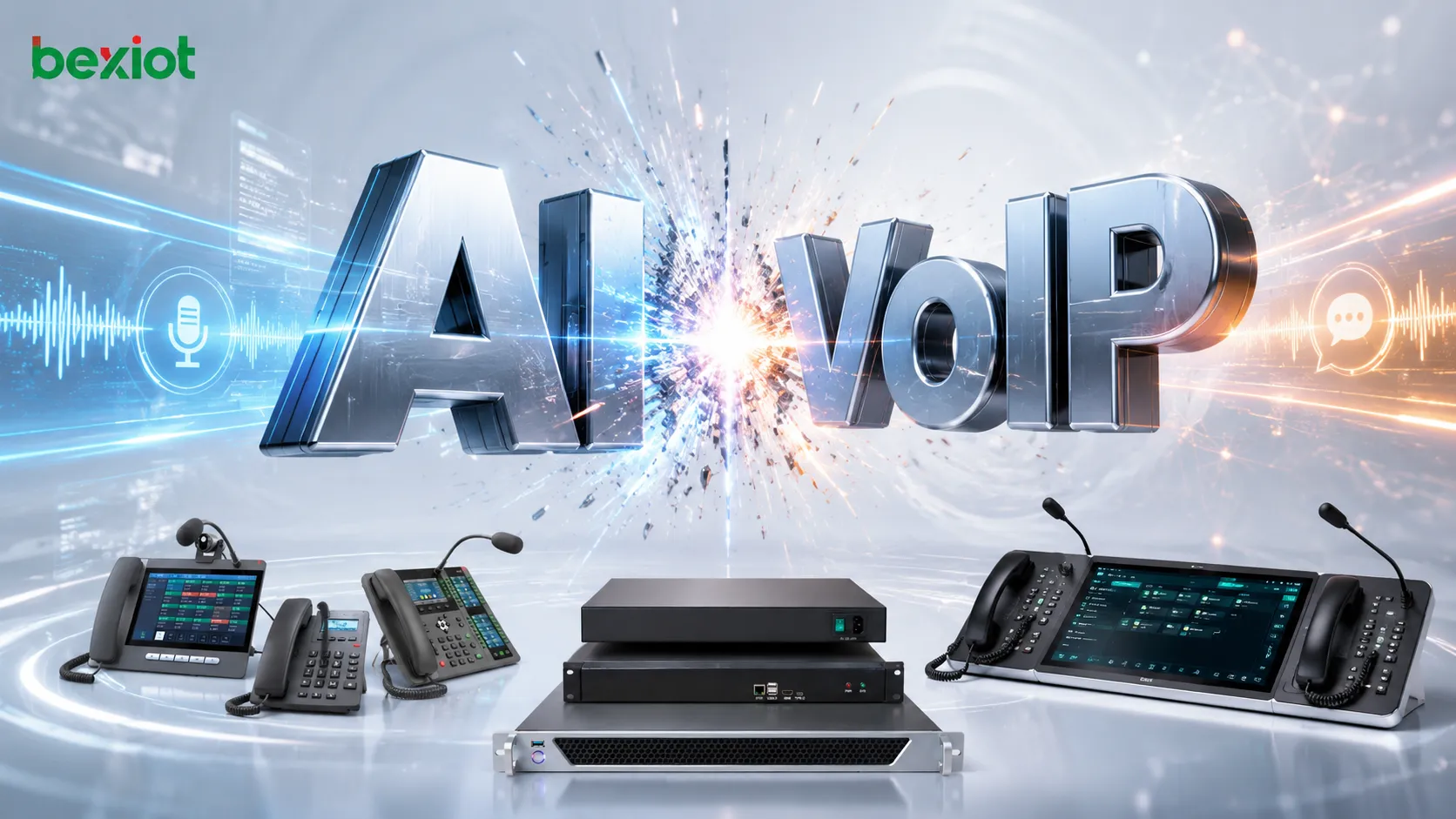
In the past, enterprise VoIP upgrades were largely evaluated across four areas: calling costs, SIP compatibility, voice quality and the flexibility of cloud deployment. By 2026, those criteria are beginning to change. Reliable call completion has become a baseline requirement, while the ability to understand, classify, translate and summarize conversations—and automatically trigger the next business action—is emerging as a new measure of communication-system value. An industry analysis published on July 21 highlighted this shift again: AI is moving beyond peripheral telephone-system assistance and into core functions such as call routing, meeting processing, customer service and communications analytics.
The use of AI in telephone systems is not entirely new. Automated attendants, speech recognition and rules-based voice bots have long been used in enterprise telephony and contact centers. Generative AI differs because it can interpret user intent, organize natural-language responses, retrieve information from multiple business sources and maintain more fluid conversations. This moves AI-powered VoIP beyond the traditional “keyword match followed by a fixed action” model, bringing advanced semantic analysis, meeting assistants, behavioral pattern recognition, natural-language interaction and automated call routing into the same communications workflow.
From Add-On Tool to Core Communications Layer
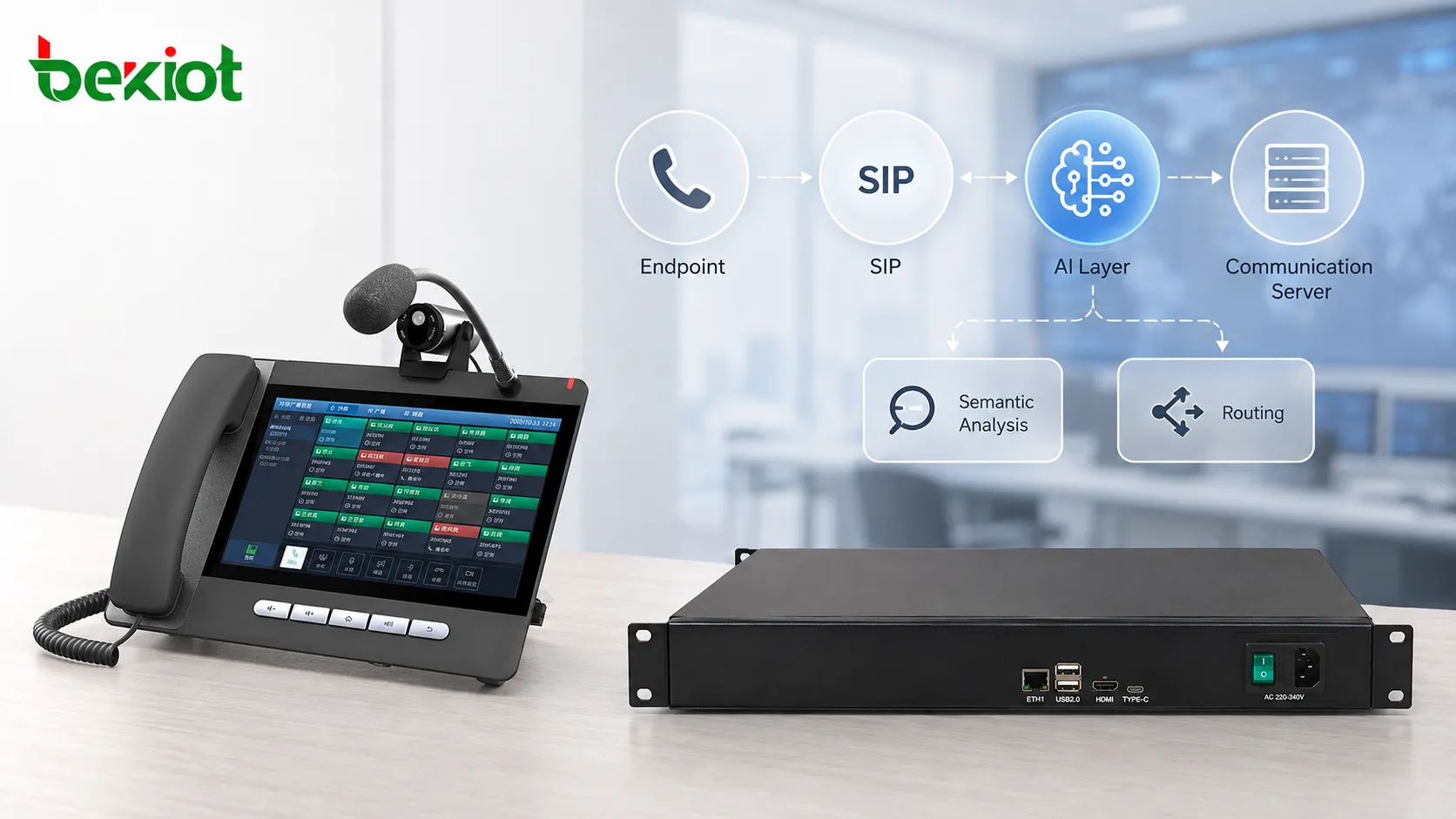
Traditional VoIP can be viewed as a standardized voice transport layer. Its primary role is to establish sessions and carry voice reliably between endpoints over IP networks. Enterprise operations have therefore focused on number management, extensions, SIP registration, call queues, IVR, recording, transfers, dispatch functions and voice-quality assurance. Generative AI does not replace those capabilities. Instead, it adds a new layer of semantic understanding and intelligent processing above the established communications infrastructure.
Consider a customer service hotline. A conventional system typically routes calls according to the caller's number, keypad selections or predefined IVR rules. With generative AI, the platform can combine previous customer interactions, the caller's current speech and available customer data to determine why the customer is calling and help direct the conversation to the most appropriate agent or workflow. The SIP session itself has not fundamentally changed; what has changed is that routing decisions can now incorporate an understanding of conversational content and context.
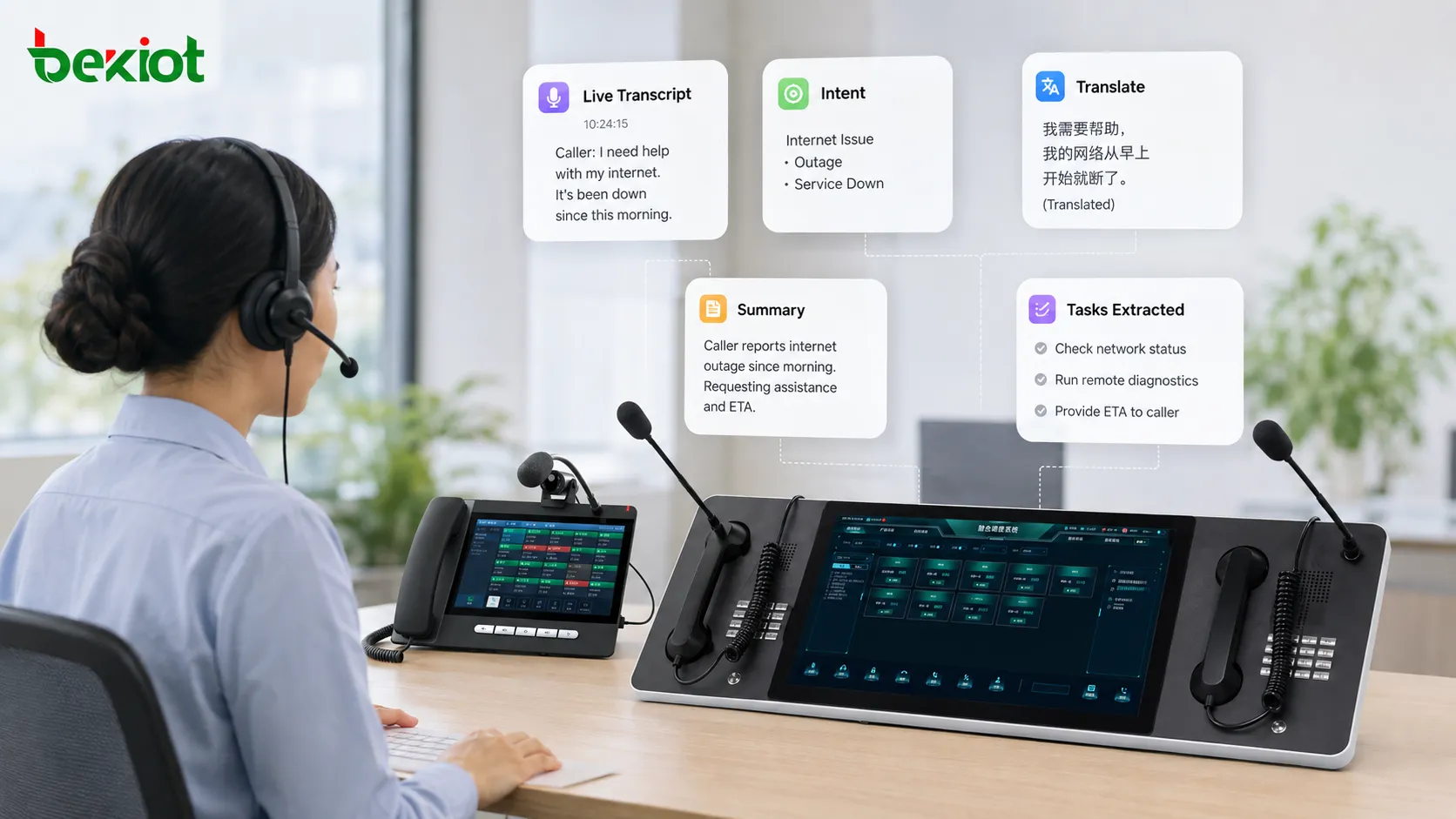
The same development is visible in enterprise meetings. Generative AI can assist with meeting scheduling and reminders, attendance tracking, key-point extraction, live captioning, multilingual translation and speech-to-text or text-to-speech processing. In a traditional workflow, employees may spend considerable time after a meeting preparing minutes and task lists. With AI integrated into the process, structured summaries, action items and key decisions can be generated as the meeting concludes.
This evolution expands the role of VoIP. A communications platform is no longer limited to establishing a call and terminating it when the conversation ends. It can participate in pre-call assessment, provide assistance during the conversation and support data analysis and workflow automation after the call.
Turning Voice into Structured Business Data
The real value of combining generative AI with VoIP is not simply the addition of another voice bot. It is the ability to transform real-time speech into information that can be interpreted, associated with business context and used to drive workflows.
Telephone conversations are inherently unstructured. Customers rarely describe their needs using the exact categories defined in a company's service system; they simply explain what has happened in their own words. By combining automatic speech recognition with the natural-language processing capabilities of large language models, a platform can first convert speech into text and then identify the issue type, relevant product, customer sentiment and possible next steps. In effect, the system converts an audio signal into usable business information.
Historical interaction analysis adds another layer of value. Text, voice and video interactions across multiple channels can be combined into a broader view of the customer. When the same person contacts the company again, the system does not necessarily have to interpret the conversation from scratch. Previous communication patterns can help indicate the likely purpose of the call and provide agents with useful context before or during the interaction.
For contact centers, this goes well beyond conventional call recording. Recording solves the problem of being able to review a conversation later. AI-assisted analysis aims to extract actionable information while the conversation is still taking place. Semantic analysis across large volumes of calls can help identify recurring inquiries, emerging service issues and customer trends, while also providing agents with real-time prompts or relevant knowledge-base recommendations.
Real-time multilingual communication is another important use case. International customer service has traditionally required multilingual agents or dedicated interpreters for certain conversations. When generative AI is integrated into the voice path, automatic speech recognition, machine translation, live captions and generated responses can be combined in one workflow. These technologies cannot eliminate every language challenge or replace professional interpreters in all situations, but they can lower the barrier to offering multilingual support and extend service coverage for international operations.
Reshaping Contact Centers and Internal Workflows
Simply adding a standalone AI feature to an existing phone system is unlikely to deliver substantial business value. The deeper impact of generative AI appears when it changes how calls are received, how problems are handled and how the interaction connects to the next stage of the service process.
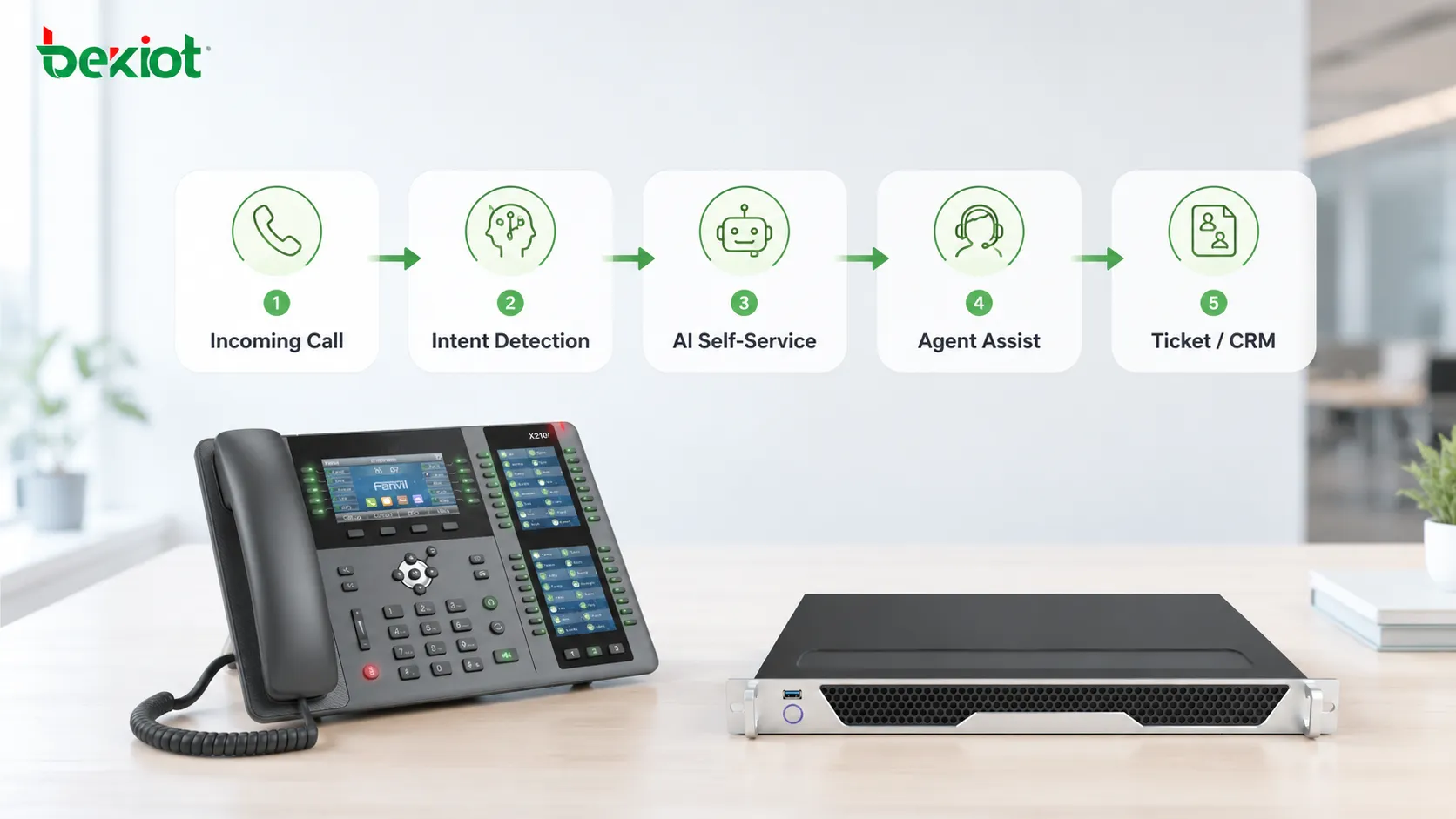
Intelligent call routing is one of the clearest examples. Traditional ACD platforms distribute calls according to factors such as caller number, queue rules, agent skill groups, operating hours and agent availability. Once predictive analytics, customer profiles and behavioral patterns are introduced, routing can include semantic context as another decision factor. Customers may no longer need to navigate multiple levels of keypad menus, and the system may be able to identify the likely reason for the call before an agent begins the conversation.
AI-powered self-service can also improve process efficiency. Compared with a fixed, rules-based IVR, generative interfaces are better suited to natural-language requests and multi-turn conversations. Straightforward inquiries and routine service requests can be completed through self-service, while conversations that require human intervention can be transferred together with customer details, a concise summary of the issue and the interaction history. The benefit is not limited to reducing individual call duration; it can also reduce repetitive questioning and unnecessary transfers that damage the customer experience.
Similar opportunities exist in internal communications. AI-generated meeting summaries, automated task extraction and structured communication records can reduce the administrative work that follows calls and meetings. Analysis across communications data can also help managers understand call-volume patterns, customer issue distribution, service trends and collaboration efficiency, providing additional information for operational decision-making.
If this trend continues, the competitive differences between VoIP platforms are likely to move beyond basic features such as transfer, conferencing and recording. Those capabilities are already highly standardized. Greater differentiation will come from how effectively a platform understands what is being communicated and how easily that understanding can be passed into CRM platforms, ticketing systems, knowledge bases, customer service applications and other business systems to create a complete workflow.
Building a Reliable Communications Intelligence Layer
Integrating generative AI with VoIP does not mean that every voice interaction should be handed over to AI. Voice communications are highly time-sensitive, and a single misunderstanding, routing error or inaccurate automated response can immediately affect service quality and operational efficiency. A more practical deployment model is to let AI handle high-volume, repetitive and information-intensive tasks first, while complex decisions, sensitive conversations and exceptional cases remain under human control.
Data governance and compliance will also become central to deployment. To understand customer history and conversation content, AI systems may need to process call recordings, transcripts, telephone numbers, customer information and data from other business applications. Enterprises therefore need clear policies defining which information can enter an AI workflow, how long it is retained, who can access it and when explicit authorization is required. The deeper AI moves into core communications processes, the less viable it becomes to treat security permissions and data governance as an afterthought.
It is equally important to recognize that AI cannot compensate for poor VoIP engineering. If the network suffers from excessive jitter or packet loss, or if codec configuration, SIP routing or endpoint acoustics are poorly designed, even an advanced language model cannot reliably interpret badly distorted or incomplete speech. Stable SIP/RTP transport, appropriate QoS policies and properly engineered audio endpoints remain the foundation on which every intelligent communications application depends.
Generative AI therefore represents an evolutionary layer rather than a wholesale replacement of traditional telephony. It adds a standardized intelligence layer on top of mature communications infrastructure. Conventional VoIP answers the question, “Where should this call go?” A more intelligent voice platform can additionally ask, “What is this conversation about? Why is the customer calling? What should happen next? What business action should be triggered when the call ends?”
As this intelligence layer matures, VoIP is likely to move further beyond its historical identity as simply “telephony over IP.” It can become a real-time voice entry point connecting customer service, workplace collaboration and enterprise workflows. The most significant contribution of generative AI may ultimately be its ability to transform conversations that once existed primarily as audio into information that can be understood, reused and applied directly to business processes.
FAQ
Do enterprises need to replace existing IP phones to deploy generative AI voice capabilities?
Not necessarily. Most generative AI capabilities are deployed in cloud communications platforms, on-premises communications servers, contact center systems or higher-level applications. If the existing VoIP environment can expose audio streams, APIs or other integration interfaces, organizations may be able to continue using their current endpoints. The exact approach depends on the existing architecture and the required AI functions.
Will real-time AI processing significantly increase voice latency?
The impact depends on the use case and processing architecture. Post-call summaries and offline analytics have little sensitivity to real-time delay, while live transcription, simultaneous translation and agent assistance require tighter control of processing latency. Long model-call paths, excessive network hops or slow media processing can affect conversational responsiveness and should be optimized during deployment.
Can generative AI voice interaction completely replace traditional IVR?
Natural-language interfaces can reduce the need for deeply nested keypad menus, but IVR remains useful for identity verification, deterministic option selection and standardized workflows. Many enterprises are more likely to adopt a hybrid architecture in which natural-language interaction and conventional IVR complement each other.
Can call recording be removed once a VoIP system uses AI?
AI analysis and call recording serve different purposes. AI can extract business information and support workflow automation, while recordings may still be required for quality reviews, dispute resolution, staff training or compliance records. Whether recordings are retained, and for how long, should be determined by business requirements, privacy obligations and internal governance policies.







