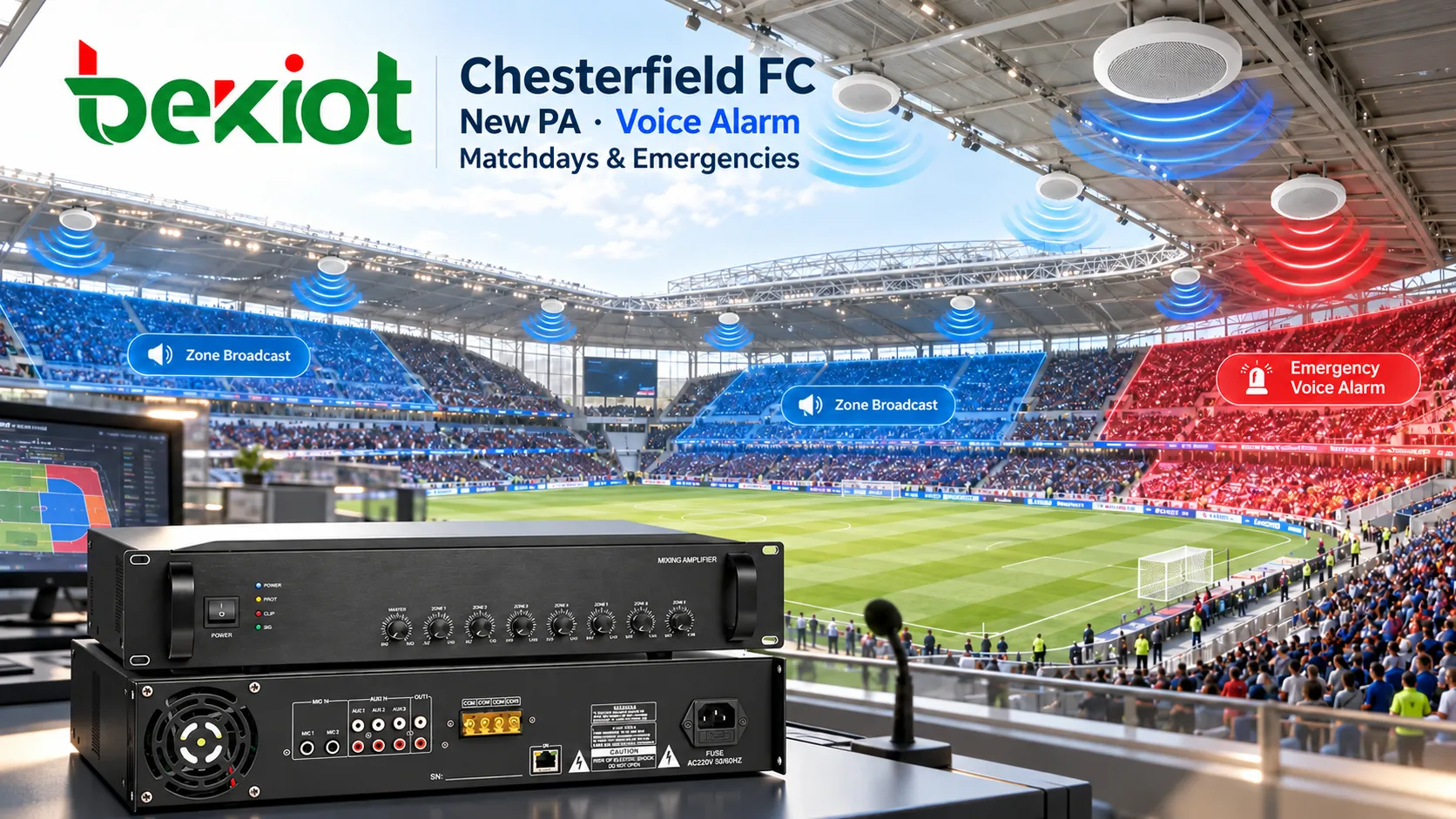
Football remains one of the world’s most widely followed sports, and large, open stadium environments place particularly high demands on public address systems. Before kick-off, the PA supports music, player introductions and the atmosphere around the event. Once spectators fill the stands, it also becomes a channel for paging, operational announcements and audience guidance. If an incident requires information to reach the entire venue or a specific area quickly, the same loudspeaker infrastructure may also become an essential voice alarm channel.
That combination of responsibilities was central to Chesterfield FC’s recent stadium PA upgrade in the UK.
In October 2026, TG Baker completed an upgrade of the public address and voice alarm system at Chesterfield FC’s 10,600-capacity SMH Group Stadium in Derbyshire. The new system replaces audio infrastructure that had been in service since the venue opened in 2010 and uses 26 JBL all-weather loudspeakers to support emergency announcements, matchday music, paging and zoned audio.
In terms of equipment count, this is not an unusually large stadium sound project. What makes the design more interesting is the way Matchday PA and Voice Alarm are treated as parts of the same communications infrastructure, with coverage, zoning, backup power and message priority considered together.
For small and midsize stadiums, that approach may be more relevant than simply increasing maximum sound pressure levels.
One Upgrade Addresses Both Spectator Experience and Safety Communication
Chesterfield FC did not replace the previous system simply because it had been operating for many years. The club had also received repeated feedback that the performance of the old PA was no longer meeting expectations.
The impact of PA quality in a football stadium is easy to underestimate. Spectators immediately notice entrance music, presenter announcements, team introductions and halftime content. If loudness and speech clarity vary significantly from one stand to another, the same match can deliver very different listening experiences depending on where a supporter is seated.
The new system, however, was not designed only to make the music sound better.
The project also requires the PA infrastructure to support Emergency Public Address and Voice Alarm functions. This means the system must provide clearly defined priority and zone control beyond normal entertainment audio. If background music is playing, a high-priority safety message cannot wait for the music to finish. If an issue affects only one stand, there may be no reason to interrupt every part of the stadium.
A modern stadium PA system therefore delivers value in two distinct areas:
Daily operation: music, announcements, match information, paging and event content;
Abnormal or emergency conditions: high-priority voice messages, zoned guidance and emergency instructions.
These applications can share loudspeakers and audio distribution infrastructure while still requiring very different priority logic. This is one reason stadium PA systems are increasingly becoming operational communications infrastructure rather than simply sound reinforcement equipment.
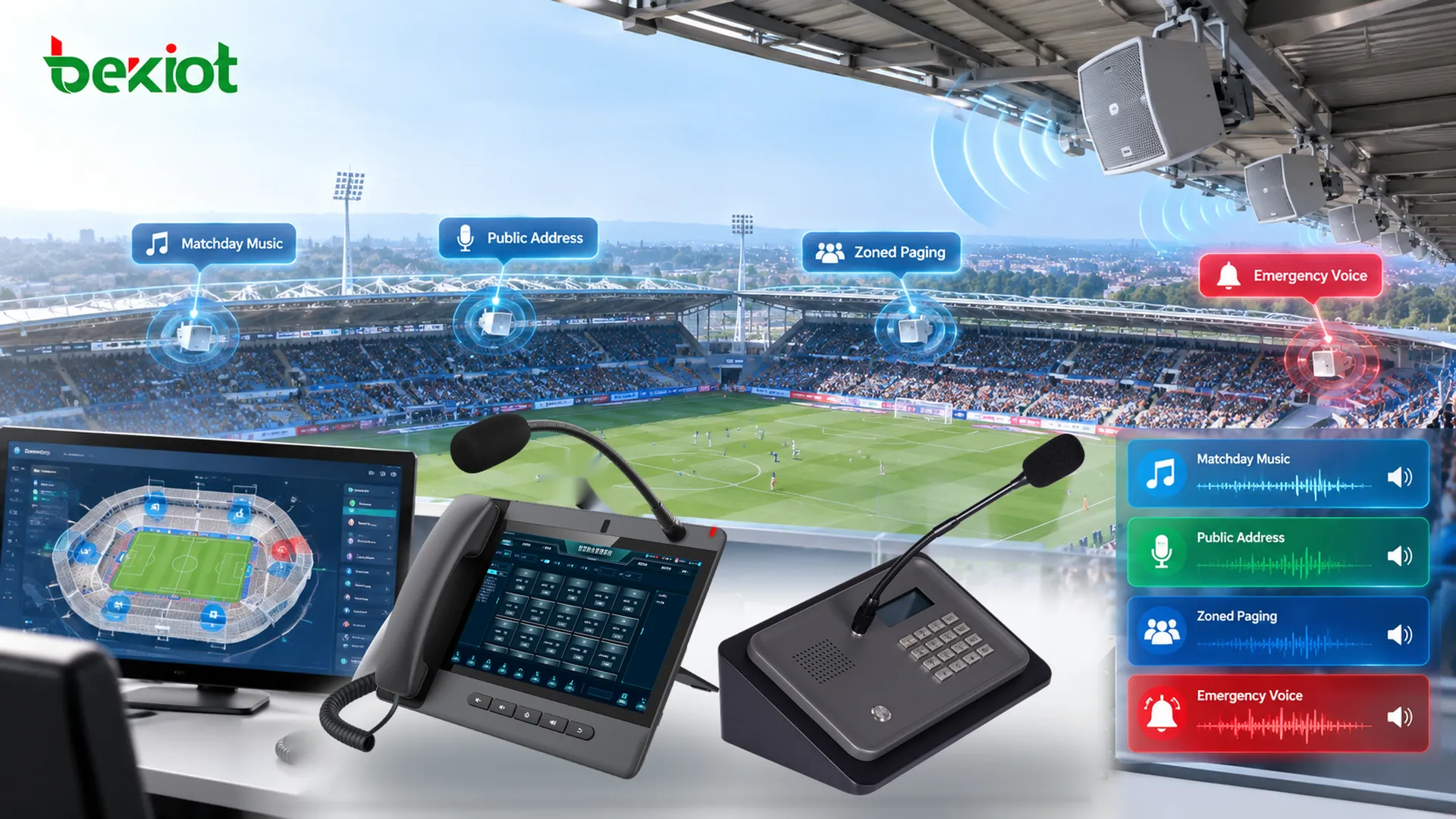
26 All-Weather Loudspeakers Provide Coverage Across Four Stands
Following a site survey, TG Baker selected 26 JBL AWC159 all-weather loudspeakers. Eight were installed in each of the East and West stands, while five were deployed in each of the North and South stands.
| Stand | Number of Loudspeakers |
|---|---|
| East Stand | 8 |
| West Stand | 8 |
| North Stand | 5 |
| South Stand | 5 |
| Total | 26 |
The distribution illustrates why stadium PA design should not follow a simple “same number of speakers per stand” rule. Stand length, seating capacity, mounting positions and acoustic conditions can all differ, so loudspeaker quantity and placement need to follow the actual coverage requirement.
The AWC159 is a two-way coaxial loudspeaker built around a 15-inch driver and carries an IP56 rating. In open or semi-open stadium environments, environmental protection has to be considered alongside acoustic performance because the loudspeakers are exposed not only to matchday crowds but also to wind, moisture and changing outdoor conditions throughout the year.
More importantly, stadium sound problems cannot be solved simply by increasing volume. Changes in seating height, reflections from stand roofs, audience absorption and rising crowd noise all affect performance. A zone may be loud enough while speech is still difficult to understand.
The objective of loudspeaker placement is therefore to create controlled coverage that provides sufficient sound level and speech intelligibility across each area while limiting unnecessary overlap between adjacent sources.
Why 100V Distribution Works Well in Stadium PA Systems
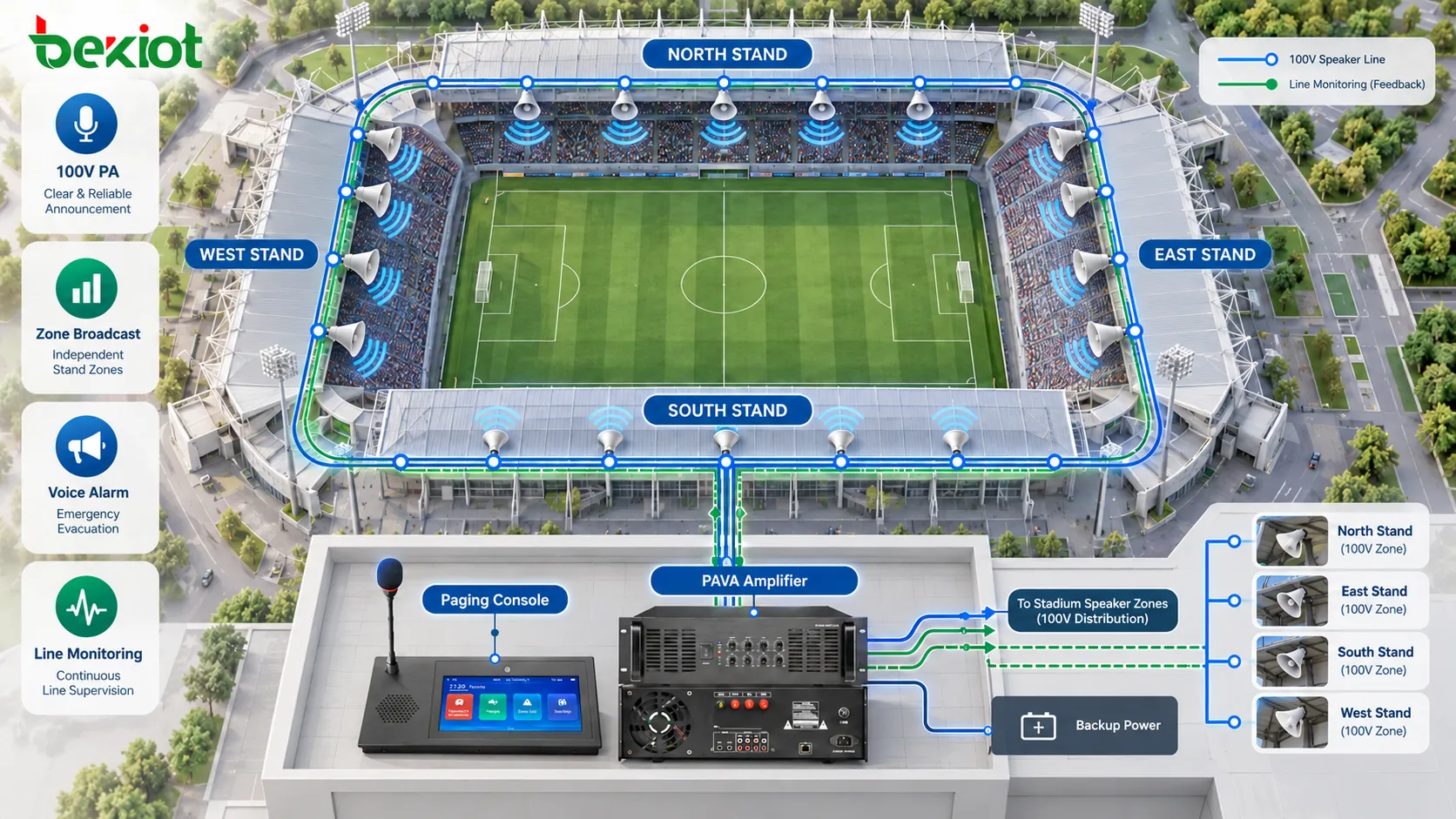
Another notable engineering choice in the Chesterfield FC project is the use of 100V loudspeaker distribution.
A stadium is very different from a meeting room. Cable runs from the equipment room to individual stands can be long, and multiple loudspeakers may share the same distributed line. With conventional low-impedance systems, large-scale deployment requires more careful management of cable loss, impedance and conductor size.
A 100V distributed audio system uses higher voltage and lower current to carry loudspeaker power over longer distances. Individual loudspeakers can then use transformer taps matched to the required power level, making this architecture well suited to installations where multiple loudspeakers are distributed over extended cable runs.
At Chesterfield FC, the 100V design also supports two additional engineering requirements: line monitoring and backup power.
The installer identified advantages in handling long cable runs, system Monitoring and overall reliability. Monitoring is especially important in a PA system that also serves a Voice Alarm function. An undetected loudspeaker-line fault could remain unnoticed during normal operation and only become apparent when an urgent message needs to be delivered.
Stadium PA design therefore has to consider more than whether audio is currently playing. Operators also need visibility into line integrity, amplifier status and whether any coverage zone has lost its ability to receive broadcasts.
Battery-Backed PAVA Keeps Voice Alarm Available During Power Loss
If a PA system is used only for matchday music, a power failure mainly stops the entertainment. When the same infrastructure is responsible for Voice Alarm, however, the consequences of losing power are much more serious.
The Chesterfield FC project uses battery-backed PAVA amplification to drive the 100V loudspeakers. The installer highlighted that the loudspeakers can be powered directly from the battery-backed PAVA amplifiers, avoiding the need for a separate set of high-power amplifiers with an additional UPS.
This reflects an important design principle: backup power should not protect only the controller while leaving the final audio output path without power.
For an emergency voice message to reach spectators, several elements need to remain operational, including the audio source, control logic, amplifiers, loudspeaker circuits and the loudspeakers themselves. Failure at any critical point can leave a stand without the message.
For that reason, evaluating a stadium Voice Alarm system requires more than confirming that batteries or a UPS are installed. It is also necessary to determine which devices are backed up, which broadcast zones remain available and how the system continues to deliver high-priority messages after the primary power source has failed.
A PAVA system should also not be understood simply as a conventional PA system with a battery attached. Its design places additional emphasis on voice alarm priority, system supervision and dependable message delivery during abnormal conditions.
Zoned Paging Prevents Every Stand from Receiving the Same Message
Stadium operations frequently shift between venue-wide announcements and highly localized communication.
Team introductions and pre-match music may be intended for the entire audience. An operational notice at one entrance may need to reach only the affected area. If spectators in one stand require temporary guidance, the message may need to be limited to that stand rather than interrupting the rest of the venue.
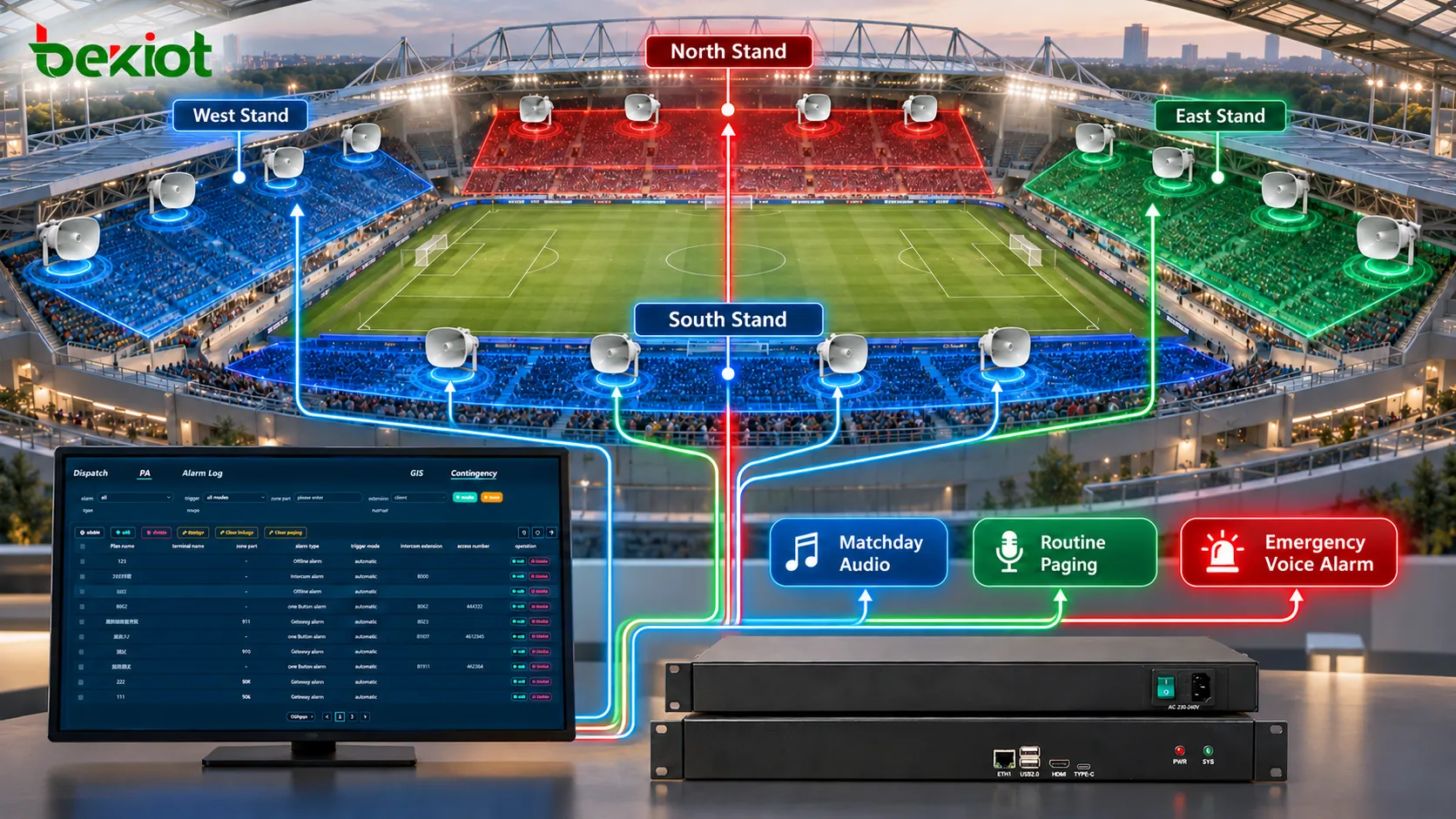
The new Chesterfield FC system supports paging to individual areas and flexible audio routing across different parts of the stadium. This may appear to be a straightforward management feature, but it directly affects how useful the PA system becomes in daily operation.
If every announcement has to be broadcast venue-wide, staff may use the system less frequently to avoid unnecessary disruption. Once individual zones can be selected, the PA can support a wider range of operational communication.
Zoning also provides more precise control for emergency messages. If an incident is localized, operators can send specific instructions to the relevant area. If the situation expands, the broadcast scope can be widened accordingly.
Modern stadium audio therefore involves three separate control dimensions:
Zone: which stand or functional area should receive the message;
Priority: whether the announcement should interrupt music or routine paging;
Content: whether the system is carrying matchday entertainment, operational information or emergency voice instructions.
In a complex public venue such as a stadium, effective PA is not about broadcasting everything everywhere. It is about delivering the right content to the right area at the right time.
Stadium PA Upgrades Are Moving Beyond Simply Replacing Loudspeakers
The Chesterfield FC project is not unusually large, but it illustrates how the priorities of stadium PA upgrades are changing.
The club’s most visible concern came from the spectator experience: the old PA had underperformed and was affecting the atmosphere before and during matches. The upgrade improves music and public address quality, which is the part of the project supporters are most likely to notice.
Behind that improvement, however, the engineering work also addresses a different set of issues that spectators may never see directly: 100V long-distance distribution, line monitoring, battery-backed PAVA amplification, zoned paging and Voice Alarm functionality.
This shifts the evaluation of a stadium PA system beyond questions such as “Is it loud enough?” or “Does the music sound better?” A complete system also needs to answer:
Can every stand receive stable and intelligible voice coverage?
Can an individual zone be paged without interrupting the entire venue?
Can high-priority messages override normal matchday content?
Can faults in loudspeaker circuits or amplification be detected?
Can critical voice announcements continue after loss of normal mains power?
Chesterfield FC’s upgrade addresses both matchday experience and voice alarm capability within the same project. For football grounds, arenas and public venues that have been operating for many years, this can provide a more useful reference than simply replacing older loudspeakers with models offering higher output power.
FAQ
What Is the Difference Between a Stadium PA System and a Music Sound Reinforcement System?
A stadium PA system often supports music as well as public address, paging, operational announcements and emergency voice information. It therefore places greater emphasis on wide-area speech intelligibility, zoning, message priority, line monitoring and system availability. Performance sound systems generally place more emphasis on musical dynamics, frequency response and the audience listening experience.
What Is a PAVA System?
PAVA stands for Public Address and Voice Alarm. It combines routine public address functions with high-priority voice alarm communication in one system, with additional attention given to emergency message priority, system monitoring and reliable operation.
Why Are 100V Loudspeaker Systems Common in Large Venues?
100V distributed audio is well suited to long cable runs and installations where multiple loudspeakers share the same line. It can simplify power distribution and system expansion across large venues. Whether a project should use 100V still depends on distance, required power, audio quality objectives and the overall system architecture.
Why Does a Stadium Need Zoned Paging?
Different stands and functional areas do not always need to receive the same information. Zoned paging reduces unnecessary venue-wide interruptions and allows operators to send announcements, spectator guidance or emergency instructions to specific areas.
Does Backup Power Guarantee That a Voice Alarm System Is Reliable?
Not by itself. It is necessary to confirm which control, amplification and output components are covered by backup power, while also checking fault monitoring, loudspeaker-line status and whether the required broadcast zones remain operational after loss of normal mains power.
Becke Telcom provides IP PA, SIP paging, PAGA and emergency voice communication solutions for stadiums, public buildings and large campuses. These systems can combine zoned broadcasting, priority control, SIP endpoints, network audio and unified dispatch platforms to support both daily operations and emergency notification.