


In emergency command, public safety, energy, transportation, industrial parks, mining, airports, ports, utilities, and large facility management, radio intercom systems have long been the foundation of frontline communication. Two-way radios are simple, fast, and familiar. Operators press the PTT button, speak to a group, and field teams can receive instructions immediately without opening an app or searching for a contact.
However, modern command work is no longer limited to radio voice. Dispatch centers now need to connect people, platforms, devices, alarms, maps, cameras, public address systems, IP phones, mobile terminals, and remote command centers. A traditional radio-only system may still be reliable for group voice, but it cannot easily participate in digital workflows unless a gateway layer is added.
A trunked radio gateway or RoIP gateway provides that integration layer. It helps bring radio communication into an IP-based command environment, allowing dispatchers to coordinate field radio users together with SIP systems, video platforms, alarm systems, broadcasting, and 4G/5G communication resources.
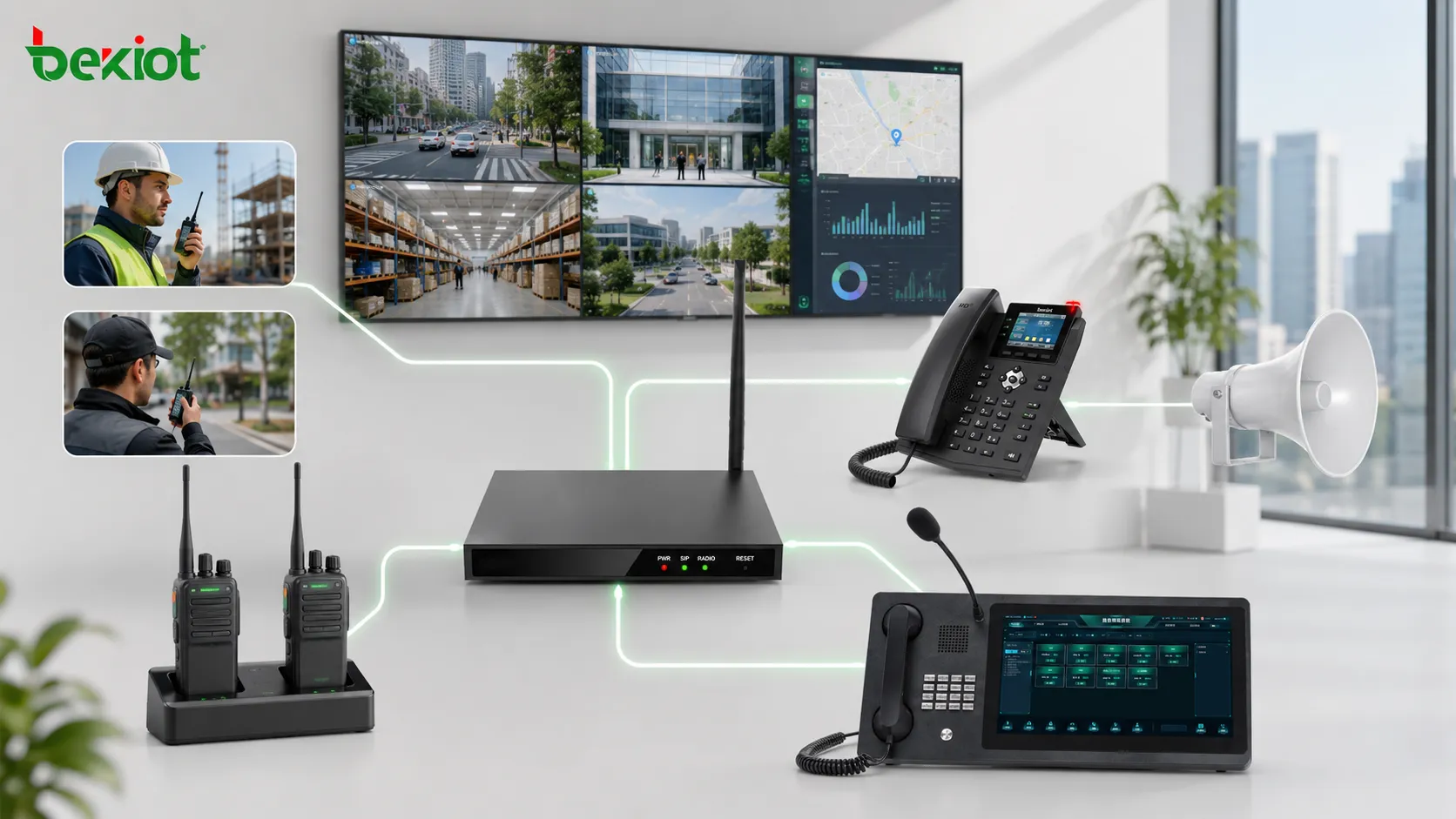
When Voice Communication Becomes Operational Collaboration
Traditional trunked radio systems are designed to solve a specific problem: fast group voice communication. This is still valuable in the field, especially when workers need hands-free awareness, quick command delivery, and simple operation under pressure. In many industrial and emergency environments, radio remains more practical than ordinary phone calls.
The limitation appears when the command center needs to do more than talk. For example, an alarm system may detect an intrusion, a video platform may display a live image, a GIS map may show a field team’s location, and a public address system may need to broadcast a warning. If the radio network is isolated, the dispatcher must manually translate all this information into voice instructions and relay them to radio users.
This creates a gap between digital systems and frontline execution. The command platform can “see” the event, but it cannot directly reach the people who need to respond. Gateway integration helps close this gap by converting radio communication into part of a wider operational workflow.
The Core Problem: Isolated Networks Slow Down Response
In many projects, different systems are built at different times by different vendors. The radio system may belong to the security department, the IP phone system may belong to IT, the video platform may belong to the surveillance team, and the alarm system may be part of building automation. Each system can work on its own, but they do not naturally communicate with each other.
During daily operations, this separation may only cause inconvenience. During an emergency, it can become a serious response problem. A fire alarm, chemical leakage warning, tunnel incident, railway equipment failure, or perimeter intrusion may require immediate cross-department communication. If the dispatcher must operate several independent systems manually, response efficiency is reduced.
Common communication barriers in real projects
Radio users often cannot speak directly with IP phone users. SIP dispatch platforms may not be able to join radio talk groups. Alarm systems may not be able to trigger radio notifications automatically. Video surveillance operators may need to call another person to inform radio teams about what they see on screen.
These barriers increase the number of manual steps in the response chain. Every extra step creates delay, and every relay may cause information loss. A gateway-based architecture reduces these barriers by creating a controlled connection between radio networks and IP communication systems.
Why simple radio coverage is not enough
Good radio coverage only means radio users can communicate within the radio system. It does not mean the radio system is integrated with the rest of the command environment. Modern dispatch requirements include cross-network calling, group linkage, recording, event-triggered communication, remote access, and coordination with other platforms.
Therefore, coverage planning and system integration should be considered together. A radio network that covers the site but remains isolated may still fail to support command collaboration effectively.
The Gateway Layer in a Converged Architecture
A radio gateway acts as a bridge between the radio world and the IP communication world. It can connect analog radios, digital trunked systems, radio base stations, SIP dispatch platforms, IP PBX systems, recording systems, public network PTT platforms, and command software. Depending on the project, it may handle audio conversion, SIP signaling, PTT control, group bridging, recording access, and platform linkage.
In a practical deployment, the gateway does not replace the radio system. Instead, it extends the value of existing radio assets. Radios, base stations, and user habits can continue to exist, while the gateway allows these assets to participate in IP-based dispatch and multi-system collaboration.
Radio-to-SIP communication
Many command platforms and IP communication systems use SIP as a standard signaling protocol. By connecting radio channels to SIP-based systems, the gateway allows radio users and IP users to communicate through controlled dispatch workflows.
This is useful in duty rooms, control centers, emergency command rooms, industrial operation centers, and multi-site management platforms. Dispatchers can coordinate radio users from a software interface, SIP console, IP phone, or unified communication platform.
PTT control and talk group coordination
Push-to-talk communication is different from ordinary full-duplex phone calls. Only one user normally speaks at a time, while others listen. When radio communication is connected to SIP or IP platforms, the gateway must handle PTT control carefully.
Important functions may include talk right request, talk right release, carrier detect, audio activation, group selection, channel mapping, and emergency priority. Without proper PTT logic, cross-network communication may become unstable or confusing.
Turning Events Into Actionable Communication
The greatest value of gateway integration appears when communication becomes event-driven. In a traditional system, the dispatcher sees an event and then manually calls or broadcasts instructions. In an integrated system, alarms, video, GIS, and dispatch logic can be connected with radio communication more directly.
For example, when a perimeter alarm is triggered in an industrial park, the platform can display the camera view, identify the nearest patrol team, and notify the correct radio group. When a tunnel incident occurs, the system can link video feeds, dispatch maintenance staff, broadcast instructions, and record the communication process. When a chemical plant alarm is triggered, the command center can call the emergency radio group and activate public address warnings through coordinated procedures.
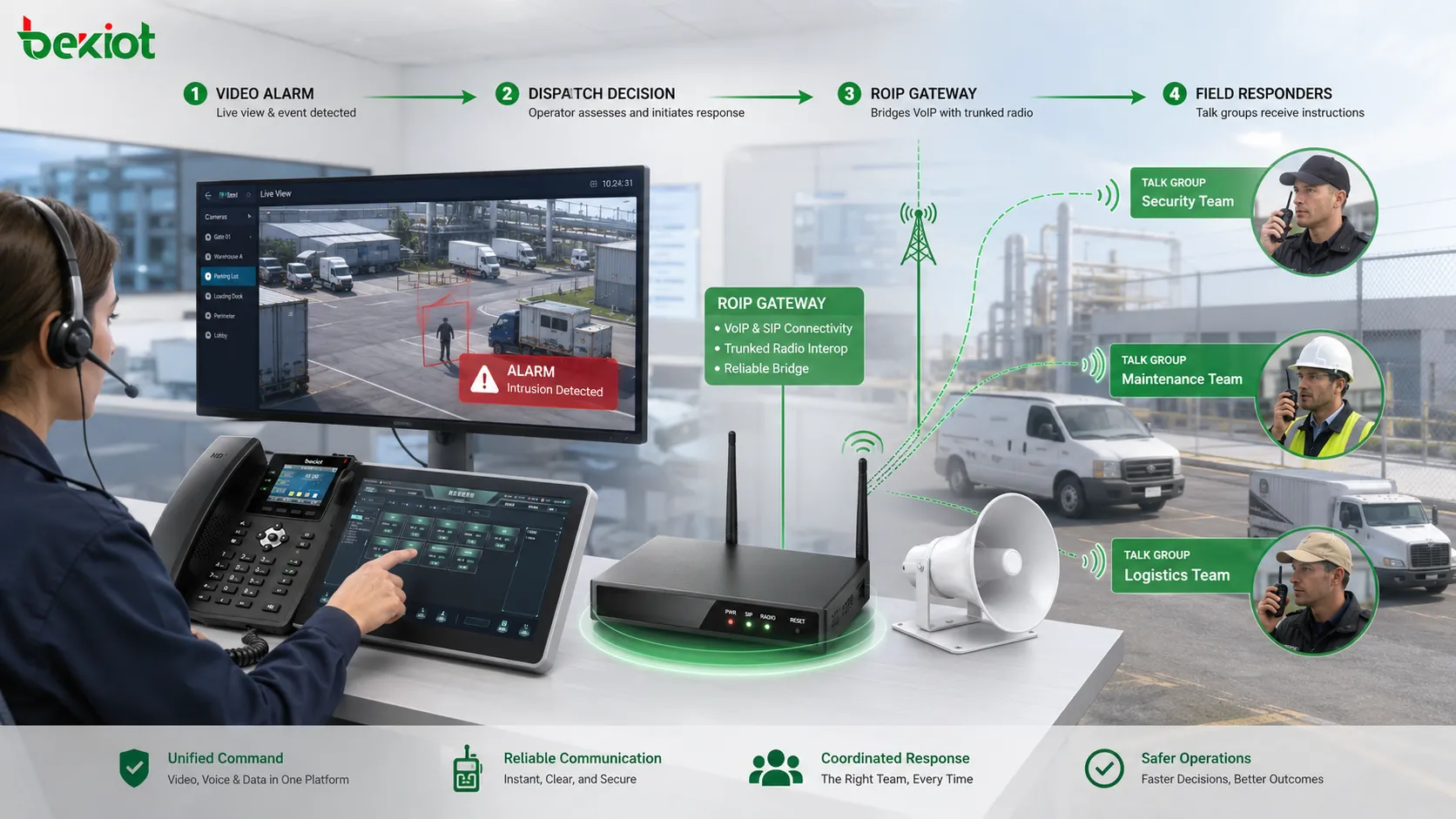
From alarm notification to response closure
A strong command workflow should include detection, confirmation, dispatch, response, recording, and review. The gateway helps with the dispatch and communication part of this loop. It ensures that the correct field teams can be reached through their existing radio devices.
After the event, voice records, group activity, alarm history, and operator actions can support review and responsibility tracking. This improves not only real-time response but also long-term management.
Reducing dependence on manual relay
Manual relay is still common in many command rooms. An operator sees an alarm, calls another person, waits for confirmation, and then asks someone else to notify the field team. This process may work in small incidents, but it becomes inefficient during multi-point events.
Gateway integration reduces the need for repeated manual transfer. The platform can connect communication actions with the actual event logic, allowing the command center to respond faster and with fewer unnecessary steps.
Extending Radio Communication Across Sites and Regions
Traditional radio systems are often limited by local coverage. A plant, railway section, airport zone, tunnel, campus, or port area may have its own radio coverage, but communication becomes more difficult when teams move outside that area or when multiple sites need unified command.
Gateway integration can extend radio communication through IP networks, private lines, VPNs, 4G/5G networks, or dispatch platforms. This allows local radio groups to be connected with remote command centers, regional management platforms, or other sites.
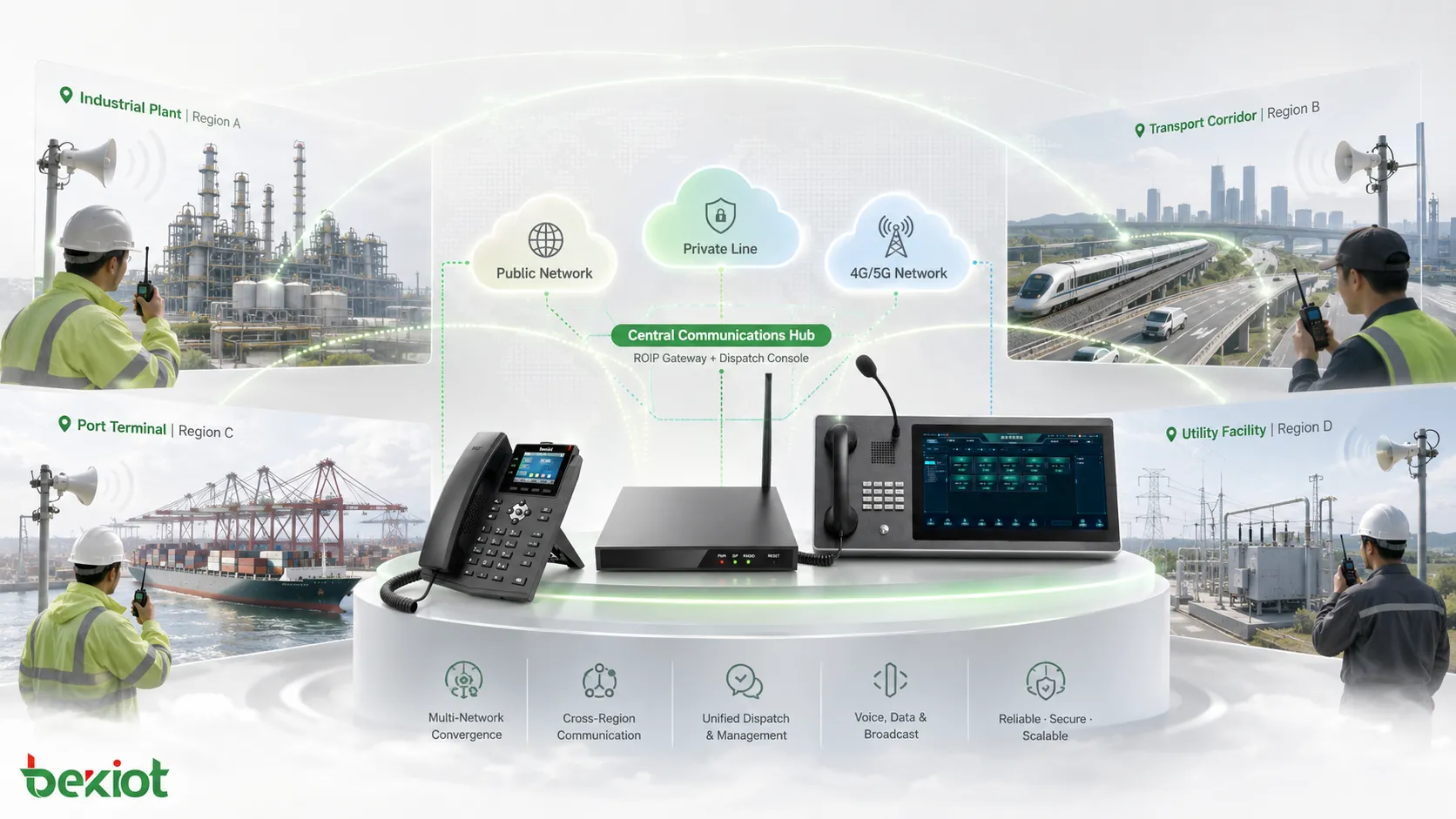
Multi-site command coordination
For organizations with several branches, construction areas, stations, warehouses, substations, or industrial zones, a gateway can help connect local radio systems into a centralized command architecture. Local radio users can keep their familiar terminals, while managers gain broader communication visibility.
This is especially valuable for energy networks, transportation lines, logistics parks, ports, mining areas, and smart city operation centers where teams are distributed across wide areas.
Public network extension for mobile teams
When field users move outside private radio coverage, public network PTT or 4G/5G communication can serve as an extension layer. A converged design can allow public network users, SIP dispatch users, and private radio users to participate in coordinated workflows.
This does not mean public networks should replace private radio in every critical application. Instead, it means different communication layers can complement each other according to coverage, reliability, cost, and operational priority.
Typical System Components
A complete converged communication solution may include radio terminals, radio base stations, RoIP gateways, SIP servers, IP PBX platforms, dispatch software, video surveillance platforms, alarm systems, public address systems, recording servers, GIS maps, mobile terminals, and remote command center clients.
The gateway is only one part of the system, but it is often the key part that enables interconnection. Without the gateway, the radio system remains separated from the digital platform. With the gateway, radio users can be integrated into a broader command architecture.
Radio layer
The radio layer includes handheld radios, vehicle radios, base stations, repeaters, and trunked radio systems. It provides direct field voice communication and remains important in environments where mobile phones or apps are not enough.
Depending on the industry, the radio system may be analog, digital conventional, or trunked. It may use different channel plans, groups, or dispatch rules. These details must be considered before gateway integration.
IP communication layer
The IP layer may include SIP servers, IP phones, dispatch consoles, recording platforms, public network PTT systems, and command center software. This layer provides flexible communication control, remote access, platform integration, and digital management.
When radio and IP communication are connected properly, operators can coordinate field users more efficiently and connect communication with other business systems.
Application linkage layer
The application layer includes video, alarms, GIS, access control, building automation, emergency plans, work orders, and incident management systems. This layer turns communication into a response workflow rather than a standalone voice function.
In modern projects, this application linkage layer is often where the business value becomes most visible.
Recommended Architecture for Project Deployment
A practical architecture should be designed according to the site’s workflow, not only according to equipment lists. Engineers should define which radio groups need to connect with which dispatch users, which alarms require automatic linkage, which sites require remote command access, and which communication paths need redundancy.
For projects that involve radio-to-IP integration, radio dispatch upgrade, public-private communication convergence, or SIP-based command linkage, RoIP technology is commonly used as the bridge between field radio networks and IP platforms.
Related product solution: Becke RoIP Gateway
When selecting a RoIP solution, project teams should review radio interface compatibility, SIP support, PTT control, audio quality, channel capacity, deployment environment, network reliability, alarm linkage requirements, and long-term maintenance needs.
Deployment Scenarios Across Industries
Gateway-based integration is suitable for any environment where radio users must be connected with command platforms or other communication systems. The architecture is especially useful in public safety, emergency management, chemical parks, power plants, substations, tunnels, rail transit, airports, ports, mines, campuses, industrial parks, and large commercial facilities.
Emergency response and public safety
Emergency teams may arrive from different departments with different radio systems. A gateway-based design can help local command posts connect radio groups, SIP dispatch users, and remote support teams. This improves coordination when time is limited and communication conditions are complex.
In disaster response, temporary command posts can use gateway integration to connect local radio users with a remote command center. Voice instructions, status reports, and field updates can be transmitted through a more organized workflow.
Energy, chemical, and industrial operations
In energy and chemical sites, safety events require fast and accurate communication. A gas alarm, equipment fault, fire warning, or restricted-area intrusion may need immediate notification to maintenance teams, safety officers, and control room operators.
By linking alarm platforms, video systems, and radio groups through a gateway, the command center can shorten the path from event detection to field response.
Transportation, ports, and rail systems
Transportation environments usually include distributed teams, moving vehicles, station staff, maintenance workers, and control center operators. Radio communication remains important, but it must often work together with video, GIS, passenger information, public address, and emergency response systems.
Gateway integration allows radio groups to become part of a unified command platform, improving coordination across routes, stations, depots, yards, and control rooms.
Key Design Points Before Implementation
Before deployment, engineers should map the entire communication workflow. This includes user groups, radio channels, SIP accounts, dispatch roles, alarm linkage rules, recording requirements, network paths, and emergency priority settings.
System design should avoid connecting everything to everyone. Good command communication depends on clear structure. The right message should reach the right group at the right time, while unnecessary cross-group communication should be controlled.
Group mapping and permission design
Different teams may require different communication permissions. Security teams, maintenance teams, emergency teams, production teams, management staff, and remote supervisors should not always share the same communication group.
The gateway and dispatch platform should support planned group mapping, role-based access, and controlled communication paths. This helps reduce communication overload and prevents unauthorized operation.
Audio quality and interface testing
Radio integration is not only a software configuration task. Audio input and output level, impedance, PTT trigger, carrier detect, grounding, connector wiring, and delay must be tested with actual equipment.
Different radio brands and systems may behave differently. A successful lab connection does not always guarantee stable field operation, so on-site testing is important.
Reliability and backup planning
For critical projects, the system should include backup power, redundant network paths, secure access control, operation logs, and recovery procedures after interruption. If the gateway is used for emergency communication, its deployment position, power source, and network connection should be protected.
Communication reliability should be verified under realistic conditions, including weak network, high traffic, multi-user calling, alarm bursts, and power recovery.
Operation and Maintenance Considerations
After installation, the system should be documented clearly. Documentation should include radio group mapping, gateway channel definitions, SIP account information, cable labeling, network topology, alarm linkage rules, permission roles, and troubleshooting procedures.
Operators should also be trained to understand when to use radio calling, SIP calling, group dispatch, alarm linkage, and emergency escalation. A powerful system can still fail operationally if users do not know the correct workflow.
Routine inspection
Routine maintenance should include radio channel tests, SIP registration checks, gateway status monitoring, recording verification, alarm linkage testing, and backup communication drills. These checks help prevent hidden failures.
For industrial and emergency environments, periodic drills are especially important. A communication system should not be tested only during real incidents.
Scalability planning
As the organization grows, more radio channels, user groups, remote sites, cameras, alarm points, and dispatch users may be added. A scalable gateway architecture can support future expansion without redesigning the entire system.
Project teams should reserve network capacity, gateway channels, SIP resources, dispatch licenses, cabinet space, and power capacity where possible.
Business Value for Integrators and Owners
A gateway-based solution helps organizations move from isolated radio communication to integrated command collaboration. It protects existing radio investment while adding IP-based communication, platform linkage, remote command, recording, and event-driven response capability.
For system integrators, this creates a clearer technical path for connecting radio, SIP, IP phone, video, alarm, public address, and dispatch systems. It reduces repeated custom development and provides a more standard architecture for project delivery.
For project owners, the value is practical: faster response, fewer manual relay steps, clearer command workflows, better use of existing equipment, improved emergency coordination, and stronger long-term scalability.
The future of professional communication is not simply more radios or more software screens. It is a connected architecture that links people, systems, events, and information into one coordinated response chain.
FAQ
Can a gateway integrate every radio system without customization?
No. Radio systems may use different interfaces, signaling methods, audio levels, PTT controls, and group logic. Compatibility testing and project-specific configuration are usually required.
Should all alarms be linked to radio groups?
No. Only important alarms should trigger radio communication. Low-priority or frequent alarms may cause communication fatigue if they are pushed to field teams without filtering.
Can radio users talk directly with IP phone users?
Yes, if the gateway and SIP platform are configured to support that workflow. The exact call method depends on the gateway design, dispatch platform, SIP server, and radio interface.
What is the biggest risk in radio-to-IP integration?
The biggest risk is assuming that protocol connection is enough. Real projects must also verify audio quality, PTT behavior, group rules, delay, permissions, network stability, and operator workflow.
Is gateway integration only suitable for large projects?
No. Small and medium projects can also benefit when they need to connect radio users with IP phones, dispatch software, alarms, or remote command users. The architecture should be scaled according to the site size and operational needs.
How often should the integrated system be tested?
Critical systems should be tested regularly through scheduled inspections and emergency drills. Testing should include radio calls, SIP calls, alarm linkage, recording, backup power, and recovery after network interruption.







