


Urban underground utility tunnels are becoming an important part of modern city infrastructure. Instead of placing power, communication, water supply, drainage, gas, and heating pipelines separately across different underground routes, a utility tunnel brings multiple municipal pipelines into a planned underground corridor. This improves maintenance efficiency, reduces repeated road excavation, protects city appearance, and supports long-term urban development.
Large-scale urban infrastructure renewal continues to create strong demand for underground pipeline upgrades, with more than 100,000 kilometers of underground pipelines expected to be improved each year. Behind this construction opportunity, utility tunnels require more than civil engineering. They also need intelligent monitoring, alarm linkage, communication, broadcasting, video, GIS, and command dispatch capabilities to support safe operation and emergency response.
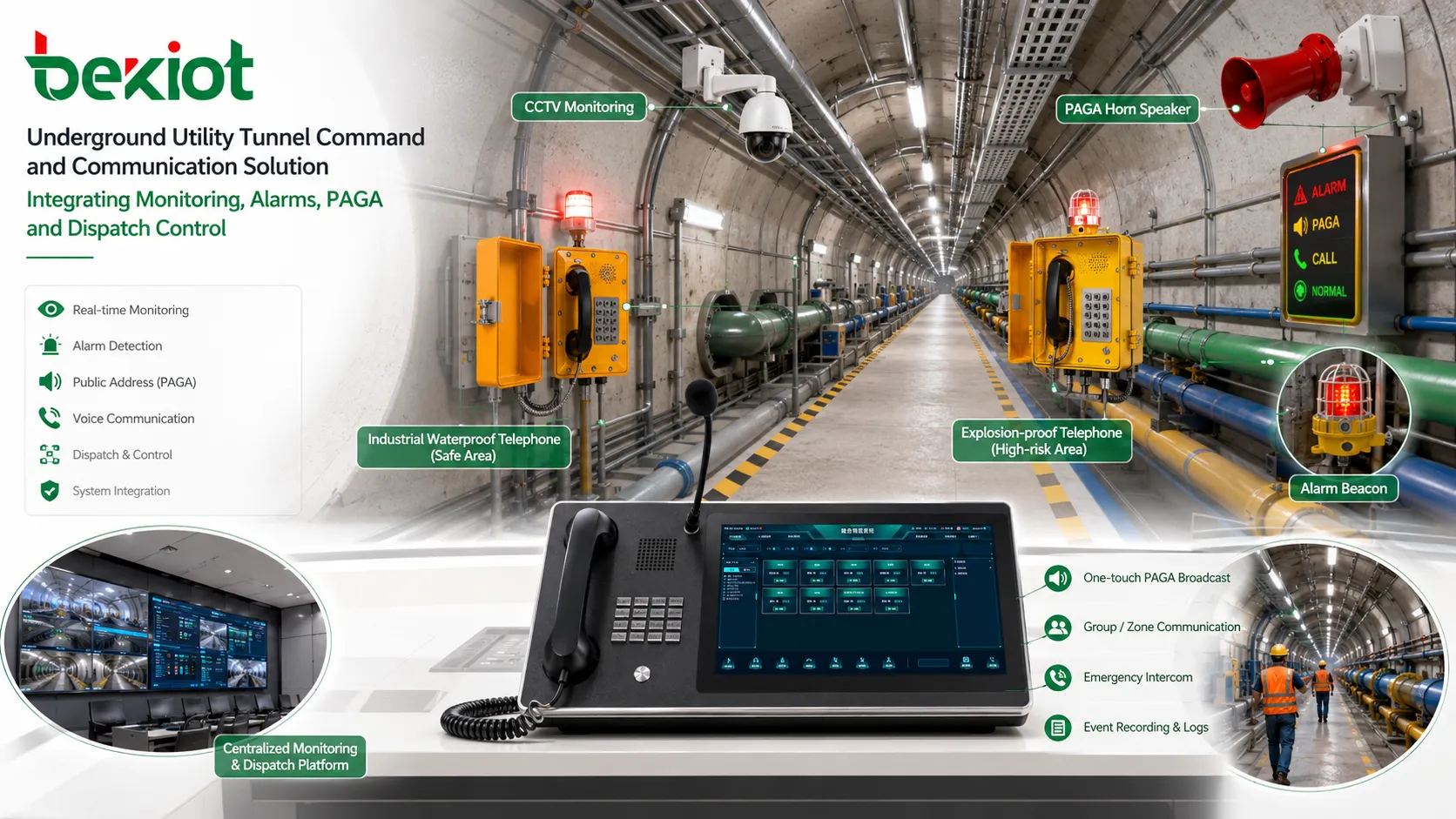
Why Utility Tunnels Need an Integrated Operation Platform
A utility tunnel is not only an underground passage for pipelines. It is a complex infrastructure environment where electricity, communication cables, water pipelines, drainage systems, gas pipelines, heating pipelines, ventilation equipment, lighting equipment, fire protection systems, and drainage facilities may coexist in one corridor. This makes operation and maintenance more efficient, but it also raises higher requirements for safety control.
When multiple types of pipelines are placed in the same underground space, any abnormal condition may affect more than one subsystem. High temperature, excessive humidity, water accumulation, harmful gas, combustible gas leakage, fire risk, equipment failure, unauthorized entry, or communication interruption may all create operational risks. A single-function monitoring system is not enough for this type of environment.
A practical utility tunnel solution should integrate monitoring, alarm, communication, broadcasting, video surveillance, GIS, and dispatch control into one operational structure. The goal is not to make the system complicated, but to make complex underground infrastructure easier to observe, manage, and respond to.
Information Systems Required for Modern Corridor Construction
Utility tunnel construction standards usually emphasize not only space, structure, seismic resistance, waterproofing, and engineering safety, but also the information-based systems that support long-term management. For the monitoring and alarm layer, a utility tunnel should include environmental and equipment monitoring, security protection, communication, early warning and alarm, a unified management platform, and a geographic information system.
Different pipeline types also require different warning mechanisms. Where fire risk exists, an automatic fire alarm system should be configured. Where gas or combustible media may be present, combustible gas detection and alarm systems should be planned. These systems should not operate as isolated devices. They should report information to the central platform and participate in linkage control when an event occurs.
The platform should collect and process information from multiple subsystems, including ventilation, power supply, lighting, monitoring and alarm, firefighting, drainage, access control, and communication equipment. Through unified monitoring and management, the operation center can better understand the condition of the tunnel and coordinate maintenance or emergency response in time.
Environmental Sensing and Video Visibility
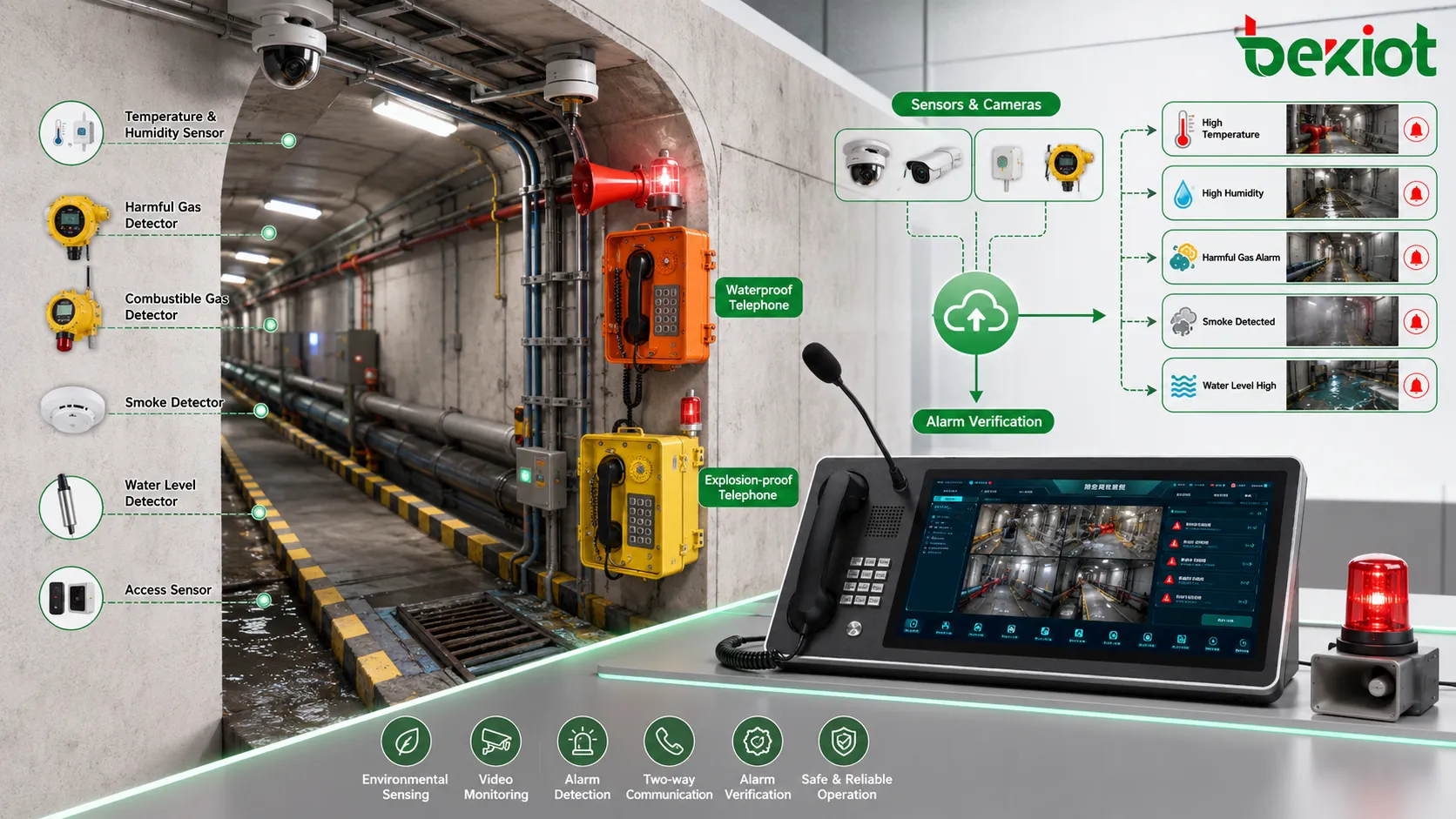
Underground utility tunnels need many types of sensor devices. Temperature and humidity sensors help operators evaluate the basic environmental condition of the corridor. Harmful gas detectors and combustible gas detectors help identify risks that may not be visible to maintenance personnel. Water level sensors, smoke detectors, equipment status sensors, and access sensors can provide additional operational data.
These sensor systems should work together with video surveillance. Cameras can provide visual confirmation when an alarm is triggered, when maintenance staff enter the tunnel, or when abnormal equipment behavior is reported. Instead of relying only on alarm text, dispatchers can use live video to verify the situation and decide whether to start broadcasting, call maintenance staff, notify emergency teams, or activate linkage procedures.
Video monitoring also improves traceability. During routine inspections, abnormal events, equipment maintenance, or emergency handling, recorded video can help managers review the process, confirm responsibility, and improve future response plans.
Communication Points Inside Critical Locations
Communication capability is essential inside underground corridors. Maintenance workers, inspection teams, security personnel, and emergency responders must be able to contact the control center when they enter the tunnel. Important nodes should be equipped with IP communication stations, emergency intercom points, or other reliable voice terminals so that personnel can report problems and receive instructions.
In addition to point-to-point communication, public address and broadcasting equipment should be deployed in suitable tunnel sections. When an emergency occurs, the control center can send warning messages, evacuation instructions, maintenance reminders, or safety announcements to the affected area. This is especially important when workers may not be near a phone terminal or when a rapid area-wide notification is required.
IP-based communication and broadcasting also help reduce system fragmentation. Voice calls, emergency help points, broadcast zones, alarm linkage, and dispatch commands can be connected through the unified platform, making the entire communication workflow easier to operate.
Related System Solution: /paga-systems/paga-solution-for-underground-utility-tunnels
Centralized Dispatch for Monitoring and Emergency Linkage
The management platform of an underground utility tunnel should support hierarchical configuration, data communication, information collection, and integrated processing. In practical terms, this means the platform must be able to receive data from different systems, understand the relationship between devices and locations, and provide operators with a clear command interface.
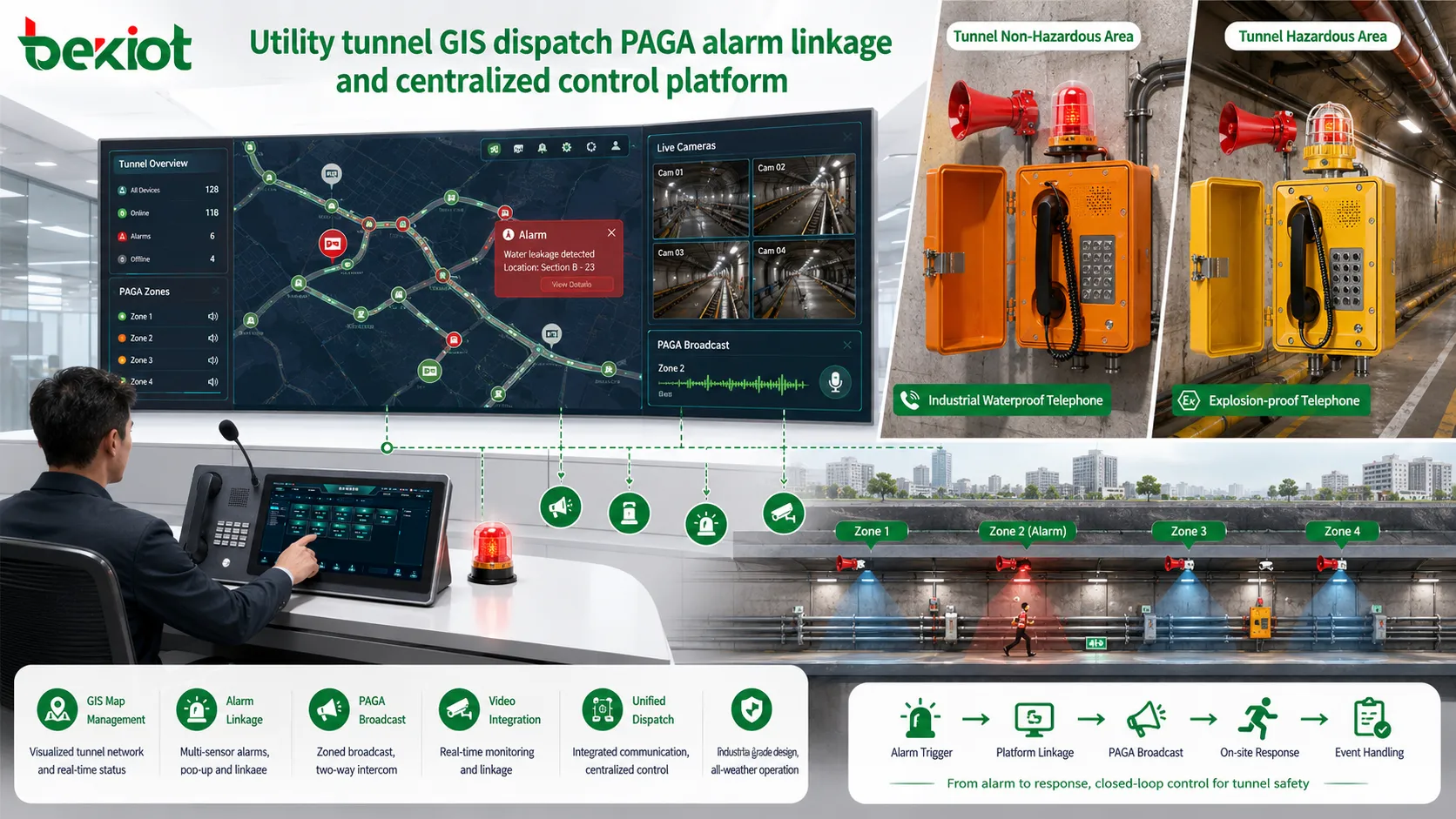
For example, when a combustible gas alarm is triggered in one tunnel section, the dispatch platform should show the alarm location on the map, display nearby cameras, notify relevant personnel, trigger local broadcast warnings, and support voice communication with field workers. If the event is serious, the platform should help the control center coordinate emergency teams, maintenance teams, and external departments.
This is where a command and dispatch system provides practical value. It connects communication gateways, video systems, IoT interfaces, alarm devices, broadcast endpoints, and field terminals. Instead of checking each subsystem separately, the operator can manage communication, warning, visual verification, and emergency response from one platform.
GIS Mapping for Location-Based Management
A geographic information system is highly valuable for underground utility tunnel operation. Since tunnels may extend across long distances and contain many cabins, sections, entrances, equipment rooms, pipelines, and inspection points, operators need a clear spatial view of the infrastructure.
GIS can show tunnel routes, device locations, alarm points, camera positions, broadcast zones, maintenance entrances, and pipeline distribution. When an alarm occurs, the platform can locate the event quickly and display related resources nearby. This reduces the time required to identify the affected area and improves command accuracy.
GIS also supports daily operation. Maintenance plans, inspection routes, equipment status, and historical events can be associated with physical locations. This helps managers move from simple device monitoring to location-based infrastructure management.
Unified Control of Ventilation, Power, Lighting, Firefighting, and Drainage
Utility tunnel management involves many electromechanical systems. Ventilation helps maintain air quality and remove harmful gases. Power supply supports communication, lighting, monitoring, and control devices. Lighting ensures safe inspection and maintenance. Firefighting systems respond to smoke, fire, or abnormal heat. Drainage systems prevent water accumulation and reduce equipment damage.
A unified management platform should monitor these systems and support linkage control where appropriate. For example, a gas alarm may require ventilation linkage. A fire alarm may require broadcast evacuation messages and video verification. A water-level alarm may require drainage equipment inspection and maintenance dispatch. A power fault may require backup power verification and emergency repair coordination.
This type of linkage is one of the main reasons why utility tunnels need a command-oriented solution rather than only a monitoring dashboard. The platform must help operators take coordinated action, not only display isolated alarms.
How the Solution Supports Daily Operation
During normal operation, the system helps the management team monitor tunnel conditions, check device status, supervise personnel entry, schedule maintenance, and review historical data. Operators can see environmental indicators, communication status, camera feeds, alarm records, and equipment conditions through the unified platform.
When maintenance workers enter the tunnel, communication stations and broadcast zones provide a safer working environment. If workers discover abnormal conditions, they can contact the control center immediately. If the control center needs to issue instructions, it can use voice calls, group communication, or area broadcasting according to the situation.
Daily operation is also a process of risk prevention. By continuously collecting sensor data, video information, and equipment status, the platform helps managers identify potential problems before they become larger incidents.
How the Solution Responds During Emergencies
In an emergency, speed and clarity are critical. The system should detect abnormal events, locate the incident area, notify personnel, display video, activate broadcasts, and support command communication as quickly as possible. This reduces the delay between alarm generation and response action.
For fire, gas leakage, harmful gas, water accumulation, unauthorized entry, or equipment failure, the platform should provide a complete event workflow. The operator needs to know what happened, where it happened, which devices are nearby, which teams should be contacted, and what linkage actions can be started.
Emergency broadcasting and voice communication are especially important. People inside the tunnel may need immediate evacuation instructions. Maintenance teams may need technical guidance. External rescue departments may need coordinated information. The dispatch platform should support these communication tasks without forcing operators to switch between several independent systems.
Deployment Value for Urban Infrastructure Projects
Improved Safety for Underground Operations
By combining sensors, alarms, video, communication, and broadcasting, the solution gives operators better visibility into underground conditions. This helps reduce blind spots and supports faster response when risks appear.
Safety is not achieved by one device alone. It depends on the ability to detect, verify, notify, communicate, and coordinate through a complete system.
More Efficient Maintenance and Management
Centralized monitoring and GIS-based management help maintenance teams understand where equipment is located, which section needs inspection, and which alarm requires action. This improves daily maintenance efficiency and reduces unnecessary manual checking.
When information is collected and processed through one platform, the operation center can make better decisions and maintain the tunnel more systematically.
Better Long-Term Scalability
Utility tunnels are built for future urban development. As new pipelines, devices, cameras, sensors, and communication points are added, the platform should support expansion without changing the whole architecture.
A scalable command and communication solution allows cities to extend monitoring, broadcasting, alarm linkage, and dispatch functions gradually as the tunnel network grows.
Recommended Implementation Path
Define the Tunnel Sections and Device Layers
The project team should first map tunnel sections, cabins, entrances, equipment rooms, pipeline types, and key risk points. Based on this structure, sensors, cameras, communication stations, broadcast speakers, and alarm devices can be placed more logically.
This avoids random device deployment and ensures that monitoring, communication, and emergency notification cover the areas that matter most.
Build the Unified Management and Dispatch Platform
The platform should collect information from environmental monitoring, equipment monitoring, security systems, communication systems, alarm systems, GIS, video surveillance, fire protection, drainage, ventilation, lighting, and power supply systems.
More importantly, it should support linkage logic. When an alarm occurs, the platform should help operators connect the alarm point with nearby video, broadcast zones, communication terminals, maintenance teams, and emergency response procedures.
Test Emergency Workflows Before Delivery
Before the system is delivered, emergency workflows should be tested in realistic scenarios. These may include gas detection alarms, fire alarms, water accumulation alarms, communication tests, broadcast tests, video linkage, GIS positioning, and maintenance communication.
Testing should confirm not only that devices work, but also that operators can complete the response process efficiently from the platform interface.
FAQ
Why do utility tunnels need both intercom and broadcasting?
Intercom supports direct communication between workers and the control center, while broadcasting provides area-wide notification. In emergencies, both functions are useful because some personnel may need two-way communication while others need immediate instructions.
Should every tunnel section have the same device configuration?
Not necessarily. Device configuration should depend on pipeline type, risk level, tunnel length, personnel access frequency, ventilation condition, and emergency response requirements. High-risk sections may require denser sensing, video, and broadcast coverage.
How does GIS improve emergency handling?
GIS helps operators locate alarms, nearby cameras, entrances, broadcast zones, and maintenance resources on a map. This reduces response delay and makes command decisions more accurate.
Can existing monitoring systems be integrated into the platform?
Yes. Many projects can integrate existing cameras, sensors, alarm devices, and control systems through gateways, standard protocols, or platform interfaces. The integration method depends on the current system architecture.
What should be considered for long-term operation?
Long-term operation should consider device maintenance, alarm record review, communication testing, backup power, platform expansion, cybersecurity, personnel training, spare parts, and periodic emergency drills.







