


In many command and dispatch projects, the existing communication environment is not built from one single system. A control center may use a SIP-based dispatch platform, field teams may still rely on private mobile radios or handheld radios, and emergency teams may use public-network push-to-talk applications over 4G or 5G. A Radio over IP gateway, also known as a ROIP gateway, radio gateway, or two-way radio gateway, is used to connect these different voice systems into one coordinated communication network.
The main value of this type of gateway is cross-system interconnection. By using the openness of SIP signaling and standardized radio-side interfaces, the gateway can connect command dispatch platforms with analog radios, digital trunked radio systems, mobile radios, handheld radios, and public-network push-to-talk platforms. In real integration projects, two usage modes are especially common: voice interworking between the dispatch platform and radio channels, and push-to-talk interworking between private radio networks and PoC systems.
For system planners, the gateway should not be viewed as only a signal converter. It is also a key node that affects dispatch efficiency, emergency response speed, group communication discipline, voice quality, and long-term system maintenance. A suitable ROIP design allows existing radio assets to remain useful while extending them into an IP-based command environment.
Related Product: Becke ROIP Gateway
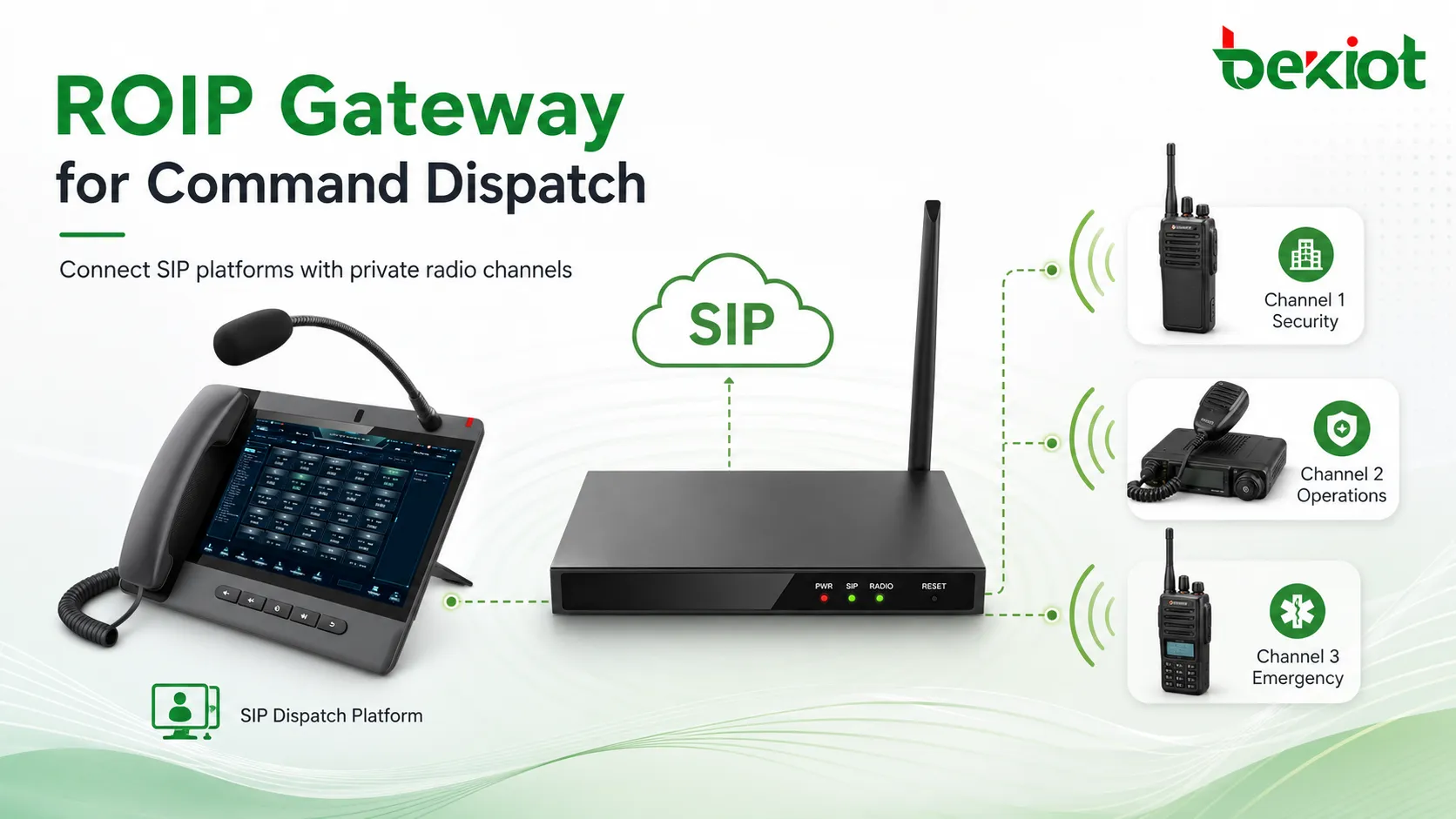
Where radio and IP dispatch meet
Many modern command dispatch systems are based on SIP softswitch platforms. They use SIP audio and video communication capabilities to support dispatch calling, extension management, recording, conferencing, and emergency coordination. In practical terms, this type of platform can be understood as an advanced telephone dispatch system with richer control and management functions.
However, many users already have private radio systems in operation. These may include analog two-way radios, DMR, PDT, TETRA digital trunked systems, marine radios, aviation radios, shortwave radios, or industry-specific radio networks. These radio systems are valuable because they are reliable, familiar to field teams, and often already deployed across important operating areas.
The integration challenge is clear: the dispatch platform usually works in a full-duplex telephone communication model, while private radios usually work in a half-duplex push-to-talk model. A ROIP gateway sits between the two sides and converts the communication logic, audio path, and control signals so that dispatch operators and radio users can communicate without replacing the existing radio network.
This is especially important in industries where radio communication has been used for many years. Replacing all radios at once may increase cost, interrupt daily operation, and require retraining. ROIP integration offers a more practical path: keep the existing radio network, connect it to the IP dispatch system, and gradually improve centralized control, recording, and remote coordination.
Mode one: voice access from dispatch phones to radio channels
The first common usage is voice interworking. In this mode, the command dispatch system can directly communicate with a radio channel through the ROIP gateway. Dispatch operators do not need to hold a physical radio. They can call a SIP number on the dispatch console, IP phone, or softphone, and the call is then converted into radio-side communication through the connected mobile radio, base station, or handheld radio.
This mode is useful when a project requires a telephone-style dispatch system to reach existing radio users. For example, a command center may need to talk to a patrol team, a maintenance crew, a tunnel operation group, a security team, or an emergency response team that still works on private radio channels.
In a typical implementation, each radio-side connector on the gateway corresponds to one SIP number in the command dispatch system. When the operator calls that SIP number, the gateway activates the connected radio channel and sends the voice to all users on that channel. Radio users can then reply through their radios, and the gateway sends the received audio back to the dispatch platform.
This mode is suitable for direct command, routine notification, emergency calling, and cross-department coordination. It is also easier for operators who are already familiar with telephone dispatch operations, because they can call a radio group in the same way they call an internal extension or dispatch terminal.
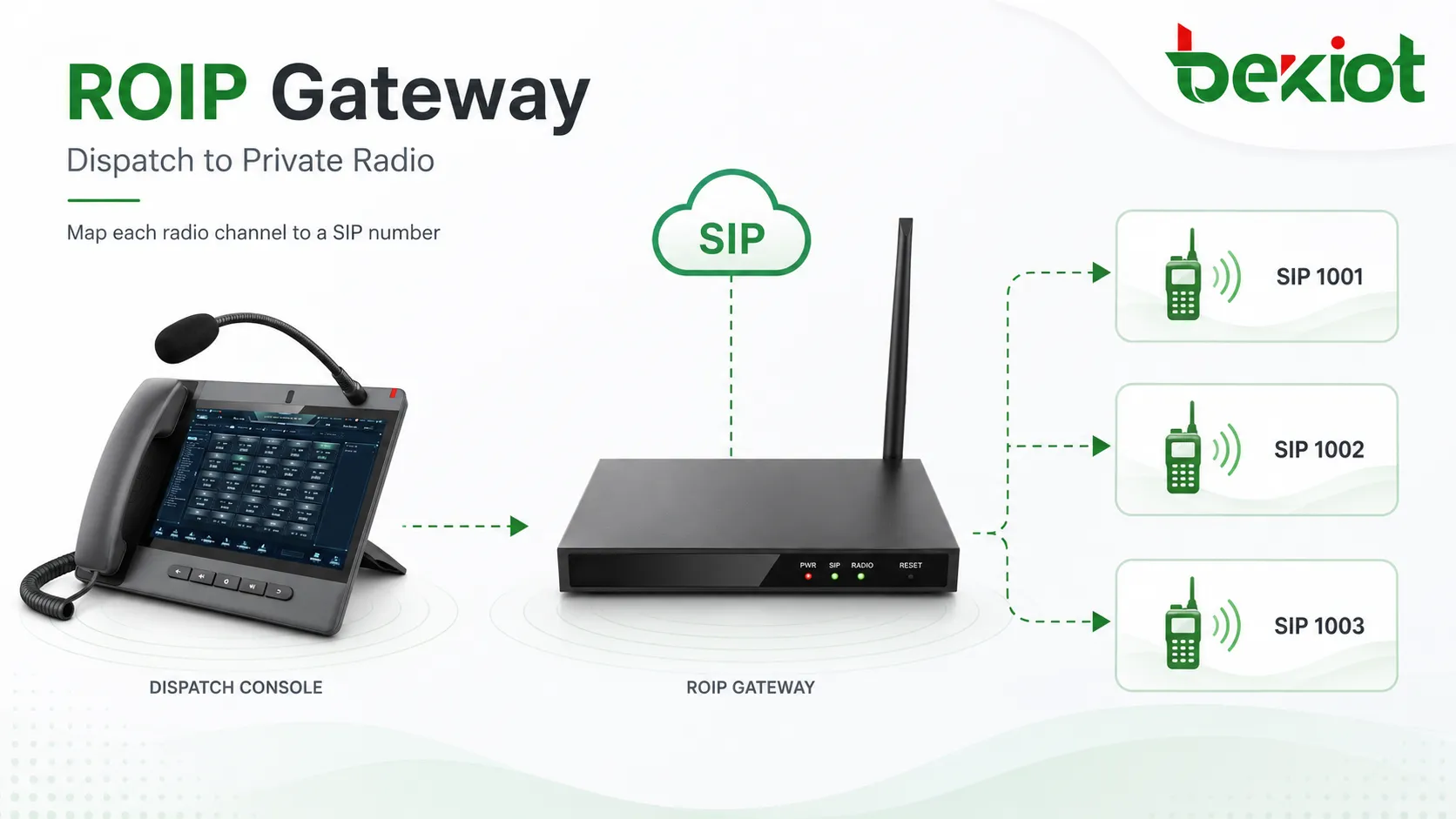
How the call path works in this model
On the radio side, the gateway uses defined physical and electrical interfaces to connect with mobile radios, handheld radios, or other radio terminals. A common radio interface may include audio input, audio output, PTT control, COR detection, ground, and other signal definitions through a multi-pin connector. These signals allow the gateway to handle both voice transmission and radio control logic.
On the IP side, the gateway registers or connects to the dispatch platform through SIP. The dispatch platform treats the radio channel as a callable SIP endpoint. This design allows radio channels to become part of the same numbering plan as dispatch extensions, IP phones, intercom terminals, and other SIP devices.
The important technical point is that the gateway must bridge two different communication habits. SIP phones and dispatch consoles usually expect full-duplex voice, while radio users press PTT, speak, release, and wait for a response. The gateway manages activation, audio direction, and signaling conversion so that the two systems can communicate in a more natural way.
In project design, the call path should be documented clearly. The document should show which SIP number maps to which radio channel, which dispatch group is allowed to call that channel, whether calls are recorded, and what priority rules apply during emergency communication. Clear documentation reduces confusion during daily operation and speeds up troubleshooting when a channel has no audio or cannot transmit.
Mode two: linking private radio with public-network push-to-talk
The second common usage is private-radio-to-PoC interconnection. PoC means Push-to-Talk over Cellular. It uses public mobile networks such as 4G and 5G to provide group calling, dispatch communication, mobile positioning, multimedia coordination, and remote team communication through smart terminals or dedicated PoC devices.
PoC is attractive in emergency command, mobile dispatch, security management, logistics, public services, industrial operation, and large-area coordination because users can communicate without building a private radio network from the beginning. It can cover wider geographic areas through existing mobile networks and can offer more flexible dispatch features.
However, PoC cannot fully replace private radio in many special industries. Private radio systems may still be required for reliability, local coverage, emergency backup, dedicated spectrum use, existing operational habits, or industry regulations. This creates a practical need: the public-network push-to-talk system and the existing private radio system must talk to each other.
In this mode, the ROIP gateway connects the radio channel to the dispatch system or PoC platform so that users on a private radio channel can communicate with PoC users in the same dispatch group. This helps create a public-private integrated communication environment without forcing the user to abandon the existing private radio investment.
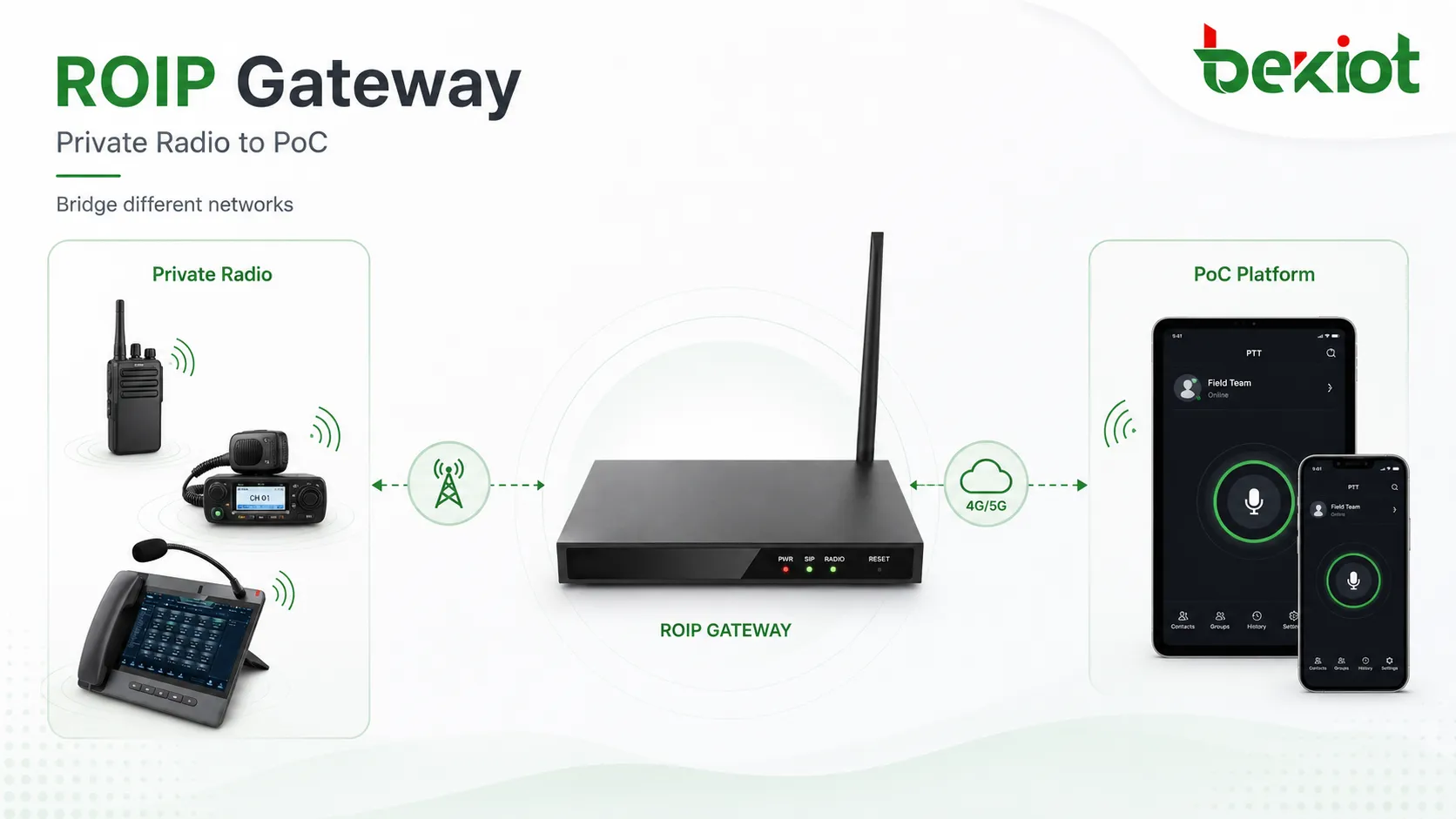
Managing push-to-talk logic across two systems
Private-radio-to-PoC interconnection is more complex than simple voice access. The gateway does not only pass audio between two sides. It must also manage the push-to-talk behavior, including who has speaking priority, when the talk right is occupied, when the talk right is released, and how the system avoids two sides transmitting at the same time.
This is especially important because both private radio and PoC systems are usually half-duplex. Only one side should speak at a time in the same group. If the gateway does not handle PTT logic correctly, users may experience clipped audio, blocked speech, delayed release, or confusing group communication.
A well-designed integration should support configurable activation and release behavior. In SIP-based scenarios, the gateway can work with SIP signaling and audio streams. In non-SIP scenarios, integration may require platform interfaces or control protocols so that the gateway can synchronize push-to-talk status with the dispatch platform.
The talk-right rule should be designed according to the operating scenario. In routine operations, first-come-first-served access may be acceptable. In emergency command, the dispatch console or authorized commander may need higher priority. For public safety or industrial emergency response, priority control can prevent important instructions from being blocked by ordinary group calls.
Deployment factors that affect stability
Before deployment, the project team should identify the type of radio system, channel quantity, dispatch platform architecture, SIP registration mode, audio level requirements, PTT trigger method, COR detection method, network conditions, and power supply environment. These details directly affect whether the final system is stable and easy to maintain.
Channel mapping is another key design point. Each radio channel should have a clear name, SIP number, dispatch group, and operational purpose. For example, one channel may be used for maintenance, another for security, another for emergency response, and another for tunnel or plant operation. Clear mapping helps dispatch operators call the right team quickly.
Audio tuning should also be handled carefully. Radio audio levels, dispatch platform gain, codec selection, noise environment, and microphone distance may all affect voice clarity. If the audio level is too low, dispatch users may hear weak or unclear speech. If it is too high, distortion may occur. Field testing is therefore necessary before project acceptance.
Network planning should not be ignored. When the ROIP gateway is deployed across different buildings, sites, or network segments, the project should consider bandwidth, delay, packet loss, firewall policy, VLAN planning, and secure remote management. Voice communication is sensitive to unstable networks, so the gateway should be placed in a network environment suitable for real-time audio transmission.
Operation and maintenance considerations
A reliable ROIP solution should be easy to operate after deployment. Dispatch staff should know which virtual channel represents which radio group, and maintenance staff should be able to check gateway registration status, network connection, audio input, audio output, PTT status, and radio-side signal detection.
For large systems, it is useful to prepare a channel table, wiring table, IP address table, SIP account table, and fault recovery procedure. These documents make later maintenance easier, especially when the system is handed over from the project team to the customer’s daily operation team.
Remote management can also reduce maintenance pressure. If a gateway supports web configuration, status monitoring, log export, and remote parameter adjustment, engineers can diagnose many problems without immediately visiting the site. This is valuable for tunnels, industrial parks, ports, power facilities, and other distributed environments.
Recommended solution approach
For projects that only need dispatch operators to talk to existing radio channels, the voice interworking model is usually sufficient. It is simple, direct, and easy to understand. The dispatch platform calls a SIP number, the gateway connects to the radio channel, and the radio users hear the dispatch voice.
For projects that need unified group communication between private radio users and public-network PoC users, the second model is more suitable. It supports broader communication integration and helps build a public-private converged dispatch system. This is valuable for emergency response, urban operations, industrial parks, transportation, energy facilities, and large organizations with mixed communication networks.
In some advanced projects, both modes can be used together. The command center may use SIP voice access for direct radio channel calling, while also allowing PoC users and private radio users to communicate in shared dispatch groups. This hybrid approach keeps the private radio system in service while adding the flexibility of IP dispatch and mobile-network push-to-talk communication.
The final selection should be based on communication goals rather than only on device quantity. If the requirement is simple radio access, the solution can remain lightweight. If the requirement includes multi-team dispatch, remote mobile users, priority command, recording, and emergency linkage, the project should be planned as a converged dispatch communication architecture.
Practical selection checklist
Use voice interworking when dispatch operators need to call existing radio channels from a SIP-based command platform.
Use PoC interconnection when private radio users and public-network push-to-talk users need to communicate in one dispatch environment.
Check radio compatibility including analog radio, DMR, PDT, TETRA, marine radio, aviation radio, or other special radio systems.
Plan channel mapping so every radio interface has a clear SIP number, group name, and operational purpose.
Test PTT and COR behavior before acceptance to avoid talk-right conflict, delayed release, or lost audio.
Verify audio quality through real field testing instead of relying only on configuration values.
Prepare maintenance documents including channel tables, wiring records, SIP accounts, IP addresses, and emergency recovery steps.
FAQ
Can a ROIP gateway connect both analog and digital radio systems?
Yes. The actual compatibility depends on the radio interface and integration method. Many projects use ROIP gateways to connect analog radios, digital trunked systems, and other industry radio terminals through defined audio and control interfaces.
Does a dispatch platform need to replace the existing radio network?
No. One of the main benefits of ROIP integration is that the existing radio network can remain in use while being connected to an IP-based dispatch platform or public-network push-to-talk system.
Why is PTT control important in this type of integration?
PTT control determines when the radio side transmits and when it releases the channel. Without proper PTT and talk-right management, users may experience blocked speech, delayed responses, or overlapping communication.
Is SIP required for every ROIP integration project?
SIP is common because many command dispatch platforms are SIP-based. However, some projects may also require non-SIP interface integration, depending on the dispatch platform and the push-to-talk system being connected.
Which industries commonly need this solution?
This solution is often used in emergency command, public safety, transportation, tunnels, industrial parks, energy facilities, ports, security operations, utilities, and other environments where private radio and IP dispatch systems must work together.
What should be tested before project acceptance?
The acceptance test should cover SIP registration, channel calling, PTT activation, COR detection, two-way audio quality, group communication delay, priority behavior, recording, network stability, and recovery after power or network interruption.







