


5G smart mining is not only about faster wireless coverage underground or across mining areas. Its real value appears when high-bandwidth, low-latency, and mobile connectivity are converted into practical applications for safety production, remote collaboration, emergency response, and intelligent operation. Among these applications, video is one of the most important capabilities because it allows the command center to see field conditions, verify incidents, guide workers, and coordinate resources in real time.
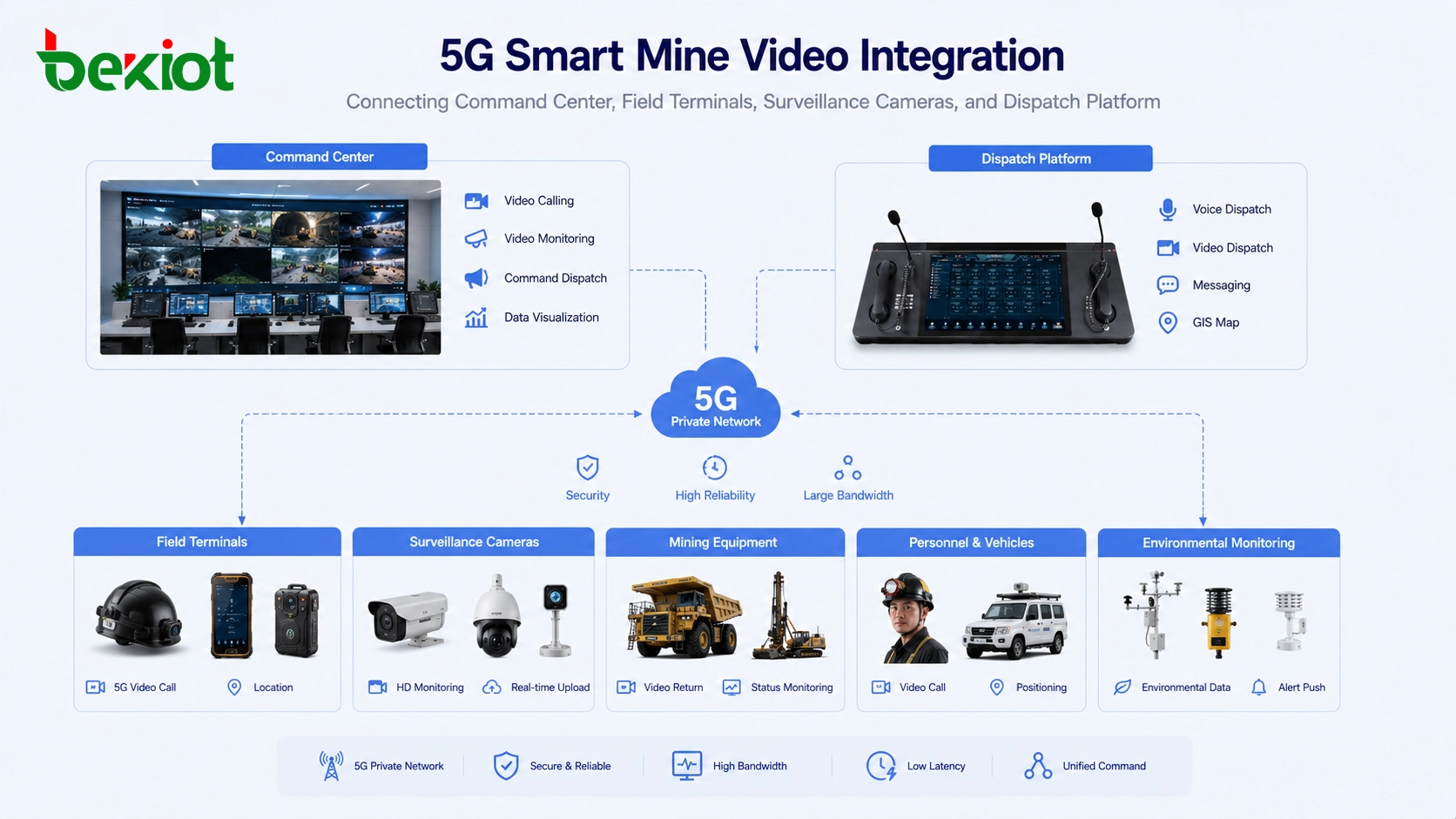
A modern smart mine may need point-to-point video calling, mobile video return, video consultation, live streaming, surveillance access, camera resource sharing, and integration with intelligent inspection or analysis platforms. To achieve this, the video system should not remain isolated. It should be connected with the 5G private network, communication terminals, dispatch consoles, video surveillance platforms, and business applications through a unified command and dispatch architecture.
Related Solution: Becke Command Dispatch System
Why video becomes a high-value application
Smart mine construction usually covers many systems, including private 5G networks, industrial IoT, unmanned driving, emergency communication, personnel positioning, production scheduling, and intelligent monitoring. These systems all depend on stable communication transmission, but video places higher requirements on bandwidth, latency, mobility, and platform integration.
Compared with traditional voice-only communication, video gives the command center more direct situational awareness. When a safety event, equipment fault, tunnel inspection, transportation issue, or emergency rescue task occurs, operators can use live video to understand what is happening before making decisions. This reduces dependence on verbal descriptions and helps improve command accuracy.
The high bandwidth and low latency of 5G make video applications more practical in mining scenarios. Field workers can use smart terminals to send video back to the command center. Fixed video terminals can support remote consultation. Surveillance cameras can be accessed through the dispatch platform. Video resources can also be connected with intelligent applications for inspection, event review, and safety analysis.
Building real-time visual communication
One important capability is point-to-point video communication over the 5G private network. Through mobile applications, VoLTE-based video calling, smart handheld terminals, or fixed desktop video terminals, users can communicate visually between the field and the command center.
This is useful when a dispatcher needs to confirm a field situation with a worker, maintenance engineer, safety officer, or inspection team. Instead of relying only on voice, the worker can show the equipment, tunnel condition, vehicle status, warning sign, or surrounding environment through live video.
In a mining environment, this type of video call can support routine operation, equipment maintenance, safety inspection, remote guidance, and emergency communication. It also allows experts outside the site to participate in problem diagnosis without entering the mining area physically.
Turning mobile terminals into field video sources
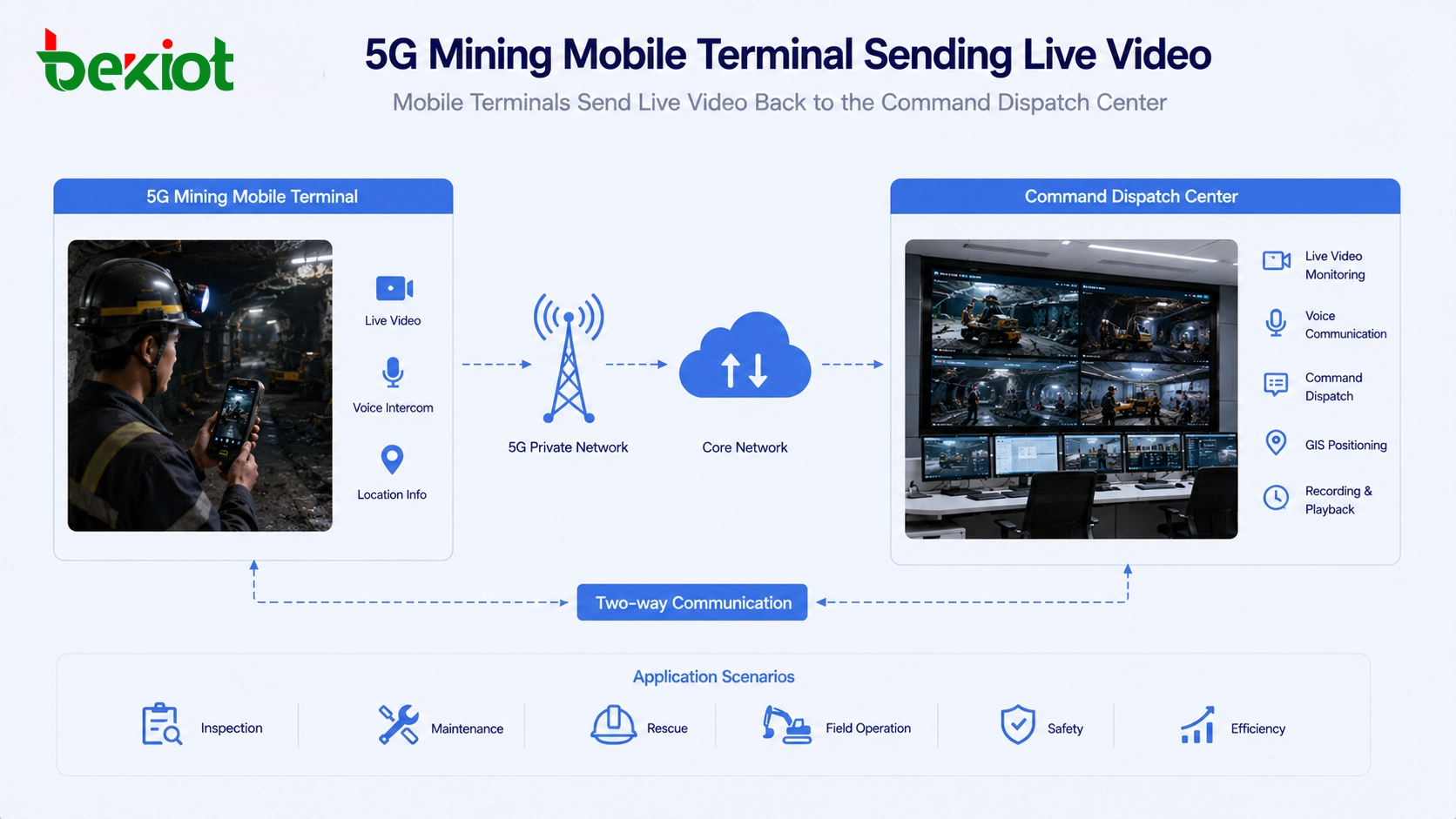
A 5G smart mine should not limit video capability to fixed cameras. Mobile terminals can become flexible field video sources. When workers carry 5G smart terminals, rugged tablets, body-worn devices, or mobile dispatch terminals, the command center can receive first-person video from the actual work location.
This mobile video return capability is especially valuable in areas where fixed cameras do not provide enough coverage. Mining sites often include tunnels, working faces, transport roads, equipment rooms, temporary operation zones, and remote corners. A mobile terminal can quickly provide visual information from places where fixed monitoring is unavailable or insufficient.
By combining mobile video with dispatch communication, the command center can call the field team, request live video, conduct remote guidance, and record the process. This creates a stronger connection between safety management, production coordination, and emergency command.
Supporting consultation, streaming, and remote collaboration
Video capability in a smart mine is not limited to one-to-one calls. It can also support video consultation, video conferencing, and live streaming. When a complex technical issue appears, the command center can invite safety managers, technical experts, maintenance teams, and remote supervisors into the same visual communication session.
Video consultation helps solve problems that require multi-party judgment. For example, when equipment abnormality, geological risk, transport interruption, or emergency rescue coordination is involved, different departments may need to see the same live image and discuss the response plan together.
Live streaming is useful for command observation, remote supervision, training, inspection review, and emergency event tracking. Through 5G network transmission, video streams can be delivered from the field to the command center, mobile clients, or other authorized management platforms.
Connecting existing surveillance resources
Most mining projects already have video surveillance systems. These cameras may cover entrances, production areas, roads, dispatch rooms, conveyor belts, equipment zones, storage areas, and key safety points. In many cases, the goal is not to rebuild all video resources, but to connect existing monitoring systems with the 5G smart mine communication platform.
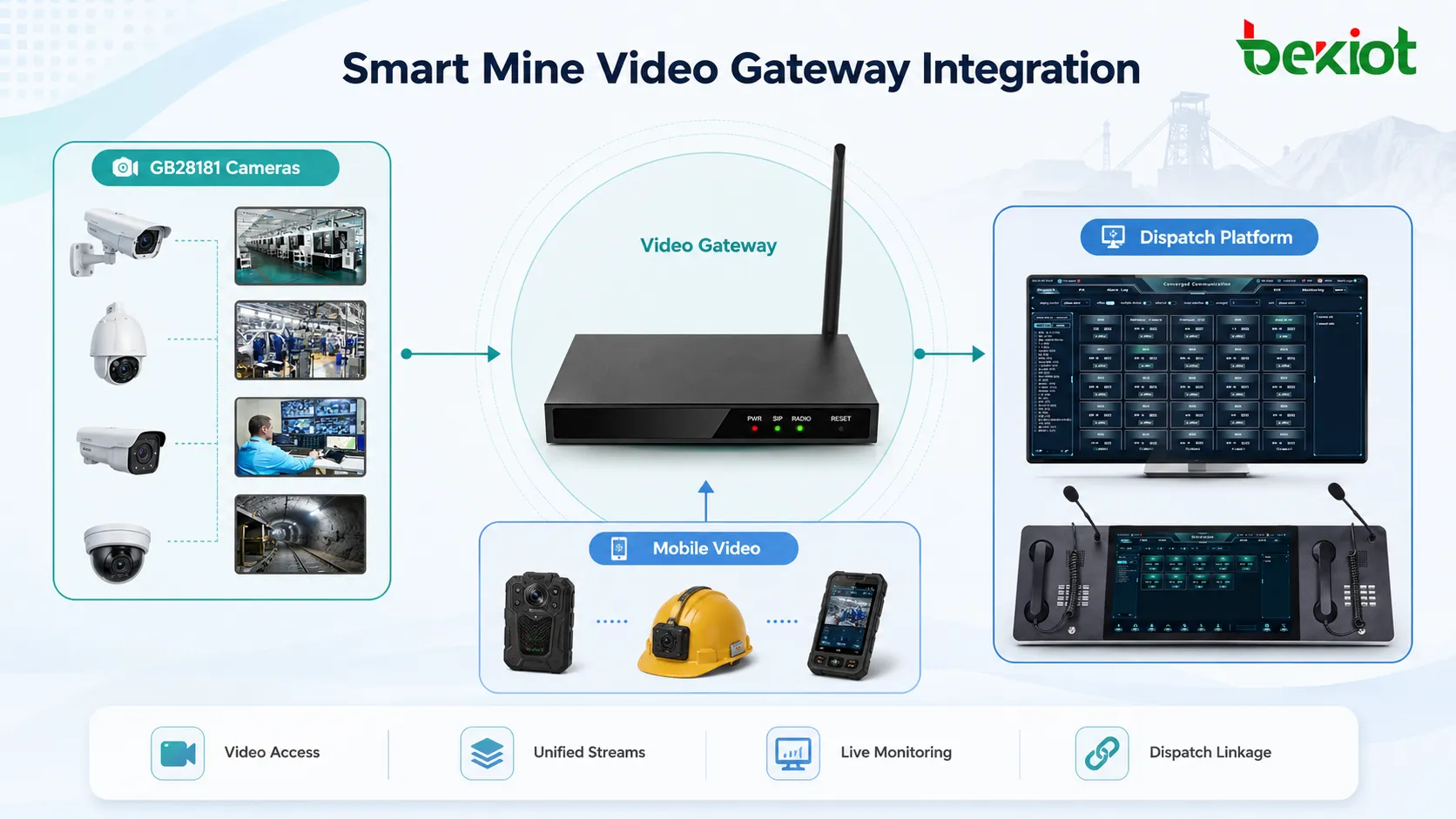
Through video access gateways or platform-level integration, existing surveillance systems can be connected to the command and dispatch platform. One important method is GB28181-based video access, which is widely used for video surveillance networking and camera resource interconnection.
After integration, dispatch operators can view surveillance video directly from the dispatch console. 5G smart terminals can also access authorized camera feeds when needed. This allows fixed monitoring, mobile video, and dispatch communication to work together instead of remaining as separate systems.
Using video gateways to unify different streams
Video resources in a mining project may come from different systems and formats. Some are fixed surveillance cameras, some are mobile terminal video streams, some are conference video sources, and some may be generated by business applications. A video access gateway can help convert, aggregate, and distribute these video streams to the command platform.
With suitable gateway integration, the command center can call up camera feeds, receive field video, support video consultation, and provide video resources to mobile applications. This makes the platform more useful for dispatching, inspection, intelligent analysis, and emergency handling.
In advanced applications, video streams can also be opened to mine business systems through APIs. For example, inspection applications can call camera feeds, intelligent analysis systems can process video data, and safety platforms can connect video with alarms or event records.
Making visual command part of daily operations
The purpose of video integration is not simply to display more camera images. The real goal is to make video part of the operational workflow. When an alarm occurs, the system should help the operator open related cameras, contact the responsible team, start a video call, review historical footage, and coordinate field response from one interface.
In production management, video can support remote inspection, equipment condition confirmation, transport route monitoring, and work progress verification. In safety management, video can support hidden-danger investigation, emergency drills, incident review, and rescue coordination. In maintenance scenarios, video can help experts guide field workers without being physically present.
This type of visual command improves the value of the 5G private network. Instead of being only a transmission channel, the network becomes the foundation for practical applications that directly support safer and more efficient mining operations.
Architecture planning for project implementation
A practical solution should begin with resource mapping. The project team should identify existing surveillance platforms, camera quantity, video protocols, terminal types, network coverage, command center requirements, mobile application needs, and business system interfaces.
The second step is to define integration paths. Point-to-point video communication can be handled through smart terminals and communication platforms. Surveillance access can be handled through GB28181 or video gateway integration. Video consultation can be connected with conferencing or dispatch functions. API output can be prepared for inspection, safety, and intelligent analysis applications.
The third step is field testing. Mining environments may have complex underground conditions, electromagnetic interference, moving vehicles, dust, humidity, and coverage challenges. Video quality, latency, terminal performance, camera access, dispatch operation, and network stability should be tested under real working conditions before acceptance.
Practical selection checklist
Use 5G private network capacity to support high-bandwidth and low-latency video applications in mining environments.
Support point-to-point video calls through mobile applications, VoLTE, smart terminals, or fixed video terminals.
Enable mobile video return for inspection, maintenance, rescue, safety supervision, and field command.
Integrate existing surveillance systems through GB28181 or video access gateway methods.
Allow dispatch consoles and 5G terminals to view authorized video resources when needed.
Prepare API integration for inspection applications, intelligent analysis platforms, alarm linkage, and business system expansion.
Recommended solution approach
For a 5G smart mine, the recommended approach is to build a converged video communication architecture. The system should not treat video calls, mobile video return, video conferencing, surveillance monitoring, and intelligent applications as separate projects. Instead, these capabilities should be connected through the command and dispatch platform.
In the first phase, the project can focus on basic video communication and mobile video return. In the second phase, existing surveillance platforms can be connected through GB28181 or video gateway access. In the third phase, video streams can be opened to inspection, safety, emergency, and intelligent analysis systems through API-based integration.
This phased construction method reduces deployment risk and protects existing investment. It also allows the 5G private network to generate real business value through visible, operational, and measurable applications.
FAQ
Can 5G video be used underground in mining areas?
Yes, but it depends on 5G private network coverage, antenna deployment, terminal capability, and environmental conditions. Underground areas should be tested carefully because tunnel structure, equipment movement, and shielding conditions may affect signal quality.
Does a smart mine need to replace its existing camera system?
Not necessarily. In many projects, existing surveillance systems can be integrated into the new command platform through video gateways, GB28181 access, or platform interfaces.
Why is mobile video return useful for mining operations?
Mobile video return allows the command center to see locations that fixed cameras may not cover. It is useful for inspection, maintenance, rescue, accident confirmation, and remote technical support.
What is the role of GB28181 in this solution?
GB28181 is commonly used for video surveillance networking and platform interconnection. In smart mine projects, it can help connect existing camera resources with a dispatch or video management platform.
How can video support intelligent mine applications?
Video streams can be connected with inspection systems, safety platforms, alarm linkage, and intelligent analysis tools through APIs or platform integration. This allows video data to support more than manual monitoring.
What should be tested before acceptance?
Acceptance testing should include video call quality, mobile video return latency, camera access stability, GB28181 compatibility, terminal viewing permissions, dispatch console operation, API availability, and network performance under real mining conditions.







