Radio networks are often built at different times and for different operational teams. Security may use conventional UHF radios, maintenance may work on a DMR network, field personnel may rely on a public-network push-to-talk service, while the control room operates through SIP phones and dispatch software. Although each system works independently, users cannot communicate across them without an integration layer.
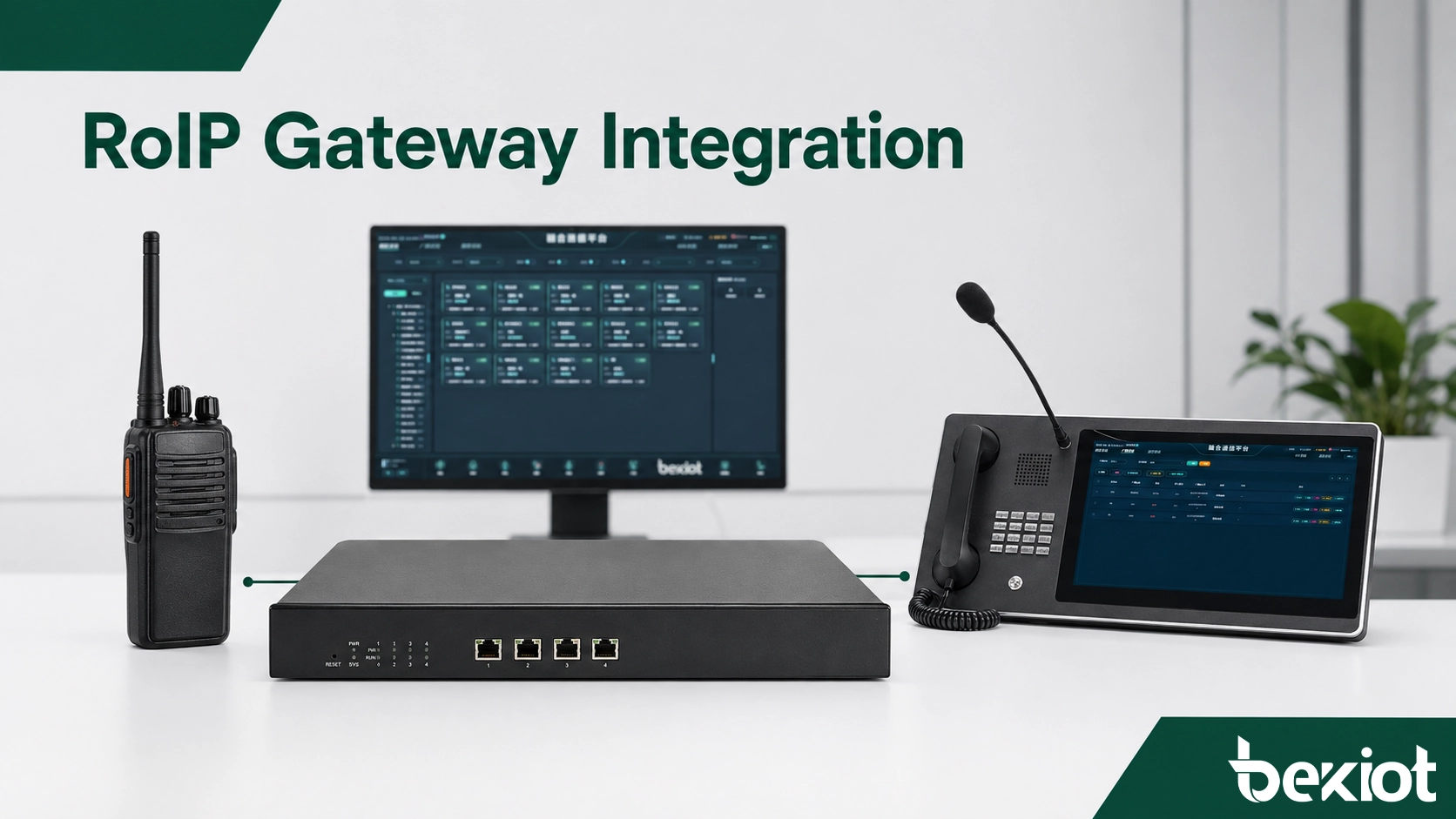
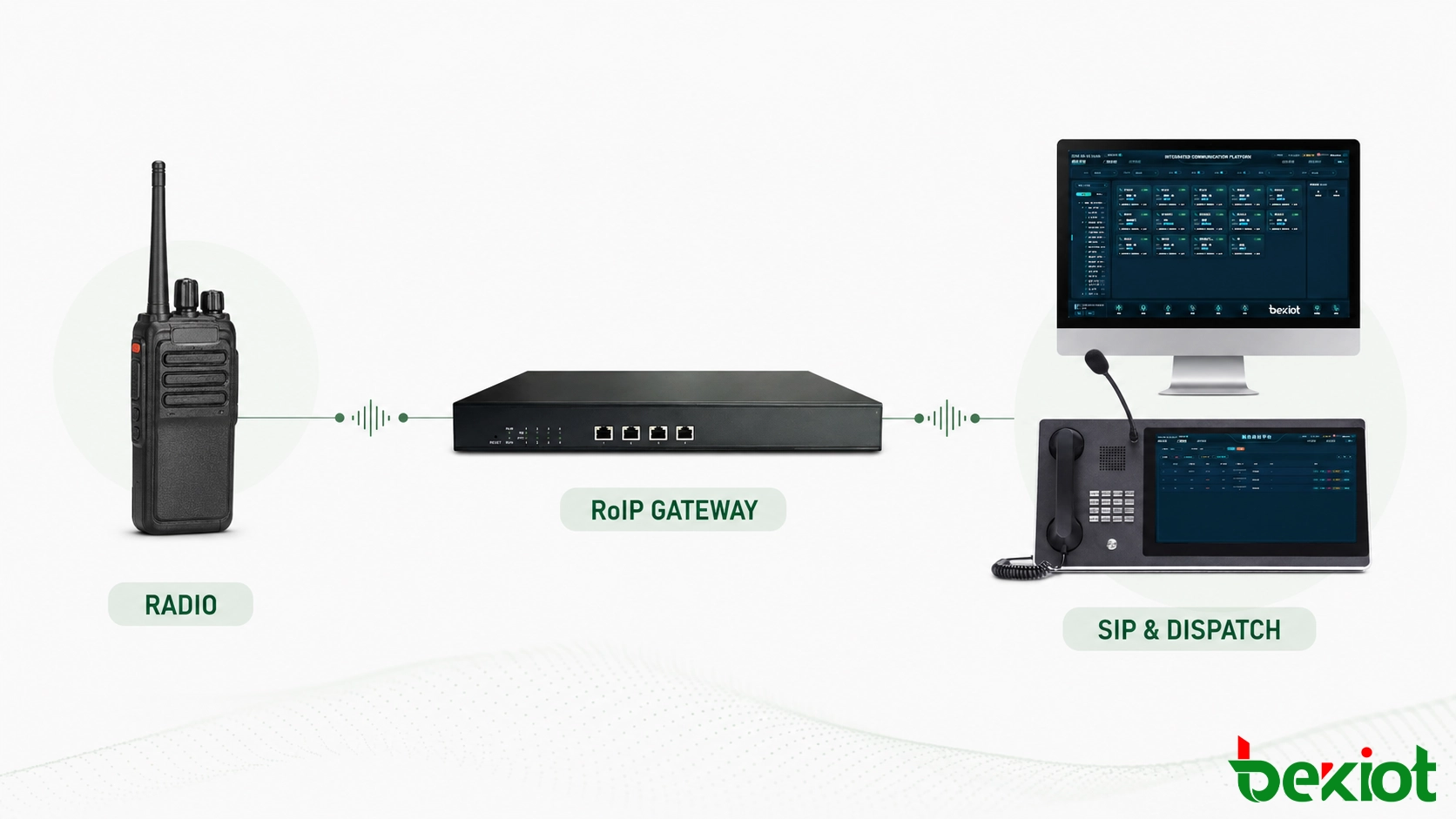
A Radio over IP gateway provides that connection. It links a radio or base station to an IP network, converts radio audio and push-to-talk control into network-based communication, and makes the radio channel available to SIP servers, dispatch consoles, recording systems and remote operators. This approach extends the useful life of existing radio infrastructure without requiring every radio network to be replaced.
The gateway does not replace the RF network itself. Frequencies, repeaters, antennas and radio coverage remain under the control of the existing radio infrastructure. RoIP extends access to those resources and provides a common communication path for systems that were originally designed to operate separately.
Why Radio Networks Need an Integration Layer
Radio systems are designed around different frequencies, channel structures, signaling methods and vendor protocols. A conventional analog radio cannot communicate directly with a DMR, PDT or TETRA network. The difference becomes even greater when a private radio system must exchange voice with SIP telephony or a cellular push-to-talk platform.
Developing a native interface for every radio protocol can be expensive and difficult to maintain. It may require access to proprietary signaling, software development kits and detailed knowledge of the radio network. Changes to the radio platform can also affect the integration.
A RoIP gateway takes a more practical approach. It connects to a compatible radio, mobile unit or base station and uses that radio as the access point to the channel. The gateway transports the audio and PTT state through the IP network, allowing the channel to be used by operators and applications in other locations.
Because the radio-side connection is largely independent of the air-interface technology, the same integration method can be applied to conventional radios, digital trunked systems, aviation radios, marine radios and HF communication equipment, provided that suitable audio and PTT interfaces are available.
Depending on the radio interface, the gateway may also monitor carrier-operated relay, squelch or channel-busy signals. These inputs help it distinguish valid radio traffic from background noise and prevent an IP user from transmitting while the radio channel is already occupied. Where such signals are unavailable, voice activity detection may be used, although it normally requires more careful adjustment in noisy radio environments.
Core Functions Available to Operators and Applications
Radio Audio and PTT Conversion
The gateway receives audio from the connected radio, converts it into an IP audio stream and sends it to authorized endpoints. In the opposite direction, audio from a dispatcher or SIP user is delivered to the radio while the gateway activates the transmitter through push-to-talk control.
PTT handling is particularly important because radio communication is normally half-duplex. The integration must control when a channel is transmitting, when it is receiving and when another user already holds the channel. Poorly coordinated PTT timing can clip the beginning of a message or cause two systems to transmit at the same time.
In an engineered deployment, PTT activation, transmitter preparation and audio transmission are handled as a timed sequence. A short lead-in period may be required before speech is sent, while the release delay must be long enough to carry the end of the message without keeping the channel unnecessarily occupied. These values should be tested with the actual radios rather than copied from a generic configuration.
SIP-Based Communication
SIP support allows a radio channel to appear as a communication resource within an IP PBX, unified communications platform or dispatch system. Depending on the system design, an operator may call a radio channel, place it in a talk group, include it in a conference or monitor it from a dispatch console.
This creates a controlled bridge between radio users and IP communication endpoints such as SIP phones, softphones, industrial intercoms and operator consoles. It also allows organizations to use existing IP networks for radio extension instead of installing long-distance analog audio lines.
SIP signaling and voice media should be considered separately during network design. A gateway may register successfully with the server while the RTP audio path is blocked by routing, firewall or NAT policies. Codec selection also affects bandwidth, delay and voice quality, so unnecessary transcoding between the gateway, server and dispatch client should be avoided.
Remote Access to Radio Resources
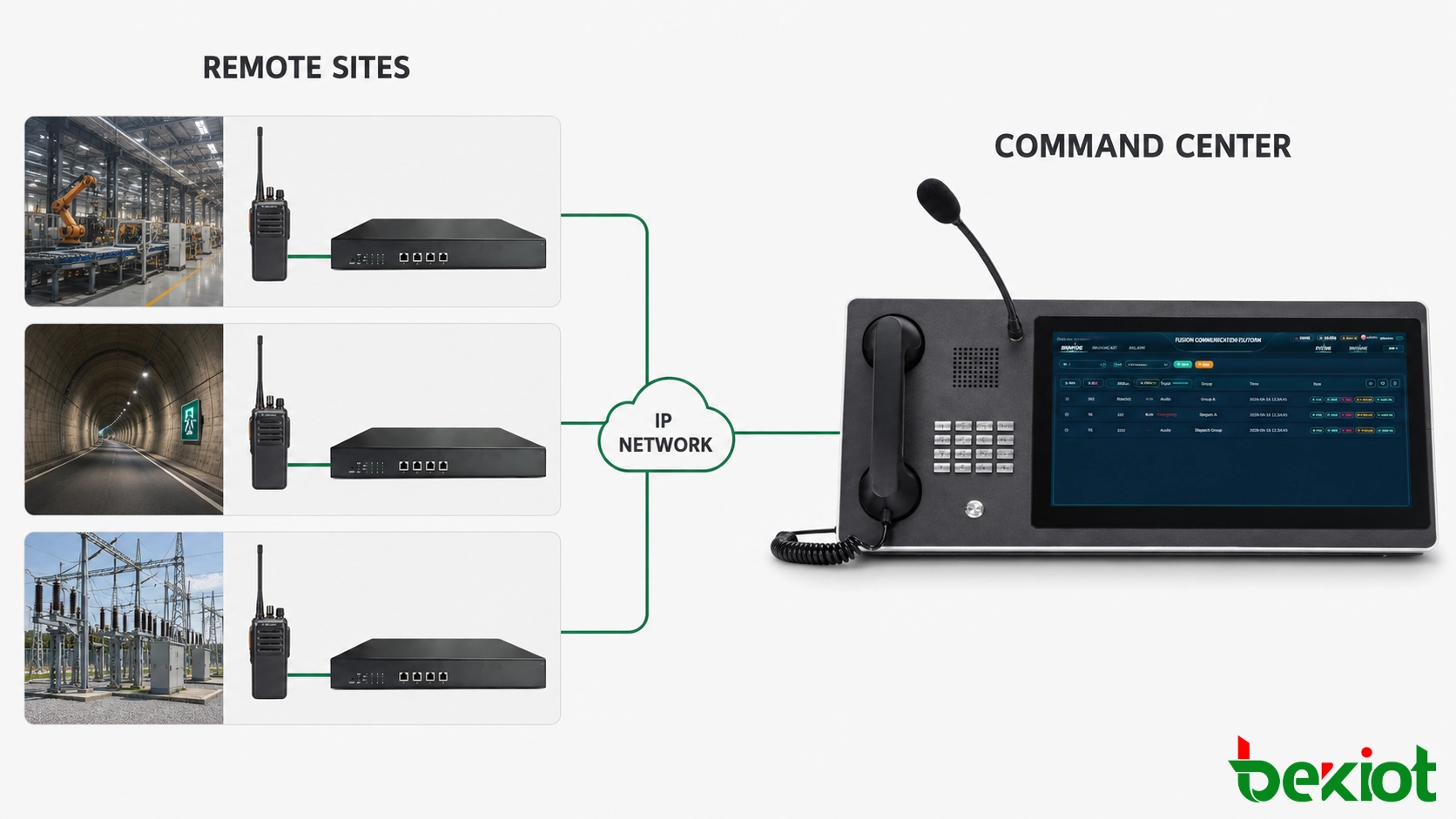
A radio no longer needs to be placed beside every dispatcher. The radio equipment can remain at a location with suitable antenna coverage, while operators access the channel from a control room in another building, city or region.
This is useful when antennas must be installed on rooftops, towers, tunnels or remote sites. It can also reduce the amount of radio equipment required at each operator position and simplify centralized management.
Multi-Site Channel Networking
Multiple gateways can be connected through an IP network to create a wider communication structure. A command center can monitor radio resources from several facilities, while authorized regional operators can access selected channels without being physically present at each radio site.
The network may use SIP registration, SIP trunks or dispatch-platform connections, depending on the required call control and operating model. Channel permissions should be defined carefully so that users see only the radio resources relevant to their responsibilities.
Capacity should be calculated by independently controlled radio paths rather than by handheld-radio quantity alone. A large user group may share one channel, while a smaller operation may require several channels to be monitored or transmitted on simultaneously. Each radio resource that needs independent concurrent access must have a suitable radio and gateway path.
Recording and Operational Supervision
Once radio audio is available on the IP side, it can be delivered to a compatible recording platform. This provides a more complete operational record when radio calls, telephone calls and dispatch communications need to be reviewed from the same system.
Gateways may also report connection, PTT or channel activity to a management platform. These status signals help technical teams identify whether a communication failure is related to the radio, gateway, IP network or central application.
For incident review, all gateways, dispatch servers and recording systems should use a common time source. Accurate time synchronization makes it possible to correlate radio traffic with alarm events, video footage and operator actions. Where supported, recordings should also retain the channel name, call direction and responsible dispatch position.
Related Product: Becke RoIP Gateways
A Practical Architecture for Command and Dispatch Centers
A typical solution contains four functional layers:
Radio layer: Conventional radios, DMR, PDT or TETRA terminals, aviation radios, HF equipment or radio base stations.
Access layer: RoIP gateways connected to radio audio, PTT and any supported control signals.
Network and control layer: LAN, WAN, VPN, SIP server, IP PBX or dispatch communication platform.
Application layer: Dispatch consoles, SIP phones, soft clients, recording servers, alarm platforms and management applications.
When a dispatcher selects a channel and presses PTT, the dispatch platform sends the voice stream and control request to the appropriate gateway. The gateway activates the connected radio and transmits the message over the radio network. Replies from field radios travel through the same path in reverse and are played at the operator console.
The architecture can be centralized or distributed. A centralized design places call control and recording at the main command center. A distributed design keeps gateways and selected communication services at local sites, reducing dependence on a single wide-area link. The correct structure depends on network reliability, operational responsibility and the required failure behavior.
For critical sites, the design should define what remains available if the WAN, SIP server or primary dispatch position fails. Local radio-to-radio communication should remain independent wherever possible. Redundant power, secondary network paths, backup dispatch positions and local fallback services can be added according to the required availability level.
Connecting Private Radio, PoC and Automated Workflows
Public-network push-to-talk, commonly called PoC, is increasingly used by mobile teams that need wide-area coverage. Private radio systems remain valuable in factories, utilities, transport operations and emergency response because they provide dedicated channels and can continue operating where public mobile coverage is limited.
Integrating these two environments is not straightforward. They use different call-control methods, identity systems and media paths. A simple back-to-back arrangement may connect a PoC terminal to a private radio terminal through their external audio interfaces. This can be useful for temporary operations, but additional audio stages and independent terminals may increase delay and create more points of failure.
For permanent deployments, the preferred design is to connect the PoC platform and the radio gateway through a supported network interface or dispatch platform. The integration should coordinate talk-permission requests, PTT release timing and busy-channel behavior. Operators on both sides should be able to communicate without manually controlling two separate terminals.
The bridge must also define how competing transmission requests are handled. If radio and PoC users press PTT at nearly the same time, the platform needs a clear arbitration rule. Priority may be assigned by user role, emergency status or the order in which the requests arrive. Without this logic, overlapping commands can create clipped audio or leave users uncertain about who controls the channel.
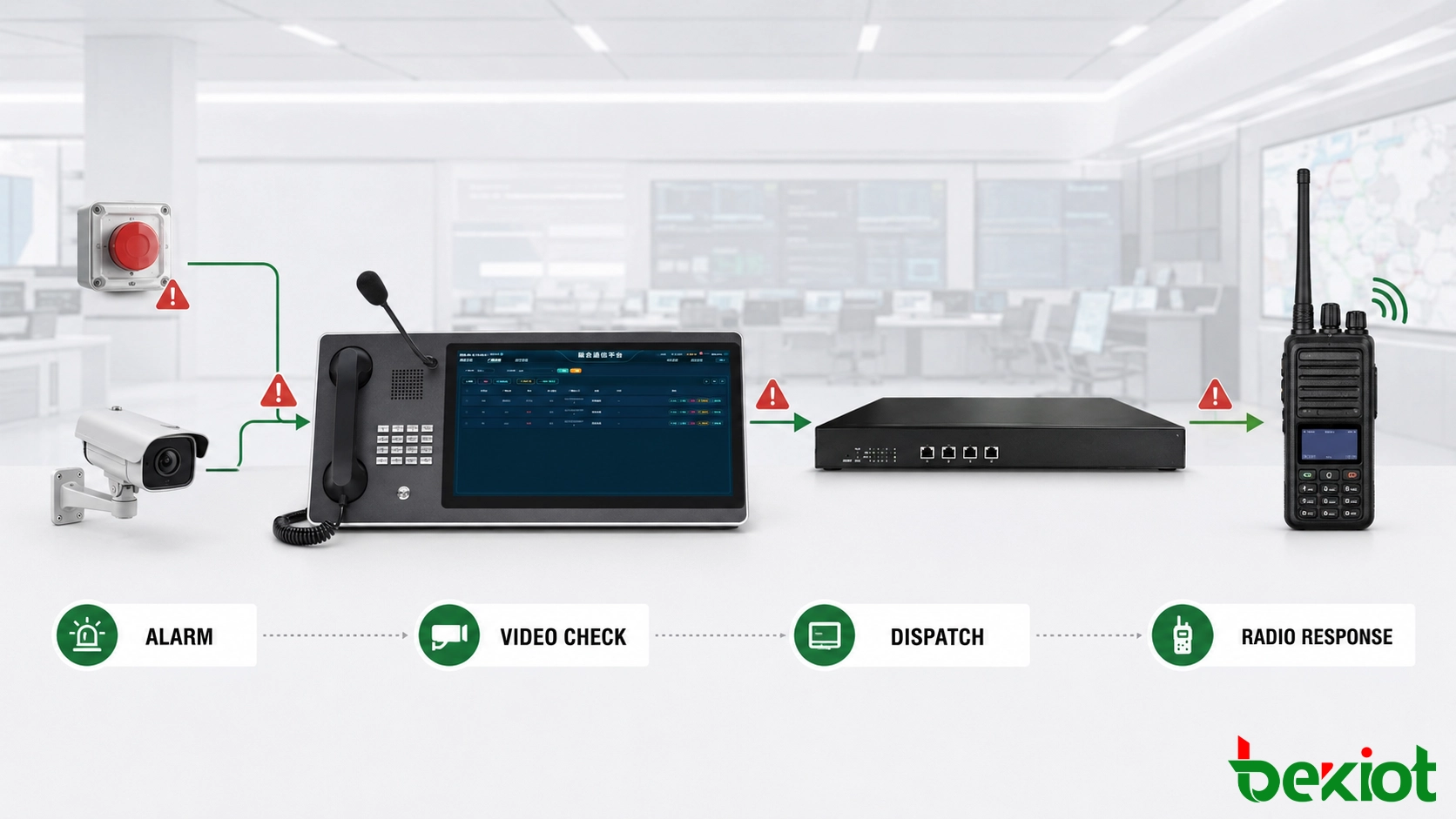
RoIP can also form part of an automated response workflow. When a fire alarm, access-control event, equipment fault or emergency button is activated, an alarm platform can send an event through an API, MQTT message or another supported interface. The communication platform then applies predefined rules, such as:
Calling a designated radio talk group.
Playing a recorded warning over selected radio channels.
Alerting the dispatch console and responsible personnel.
Opening the associated camera view for verification.
Recording the voice session and event-handling process.
This type of integration connects radio communication with alarms, video surveillance and command applications. The gateway does not make operational decisions by itself; it provides the communication path used by the workflow.
Technical Limits and Deployment Decisions
A basic radio connection normally carries voice, receive audio and PTT control. It does not automatically expose every feature available inside a digital trunked radio system. Functions such as private calls, text messaging, radio identification, emergency signaling, GPS location and remote channel selection require additional radio-side signaling, a supported control interface or integration with the radio network infrastructure.
This distinction should be confirmed before equipment is selected. If the project only requires group voice communication between radio users and dispatchers, audio-and-PTT integration may provide a practical and economical solution. If the command center must display individual radio IDs, locations or emergency states, deeper integration is required.
The following factors should be reviewed during solution design:
Radio compatibility: Confirm available audio, PTT, accessory and control interfaces for each connected radio.
Channel requirements: Identify which channels must be monitored and which require simultaneous transmission access.
Audio quality: Adjust input and output levels to prevent low volume, distortion, noise and echo.
PTT timing: Test transmission activation and release delays so that messages are not clipped.
Network performance: Evaluate latency, jitter, packet loss and bandwidth across every communication path.
Failure behavior: Define what happens when a gateway, central server or WAN link becomes unavailable.
Access control: Restrict channel monitoring and transmission privileges by user, role and location.
Integration scope: Document whether the project needs voice only or additional radio signaling and data.
Acceptance testing: Test normal calls, busy channels, simultaneous events, network interruption, recovery and recording.
Network acceptance should be based on the complete end-to-end path rather than a simple connectivity test. Engineers should confirm that audio remains intelligible during normal network loading, that jitter buffers do not introduce excessive delay, and that packet loss does not cause repeated words or gaps. Firewall rules must also permit both SIP signaling and the negotiated media ports.
A successful RoIP project begins with an inventory of existing radio resources and operational workflows. The gateway should then be selected according to the required interfaces, call-control method and integration depth. Starting with those requirements prevents a voice-only connection from being mistaken for full digital radio control.
Frequently Asked Questions
Can a RoIP gateway operate through a VPN?
Yes. A VPN is commonly used when gateways and dispatch servers are located on different private networks. The VPN must provide suitable latency, routing and security policies for real-time audio and SIP traffic.
How many gateways are required for a radio project?
The quantity depends on the number of radio resources that must be independently accessed. Each channel or radio path requiring simultaneous operation normally needs its own controllable connection. Shared or switched-radio designs may reduce hardware requirements but can limit concurrent access.
Can the system continue working if the WAN connection fails?
It can if local fallback is included in the design. Local radio communication may remain available even when the central dispatch connection is lost, while distributed servers or local operator positions can provide additional resilience.
Should radio traffic be encrypted on the IP network?
Sensitive deployments should protect signaling, voice traffic and management access using the security functions supported by the complete system. Network segmentation, VPNs, strong authentication and restricted administration are also important.
Does installing a gateway change the radio coverage area?
No. Radio coverage still depends on the connected radio system, antenna position, transmission power, terrain and surrounding structures. The gateway extends access to the radio resource over the IP network, but it does not increase RF coverage by itself.