


China Mobile HeDuiJiang is a public-network Push-to-Talk over Cellular service. It uses mobile operator networks and dedicated smart intercom terminals to provide wide-area group communication. Compared with a traditional private radio system, this type of PoC communication is easier to deploy, requires less dedicated radio infrastructure, and is attractive for many field teams, patrol users, public service units, and temporary project groups.
However, public PoC platforms are often operated as closed service platforms. They are designed for terminal-to-terminal group communication inside the operator ecosystem, not for deep customer customization or direct integration with third-party command dispatch platforms. In many emergency communication, industrial dispatch, public safety, utility, transportation, and security projects, users still need to connect PoC intercom terminals with a unified dispatch system, IP phones, SIP consoles, private radio channels, and other communication resources.
Why Integration Is Needed in Dispatch Projects
PoC intercom is convenient for mobile users because it depends on cellular data networks and cloud platform services. Field personnel can press the PTT key and talk with members in the same group without building a private repeater network. This makes it useful for wide-area work coordination, temporary teams, logistics, security patrols, municipal service, and emergency support.
The limitation appears when the project requires cross-system communication. A command center may already use a dispatch platform, SIP phones, recording servers, private radio channels, video systems, alarm linkage, GIS maps, and duty consoles. If the PoC platform stays isolated, dispatchers cannot easily call, monitor, record, or coordinate those PoC users from the central system.
For this reason, the practical requirement is not only “using PoC intercom.” The real requirement is to make PoC intercom part of a converged communication workflow. Operators should be able to talk with PoC groups, receive voice from field users, bridge public and private radio resources, and manage response actions from the same dispatch interface.
The Practical Role of a RoIP Gateway
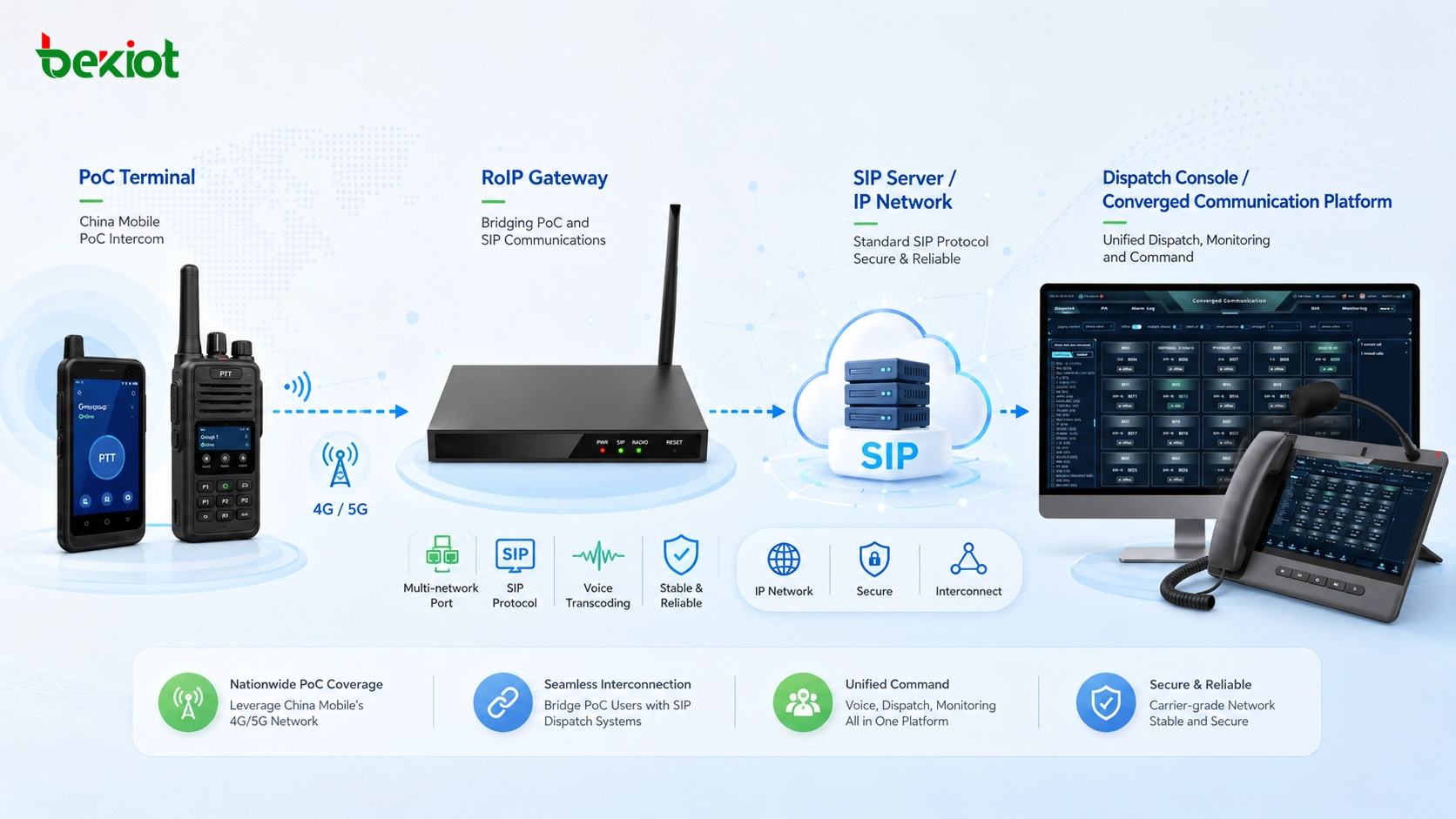
A RoIP gateway provides a practical method for connecting public PoC terminals to command dispatch systems. In this type of solution, the PoC terminal is connected to the gateway through a dedicated cable interface. The gateway receives voice and control signals from the intercom terminal and then converts the communication into SIP or IP-based voice resources.
The original article describes a typical hardware connection method using a 9-pin aviation connector. Through this connector, the RoIP gateway can interface with the PoC intercom terminal, receive voice input and output, handle PTT control, and convert the terminal-side intercom audio into SIP communication. After that, the dispatch system can call the corresponding gateway port and communicate with the PoC group.
This approach avoids the need to modify the public PoC platform itself. Instead of asking the operator platform to open deep integration interfaces, the gateway works at the terminal access layer. It turns a physical PoC terminal into an IP-dispatch-accessible communication channel.
Related solution: /roip/
How the Connection Works
The working principle is straightforward. The RoIP gateway is connected to a PoC intercom terminal through a matching cable. The terminal remains logged into the operator’s PoC group, while the gateway connects to the command dispatch system as a SIP or IP voice device.
When the dispatcher needs to talk to the PoC group, the dispatch console calls the port number assigned to the RoIP gateway. After the call is connected, the gateway automatically activates the PoC terminal and transmits the dispatcher’s voice to the PoC group. The field users hear the dispatcher just like they hear another intercom user in the same group.
The communication also works in the reverse direction. When a PoC group member speaks, the RoIP gateway receives the terminal-side voice and sends it to the dispatch system. The IP dispatch terminal, SIP phone, or command console can then hear the PoC group audio in real time.
Typical System Components
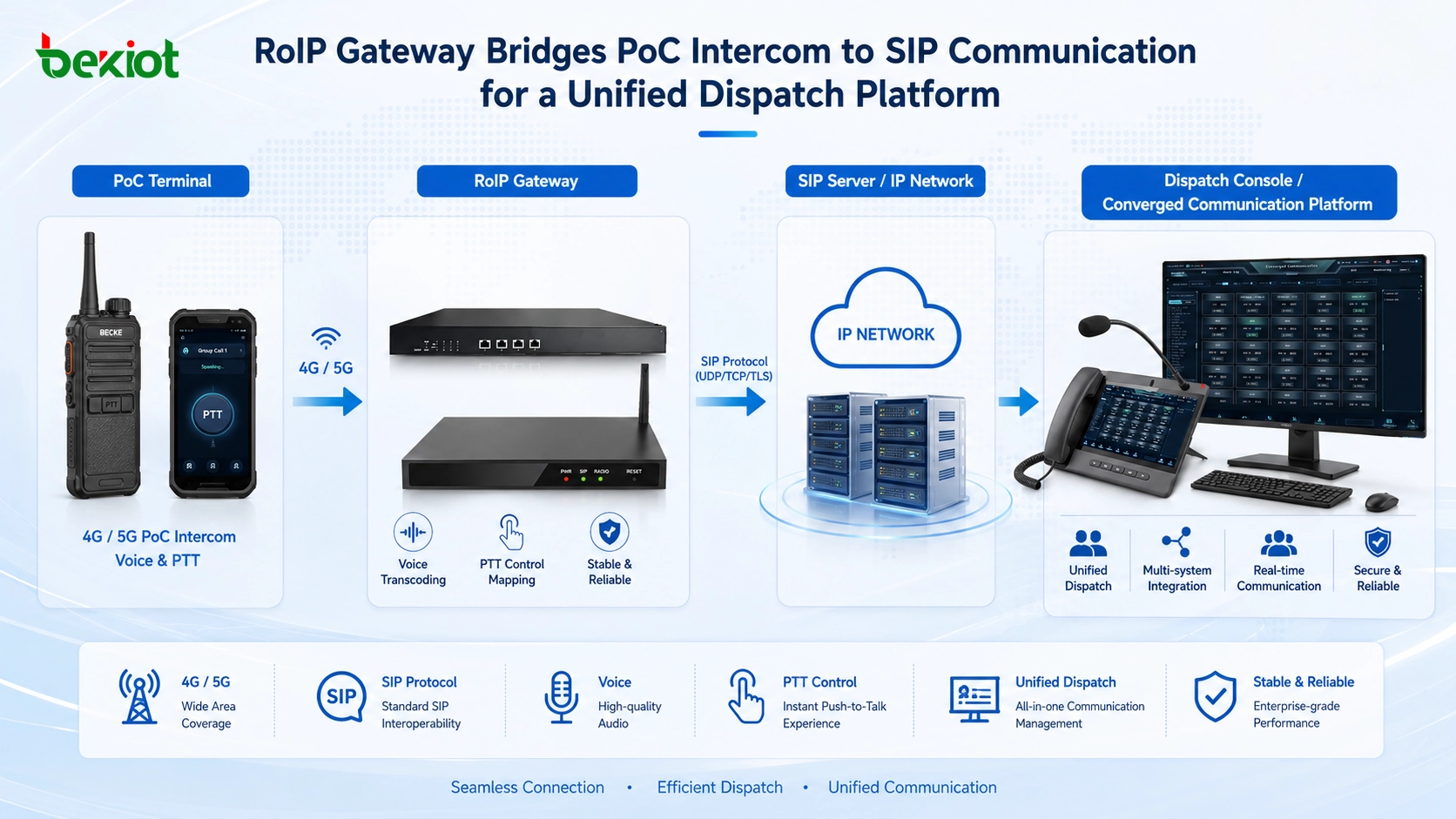
A complete access solution usually includes the PoC intercom terminal, a matching terminal cable, a RoIP gateway, an IP network, a SIP server or dispatch platform, and operator-side PoC service coverage. The PoC terminal stays responsible for communication with the public PoC group, while the gateway is responsible for protocol and audio conversion.
The dispatch system does not need to understand the internal operating logic of the PoC platform. It only needs to manage the gateway port as a callable communication resource. This simplifies integration and allows existing dispatch platforms to communicate with operator-based PoC users.
| System Element | Main Function | Deployment Notes |
|---|---|---|
| PoC intercom terminal | Connects to the public-network intercom group | Requires operator network coverage and an active PoC service account |
| Custom connection cable | Links terminal audio and control pins to the gateway | Must match the terminal model and interface definition |
| RoIP gateway | Converts terminal voice and PTT control into IP/SIP communication | Each port can usually be mapped to a dispatch resource or SIP number |
| Command dispatch system | Provides call control, dispatch operation, recording, and group communication | Can call the gateway port to reach the PoC group |
| IP network | Transports voice and signaling between gateway and dispatch platform | Should provide stable LAN/WAN connectivity and proper QoS planning |
Bridge Between Public and Private Radio Groups
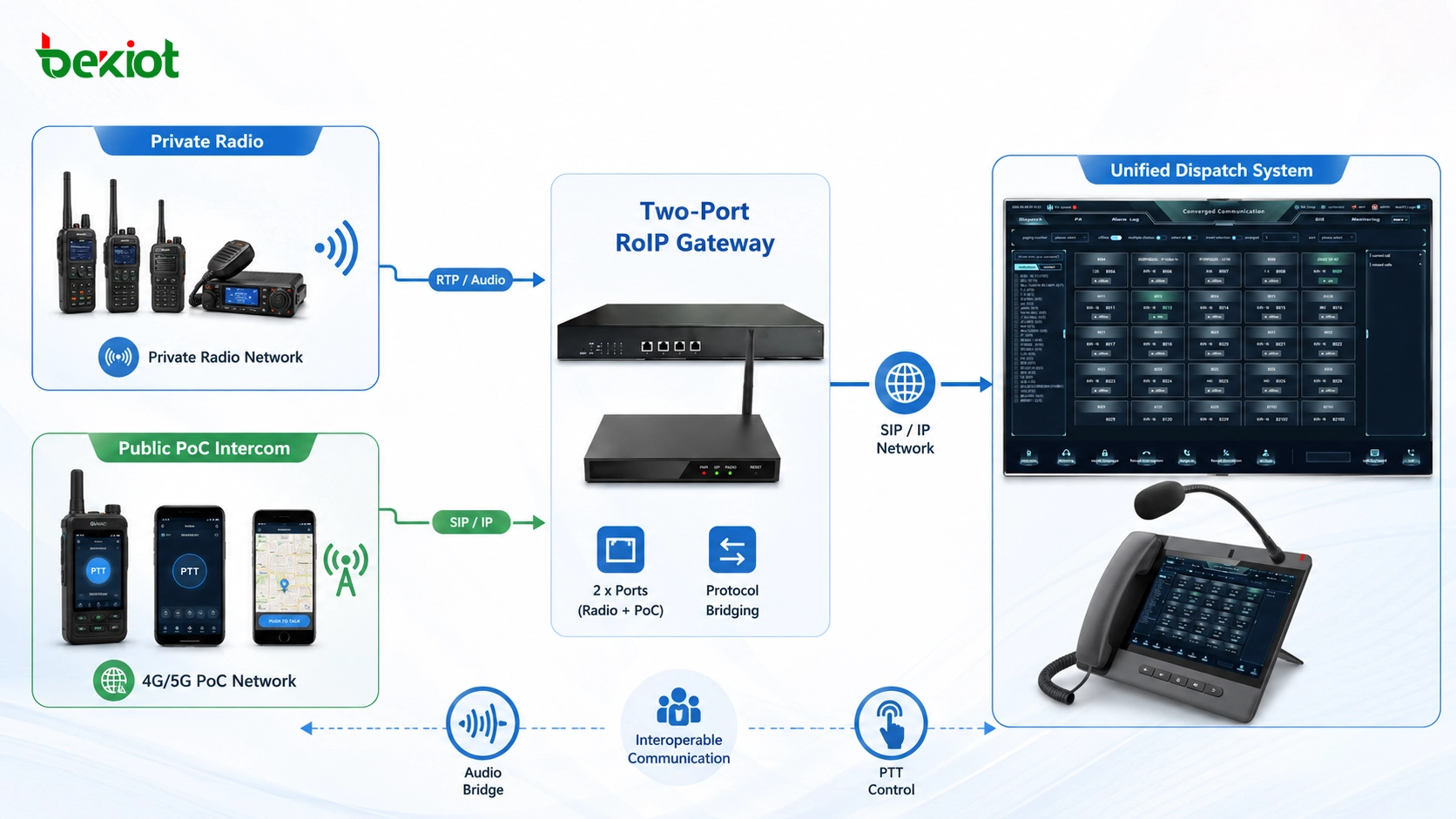
The same method can also be used to bridge public PoC intercom with private radio communication. In some projects, users already have private radio systems such as VHF, UHF, PDT, DMR, or other trunked radio channels. At the same time, another group of users may use public PoC terminals because they work across a wider area or do not have access to the private radio network.
A two-port RoIP gateway can support a simple and useful bridging model. One port is connected to a private radio terminal, and the other port is connected to a public PoC intercom terminal. After the parameters are configured in the gateway or dispatch platform, the two radio groups can communicate with each other without changing user habits.
In this model, private radio users continue using their existing radios, while PoC users continue using their public-network intercom terminals. The gateway handles cross-system audio and control conversion. This is especially useful for emergency response, public safety coordination, industrial site support, temporary events, and projects where several communication systems must work together.
Operation Flow in the Dispatch Center
From the dispatcher’s point of view, the workflow should remain simple. The command center does not need to operate the PoC terminal manually every time. The dispatcher selects or calls the gateway port from the dispatch console. Once connected, the gateway activates the corresponding PoC terminal channel and creates a voice path between the dispatch system and the PoC group.
This operation model is suitable for duty rooms and command centers because it keeps the communication process close to normal dispatch calling. The operator does not need to hold a separate PoC terminal, switch between systems, or manually relay messages between different groups.
When combined with a converged communication platform, the same dispatch interface may also manage SIP phones, industrial telephones, private radios, RoIP channels, emergency call points, paging systems, and recording resources. Becke Telcom converged communication system can be considered in projects that need this type of cross-network voice dispatch, radio integration, and unified command workflow.
Network Architecture for Field Deployment
A typical architecture includes the public PoC terminal on one side and the command dispatch network on the other side. The PoC terminal communicates with its original operator platform through the mobile network. The RoIP gateway connects locally to the terminal through a cable and connects upstream to the dispatch platform through IP networking.
For single-channel projects, one gateway port may correspond to one PoC group. For larger projects, multiple gateway ports can be used to connect several PoC terminals, private radio channels, or special communication groups. The dispatch system can then assign these resources to different departments, incident types, duty seats, or response workflows.
When designing the network, engineers should confirm IP address planning, SIP registration settings, port mapping, audio codec selection, PTT timing, network delay, recording requirements, and failover strategy. Although the access principle is simple, project reliability depends on careful configuration and testing.
Benefits for Converged Communication Projects
The biggest benefit is interoperability. A closed public PoC platform can be connected to a command dispatch system without rebuilding the entire communication system. This helps project teams protect existing terminal investment while still improving command center control.
The second benefit is simple implementation. By using gateway access and custom cables, the project can adapt to different PoC terminals and private radio models. This reduces the need for platform-level customization and makes field deployment easier.
The third benefit is operational consistency. Dispatchers can handle PoC users, private radio users, and IP voice users from one platform. This improves response efficiency, reduces manual message relay, and makes communication records easier to manage.
| Application Need | Gateway-Based Solution | Project Value |
|---|---|---|
| Connect PoC users to dispatch center | Map PoC terminal to a RoIP gateway port | Dispatch console can call and talk with PoC group |
| Bridge private and public intercom | Use two gateway ports for private radio and PoC terminal | Different radio groups can communicate without changing terminals |
| Integrate closed PoC platform | Access through terminal audio and control interface | Reduces dependence on platform API customization |
| Simplify field deployment | Use custom cables and port configuration | Adapts to multiple terminal models and project environments |
| Improve dispatch management | Route audio into a unified communication system | Supports centralized operation, recording, and incident coordination |
Engineering Considerations
Before deployment, engineers should confirm the exact PoC terminal model, connector definition, audio input and output levels, PTT control method, gateway port quantity, SIP registration mode, and dispatch platform compatibility. Different terminal models may require different custom cables, so interface verification is important.
Audio tuning is also necessary. If the input gain is too high, the dispatch side may hear distortion. If the output gain is too low, field users may not hear the dispatcher clearly. Engineers should test both directions of communication, including dispatcher-to-PoC voice and PoC-to-dispatch voice.
PTT timing should be tested carefully. Some terminals need a short activation time before transmitting audio. If the gateway opens audio too quickly, the first syllable may be clipped. If the delay is too long, the communication experience may feel slow. Proper gateway configuration can improve natural operation.
Where This Solution Is Useful
This solution is suitable for emergency command centers, urban management, transportation operations, industrial parks, energy sites, security dispatch, temporary event support, public service coordination, utility maintenance, and projects that already use public PoC terminals but need command-center integration.
It is also suitable for hybrid communication environments. For example, an emergency team may use private radios inside a local site, while external support teams use PoC terminals across a wider area. A RoIP gateway can connect both sides so that the command center can coordinate them through one dispatch system.
In many real projects, the most important value is not the gateway device alone. The value lies in making isolated communication resources usable inside a coordinated command workflow. Once PoC, private radio, SIP voice, and dispatch terminals can work together, the command center gains a clearer and more controllable communication structure.
Conclusion
Connecting China Mobile HeDuiJiang or similar PoC intercom services to a command dispatch system is practical when a RoIP gateway is used as the access bridge. The gateway connects to the PoC terminal through a dedicated interface, receives voice and PTT control, converts the communication into SIP or IP voice, and allows the dispatch system to call and communicate with the PoC group.
The same method can also bridge private radio and public PoC groups. With a two-port RoIP gateway, one port can connect to a private radio terminal and another port can connect to a PoC terminal, allowing two originally separate communication groups to interoperate. This provides a simple, flexible, and project-friendly method for solving the access problem of closed public-network intercom platforms in converged communication systems.
FAQ
Does a RoIP gateway require changes to the public PoC platform?
Usually no. The gateway-based method works through terminal-side voice and control access. It does not depend on deep modification of the public PoC cloud platform, which makes it easier to deploy in practical projects.
Can one gateway connect multiple PoC groups?
Yes, if the gateway has multiple ports and each port is connected to a separate PoC terminal or channel. Each terminal can remain in a different group, and the dispatch system can manage them as different communication resources.
What should be checked before making a custom cable?
Engineers should confirm the terminal connector type, pin definition, audio input and output levels, PTT control pins, ground reference, and whether the terminal needs special accessory detection. Incorrect wiring may cause poor audio or failed transmission.
Can PoC and private radio users talk at the same time?
They can interoperate through the gateway, but the actual communication behavior depends on the radio systems involved. Many PTT systems are half-duplex, so speaking order, PTT timing, and gateway control logic should be tested before formal deployment.
Is this solution suitable for emergency command applications?
Yes, but it should be tested under real operating conditions. Emergency projects should verify network availability, audio clarity, gateway stability, power backup, recording, dispatch permissions, and fallback communication methods.







