



Packet Loss Concealment, usually shortened to PLC, is an audio processing technique used in VoIP, SIP phones, IP intercoms, dispatch systems, paging platforms, video calls, radio-over-IP gateways, and other real-time communication systems. Its purpose is to reduce the audible impact when voice packets are lost, delayed too long, or arrive in a way that cannot be played correctly. In IP communication, voice is divided into small packets and transmitted through the network. If some packets disappear, the receiver no longer has a complete audio stream.
Without PLC, packet loss may sound like clicks, gaps, robotic speech, broken words, sudden silence, or unstable voice. In ordinary office calls, this may be annoying. In industrial telephones, emergency calls, control room communication, public safety systems, or dispatch conversations, it may affect understanding and response. PLC does not remove the network problem itself, but it helps the audio system hide or smooth the missing parts so that speech remains more understandable.
What PLC means in voice communication
PLC is a receiver-side audio repair method. When a voice packet is missing, the receiving device or software cannot wait too long, because real-time communication must continue. Instead of stopping playback completely, PLC estimates what the missing sound should be like based on the audio before and sometimes after the loss. It then fills the gap with a generated or adjusted audio segment.
This process is different from retransmission. In file transfer, a lost packet can be sent again because time is not critical. In a live voice call, waiting for retransmission may create delay that is more harmful than the loss itself. PLC accepts that the original packet may be gone and tries to make the missing part less noticeable.
The effectiveness of PLC depends on the codec, packet size, packet loss pattern, jitter buffer design, device processing ability, and type of speech. It works best when packet loss is short and occasional. If the network loses too many packets for a long period, PLC cannot fully reconstruct the original voice. It is an audio continuity tool, not a replacement for good network design.
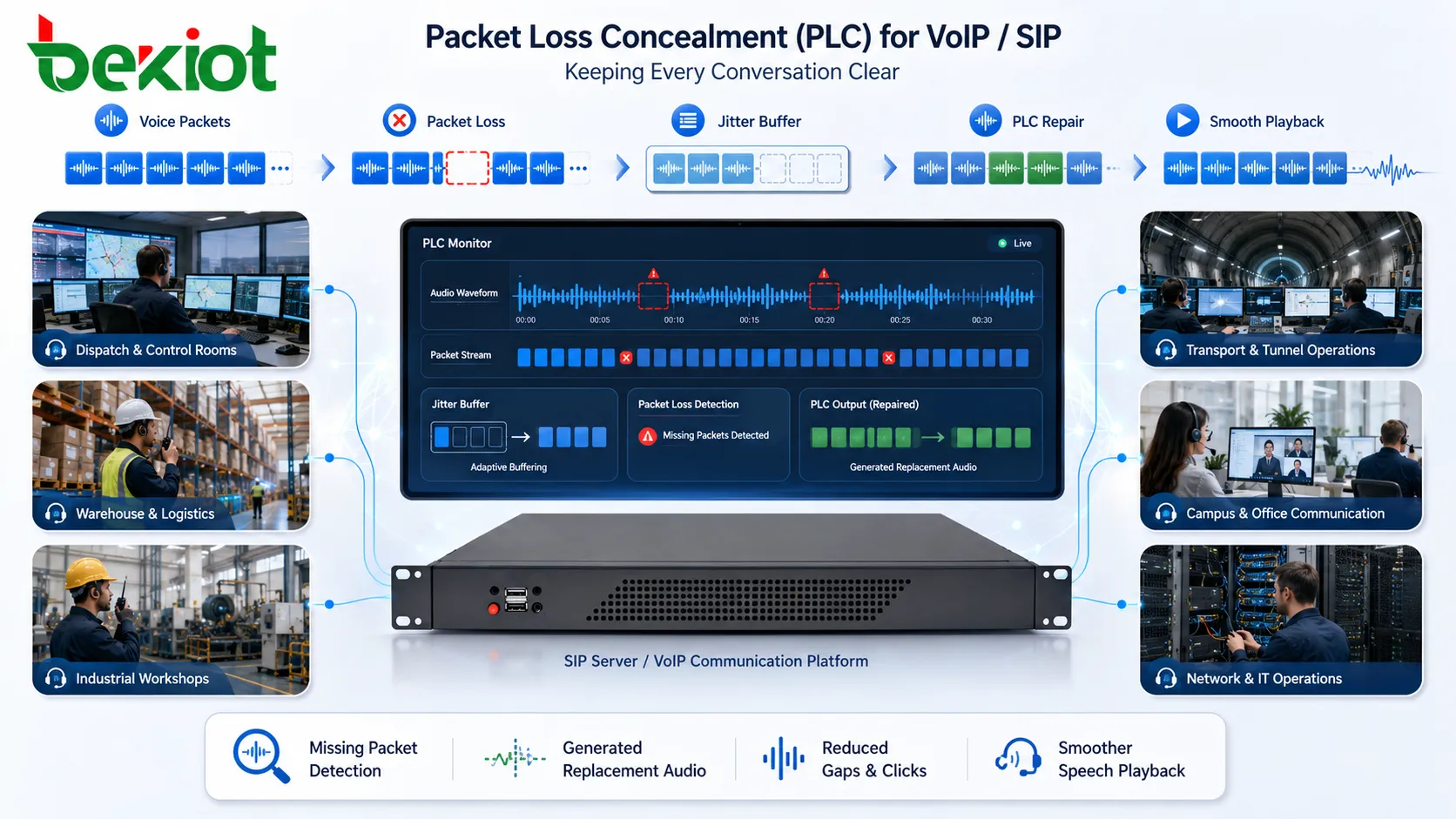
Core audio advantages
Reduces audible gaps
The most direct advantage of PLC is reducing audible gaps. When packets are lost without concealment, the listener may hear sudden silence or broken syllables. PLC fills these short gaps so that the voice continues more smoothly. The listener may still notice a slight change in quality, but the call feels less interrupted.
This is important because human speech depends on continuity. Even a short missing segment can make a word difficult to recognize. In fast conversations or emergency instructions, a missing word can change the meaning of the message. PLC helps preserve the flow of speech.
Improves speech intelligibility
PLC improves intelligibility by keeping more of the speech pattern recognizable. It may extend the previous sound, estimate a similar waveform, repeat a suitable frame, or apply codec-specific recovery logic. These methods help the ear follow the sentence even when the original packet is missing.
In practical communication, the goal is not perfect studio-quality audio. The goal is to help the listener understand the speaker quickly. For industrial calls, dispatch instructions, maintenance reports, and emergency communication, intelligibility is more important than perfect sound quality.
Reduces clicks and harsh artifacts
Packet loss can produce sharp clicks, pops, or abrupt transitions if the audio stream suddenly jumps from one frame to another. PLC smooths the transition around the missing part. This reduces harsh artifacts and makes the call more comfortable to listen to.
Listening comfort matters during long shifts or repeated dispatch communication. Operators who monitor many calls or handle frequent intercom conversations may become tired if the audio is constantly sharp and broken. PLC helps reduce listening fatigue caused by short packet loss events.
Maintains conversational rhythm
Real-time conversation depends on rhythm. If every lost packet creates silence or interruption, speakers may start repeating themselves, talking over each other, or assuming that the other side did not hear. PLC helps maintain a more natural rhythm by preventing small losses from breaking the call flow.
This advantage is especially useful in push-to-talk systems, command dispatch, call centers, and field communication, where short voice messages need to be received quickly. A smoother rhythm reduces the need for repeated confirmation.
How PLC works with other audio mechanisms
PLC rarely works alone. It usually operates together with jitter buffers, codecs, packet timing, echo cancellation, noise suppression, automatic gain control, and network QoS. The jitter buffer stores a small amount of incoming audio to absorb timing variation. If a packet arrives too late, the system may treat it as lost. PLC then fills the missing audio position so playback can continue.
The codec also matters. Some codecs include built-in PLC methods. Others rely more on the endpoint or media engine. Wideband voice codecs may have more audio detail to preserve, while narrowband codecs may be simpler but less natural. The processing method should match the voice system’s codec policy.
PLC also interacts with packetization interval. If each packet carries a longer audio segment, one lost packet removes more speech. If each packet carries a shorter segment, loss may be easier to conceal, but the network carries more packet overhead. System design should balance bandwidth, delay, packet loss behavior, and audio quality.
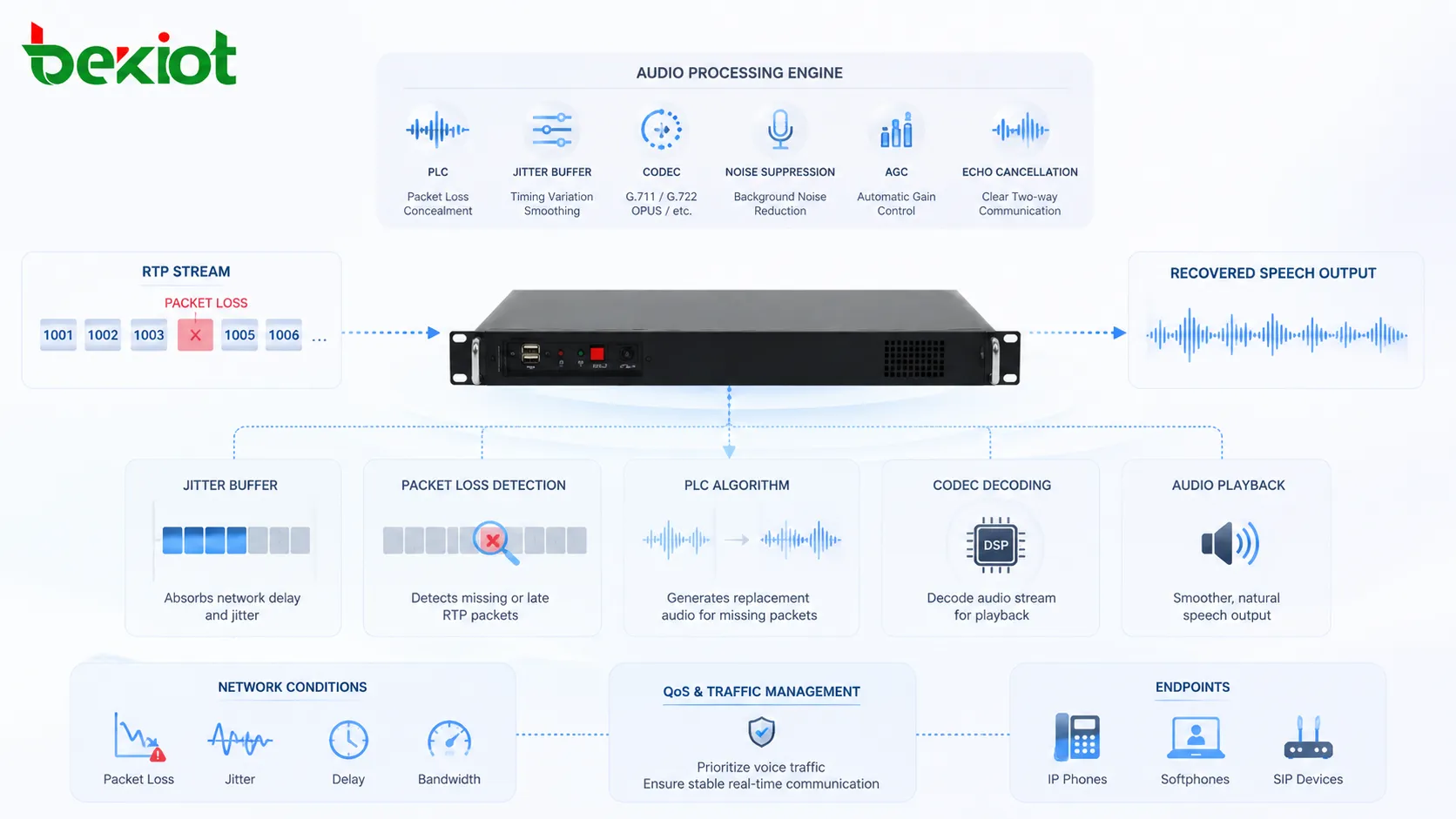
Value in real communication systems
VoIP phones and SIP endpoints
In SIP phones and VoIP endpoints, PLC helps maintain call quality when the LAN, WAN, Wi-Fi, or internet path is imperfect. A small amount of packet loss may occur because of congestion, wireless interference, routing changes, or overloaded links. PLC reduces the user’s perception of these short faults.
For office users, this improves daily call comfort. For industrial or service environments, it supports clearer communication between field points and control rooms. The endpoint still needs stable registration and proper network configuration, but PLC improves resilience when minor packet loss occurs.
Industrial telephones and emergency points
Industrial telephones and emergency call points may be installed in large facilities, tunnels, outdoor yards, parking areas, power rooms, production lines, or remote equipment areas. These locations may use long network paths or shared infrastructure. Packet loss can occur when the network is busy or unstable.
PLC helps prevent small packet loss from making urgent calls difficult to understand. A worker reporting a fault, a person using an emergency help point, or a security guard calling a control room needs speech to remain clear enough for quick response. PLC supports this requirement at the audio layer.
Dispatch and command platforms
Dispatch platforms often handle many real-time audio sessions, including group calls, intercom calls, emergency calls, radio gateway audio, and operator communication. Packet loss may affect not only one private conversation but also coordinated command work.
PLC improves the stability of received audio in these systems. It can make field reports easier to understand, reduce repeated questions, and help operators maintain focus. However, dispatch systems should also use QoS, controlled network paths, and monitoring. PLC is helpful, but it should not be the only protection.
RoIP and radio gateway communication
Radio-over-IP systems convert radio audio into IP streams and send it across networks. These systems are sensitive because radio speech is often short, operational, and sometimes already affected by background noise. Packet loss may make a short push-to-talk message hard to understand.
PLC can help smooth missing audio frames in RoIP paths. It improves listening continuity when packets are occasionally lost between radio gateways, dispatch consoles, or remote sites. Good timing and low delay are still important, especially for push-to-talk operation.
Advantages in industrial and noisy environments
PLC is especially valuable when audio is already difficult because of site noise. In a quiet office, the listener may tolerate a small gap more easily. In a noisy factory, tunnel, port, or utility site, a missing syllable may be harder to infer because the speaker’s voice is already competing with background sound.
By filling short gaps, PLC helps preserve enough speech structure for the listener to understand the message. It may not remove machine noise or improve microphone pickup directly, but it prevents network loss from adding another layer of damage. When combined with noise suppression and good acoustic design, PLC contributes to clearer industrial communication.
For emergency calls, this can be important. A field user may only have a few seconds to report location, hazard type, or required assistance. If key words are broken by packet loss, the operator may need to ask again. PLC reduces the chance that small network imperfections cause repeated communication.
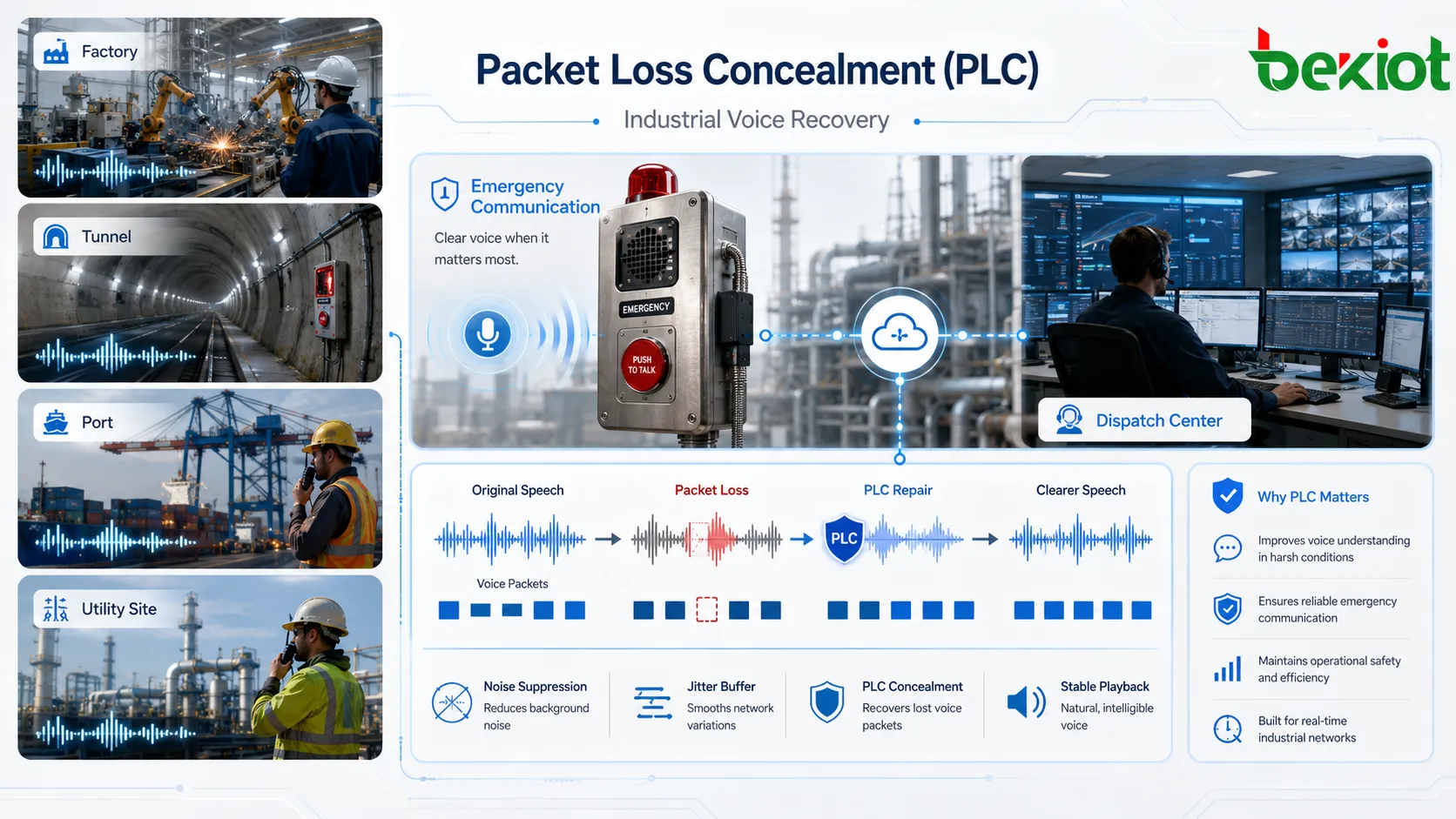
Limits and realistic expectations
PLC cannot recreate missing speech perfectly. It uses estimation, not the original lost data. When packet loss is short and isolated, the result may sound smooth. When loss is heavy, continuous, or bursty, PLC may produce stretched speech, artificial sound, repeated fragments, or temporary distortion.
PLC also cannot solve high delay, severe jitter, wrong codec configuration, overloaded servers, poor microphone quality, weak speaker output, or acoustic noise at the source. These problems need separate solutions. PLC is one part of audio resilience, not a complete call-quality strategy.
Another limit is that different devices and codecs may have different PLC performance. Some endpoints conceal losses naturally, while others produce more noticeable artifacts. When selecting communication equipment for important applications, audio testing under packet loss conditions can be useful.
Deployment and optimization considerations
The first step is to build a stable network. PLC should not be used as an excuse to ignore network quality. Voice VLANs, QoS, sufficient bandwidth, proper switch configuration, controlled Wi-Fi, stable WAN links, and monitored packet loss are still essential. PLC improves tolerance, but stable transport remains the foundation.
Second, choose suitable codecs and packetization settings. If the system uses codecs with strong PLC support, voice may remain more natural during minor packet loss. Packetization interval should be selected carefully because larger packets may increase the audible impact of a single loss.
Third, test actual endpoints and platforms. A SIP phone, industrial telephone, dispatch console, gateway, or intercom terminal may behave differently under packet loss. Laboratory specifications are useful, but real network simulation and field testing show whether the audio remains understandable.
Fourth, monitor call quality. Packet loss, jitter, delay, MOS-like indicators, RTP statistics, and user complaints should be reviewed together. If PLC is frequently active because the network is losing many packets, the root cause should be fixed rather than hidden.
Common misunderstandings
One misunderstanding is that PLC eliminates packet loss. It does not. Packet loss still occurs in the network. PLC only reduces the audible effect at the receiver. Engineers should still investigate the network if packet loss is frequent or severe.
Another misunderstanding is that PLC always improves audio naturally. Poor PLC implementation may create robotic or artificial sound. Good concealment should preserve intelligibility while avoiding distracting artifacts. This is why endpoint and codec quality matter.
A third misunderstanding is that PLC can replace QoS. It cannot. QoS reduces the chance that voice packets are delayed or dropped under congestion. PLC helps after loss has already happened. The two functions support different parts of voice quality.
Some users also assume that audio clarity depends only on the endpoint. In reality, the full path matters: microphone, codec, network, jitter buffer, PLC, speaker, and acoustic environment. PLC is useful, but it works best as part of a complete audio design.
Evaluation standards
PLC performance should be evaluated by speech intelligibility during packet loss, not only by whether audio continues. Testers should check whether words remain understandable, whether gaps are smooth, whether the voice becomes artificial, and whether the listener can follow the conversation without repeated clarification.
Testing should include different packet loss patterns. Random loss, short bursts, and network jitter may produce different results. A system that handles isolated loss well may still perform poorly under burst loss. Important communication systems should be tested under realistic network conditions.
Evaluation should also include delay and user experience. A system that hides loss but adds too much delay may harm conversation flow. The best result balances concealment, latency, natural sound, and reliability.
Closing Notes
Packet Loss Concealment provides important audio advantages in VoIP and IP-based communication systems. It reduces audible gaps, improves speech continuity, smooths harsh artifacts, supports conversational rhythm, and helps maintain intelligibility when packets are missing or unusable. For industrial telephones, SIP intercoms, dispatch systems, emergency phones, and RoIP gateways, these advantages can directly improve real-world communication reliability.
PLC is most effective when packet loss is short and occasional. It should be combined with good network design, QoS, suitable codecs, jitter buffer tuning, noise suppression, acoustic optimization, and regular monitoring. It cannot replace a stable network, but it can make voice communication more tolerant of unavoidable imperfections.
FAQ
What is Packet Loss Concealment?
Packet Loss Concealment is an audio processing technique that estimates or fills missing voice segments when packets are lost, helping real-time communication sound smoother and more understandable.
Does PLC recover the original lost packet?
No. PLC does not recover the original packet. It creates a replacement or smoothing effect based on available audio information to reduce the audible impact of the loss.
Why is PLC important for VoIP calls?
VoIP calls are real-time and cannot wait long for retransmission. PLC helps keep speech moving when packets are missing, reducing silence, clicks, and broken words.
Can PLC solve poor network quality?
No. PLC helps hide small losses, but severe packet loss, high jitter, congestion, or unstable links should be fixed through proper network design and monitoring.
Where is PLC especially useful?
It is useful in SIP phones, industrial telephones, emergency call points, dispatch systems, IP intercoms, RoIP gateways, video calls, and any real-time voice system affected by occasional packet loss.







