


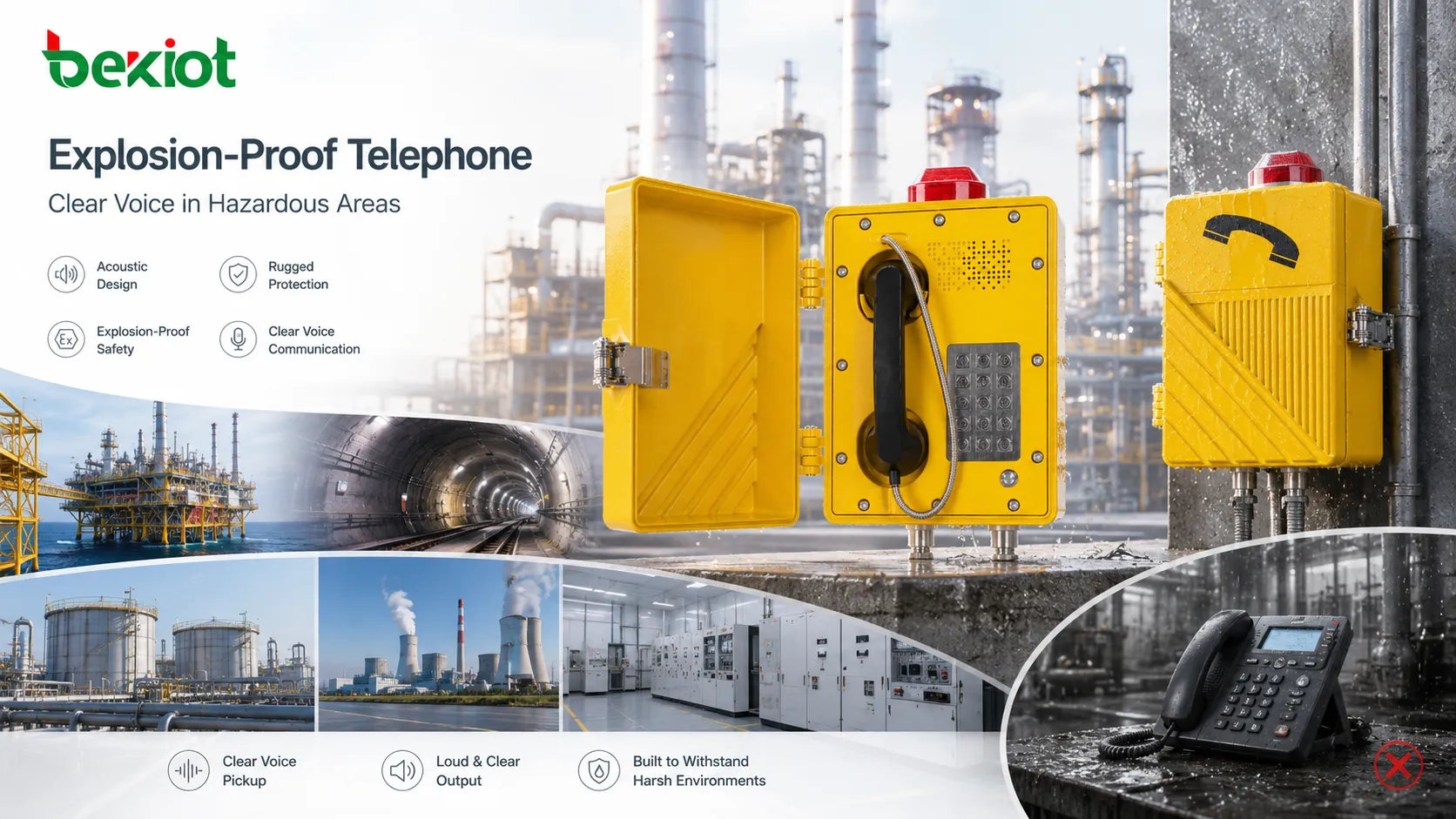
Explosion-proof telephones are installed in environments where ordinary communication equipment may not be suitable. Oil and gas plants, petrochemical workshops, tank farms, offshore platforms, mines, tunnels, power stations, chemical storage zones, and heavy industrial facilities often combine hazardous atmospheres with high noise, vibration, moisture, dust, corrosion, and strict safety requirements. In these places, a telephone must not only be safe to install; it must also allow people to hear and speak clearly during routine operation and emergency response.
The acoustic design of an explosion-proof telephone is therefore a key part of its real value. A rugged enclosure alone does not guarantee effective communication. If the microphone captures too much background noise, if the speaker output is weak, if the handset produces echo, or if the sealed housing blocks sound transmission, the call may connect but the message may still fail. Good acoustic design helps the telephone deliver clear, stable, and understandable voice in conditions where workers cannot afford repeated calls or misunderstood instructions.
Why acoustic design is more demanding in explosion-proof telephones
Explosion-proof telephones face a special design conflict. On one side, the device must meet hazardous-area installation requirements through a protected enclosure, sealed structure, safe electrical design, cable entry protection, corrosion resistance, and mechanical strength. On the other side, voice communication depends on sound entering and leaving the device clearly. The design must protect the internal components without making the voice muffled, weak, distorted, or difficult to understand.
Industrial noise adds another challenge. A field worker may speak beside pumps, compressors, conveyors, ventilation fans, generators, pressure equipment, cranes, or moving vehicles. The control room operator needs to hear the human voice, not only the surrounding machinery. Acoustic design must improve the signal-to-noise ratio so that speech remains recognizable even when the background environment is harsh.
In emergency situations, this becomes even more important. A worker may report a gas alarm, fire risk, injured person, equipment failure, or evacuation condition. The person may speak quickly, breathe heavily, wear gloves or protective equipment, and stand in a noisy area. A well-designed explosion-proof telephone helps preserve message clarity at the moment when communication quality matters most.
Core acoustic advantages
Improved speech intelligibility
The most important advantage is improved speech intelligibility. In industrial communication, the goal is not simply loud sound. The listener must understand words accurately. A good explosion-proof telephone should make consonants clear, reduce muffled speech, maintain natural voice tone, and prevent the caller’s words from being buried under machine noise.
Speech intelligibility depends on the microphone, handset cavity, speaker receiver, acoustic channel, enclosure structure, and audio circuit. If any part is poorly designed, the user may need to repeat the same message several times. Good acoustic design reduces this burden and helps operators make faster decisions.
Better noise resistance
Explosion-proof telephones are often used in places where background noise cannot be removed. Acoustic design can help reduce the amount of unwanted noise that reaches the microphone. A close-talk handset, protected microphone position, directional pickup, acoustic shielding, and stable handset fit can all improve voice pickup.
Noise resistance does not mean removing every background sound. Some environmental sound may remain. The key is to keep the speaker’s voice dominant enough for the remote side to understand. This is especially valuable in pump rooms, compressor stations, workshops, tunnels, offshore decks, and loading areas.
Stable volume under harsh conditions
Good acoustic design helps keep local and remote volume stable. The field worker should hear the control room clearly, and the control room should receive a usable signal from the field telephone. Speaker output, handset receiver sensitivity, amplifier tuning, and microphone gain should be matched with the expected noise level.
If the output is too low, the user may miss important instructions. If it is too high and poorly controlled, the sound may distort or create feedback. A good design provides enough loudness while keeping speech clear and comfortable.
Reduced echo and acoustic feedback
Echo and feedback can make industrial calls difficult. A sealed metal enclosure, reflective wall, tunnel, equipment room, or loud speaker output may cause sound to return to the microphone. In hands-free or speakerphone designs, this problem can be even more obvious.
Explosion-proof telephone acoustic design should reduce unnecessary sound reflection and isolate the microphone from the speaker path where possible. In handset-based designs, the physical separation between receiver and microphone already helps. In speaker-assisted designs, echo control and acoustic layout become more important.
Handset and microphone design
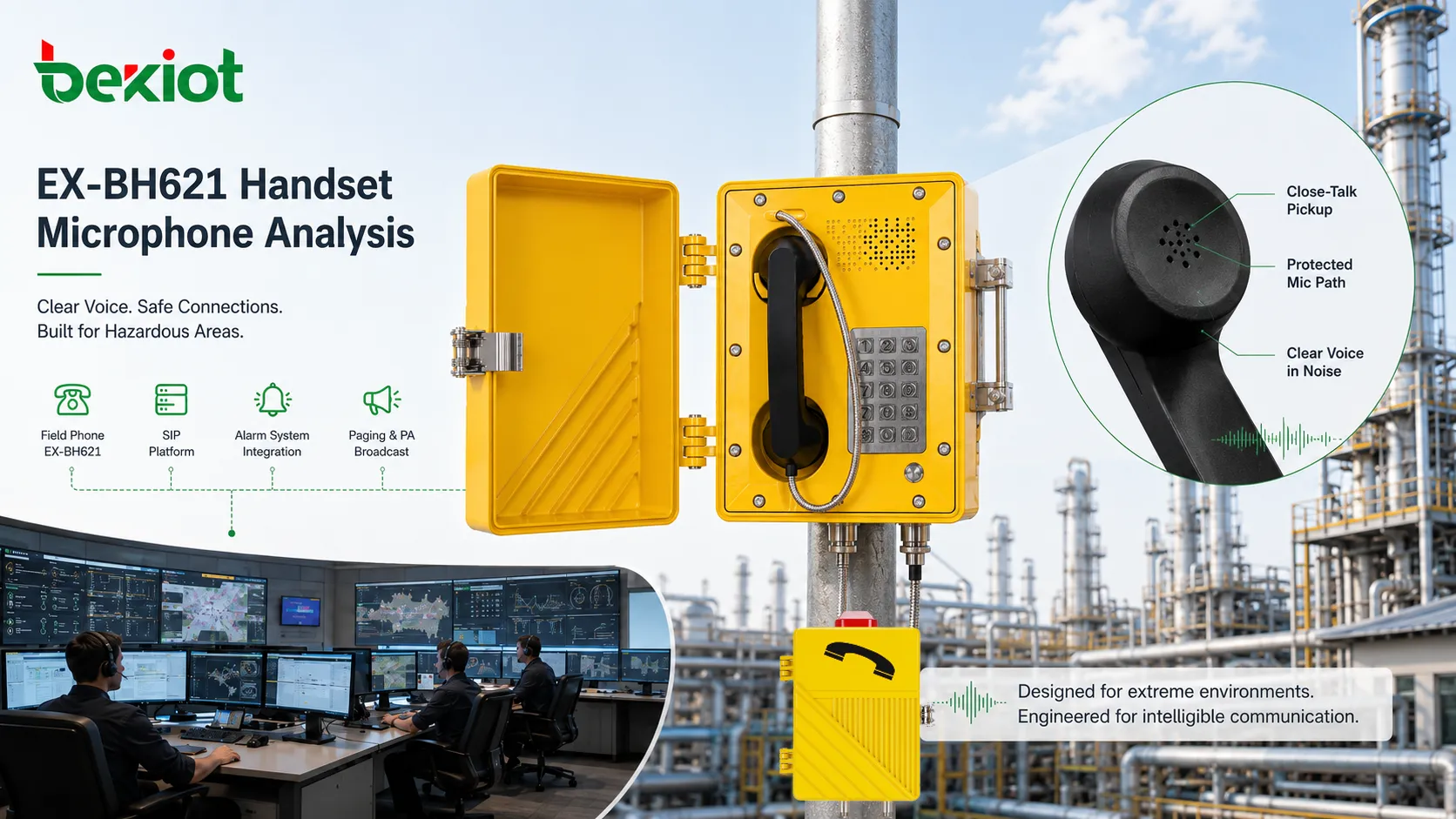
The handset is one of the most important acoustic parts of an explosion-proof telephone. A properly shaped handset places the microphone close to the user’s mouth and the receiver close to the ear. This naturally improves voice pickup and reduces the impact of surrounding noise. In high-noise locations, a handset often provides better clarity than a distant hands-free microphone.
The microphone opening must be protected but not blocked. If the opening is too exposed, dust, water, and impact may damage the microphone. If it is too restricted, speech becomes dull or weak. Good design uses an acoustic path that allows voice to reach the microphone while maintaining the protective structure required by the environment.
The handset cable and grip also matter. Workers may wear gloves, hold tools, or operate under pressure. The handset should be easy to hold, stable near the mouth, and durable enough for repeated use. A loose, uncomfortable, or poorly positioned handset reduces the benefit of even a good microphone.
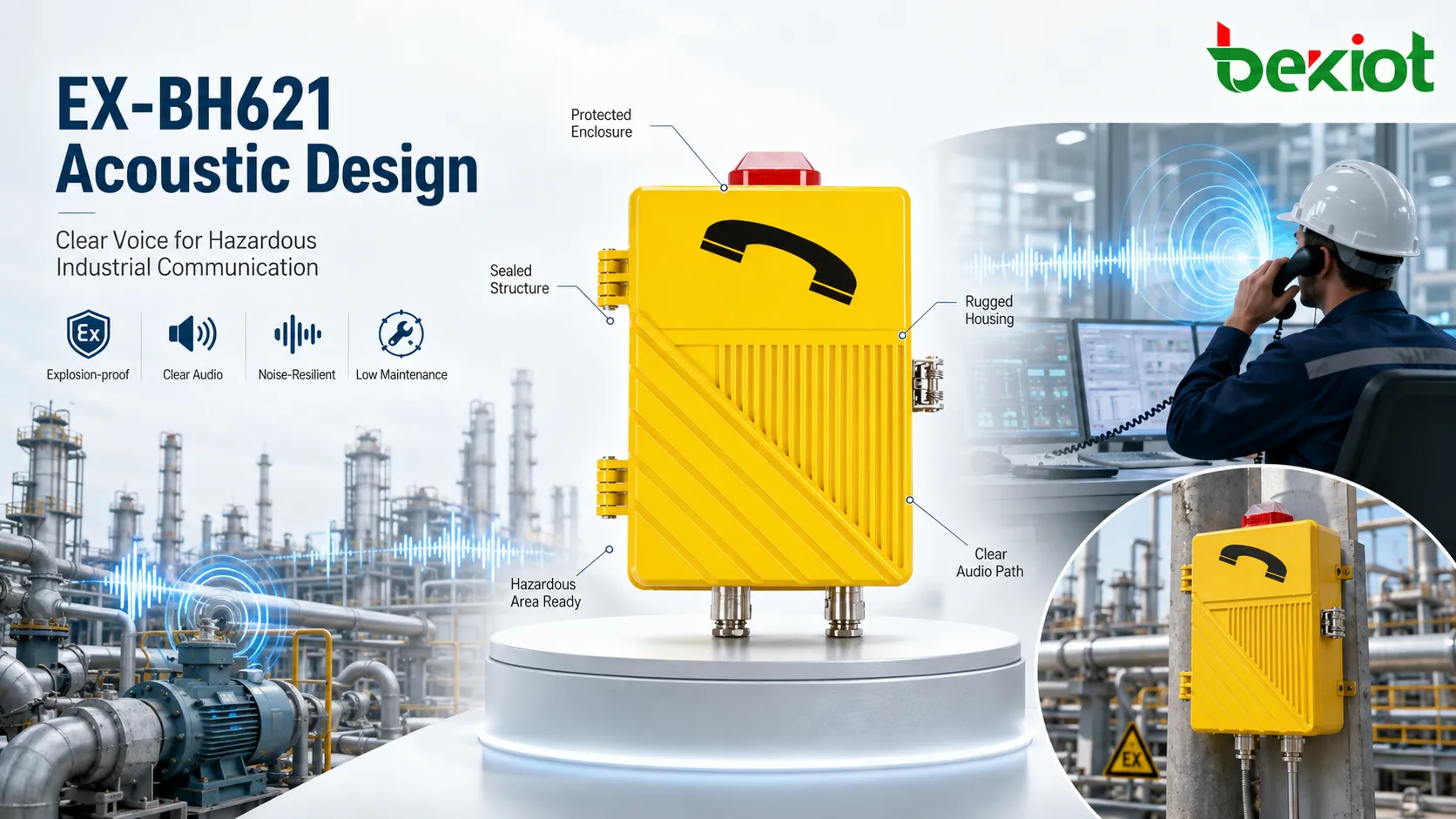
Becke Telcom EX-BH621 explosion-proof industrial telephone is an example of a field telephone where the handset, enclosure, and industrial installation concept are intended for hazardous-area communication. In actual projects, the acoustic advantage depends on both the product design and correct site installation.
Speaker and receiver output
The receiving side of the telephone is just as important as the transmitting side. Field users must hear the control room’s instructions clearly. In industrial environments, the receiver should provide sufficient volume and avoid harsh distortion. A loud but unclear receiver can be just as problematic as a weak one.
Good speaker and receiver design focuses on the voice frequency range. Human speech must remain distinct from low-frequency machine rumble and high-frequency environmental noise. The device should avoid excessive resonance inside the handset or enclosure. Acoustic tuning can help the user hear spoken instructions more clearly.
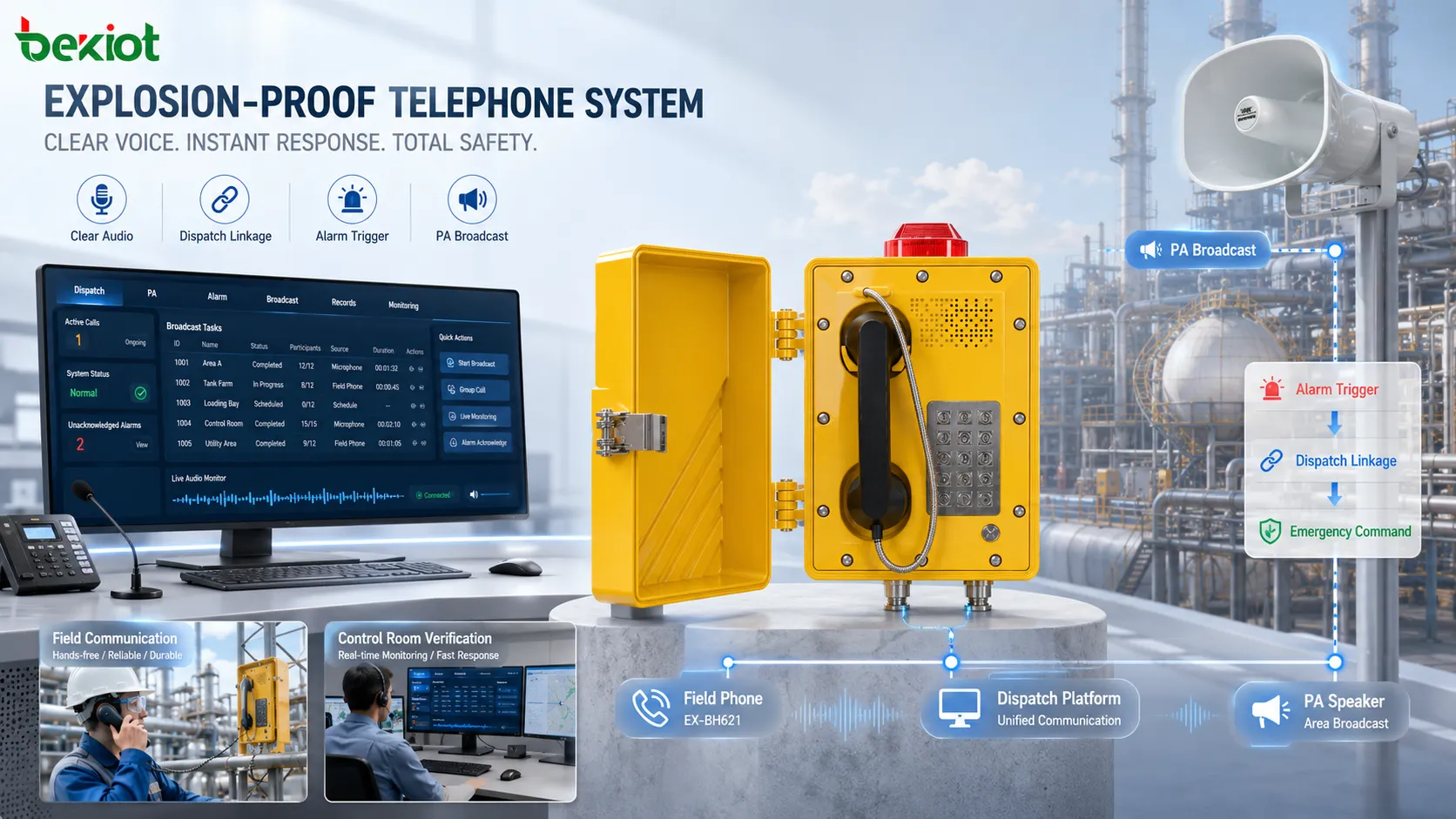
Some explosion-proof telephones may be linked with external speakers, paging systems, or alarm broadcasting systems. In these designs, the telephone supports point-to-point voice communication while the larger system handles wide-area announcements. The acoustic design of the telephone should remain clear for the direct call, while the system-level design handles public or zone-based output.
Enclosure structure and acoustic balance
Explosion-proof telephone enclosures are usually strong and sealed. This is necessary for safety and durability, but it can affect acoustic performance. If the housing creates unwanted resonance, blocks sound paths, or transmits vibration into the microphone, the call may become unclear. Good design treats the enclosure as part of the acoustic system, not only as a protective shell.
Materials, internal spacing, sealing method, front panel layout, handset hook position, microphone channel, and cable entry design can all influence sound. A rigid housing may protect the device, but the acoustic path must still allow clear speech transmission. This balance is one reason explosion-proof telephone design is more specialized than ordinary office telephone design.
Installation position also affects the enclosure’s acoustic behavior. A phone mounted on a steel structure, near a vibrating machine, inside a semi-enclosed cabinet, or against a reflective wall may sound different from the same phone installed in a quieter control area. Site testing should be part of acceptance.
System-level acoustic performance
Network and platform influence
Acoustic quality is not created by the telephone alone. If the device is connected to a VoIP platform, SIP server, PBX, dispatch system, or gateway, codec selection, packet loss, jitter, delay, gain settings, and echo control can all affect what users hear. A strong acoustic device can still sound poor if the system path is unstable.
For IP-based installations, voice packets should receive proper network priority where required. The system should avoid excessive delay and unstable media paths. For analog installations, cable distance, line noise, grounding, and interface quality should be checked. Acoustic design and communication architecture should work together.
Integration with alarms and dispatch
In many hazardous-area projects, explosion-proof telephones are integrated with dispatch consoles, alarm systems, paging systems, or emergency command platforms. In these cases, clear audio helps operators verify field reports and issue instructions. A gas alarm or emergency button may create an event, but voice communication helps people understand the real situation.
The telephone may also support communication before or after an evacuation broadcast. A worker can call the control room to report the incident, the operator can trigger paging or dispatch action, and the field telephone can be used again to confirm site status. Clear audio supports the entire response chain.
Application value in hazardous industries
In oil and gas facilities, acoustic design helps workers communicate near pumps, compressors, loading skids, and tank areas. In chemical plants, it supports clear reporting during process alarms, maintenance tasks, or emergency response. In mining and tunnel environments, it helps overcome echo, ventilation noise, and long-distance communication challenges.
In offshore and marine environments, wind, engine noise, humidity, and corrosion make clear field communication difficult. A rugged explosion-proof telephone with suitable acoustic design can provide a fixed and recognizable communication point. In power plants and heavy industrial sites, clear telephone audio supports coordination between control rooms and field maintenance teams.
The common value across these industries is reliability under pressure. Workers need to call, report, confirm, and receive instructions without depending on mobile phones or informal communication. Acoustic design ensures that the installed telephone remains useful in the environment where it is needed most.
Deployment and maintenance considerations
Good acoustic performance requires correct deployment. The telephone should be installed where users can safely approach it, speak close to the handset, and hear the reply. It should not be placed directly beside the loudest noise source unless no alternative exists. The mounting height, wall material, surrounding equipment, and cable path should all be considered.
After installation, audio testing should be performed under real operating conditions. The test should include speaking from the field telephone to the control room, listening from the field side, checking for echo, confirming volume, and testing during normal machine noise. A quiet-room test cannot prove industrial acoustic performance.
Maintenance should include checking the handset, microphone opening, receiver clarity, cable condition, hook switch, enclosure sealing, corrosion, water ingress, terminal connection, and system audio settings. Dust, oil, moisture, vibration, and physical impact may gradually affect sound quality. Regular inspection helps maintain communication reliability.
Common acoustic problems
A common problem is muffled speech. This may be caused by blocked microphone openings, damaged handset parts, water ingress, incorrect installation, aging components, or poor acoustic design. Cleaning and inspection should be done carefully without damaging the protective structure.
Another problem is excessive background noise. The device may be too far from the user’s mouth, installed in a very noisy position, or configured with excessive microphone gain. In some cases, relocating the phone slightly or adjusting gain can improve the result.
Echo may occur when the local output is too loud, the enclosure reflects sound, the network delay is high, or the gateway echo control is weak. Troubleshooting should consider both the endpoint and the communication platform. Low volume, distortion, intermittent sound, and one-way audio should also be checked through a full-path test.
Evaluation standards
The acoustic design of an explosion-proof telephone should be evaluated by real speech intelligibility. Can the control room understand the field worker clearly? Can the field worker hear instructions in the expected noise level? Does the handset remain comfortable and stable during use? Does the device avoid excessive echo and distortion?
Evaluation should also include environmental durability. The microphone and receiver should remain usable after exposure to dust, moisture, cleaning, vibration, and daily handling. The enclosure should protect the acoustic components without weakening voice transmission.
For emergency communication, testing should include urgent speech, background alarms, machinery noise, and control room response. A telephone that works only in a quiet test is not enough for hazardous-area communication. The standard should be communication clarity under realistic conditions.
Closing Notes
The special advantage of explosion-proof telephone acoustic design is its ability to combine safety, durability, and voice clarity in hazardous industrial environments. It must protect the device while still allowing effective microphone pickup, clear receiver output, noise resistance, echo control, and stable communication.
Good acoustic design supports more than comfort. It helps workers report incidents accurately, helps control rooms issue instructions clearly, and helps emergency teams respond with better information. In hazardous areas, communication clarity can directly affect response speed and operational safety.
For projects that require explosion-proof telephones with reliable industrial communication performance, Becke Telcom offers options such as the EX-BH621 for hazardous-area field communication. The right solution should be selected according to site classification, noise level, installation environment, platform integration, and maintenance needs.
FAQ
Why is acoustic design important for explosion-proof telephones?
Because hazardous industrial sites are often noisy and harsh. Acoustic design helps users hear and speak clearly while the telephone still maintains the protection required for dangerous environments.
Does a stronger enclosure reduce sound quality?
It can if not designed properly. A good explosion-proof telephone balances enclosure strength with protected acoustic paths, suitable microphone placement, and clear receiver output.
What causes poor voice clarity in hazardous-area telephones?
Common causes include blocked microphone openings, high background noise, weak receiver output, echo, water ingress, damaged handset parts, poor installation position, or network and gateway audio problems.
Is handset communication better than hands-free communication in noisy areas?
In many high-noise areas, a handset can provide better clarity because the microphone is closer to the user’s mouth and less exposed to surrounding noise. Hands-free communication requires stronger acoustic and echo control design.
How should acoustic performance be tested?
It should be tested after installation under real site conditions, including normal machine noise, control room communication, field-side listening, echo behavior, emergency speech, and long-term maintenance inspection.







