


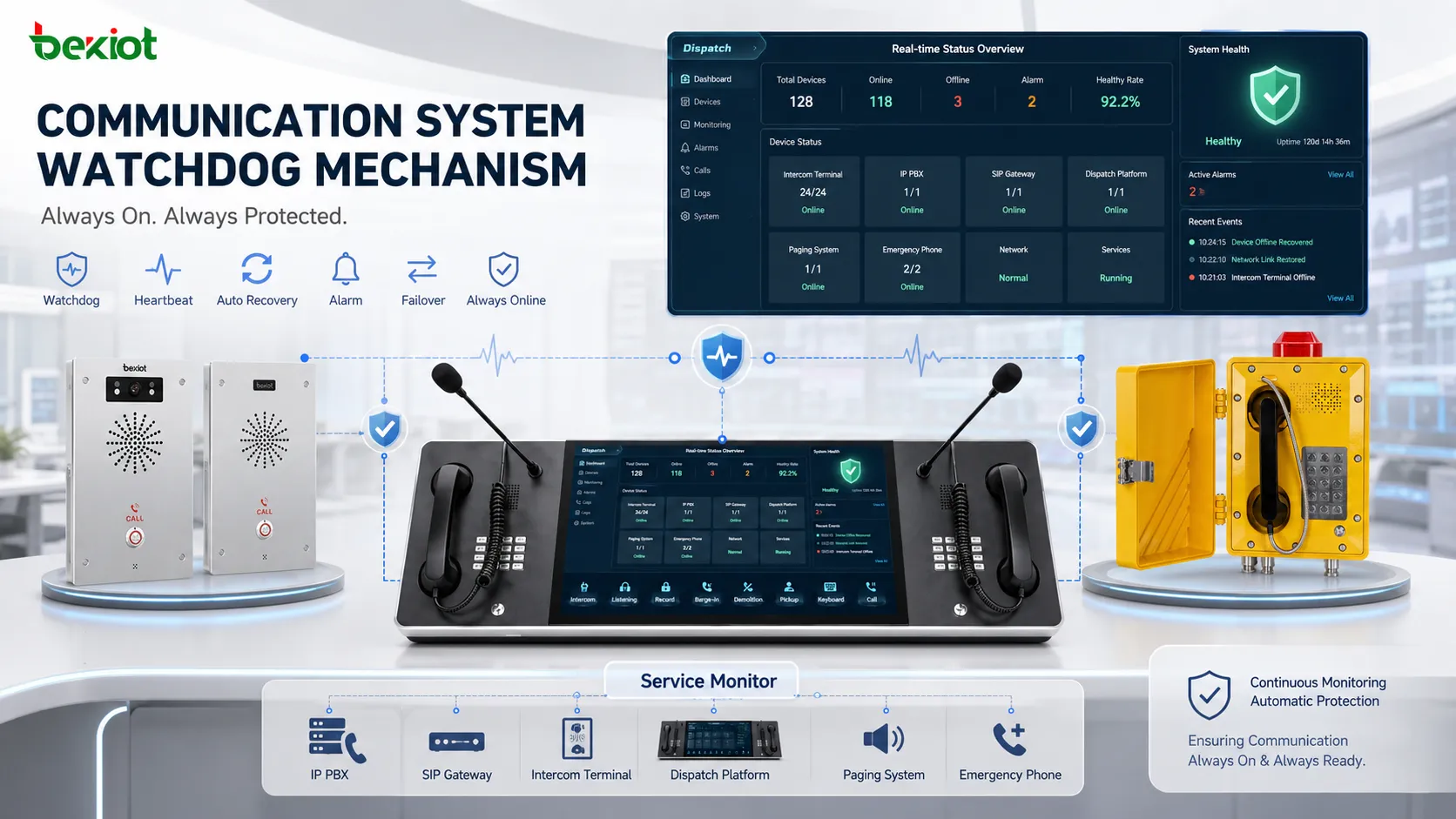
In a communication system, the word “watchdog” does not refer to a visible user function like calling, paging, recording, or dispatching. It represents a background protection mechanism that continuously checks whether hardware, software, network services, communication links, or key processes are still working normally. When the monitored object stops responding, becomes abnormal, or enters an unexpected state, the watchdog can trigger restart, recovery, alarm reporting, failover, or maintenance notification.
This mechanism is especially important in communication systems because many devices and services are expected to stay online for long periods. IP PBX servers, SIP gateways, intercom terminals, dispatch platforms, paging systems, network switches, emergency phones, radio gateways, and alarm-linked communication devices may operate continuously. A watchdog helps prevent a small software freeze, process crash, network fault, or device lock-up from becoming a long service outage.
Basic meaning of watchdog in communication systems
A watchdog is essentially a monitoring and recovery mechanism. It watches a target process, device, module, service, or communication path. If the target behaves normally, the watchdog remains silent. If the target stops responding within a defined time, fails to send heartbeat signals, or does not meet health-check conditions, the watchdog treats it as abnormal and starts a predefined action.
The monitored target may be a single embedded device, a server application, a SIP service, a gateway module, a network interface, a database process, a recording service, or a communication link. The watchdog may be implemented in hardware, firmware, operating system software, platform middleware, network management software, or a cloud-based monitoring system.
The value of a watchdog is not that it prevents every fault from happening. Its value is that it can detect certain failures quickly and reduce the time before recovery. In many systems, a service may appear powered on but no longer respond correctly. Without watchdog logic, the fault may remain hidden until users complain. With watchdog logic, the system can restart the failed process, reboot the device, switch to a backup path, or send an alarm to administrators.
How a watchdog works
Heartbeat monitoring
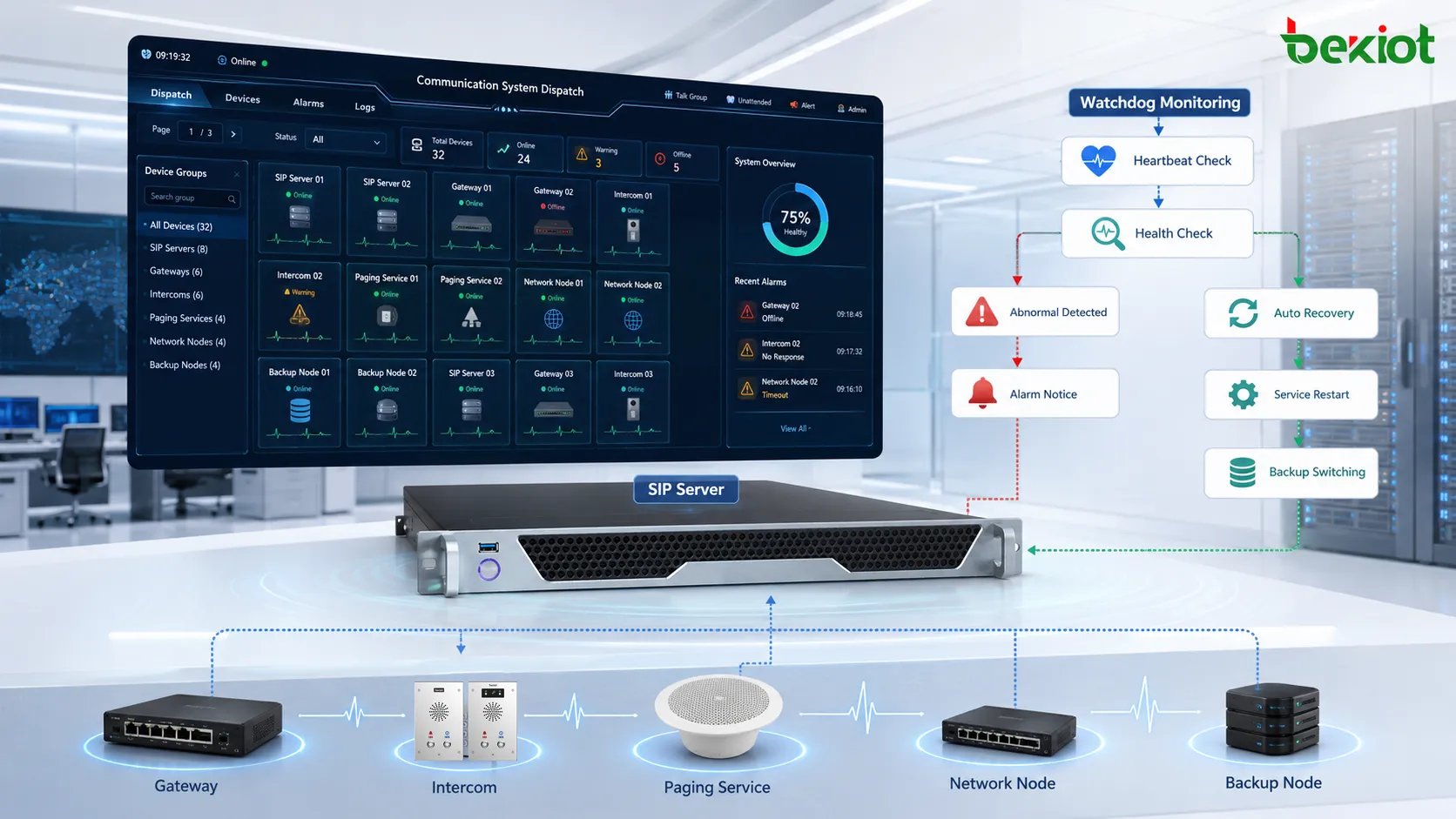
One common method is heartbeat monitoring. The monitored service or device sends a regular signal to prove that it is alive. This heartbeat may be a software event, local timer reset, network packet, status report, SIP registration update, keepalive message, or management protocol response. As long as the watchdog receives the heartbeat within the expected time, it considers the target healthy.
If the heartbeat is missing for too long, the watchdog assumes that the target has failed or become unreachable. The next action depends on system design. It may restart the software service, reboot the device, mark the endpoint offline, trigger an alarm, or switch traffic to another resource.
Timer reset mechanism
In embedded systems, a hardware watchdog timer is common. The main processor or software must reset the watchdog timer periodically. If the software freezes, enters an endless loop, or stops executing normal tasks, it fails to reset the timer. When the timer expires, the watchdog circuit resets the device.
This method is useful for communication terminals, gateways, controllers, embedded intercoms, alarm devices, and field endpoints. These devices may be installed remotely and cannot always be manually restarted. A hardware watchdog gives the device a way to recover from certain lock-up conditions without human intervention.
Service health checking
Software watchdogs often check service health. They may monitor whether a SIP process is running, whether a web service responds, whether a database is reachable, whether a recording process is writing files, whether a media service is handling RTP streams, or whether a queue is blocked.
Health checking is more advanced than simply checking whether a process exists. A process may still appear in the operating system but no longer function correctly. A good watchdog may perform functional checks, such as sending a test request, checking response time, verifying port status, or confirming that a service can complete its expected task.
Network reachability checking
Communication systems depend on network paths. A watchdog may check whether a gateway, SIP server, terminal, branch device, or remote platform is reachable. This can be done through ping, TCP connection checks, SIP OPTIONS, SNMP polling, API health checks, or application-level keepalive messages.
Network watchdog functions help detect device offline status, link failure, packet path interruption, routing problems, firewall blocking, or service unavailability. They can also support automatic failover when a primary connection fails.
Types of watchdog mechanisms
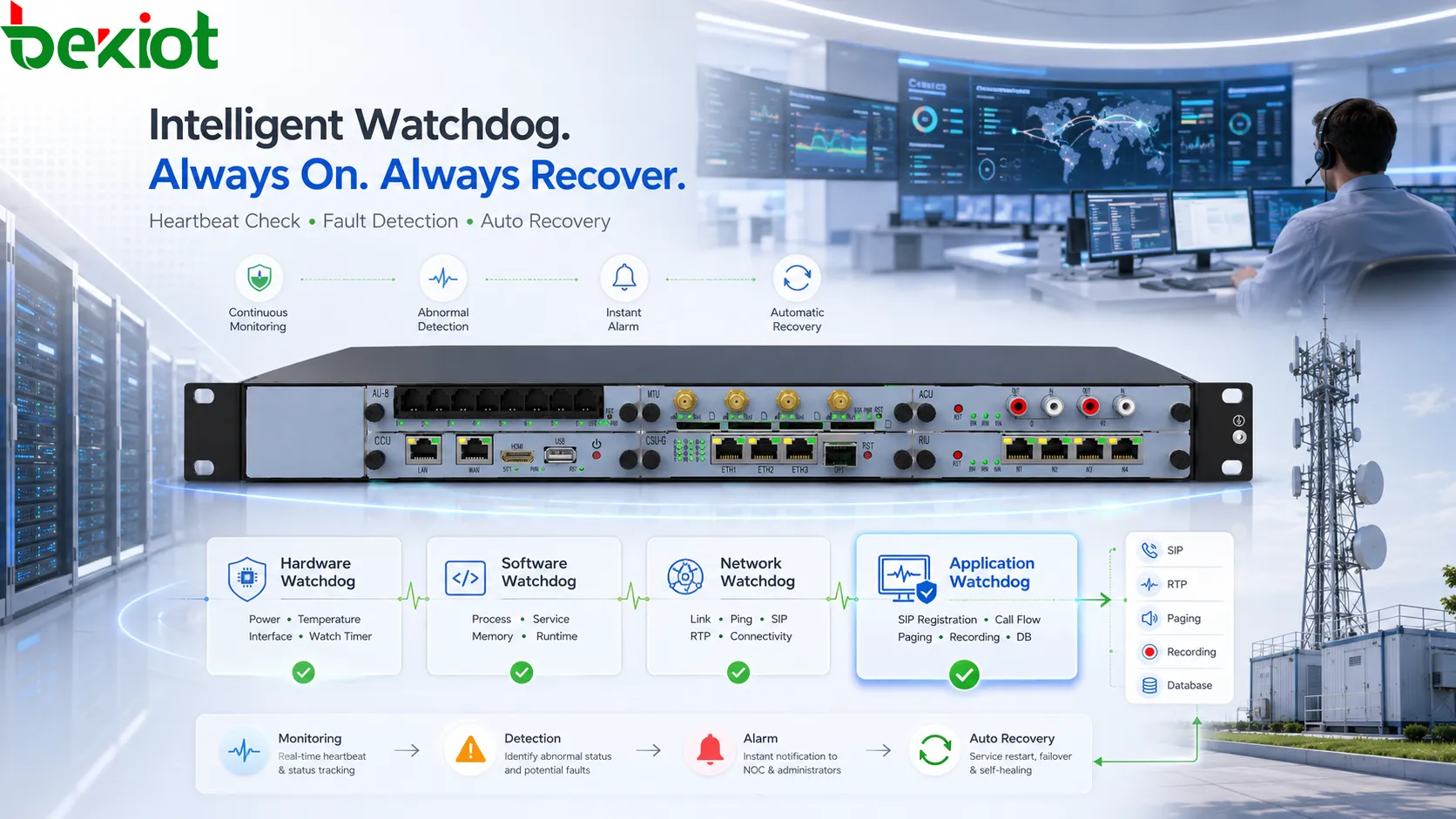
Hardware watchdog
A hardware watchdog is built into the physical device or chip-level design. It operates independently from the main software. If the main system becomes unresponsive, the hardware watchdog can reset the device. This is common in embedded communication equipment because hardware-level recovery is more reliable when the operating system itself becomes stuck.
The advantage of a hardware watchdog is independence. It does not rely on the same software process that may have failed. The limitation is that it usually performs a simple action such as rebooting the device. It may not understand the reason for the fault unless logs are preserved before or after restart.
Software watchdog
A software watchdog is implemented as a service or process. It monitors applications, system resources, service status, memory usage, CPU load, disk space, database access, media services, registration status, or communication processes. If a problem is detected, it can restart only the failed component rather than rebooting the whole device.
Software watchdogs are flexible. They can apply different rules to different services. For example, a recording process may be restarted without affecting calls, while a SIP service restart may require more careful handling. The weakness is that a software watchdog may fail if the operating system or hardware becomes completely frozen.
Network watchdog
A network watchdog monitors communication paths and remote reachability. It may check whether SIP trunks are reachable, whether branch gateways respond, whether IP phones remain registered, whether dispatch terminals are online, or whether redundant links are active. This type of watchdog is especially useful in multi-site communication systems.
Network watchdogs help administrators distinguish between device failure and network path failure. A terminal may be healthy locally but unreachable because of a switch, router, firewall, VPN, or WAN problem. Network-level checks provide early warning before users report major service interruption.
Application-level watchdog
An application-level watchdog checks whether the business function is actually working. In a communication system, this may include SIP registration, call routing, RTP media handling, paging playback, intercom response, alarm linkage, recording file generation, database writing, or dispatch task execution.
This is often the most meaningful form of monitoring because it checks real service behavior. A server may be powered on, the network may respond, and the process may exist, but calls may still fail. Application-level watchdog logic helps detect faults closer to the user experience.
System values of watchdog design
The first value is automatic recovery. Many communication failures are temporary or process-level problems. If a service freezes, a watchdog can restart it quickly. If a device locks up, a hardware watchdog can reboot it. This reduces downtime and avoids waiting for manual intervention.
The second value is fault visibility. A watchdog can trigger alarms when something abnormal happens. Administrators can know that a SIP trunk is down, a gateway is unreachable, a recording process stopped, a terminal is offline, or a network link is unstable. This changes maintenance from passive complaint handling to active fault awareness.
The third value is service continuity. In communication systems used for emergency calls, industrial dispatch, campus security, elevator phones, public assistance, transport operations, or utility management, downtime may affect safety and response quality. Watchdog mechanisms reduce the chance that a silent fault remains unnoticed for a long time.
The fourth value is maintenance efficiency. Instead of checking every device manually, administrators can rely on watchdog alarms, logs, and health status. This is useful for systems with many distributed endpoints, remote sites, unmanned stations, or large-scale voice networks.
The fifth value is operational confidence. When a system includes reliable self-checking and recovery logic, operators and managers can trust the communication infrastructure more. They still need maintenance and testing, but they have a stronger safety layer against hidden software or connectivity failures.
Application areas in communication systems
IP PBX and SIP platforms
IP PBX and SIP platforms often use watchdog mechanisms to monitor SIP services, registration modules, routing engines, media services, database access, web management, and recording functions. If a service becomes unresponsive, the watchdog can restart it or notify administrators.
For voice platforms, watchdog design is important because a failed service may affect many users. A SIP service crash can stop registration. A media service failure can affect calls. A database fault can affect call records and configuration access. Early detection and recovery help maintain system stability.
VoIP gateways and trunk gateways
Gateways may use watchdogs to monitor SIP trunks, analog ports, E1/T1 links, FXO lines, FXS status, network interfaces, CPU load, memory use, and call processing services. If a trunk becomes unavailable, the system may switch to a backup route or report an alarm.
In gateway deployments, watchdog logic helps protect voice access. A gateway may be located in a branch office, industrial site, remote cabinet, or carrier interconnection point. Automatic restart and status reporting reduce maintenance difficulty, especially when the device is not easy to access physically.
Intercom, paging, and emergency terminals
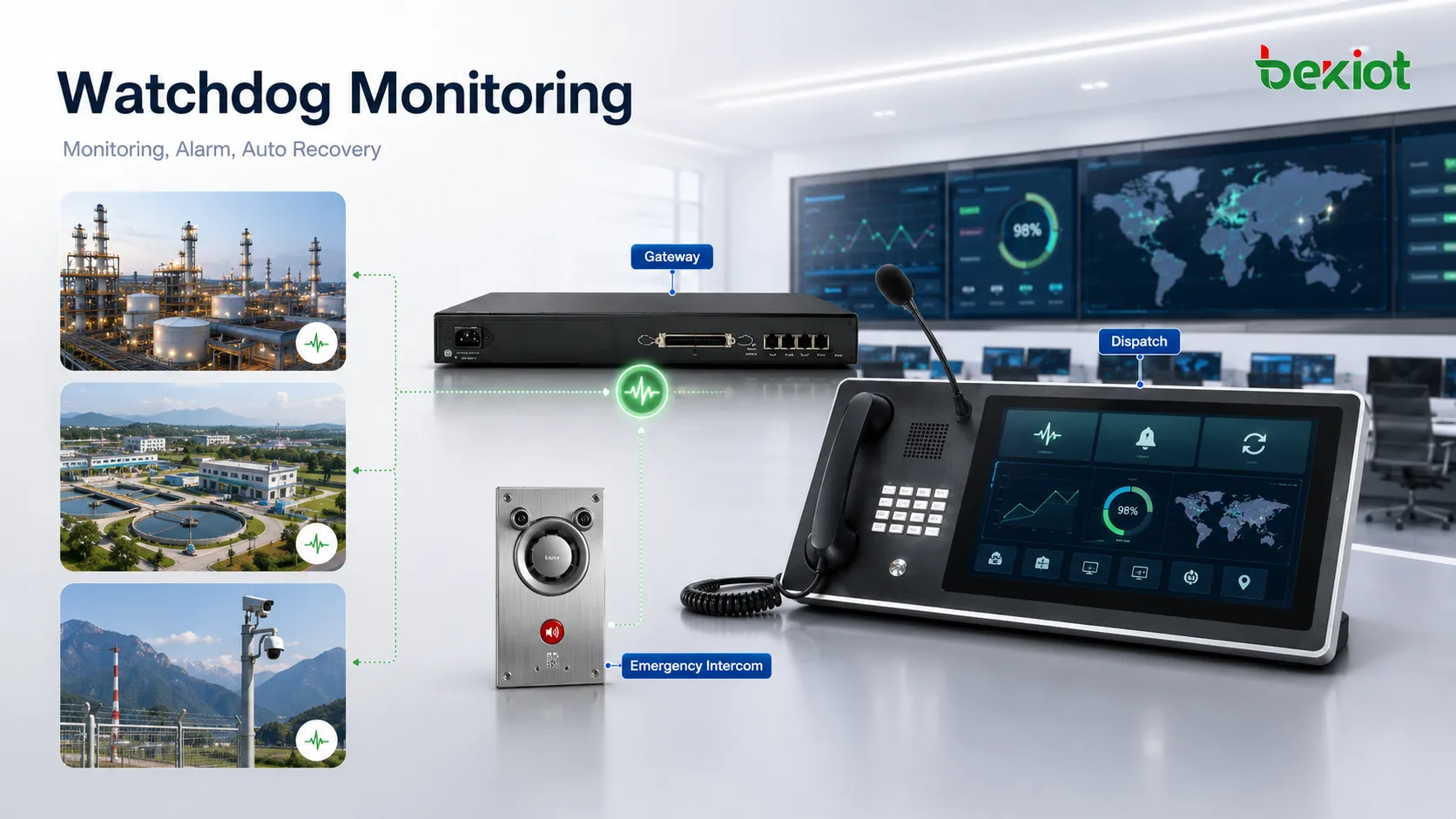
Embedded intercoms, emergency phones, paging terminals, help points, and industrial telephones may include hardware or software watchdogs. These devices often operate unattended. If they freeze, users may not know until an emergency call fails. A watchdog can reboot the device after abnormal software behavior.
For emergency terminals, watchdog design should be combined with regular testing. A reboot mechanism helps recover from some faults, but it does not replace inspection of microphones, speakers, buttons, cable connections, power, and network access.
Dispatch and command systems
Dispatch systems may monitor operator consoles, voice services, group call modules, recording services, alarm linkage, map services, databases, and platform interfaces. A watchdog can help detect when a key command function stops responding.
In command environments, it is not enough for the server to be powered on. Operators need real-time communication, paging, intercom, video linkage, and event records to function together. Application-level watchdogs can check whether these service modules are available.
Design considerations
A watchdog should be designed according to risk. Not every minor service requires an immediate reboot. Some faults should trigger a warning first. Some should restart a service. Some should switch to backup. Some should require manual confirmation. The recovery action should match the importance of the monitored function.
Thresholds are also important. If the timeout is too short, the watchdog may trigger false restarts during temporary network delay or high system load. If the timeout is too long, fault recovery is delayed. The correct value depends on service behavior, network conditions, and operational requirements.
Logging should be preserved. If a watchdog restarts a device or service without keeping records, engineers may not know why the fault happened. Logs should show the monitored object, failure time, trigger reason, recovery action, and result. This helps identify repeated problems rather than simply hiding them with automatic restarts.
Recovery loops should be avoided. If a service keeps failing and the watchdog keeps restarting it endlessly, the system may appear unstable and logs may be overwritten. Good design should support escalation after repeated failures. For example, after several restart attempts, the system may raise a high-level alarm and require engineer review.
Common misunderstandings
One misunderstanding is that a watchdog makes a system failure-proof. It does not. A watchdog can detect certain abnormal states and trigger predefined actions, but it cannot solve every hardware fault, cabling problem, configuration error, database corruption, power failure, network outage, or security attack.
Another misunderstanding is that rebooting is always the best solution. Rebooting may restore a frozen embedded device, but it may also interrupt active calls or hide deeper software problems. For servers and platforms, service-level restart, failover, or alarm reporting may be more appropriate than full reboot.
A third misunderstanding is treating watchdog alarms as noise. If watchdog events happen frequently, the system is telling administrators that something is unstable. Repeated watchdog resets may indicate memory leaks, network instability, firmware bugs, overheating, insufficient resources, or poor configuration. The cause should be investigated.
Finally, some projects enable watchdog functions but never test them. A watchdog should be verified during commissioning and maintenance. Engineers should confirm that the monitored service is detected correctly, the recovery action works, and alarms are reported to the right people.
Maintenance and optimization
Maintenance should include reviewing watchdog logs, restart history, failure frequency, alarm records, device uptime, service status, and system resource trends. If a device reboots frequently, the maintenance team should identify the root cause instead of accepting automatic recovery as normal behavior.
Firmware and software updates may improve watchdog behavior or fix the faults that trigger it. However, updates should be tested carefully in critical communication systems. A new version may change restart behavior, heartbeat timing, or monitoring rules.
Administrators should also review watchdog coverage. Important services may be added over time, but not included in monitoring. New SIP trunks, recording modules, paging services, or remote gateways should be added to health checks when they become part of the communication workflow.
For remote or unmanned sites, watchdog alarms should be linked with clear response procedures. If a gateway restarts, who checks the trunk? If an emergency phone stops sending heartbeat, who inspects the site? Monitoring only creates value when someone responds to the information.
Evaluation standards
A good watchdog design should detect meaningful failures quickly without causing unnecessary restarts. It should monitor the right objects, use reasonable timeout values, preserve useful logs, and trigger recovery actions that match the service importance.
It should also support visibility. Administrators should be able to see watchdog status, restart history, failure causes, and alarm records. If the mechanism works silently with no trace, it may be difficult to manage long-term reliability.
Another standard is recovery effectiveness. After the watchdog acts, does the service return to normal? Are users affected? Is the fault reported? Does the system avoid endless restart loops? These questions determine whether the watchdog is truly improving stability.
Finally, watchdog design should support the whole communication workflow. Monitoring only the server power state is not enough. Real communication functions such as SIP registration, call routing, media handling, paging playback, intercom response, and recording service may also need health checks depending on the system.
Closing Notes
The “watchdog” in a communication system represents a monitoring and self-recovery mechanism. It checks whether devices, services, software processes, network paths, communication links, or application functions are still operating normally. When something stops responding or becomes abnormal, it can trigger restart, failover, alarm reporting, or maintenance notification.
Its value is especially important in systems that need long-term uptime, such as IP PBX platforms, VoIP gateways, dispatch systems, emergency terminals, paging systems, intercom devices, and remote communication nodes. A watchdog reduces the time between failure and recovery, improves fault visibility, and helps prevent silent service interruption.
However, watchdog design should not be treated as a replacement for good engineering. Stable hardware, correct configuration, reliable power, protected networks, suitable capacity, regular testing, and active maintenance are still necessary. A watchdog is a safety layer, not a complete reliability strategy.
FAQ
What does watchdog mean in a communication system?
It means a monitoring mechanism that checks whether devices, services, software, or network paths are operating normally and triggers recovery or alarms when abnormalities are detected.
Is a watchdog hardware or software?
It can be either. Hardware watchdogs usually reset embedded devices when software freezes, while software watchdogs monitor services, processes, network status, and application health.
Does a watchdog prevent all system failures?
No. It helps detect and recover from certain failures, but it cannot prevent every hardware fault, configuration error, power problem, network outage, or security issue.
Why are watchdog logs important?
Logs show when the watchdog was triggered, what failed, what action was taken, and whether recovery succeeded. They help engineers find root causes instead of only seeing automatic restarts.
Where is watchdog monitoring commonly used?
It is commonly used in IP PBX servers, SIP gateways, dispatch platforms, intercom terminals, paging systems, emergency phones, network devices, and remote communication equipment.







