Overseas engineering projects often face a difficult communication environment. Project teams may be located far from the domestic headquarters, the site may be temporary or mobile, local telecom resources may be limited, and different teams may use separate phones, radios, video systems, and mobile apps. For infrastructure construction, energy projects, industrial parks, mining sites, ports, camps, and Belt and Road related projects, communication is not only a daily office requirement. It is also part of safety control, emergency response, security management, and field coordination.
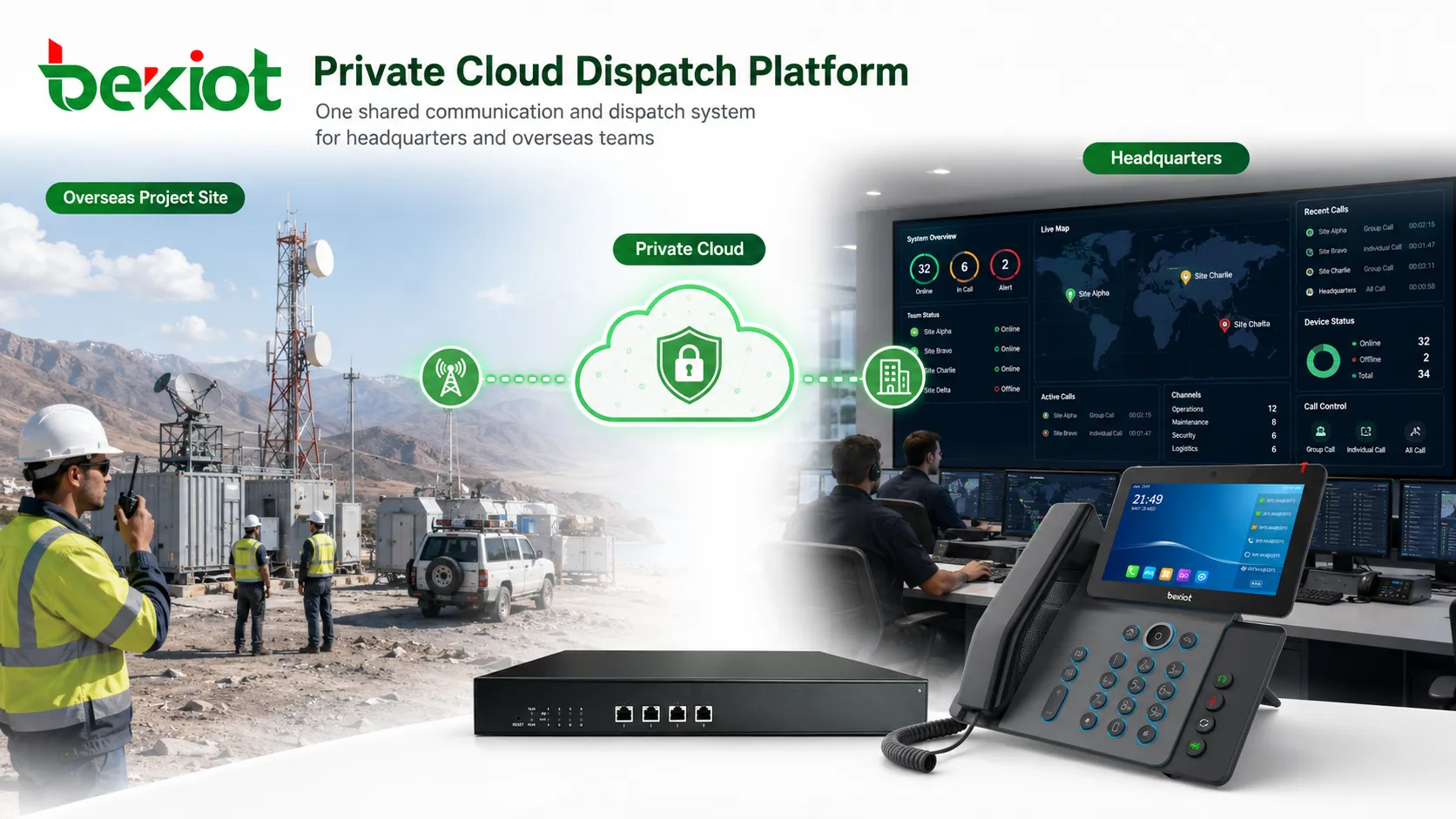
A private cloud dispatch command platform provides a practical way to build cross-border communication and command capability. By deploying the core platform in an accessible cloud region and connecting IP phones, public network PTT terminals, ROIP gateways, video surveillance systems, and headquarters dispatch consoles, enterprises can create a unified communication environment for both the overseas site and the domestic command center.
Why Overseas Sites Need a Unified Platform
Many overseas projects are built in stages. At the beginning, the team may only need basic phone calls and instant field communication. As the project expands, more requirements appear: site security, emergency reporting, video monitoring, personnel positioning, task assignment, duty communication, remote supervision, and coordination between local teams and the domestic headquarters.
If each system is built separately, management becomes complicated. Phones, radios, video cameras, mobile terminals, and alarm devices may run on different platforms. Headquarters may not see the real-time situation of the site, while field workers may not have a fast way to reach the command center during emergencies.
A private cloud command platform solves this by integrating voice, video, push-to-talk, ROIP gateway access, monitoring, GIS location, and dispatch management into one architecture. It reduces the number of isolated systems and creates a more manageable communication foundation for overseas operations.
Cloud Deployment for Cross-Border Access
For overseas projects, the communication platform can be deployed on a cloud server in a region that is convenient for both the domestic headquarters and the project country. Common deployment options include cloud regions such as Hong Kong, Singapore, or overseas cloud platforms like AWS, depending on network access, compliance, latency, and project requirements.
This approach reduces the complexity of local server management. The project team does not need to build a full data center at the construction site. The platform can be deployed once in the cloud and then accessed by users from the headquarters, overseas offices, mobile terminals, IP phones, ROIP gateways, and dispatch consoles.
Compared with a fully local deployment, private cloud deployment is especially useful for temporary projects, multi-country projects, and sites where IT maintenance resources are limited. It provides better flexibility while still allowing the enterprise to manage its own communication system, user permissions, routing rules, terminal registration, and dispatch workflows.
Core Capabilities in One Architecture
A complete private cloud dispatch platform should not be limited to simple voice calling. Overseas projects usually require a combination of multiple communication and management functions.
The platform can provide VoIP calling, video calling, public network PTT, dispatch control, personnel positioning, emergency SOS alerts, video return, task assignment, call recording, group communication, and remote management. These functions help the headquarters stay connected with the site, while also giving field teams a more direct channel for daily coordination and emergency reporting.
For project owners, the value is not only communication convenience. A unified platform improves operational visibility. Headquarters can communicate with site workers, check video feeds when necessary, locate personnel, organize group calls, and coordinate different departments without relying on multiple disconnected tools.
Public Network PTT for Mobile Field Teams
Public network PTT terminals are suitable for mobile teams working across construction zones, camps, roads, ports, industrial sites, or remote operation areas. These terminals can use local data SIM cards in the project country and communicate through 4G or other available mobile data networks.
When selecting PTT terminals for overseas use, the project team should confirm local frequency bands, carrier compatibility, data coverage, SIM card availability, and service cost. Different countries may use different 4G bands, so terminal compatibility must be checked before deployment.
Public network PTT devices can provide quick push-to-talk operation, group calling, emergency SOS reporting, voice communication, and in some cases video communication or image reporting. For complex field environments, a loud speaker, dedicated PTT key, and rugged housing can improve usability during outdoor work, site patrol, security duty, or emergency handling.
Fixed IP Phones for Key Positions
In addition to mobile PTT terminals, fixed IP phones are useful for offices, duty rooms, gatehouses, control rooms, warehouses, dormitories, and other important points at the overseas site. They provide stable audio and video communication between the local project team and the domestic headquarters.
IP phones can register to the private cloud platform as extensions. Internal calls between headquarters and the overseas site can be made through the platform, reducing dependence on international mobile calls and making daily coordination easier.
For important positions, IP phones also create a clear communication entrance. Instead of relying only on personal mobile numbers, the project can assign role-based extensions such as duty desk, security office, project manager office, warehouse, logistics, or emergency contact point.
ROIP Gateway Access for Local Radios
In many overseas projects, conventional two-way radios remain the most convenient local communication tool. They are simple, fast, and useful when workers are moving around the site. However, traditional radios are often limited to local coverage and cannot be directly reached by the domestic headquarters.
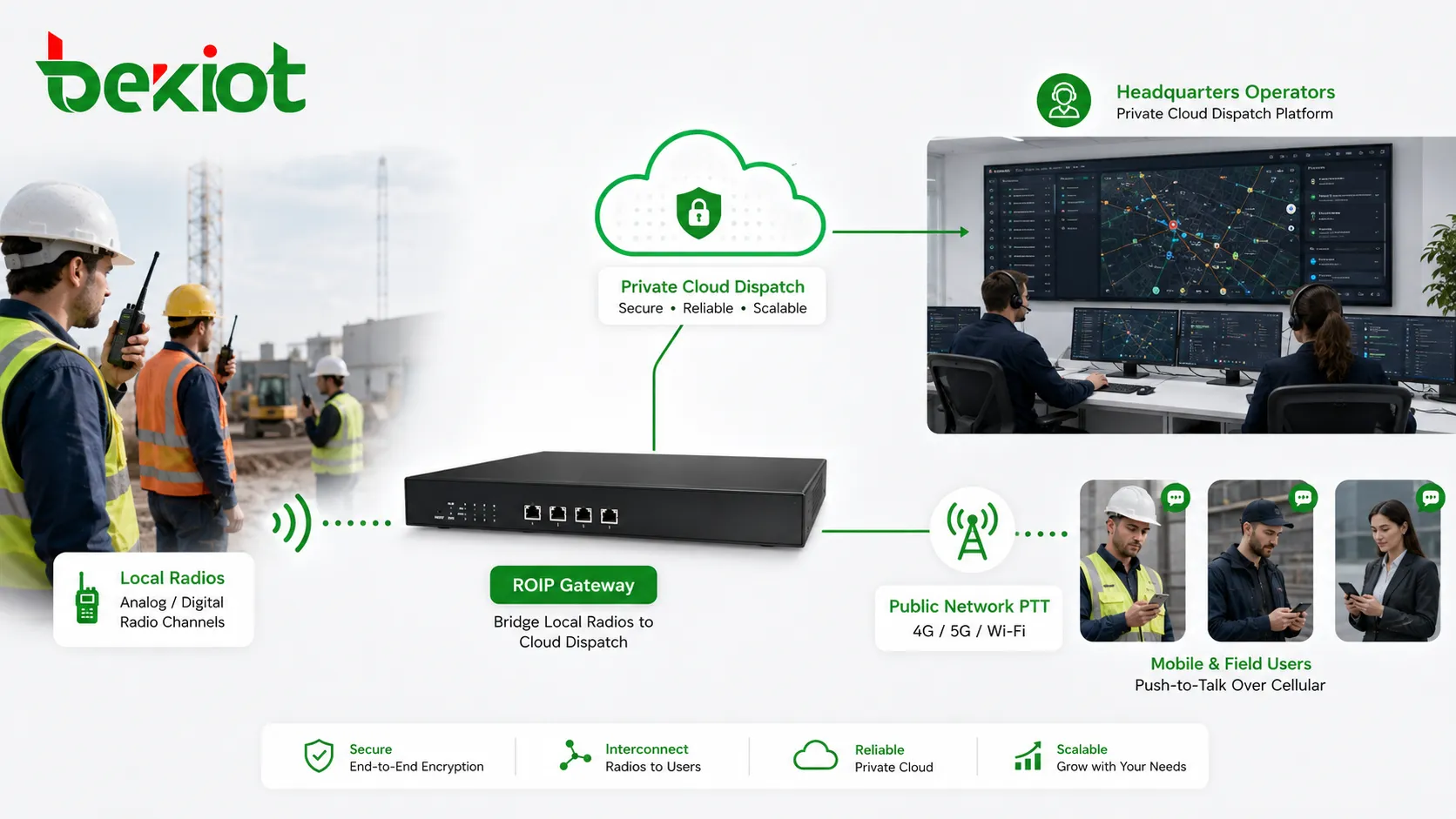
A ROIP gateway bridges local radio channels with the IP-based dispatch platform. After integration, dispatchers at headquarters can communicate with local radio users through the platform. Public network PTT users can also be connected with conventional radio users when the system is configured correctly.
This design is important because it combines the advantages of local radio and cloud dispatch. When the internet connection is stable, headquarters can join radio communication through the platform. If the wide-area network is temporarily unavailable, local radios can still maintain essential on-site wireless communication within the project area.
Related product: Becke ROIP Gateway
Video Surveillance Integration
Video surveillance is an important security and management tool for overseas projects. Construction areas, storage yards, entrances, dormitories, production zones, ports, and remote work areas may all require cameras. However, in many projects, video systems are deployed independently and are not connected with communication or dispatch platforms.
By deploying a video networking platform in the cloud, the headquarters can remotely access video resources from overseas sites when needed. This reduces the need for continuous high-bandwidth transmission. Instead of sending all video streams back all the time, the platform can pull live video on demand, which helps reduce bandwidth pressure and data cost.
When video surveillance is integrated with the dispatch platform, operators can view field video during an emergency call, site inspection, alarm event, or command operation. Video can be managed independently or displayed through the unified dispatch interface, creating a more complete audio-video command environment.
Headquarters Dispatch Console
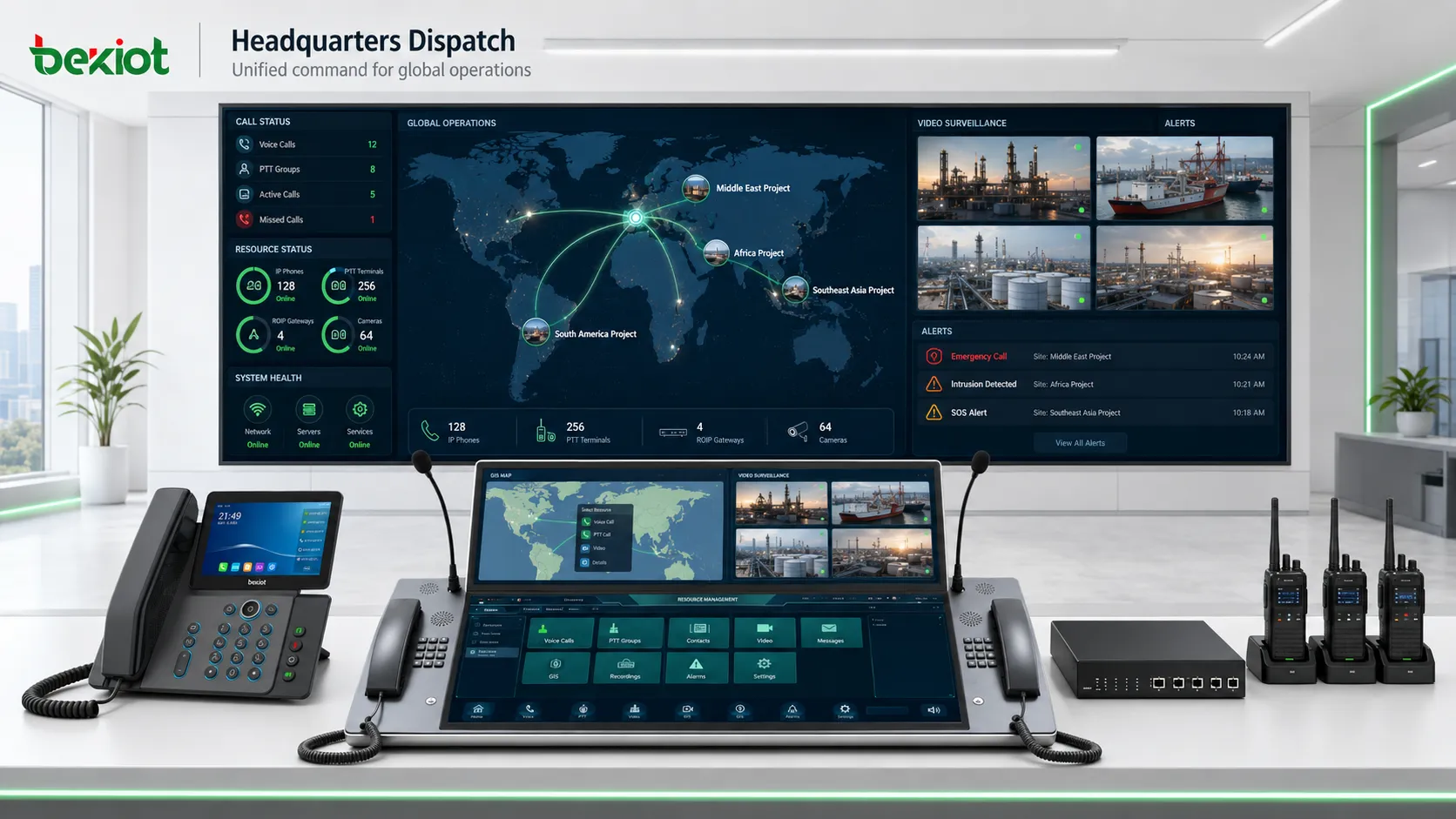
The domestic headquarters can deploy a dispatch console to supervise the communication status of overseas project terminals. The console can display IP phones, public network PTT users, radio channels connected through ROIP gateways, video resources, GIS location information, and emergency events.
A multi-screen layout can be used for larger command centers. One screen may show the communication panel, another may show GIS positioning, another may show video feeds, while other areas display call records, task status, alarm messages, or group information.
Dispatchers can call overseas PTT users, communicate with local radio channels through ROIP gateways, contact fixed IP phones, view camera feeds, and coordinate different teams from one interface. This is especially useful when the headquarters needs to support several overseas sites at the same time.
Recommended System Architecture
A practical architecture can be divided into five layers. The first layer is the cloud platform layer, where the communication and dispatch platform is deployed on a private cloud server. This layer handles SIP registration, user management, group control, routing, recording, positioning, dispatch logic, and system management.
The second layer is the terminal access layer. This includes IP phones, public network PTT devices, mobile dispatch clients, video terminals, and other communication endpoints used by the overseas project team.
The third layer is the ROIP gateway layer. This connects local radio channels to the IP-based communication system, allowing conventional radios and cloud dispatch users to communicate across networks.
The fourth layer is the video integration layer. Cameras and video networking gateways can provide on-demand viewing, remote monitoring, and video linkage with dispatch events.
The fifth layer is the headquarters command layer. Dispatch consoles, management clients, monitoring screens, and operation seats allow domestic teams to supervise field communication, coordinate tasks, and respond to incidents.
| System Layer | Main Components | Primary Role |
|---|---|---|
| Cloud platform | Private dispatch and communication server | Unified registration, routing, group control, recording, and management |
| Mobile communication | Public network PTT terminals and mobile clients | Field push-to-talk, emergency SOS, mobile voice and video communication |
| Fixed voice access | IP phones and office terminals | Stable communication for duty rooms, offices, and key positions |
| Radio interconnection | ROIP gateway | Connects conventional radio channels with the cloud dispatch platform |
| Visual management | Video surveillance platform and GIS | Remote viewing, location display, and situation awareness |
| Command operation | Headquarters dispatch console | Cross-border command, calling, monitoring, and emergency coordination |
Deployment Process for Overseas Projects
Assess the communication environment
Before deployment, the project team should investigate the local network environment, mobile operator coverage, available 4G frequency bands, internet access quality, data SIM policy, site layout, radio coverage requirements, and headquarters access conditions.
This step is important because overseas projects are often affected by local carrier policies, network stability, geographic conditions, and construction progress. The communication plan should be based on real field conditions rather than only office assumptions.
Select the cloud region and access method
The private cloud server should be placed in a region that provides reasonable access quality for both the domestic headquarters and the overseas project site. Latency, bandwidth, data security, system maintenance, and compliance should all be considered.
If multiple overseas projects will use the same platform, the design should also consider expansion capacity, domain planning, VPN access, firewall rules, and user permission separation between different projects.
Plan terminals and communication groups
The system should define which users need public network PTT terminals, which positions need fixed IP phones, which radio channels require ROIP gateway access, and which cameras need to be connected to the platform.
Group planning is also important. The platform can create groups for security, construction, logistics, management, emergency response, maintenance, transportation, or subcontractor teams. Clear grouping makes dispatch operation faster and reduces confusion during urgent events.
Test real communication scenarios
After deployment, the acceptance test should include internal calls, headquarters-to-site calls, PTT group calls, radio-to-platform communication through the ROIP gateway, emergency SOS reporting, video viewing, GIS display, recording playback, and network interruption scenarios.
Testing should also confirm whether local radios can continue working when the external network is unavailable. This verifies that the system still provides on-site communication resilience even if cross-border access is temporarily interrupted.
Operational Benefits
A private cloud dispatch platform provides a cost-effective way to solve cross-border communication and command problems. Instead of building several independent systems, the enterprise can deploy one platform that supports voice, video, PTT, radio interconnection, monitoring, positioning, and dispatch management.
For daily operation, the platform improves communication between headquarters and overseas teams. Managers can contact field users more directly, organize group communication, check video when needed, and supervise key positions.
For emergency response, the platform provides faster escalation. A field worker can press an SOS button, a dispatcher can call the relevant group, headquarters can view video, and local radio users can be reached through the ROIP gateway. This helps reduce response time and improves command efficiency.
For long-term project management, private deployment also offers better control. The enterprise can manage users, permissions, data, recordings, routing rules, terminal groups, and integration policies according to its own operational requirements.
Planning Notes for Long-Term Operation
Overseas communication systems should not be designed only for the first project phase. As the site expands, more users, more cameras, more radio channels, and more command workflows may be added. The platform should therefore support expansion from the beginning.
It is also necessary to document extension numbers, user groups, ROIP gateway channels, radio frequencies, SIM card information, camera locations, cloud server configuration, network routes, and emergency contact workflows. Clear documentation reduces maintenance difficulty, especially when headquarters and overseas teams work in different time zones.
Regular drills are recommended. A system that is rarely used during normal operation may fail to deliver its value during a real emergency if users are unfamiliar with the workflow. Scheduled tests for PTT calls, radio gateway access, SOS alarms, video pull, and dispatch console operation can keep the system ready.
FAQ
Is a private cloud platform suitable for temporary overseas projects?
Yes. It is often suitable because the core system can be deployed in the cloud without building a full local server room at the project site. Terminals can be added or removed as the project changes.
Why use public network PTT instead of only mobile phones?
Public network PTT provides faster group communication, dedicated push-to-talk operation, and more suitable dispatch behavior for field teams. It is easier for construction, security, logistics, and emergency groups than calling users one by one.
What is the role of a ROIP gateway?
A ROIP gateway connects local conventional radio channels to the IP-based dispatch platform. It allows headquarters dispatchers, public network PTT users, and local radio users to communicate across different networks.
Can video surveillance be added later?
Yes. A video networking platform can be added based on project requirements. The system can support on-demand video viewing, which helps reduce bandwidth usage compared with continuous video backhaul.
What should be checked before deployment?
The project team should check local network coverage, 4G band compatibility, SIM card policy, radio coverage, cloud access quality, video bandwidth, user grouping, emergency workflows, and long-term maintenance responsibilities.