


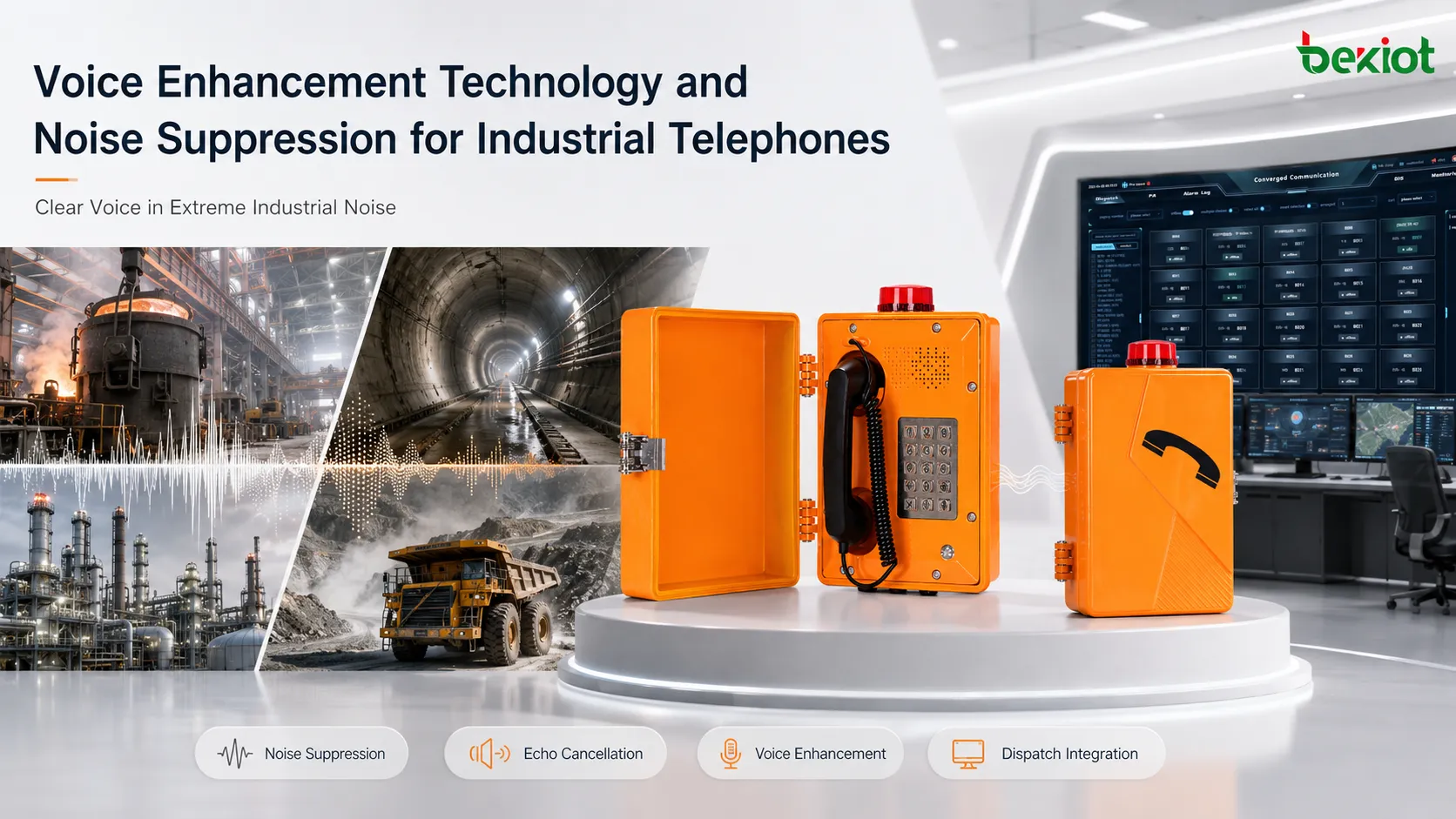
Industrial telephones are often used in places where ordinary voice communication is difficult. Workers may speak near running machines, ventilation fans, pumps, compressors, vehicles, alarms, wind, rain, echoing corridors, production lines, tunnels, or outdoor equipment areas. In these environments, a call that technically connects may still fail if the listener cannot understand the message clearly.
Voice enhancement technology and noise suppression are designed to solve this practical problem. Their purpose is not to make the sound artificially polished, but to keep speech intelligible under industrial conditions. A good industrial telephone should help the remote operator hear the speaker, reduce unnecessary background interference, control echo, maintain stable volume, and support clear instructions during routine operation or emergency response.
Why audio clarity matters in industrial telephones
In industrial communication, poor audio quality is not only an inconvenience. It can delay maintenance, cause wrong instructions, increase repeated calls, and weaken emergency response. A worker reporting a fault from a noisy pump room may need to describe equipment status accurately. A tunnel operator may need to confirm the location of an incident. A security post may need to coordinate with a control room during an alarm. If the message is masked by noise, the communication system loses its value.
Industrial telephones must therefore be evaluated by speech intelligibility, not only by call connection. A device may support SIP registration, analog dialing, hotline calling, or dispatch integration, but if the microphone captures too much surrounding noise, the user still needs to shout. If the speaker output is weak or distorted, the field worker may miss the reply. Voice enhancement focuses on making the communication usable in the real site.

How voice enhancement works
Voice enhancement is a combination of acoustic design, microphone selection, circuit processing, software algorithms, speaker tuning, and installation planning. It begins at the point where the user speaks. The microphone must capture the user’s voice while reducing unnecessary surrounding sound. The housing structure should protect the microphone without blocking speech. The audio circuit should process the signal cleanly and avoid excessive distortion.
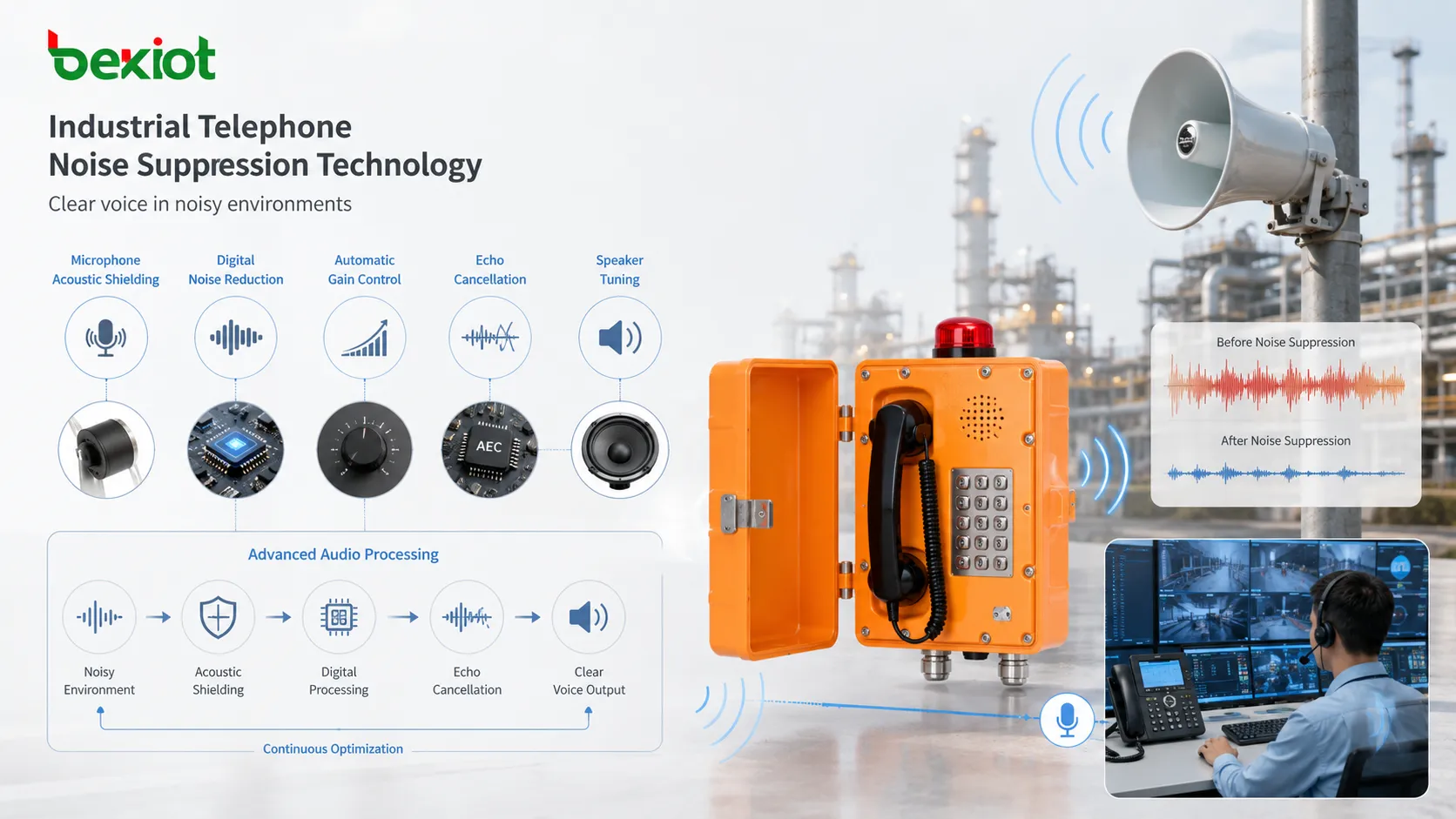
In IP-based or digital industrial telephones, signal processing may include noise reduction, automatic gain control, echo cancellation, voice activity detection, packet loss concealment, and codec optimization. In analog industrial telephones, the design may rely more on microphone quality, handset structure, acoustic isolation, circuit stability, and speaker output. In both cases, the goal is the same: speech should remain clear enough for the listener to understand the message quickly.
Voice enhancement is also affected by the installation position. A wall-mounted industrial phone installed directly beside a compressor will face more noise than one placed at a protected communication point. A phone installed inside a metal enclosure may produce more echo or resonance. Good audio performance depends on both device design and site deployment.
Noise suppression technologies
Microphone direction and acoustic shielding
The first level of noise suppression is physical design. A well-positioned microphone opening, acoustic channel, handset shape, or front panel structure can help focus on the speaker’s voice and reduce unwanted sound from other directions. This is especially useful for industrial telephones used near machines, vehicles, or ventilation equipment.
Acoustic shielding does not mean completely blocking environmental sound. The device still needs to capture speech naturally. The challenge is to reduce the noise that competes with the speaker’s voice. In handset telephones, the microphone is close to the user’s mouth, which naturally improves the signal-to-noise ratio. In hands-free intercom-style devices, microphone placement and algorithm design become more important.
Digital noise reduction
Digital noise reduction analyzes the incoming audio signal and attempts to separate voice from background noise. It may reduce steady noise such as fans, engines, air flow, electrical hum, or machine vibration. This helps the remote listener focus on speech instead of continuous background sound.
Noise reduction must be balanced carefully. If the algorithm is too aggressive, it may cut off speech endings, make the voice sound unnatural, or reduce important consonants. If it is too weak, the noise remains dominant. Good industrial telephone design keeps voice intelligible rather than simply making the channel quiet.
Automatic gain control
Automatic gain control adjusts the audio level when the speaker talks louder or softer. In industrial environments, users may stand at slightly different distances from the microphone or speak with different force depending on noise level. Automatic gain control helps maintain a more stable output level for the listener.
However, gain control should not amplify background noise during silent moments. If the system increases gain when the user is not speaking, machine noise may become louder. Proper voice activity detection and gain control design are important for stable call quality.
Echo cancellation
Echo occurs when audio from the speaker returns to the microphone and is sent back to the far end. It may happen in hands-free devices, metal enclosures, tunnels, large rooms, or areas with reflective surfaces. Echo makes communication tiring and can cause users to interrupt each other.
Echo cancellation estimates the reflected sound and removes it from the microphone signal. This is important for industrial telephones with loudspeaker mode or panel-mounted intercom structures. Good echo control allows both sides to communicate more naturally, especially when the local speaker output must be loud.
Speaker and output design
Clear audio is not only about the microphone. The local speaker, handset receiver, amplifier, and acoustic outlet must also perform well. In a noisy workshop or outdoor yard, the user may need higher sound pressure than in an office. At the same time, the output should not be harsh, distorted, or difficult to understand.
A good industrial telephone should provide enough volume for the expected environment while preserving speech clarity. Strong volume without intelligibility is not useful. If the speaker distorts at high level, users may hear loud but unclear sound. If the receiver is too weak, users may press the handset tightly to the ear or miss important instructions.
Some devices also support external speaker or paging linkage. This can be useful when one call or announcement must reach a larger area. In such cases, output design should consider amplifier capacity, speaker placement, priority control, and feedback prevention.
System-level audio integration
Industrial telephone audio quality also depends on the wider communication system. SIP servers, IP PBX platforms, dispatch systems, analog gateways, VoIP gateways, network switches, codecs, WAN links, and recording systems all affect the final result. A well-designed telephone may still sound poor if the network has packet loss, jitter, excessive delay, wrong codec selection, or echo problems in the gateway.
For IP industrial telephones, codec policy should match the system environment. Wideband codecs may improve clarity in internal networks, while narrowband codecs may be required for PSTN or legacy integration. QoS settings can help voice packets receive priority over ordinary data. Jitter buffers and packet loss handling can improve stability on imperfect networks.
For analog industrial telephones, line quality is important. Cable distance, grounding, moisture, poor terminals, surge damage, and impedance mismatch may introduce noise or low volume. Maintenance teams should check the whole voice path instead of replacing the endpoint immediately.
Application scenarios
Factories and production workshops
Factories often contain motors, conveyors, presses, compressors, fans, and moving vehicles. Workers need to communicate with control rooms, supervisors, maintenance teams, and safety personnel. Voice enhancement helps reduce repeated conversations and improves coordination during equipment fault handling.
Tunnels, mines, and underground corridors
Underground and enclosed spaces may have echo, ventilation noise, humidity, and long cable routes. Noise suppression and echo control are important because voice messages may relate to safety, evacuation, inspection, or maintenance. The telephone should remain understandable even when users are under pressure.
Ports, yards, and outdoor facilities
Outdoor industrial telephones may face wind, rain, vehicles, cranes, loading equipment, and distance-related noise. Microphone shielding, strong speaker output, weather-resistant design, and stable system connection help maintain usable communication. Becke Telcom BT27 industrial telephone can be used as a field communication option in outdoor and industrial environments where durability and voice clarity are both important.
Power plants, chemical plants, and utility sites
These sites require clear communication between control rooms and field points. Calls may involve operating instructions, safety confirmation, inspection reports, or emergency coordination. Audio quality becomes part of operational reliability because misunderstood instructions can affect safety and response efficiency.

Deployment and maintenance considerations
Good audio performance should be planned before installation. The telephone should not be placed at the loudest point unless the application requires it. Installers should consider user standing position, microphone direction, nearby noise sources, wall reflection, rain exposure, cable protection, and access for maintenance. A small change in mounting position can improve speech clarity significantly.
After installation, audio testing should be performed under real working conditions. Testing in a quiet environment is not enough. The team should test when machines are running, vehicles are moving, ventilation is active, and alarms or public address systems may be present. Both sides of the call should confirm clarity, volume, echo, and delay.
Maintenance should include checking microphone openings, handset cable, speaker grille, sealing condition, water ingress, cable terminals, network status, line noise, firmware version, codec settings, and call logs. Dust, oil, moisture, corrosion, or physical damage can gradually reduce audio quality. Regular inspection helps prevent small issues from becoming communication failures.
Common problems and optimization
One common problem is assuming that louder audio always means better communication. In reality, excessive gain may increase distortion, echo, or background noise. The correct goal is intelligibility. Volume, microphone sensitivity, gain control, and speaker output should be adjusted together.
Another problem is ignoring the acoustic environment. A device mounted inside a metal cabinet, under a noisy fan, beside a pump, or near a reflective wall may perform poorly even if the product itself is suitable. Site layout should be part of audio design.
Network issues are also often misdiagnosed as device problems. Packet loss, codec mismatch, jitter, NAT problems, or gateway echo can create poor voice quality. For IP systems, troubleshooting should include network and platform checks. For analog systems, line condition and grounding should be tested.
Finally, hands-free operation may be expected in places where a handset would provide better clarity. Hands-free communication is convenient, but it is more affected by background noise and echo. For very noisy areas, a handset, headset, or close-talk microphone design may be more reliable.
Evaluation standards
A good industrial telephone should be evaluated by real speech intelligibility. Can the control room understand the field worker? Can the field worker hear the reply clearly? Does the call remain usable when machines are running? Does the system control echo? Does the device recover after network interruption? Does the audio remain stable over time?
Evaluation should also include durability and maintainability. The microphone and speaker openings should resist dust and moisture. The handset and cable should withstand frequent use. The device should support the required communication platform. Maintenance staff should be able to inspect, clean, test, and repair it efficiently.
For projects with emergency communication requirements, testing should include urgent scenarios. The telephone should support clear speech when users speak quickly, background noise rises, or operators need to issue immediate instructions. Audio quality should be treated as part of safety performance.
Closing Notes
Voice enhancement technology and noise suppression are essential to the practical value of industrial telephones. They improve microphone pickup, reduce background noise, stabilize audio levels, control echo, support speaker clarity, and help communication remain understandable in harsh environments. These technologies matter because industrial calls often carry operational, maintenance, safety, or emergency information.
The best result comes from combining suitable device design with correct deployment. Microphone structure, speaker output, acoustic shielding, digital processing, codec settings, network quality, installation position, and maintenance all affect the final voice experience. A telephone should not be judged only by whether it connects; it should be judged by whether people can communicate clearly where it is installed.
For industrial sites that need rugged field communication with practical audio performance, Becke Telcom provides options such as the BT27 industrial telephone for factories, outdoor areas, utility sites, and harsh operating points. The right model and configuration should be selected according to noise level, installation environment, communication platform, and maintenance requirements.
FAQ
What is voice enhancement in industrial telephones?
Voice enhancement refers to technologies and design methods that improve speech clarity, such as microphone optimization, noise reduction, gain control, echo cancellation, speaker tuning, and codec selection.
Why is noise suppression important?
Industrial sites often have machine noise, wind, vehicles, alarms, and echo. Noise suppression helps the listener hear the speaker more clearly and reduces repeated or misunderstood communication.
Is high speaker volume enough for noisy areas?
No. High volume alone may cause distortion or echo. The goal should be speech intelligibility, which depends on speaker quality, microphone pickup, noise control, installation position, and acoustic conditions.
Can network problems affect voice quality?
Yes. In IP systems, packet loss, jitter, delay, codec mismatch, and QoS problems can reduce call quality. The endpoint, network, gateway, and platform should be checked together.
How should industrial telephone audio be tested?
Audio should be tested under real site conditions, including normal machine noise, user speaking distance, control room listening, speaker output, echo behavior, and emergency communication scenarios.







